
Introduction
In a significant judgment affecting thousands of teachers across India, the Supreme Court has reaffirmed that the Teacher Eligibility Test (TET) is a mandatory qualification for teachers serving in elementary schools, even if they were appointed before the enactment of the Right of Children to Free and Compulsory Education Act, 2009 (RTE Act).
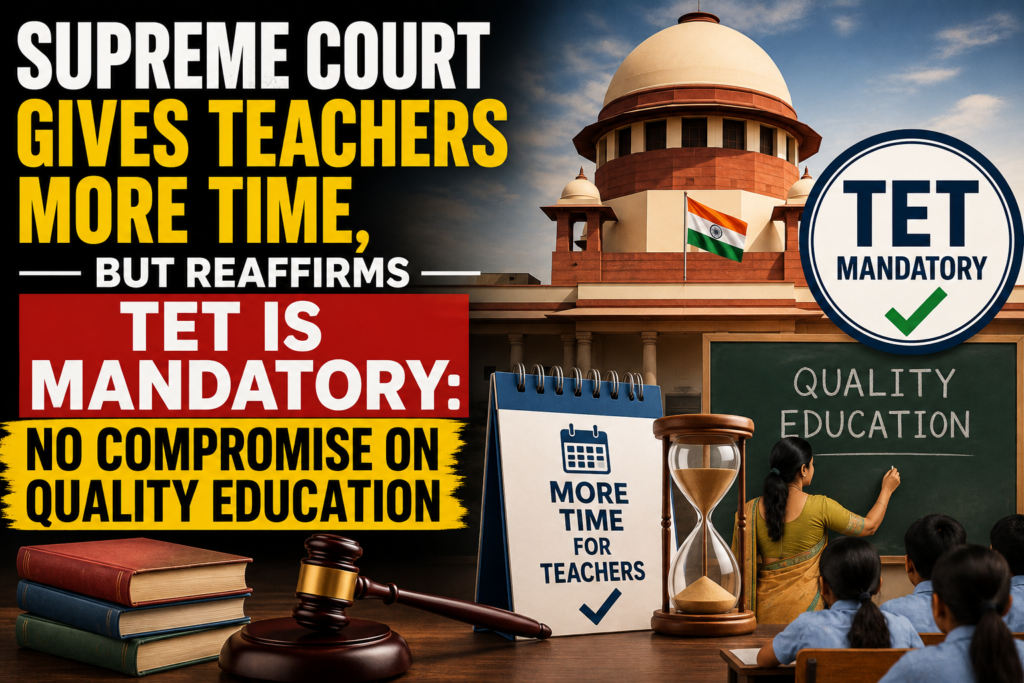
While refusing to review its earlier judgment, the Court granted limited relief by extending the deadline for in-service teachers to acquire the TET qualification from 31 August 2027 to 31 August 2028.
The judgment was delivered by a Bench comprising Justice Dipankar Datta and Justice Manmohan in a batch of review petitions led by State of Uttar Pradesh v. Anjuman Ishaat-e-Taleem Trust & Others.
The decision is important because it settles a long-running debate regarding whether teachers appointed before the RTE Act came into force can be compelled to acquire TET qualifications during their service.
Background of the Dispute
The controversy began with the Supreme Court’s earlier judgment in Anjuman Ishaat-e-Taleem Trust v. State of Maharashtra delivered in 2025.
In that judgment, the Court held that:
TET is a mandatory qualification for teachers.
The requirement applies not only to future recruits but also to teachers already in service.
Teachers having more than five years of service left must clear the TET within a specified period.
Any teacher seeking promotion must necessarily possess TET qualification.
The Court had initially granted two years, ending on 31 August 2027, for in-service teachers to qualify the examination.
This ruling triggered numerous review petitions from State Governments, teachers’ unions, educational organizations, and individual teachers across the country.
Why Were Review Petitions Filed?
The review petitioners did not challenge the entire judgment.
Their primary grievance was that the Supreme Court had allegedly misinterpreted the RTE Act by making TET compulsory for teachers who had already been appointed before the Act came into force.
According to the petitioners:
The law should not operate retrospectively.
Their appointments were valid when made.
TET was not part of their service conditions at the time of appointment.
Imposing a new qualification midway through their careers was unfair.
Thousands of teachers could potentially lose their jobs.
The petitioners therefore requested the Court to reconsider its earlier decision.
What Is a Review Petition?
Before understanding the Court’s reasoning, it is important to know what a review petition actually means.
A review petition is not a second appeal.
The Supreme Court can review its own judgment only in exceptional situations, such as:
An obvious error apparent on the face of the record.
Discovery of important new evidence.
Serious miscarriage of justice.
The Court emphasized that a review proceeding cannot become an attempt to reargue a case merely because a party is unhappy with the outcome.
In simple terms, a review is not an opportunity to ask the Court to change its mind simply because another interpretation is possible.
Core Question Before the Court
The central issue was:
Can teachers appointed before the RTE Act be required to acquire TET qualification after their appointment?
The answer given by the Supreme Court was a clear “Yes.”
Understanding Section 23 of the RTE Act
The Court closely examined Section 23 of the RTE Act.
This provision deals with qualifications of teachers.
The Court noted an important distinction in the language used by Parliament.
Future Appointments
Section 23(1) refers to “any person” seeking appointment as a teacher.
This part deals with future appointments.
Existing Teachers
The provisos to Section 23(2) use the expression “teacher” rather than “person.”
According to the Court, this distinction is deliberate.
The provisos specifically address teachers who were already serving when the RTE Act came into force.
Parliament therefore clearly intended that existing teachers should also eventually acquire the prescribed minimum qualifications.
Why the Court Rejected the Argument of Retrospective Application
One of the strongest arguments raised by the petitioners was that the law was being applied retrospectively.
The Supreme Court disagreed.
The Court explained that:
The RTE Act did not invalidate past appointments.
Existing teachers were not removed immediately.
The law itself granted substantial time to acquire qualifications.
The 2017 amendment granted additional time for compliance.
Therefore, the Court held that the law was not retrospective in the true sense.
Instead, it merely required existing teachers to meet educational standards within a reasonable period.
What About the NCTE Act?
The petitioners also relied upon provisions of the National Council for Teacher Education Act, 1993 (NCTE Act).
They argued that teachers appointed before certain amendments could not be removed solely because they lacked qualifications later prescribed by the NCTE.
The Supreme Court rejected this argument as well.
The Court pointed out that while the first proviso protected existing teachers, the second proviso expressly required them to acquire the prescribed qualifications within the period specified under the RTE Act.
Thus, the NCTE Act and the RTE Act had to be read together, not in isolation.
Is TET a New Service Condition?
Another important argument raised by teachers was that TET amounted to a new service condition imposed after appointment.
The Court was not convinced.
According to the Supreme Court:
Section 23 itself contemplated acquisition of qualifications by existing teachers.
Parliament had expressly provided compliance periods.
The objective was not punishment but improvement of educational standards.
The Court therefore held that TET cannot be viewed as an arbitrary new service condition imposed midway through employment.
Children’s Right to Education Comes First
Perhaps the most significant aspect of the judgment is its emphasis on children’s rights.
The Court repeatedly stressed that the RTE Act is a child-centric legislation.
According to the Court:
The right of children to quality education under Article 21A of the Constitution must remain the primary consideration.
The Bench observed that:
Educational quality cannot be compromised.
TET ensures minimum teaching standards.
Continuation of unqualified teachers indefinitely would adversely affect future generations.
The Court made it clear that the interests of teachers, though important, cannot override the educational interests of millions of school-going children.
Concern Raised by States
Several State Governments argued that strict implementation of the earlier judgment could result in large numbers of teachers becoming ineligible.
This could potentially:
Create teacher shortages.
Disrupt school functioning.
Affect students’ education.
The Court acknowledged these concerns.
However, it noted that:
The RTE Act has existed since 2010.
The amendment was introduced in 2017.
Teachers have effectively had over fifteen years to acquire the qualification.
Therefore, the Court refused to dilute the requirement itself.
Supreme Court Grants Limited Relief
Although the Court rejected all substantive challenges, it adopted a practical approach.
Recognizing the possibility of administrative difficulties and the need to protect continuity in education, the Court exercised its powers under Article 142 of the Constitution.
New Deadline
The Court extended the deadline for acquiring TET from:
31 August 2027 → 31 August 2028
Thus, teachers now receive an additional year to comply.
Directions to State Governments
The Supreme Court also directed States and competent authorities to ensure regular conduct of TET examinations.
The Court suggested that:
TET should preferably be conducted twice every year.
There should be approximately six months between successive examinations.
This would provide teachers with adequate opportunities to qualify.
No Further Extensions
The Court issued a clear warning.
It categorically stated that:
No further request for extension of time will be entertained.
This means that 31 August 2028 is intended to be the final deadline.
Why This Judgment Is Important
This ruling has nationwide significance because it affects thousands of teachers employed in elementary schools.
The judgment establishes several important principles:
- TET Is Mandatory
The Supreme Court has conclusively held that TET is not optional.
- Existing Teachers Are Also Covered
Teachers appointed before the RTE Act are not exempt from the requirement.
- Quality Education Is a Constitutional Right
The Court linked TET directly with Article 21A and the constitutional guarantee of quality education.
- Review Jurisdiction Is Limited
The judgment reiterates that review petitions cannot be used as disguised appeals.
- Practical Difficulties Will Be Considered
While maintaining the legal principle, the Court demonstrated flexibility by extending the deadline by one year.
Conclusion
The Supreme Court’s decision strikes a balance between legal principle and practical reality.
On one hand, the Court firmly reaffirmed that Teacher Eligibility Test qualification is a mandatory requirement flowing from the constitutional goal of providing quality education to children. On the other hand, it recognized the practical difficulties faced by serving teachers and granted them additional time to comply.
The message emerging from the judgment is clear: educational standards cannot be compromised, but implementation should be fair and realistic. With the deadline now extended to 31 August 2028, teachers have been given one final opportunity to meet the statutory requirement.
For governments, educational authorities, and teachers alike, the judgment marks the closing chapter of a long legal controversy and sets a definitive roadmap for the future of elementary education in India.