Disclaimer!

This Website is owned and operated by Law Offices of Zuber Ali and is made available strictly for educational, informational, and public legal awareness purposes. All content published on this Website, including but not limited to blog posts, case summaries, full texts or excerpts of judgments, legal articles, explanations, commentaries, and any other material, is provided solely to promote general understanding of legal principles and developments in Indian law among the public.
The information and materials available on this Website do not constitute legal advice, professional opinion, or any form of legal services. Nothing contained on this Website is intended to create, nor should it be construed as creating, any attorney-client relationship, lawyer-client relationship, or any other professional relationship between the user and the owner/operator of this Website or any person associated with it. Users are strongly advised not to rely upon or act on the basis of any content available on this Website without seeking specific advice from a qualified and competent legal professional who is duly enrolled and authorized to practice law.
We make reasonable efforts to ensure that the information on this Website is accurate and up-to-date at the time of publication. However, We do not provide any warranty, express or implied, as to the completeness, accuracy, reliability, suitability, or timeliness of the content. Laws, rules, regulations, and judicial pronouncements are dynamic and subject to amendments, clarifications, interpretations, and reversals. Accordingly, We shall not be responsible or liable for any errors, omissions, inaccuracies, or for any consequences arising from the use of, or reliance upon, any information provided on this Website.
To the maximum extent permitted under applicable Indian law, including but not limited to the Information Technology Act, 2000 and other relevant statutes, We expressly disclaim all liability for any direct, indirect, incidental, consequential, special, punitive, or exemplary damages arising out of or in any way connected with the access to, use of, or inability to use this Website or any content therein. This includes, without limitation, any loss, damage, injury, or harm, whether financial, legal, or otherwise, suffered by any user or third party due to decisions or actions taken based on the material available on this Website.
This Website may occasionally contain links to external websites, government portals, databases, or third-party resources. We do not endorse, control, monitor, or assume any responsibility for the accuracy, privacy practices, or content of such external sources. Any access to or use of such third-party resources is entirely at the user’s own risk.
By accessing, browsing, or using this Website in any manner, you expressly acknowledge that you have read, understood, and voluntarily agreed to this Disclaimer. You further agree that your use of this Website is at your sole risk and that you will not hold Us liable for any issues arising from such use. If you do not agree with any part of this Disclaimer, you must immediately cease accessing or using this Website.

lawofficesofzuberali@gmail.com

PIL in India Explained: Who Can File a Public Interest Litigation, What Cases Qualify & When Can Courts Reject a PIL?

Public Interest Litigation (PIL): The Complete Guide to Who Can File It, What It Is Used For, Its Limits, Misuse, Costs & Supreme Court Rules What if a person is suffering a legal wrong but cannot approach the court himself? What if an entire community is affected by illegal government action? What if pollution is […]
PIL in India Explained: Who Can File a Public Interest Litigation, What Cases Qualify & When Can Courts Reject a PIL? Read More »

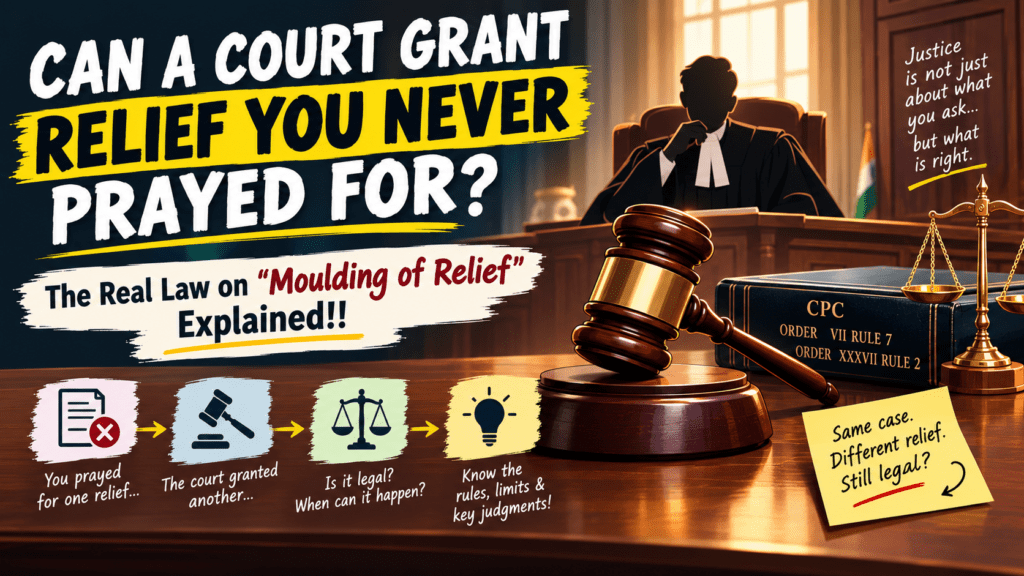
Can a Court Grant Relief You Never Prayed For? The Real Law on “Moulding of Relief” Explained

Can Courts Go Beyond the Prayer Clause? Know When a Judge Can Grant Extra Relief, When It Cannot, and What the Supreme Court Says You file a case asking the court for Relief A. During the proceedings, the court finds that Relief A is not the most appropriate remedy, but another form of relief is

Can a Court Grant Relief You Never Prayed For? The Real Law on “Moulding of Relief” Explained Read More »

How Do Courts Read the Law? 12 Powerful Rules of Interpretation Every Indian Should Know

Literal, Golden, Mischief, Purposive & Other Rules Explained in Simple Language A law may contain only a few words, but those words can decide a person’s liberty, property, business, tax liability, marriage, employment or legal rights. So what happens when two parties read the same legal provision differently? Does the court simply choose the interpretation

How Do Courts Read the Law? 12 Powerful Rules of Interpretation Every Indian Should Know Read More »

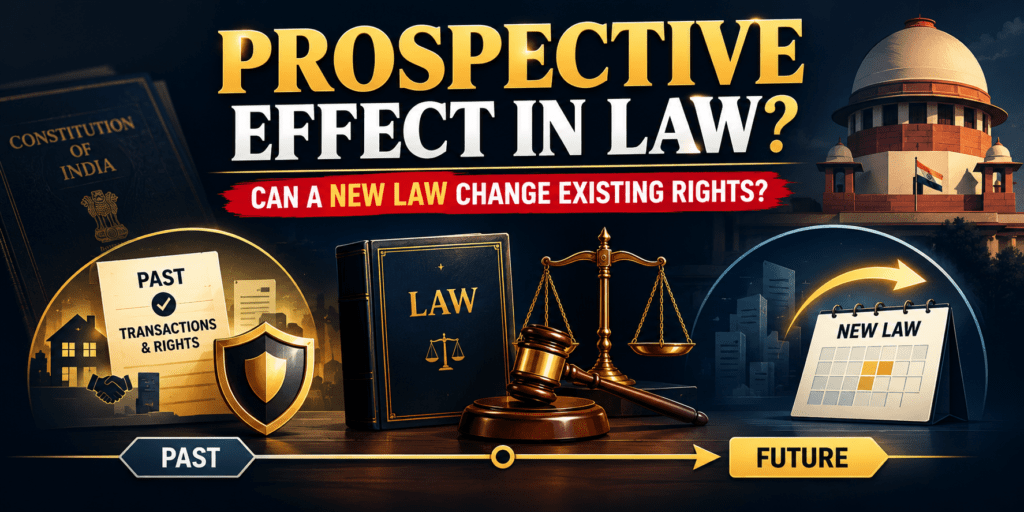
Prospective Effect in Law: What Does It Really Mean? Can a New Law Change Your Existing Rights? Know the Rule, Exceptions & Supreme Court Position

What Is Prospective Effect in Law? Whenever a new law, amendment, rule or legal provision comes into force, an important question arises: Does the new law apply only to future events, or can it also affect things that happened before the law came into force? This is where the concept of “prospective effect” becomes important.

Prospective Effect in Law: What Does It Really Mean? Can a New Law Change Your Existing Rights? Know the Rule, Exceptions & Supreme Court Position Read More »

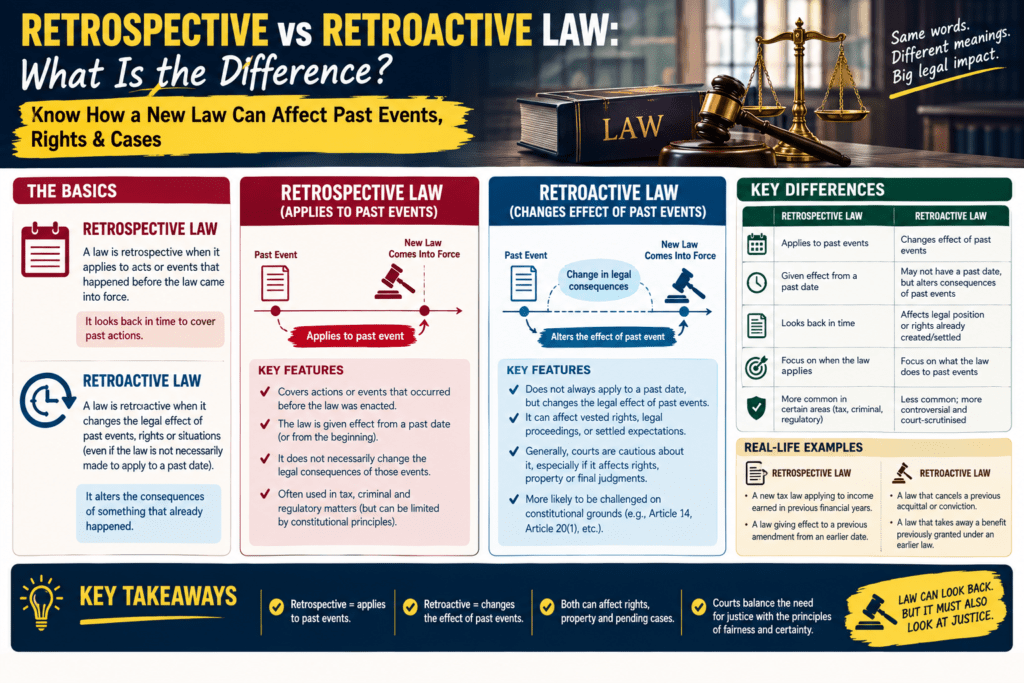
Retrospective vs Retroactive Law: What Is the Difference? Know How a New Law Can Affect Past Events, Rights & Cases

Can a new law change the legal consequences of something that happened years ago? This is one of the most important questions in statutory interpretation. Whenever Parliament or a State Legislature introduces a new law or amends an existing law, one question immediately arises: Does the new law apply only to future events, or can

Retrospective vs Retroactive Law: What Is the Difference? Know How a New Law Can Affect Past Events, Rights & Cases Read More »

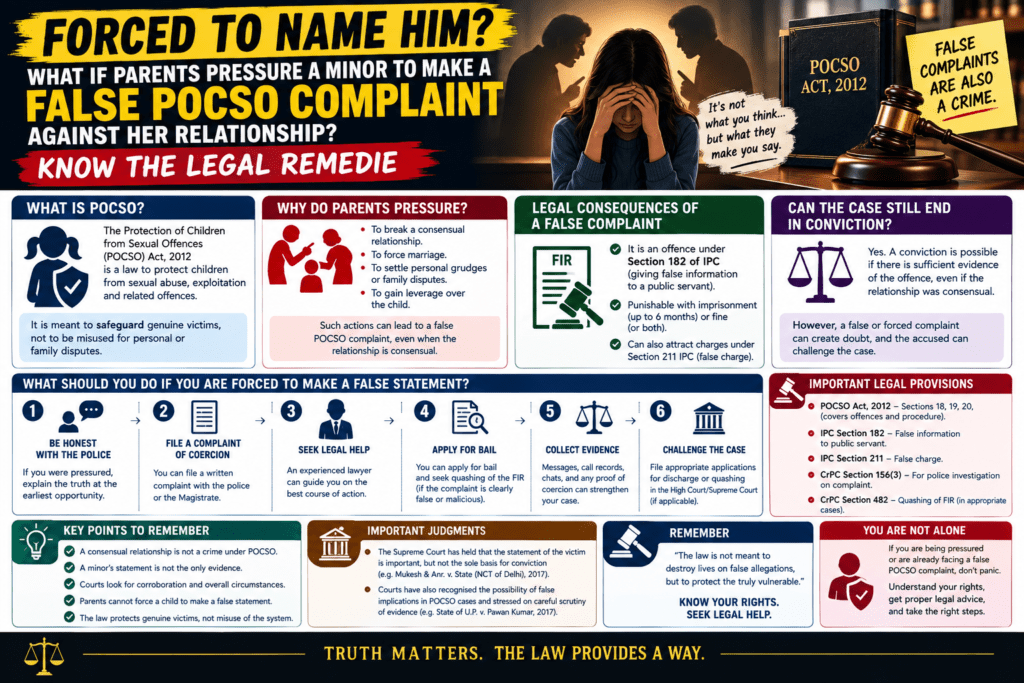
“Forced to Name Him?” — What If Parents Pressure a Minor to Make a False POCSO Complaint Against Her Relationship? Know the Legal Remedies

INTRODUCTION: A romantic relationship involving a person below 18 can quickly become a serious criminal case when the relationship is opposed by the child’s family. Sometimes, the allegation may be genuine and require strict legal action. But there can also be cases where the family strongly objects to the relationship and the accused alleges that

“Forced to Name Him?” — What If Parents Pressure a Minor to Make a False POCSO Complaint Against Her Relationship? Know the Legal Remedies Read More »

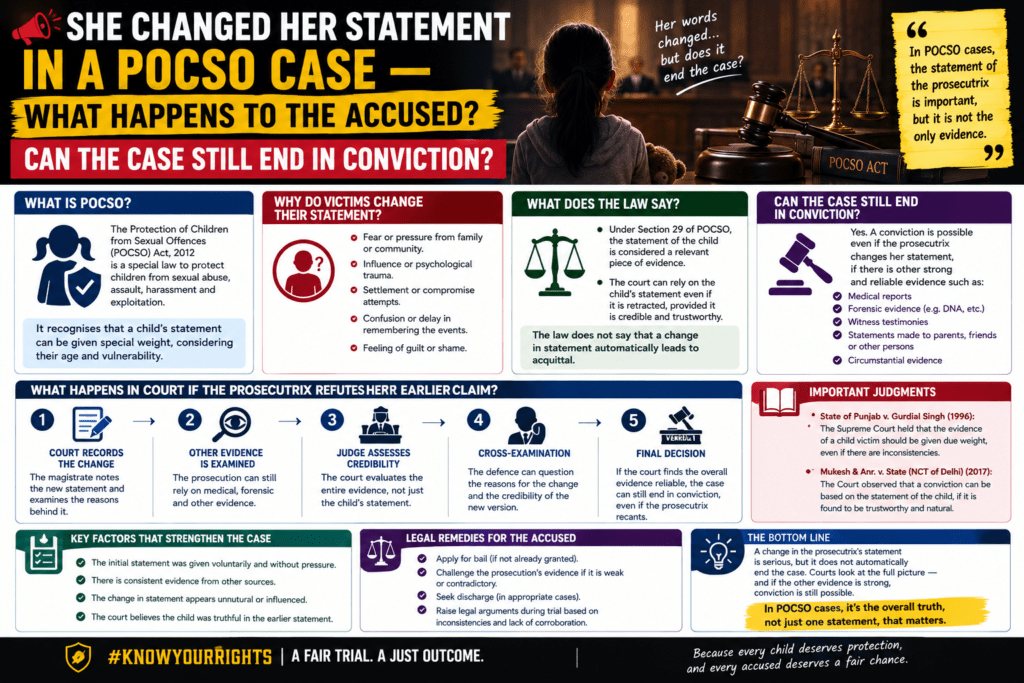
She Changed Her Statement in a POCSO Case — What Happens to the Accused? Can the Case Still End in Conviction?

A POCSO case can take a completely different turn when the prosecutrix/child victim does not support the prosecution case during trial, contradicts her earlier statement, says that the incident did not happen as alleged, or states that she was in a relationship with the accused. But does that automatically mean the accused will be acquitted?

She Changed Her Statement in a POCSO Case — What Happens to the Accused? Can the Case Still End in Conviction? Read More »

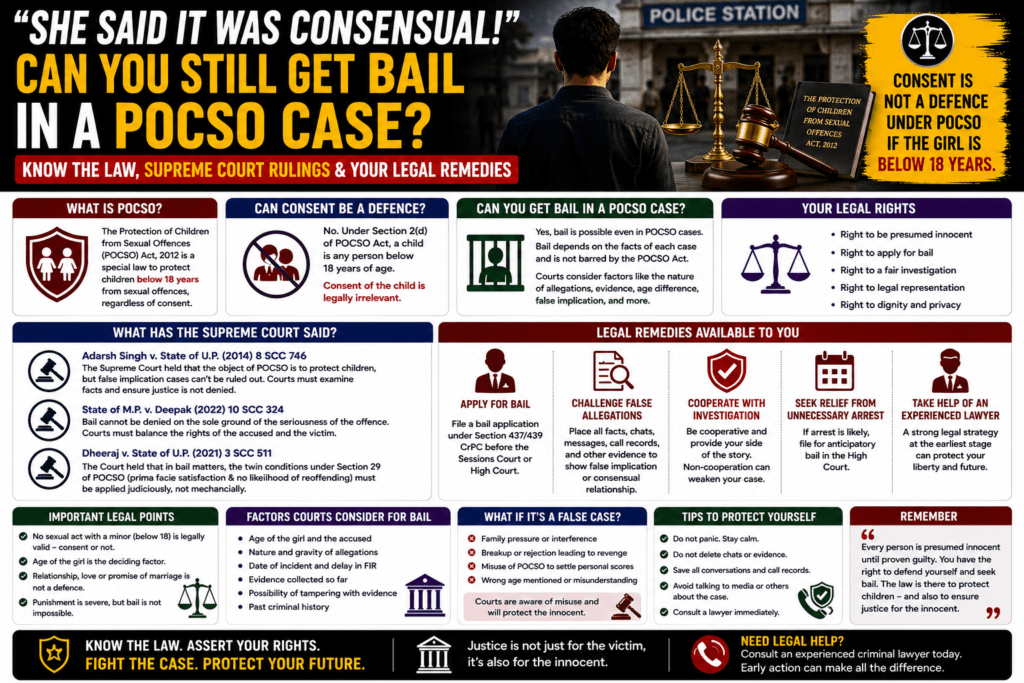
“She Said It Was Consensual!” Can You Still Get Bail in a POCSO Case? Know the Law, Court Rulings & Your Legal Remedies

The girl says she went willingly.She says she was in love with the accused.She says there was no force or threat.She even says that she consented to the physical relationship. But there is a POCSO case. So the obvious question is: If the girl herself says that everything happened with her consent, can the accused

“She Said It Was Consensual!” Can You Still Get Bail in a POCSO Case? Know the Law, Court Rulings & Your Legal Remedies Read More »

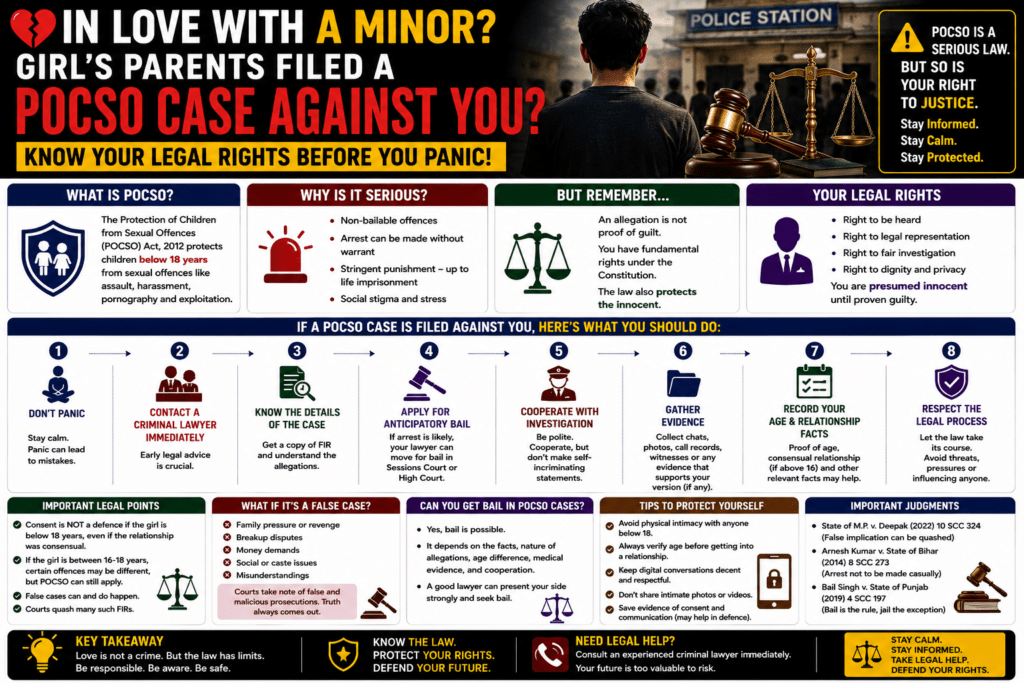
In Love With a Minor? Girl’s Parents Filed a POCSO Case Against You? Know Your Legal Rights Before You Panic!

Introduction You are in a relationship. You both like each other. You talk regularly. You meet each other. You may even have plans to marry. Then suddenly, everything changes. The girl’s parents discover the relationship. They strongly oppose it. And then you receive the news: “A POCSO case has been registered against you.” For many

In Love With a Minor? Girl’s Parents Filed a POCSO Case Against You? Know Your Legal Rights Before You Panic! Read More »

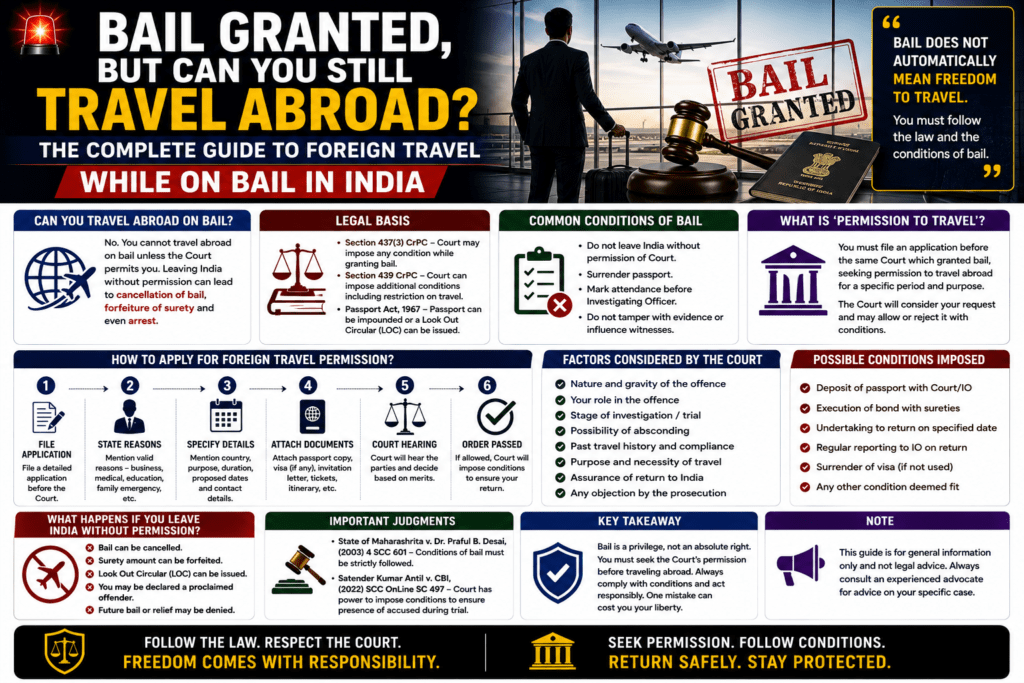
Bail Granted, But Can You Still Travel Abroad? The Complete Guide to Foreign Travel While on Bail in India

Can I travel abroad if I am on bail?Can the court stop me from leaving India after granting bail?Can I get my passport back while my criminal case is pending?What if I need to travel abroad for work, business, medical treatment or family reasons? These are common questions for a person facing criminal proceedings in

Bail Granted, But Can You Still Travel Abroad? The Complete Guide to Foreign Travel While on Bail in India Read More »