
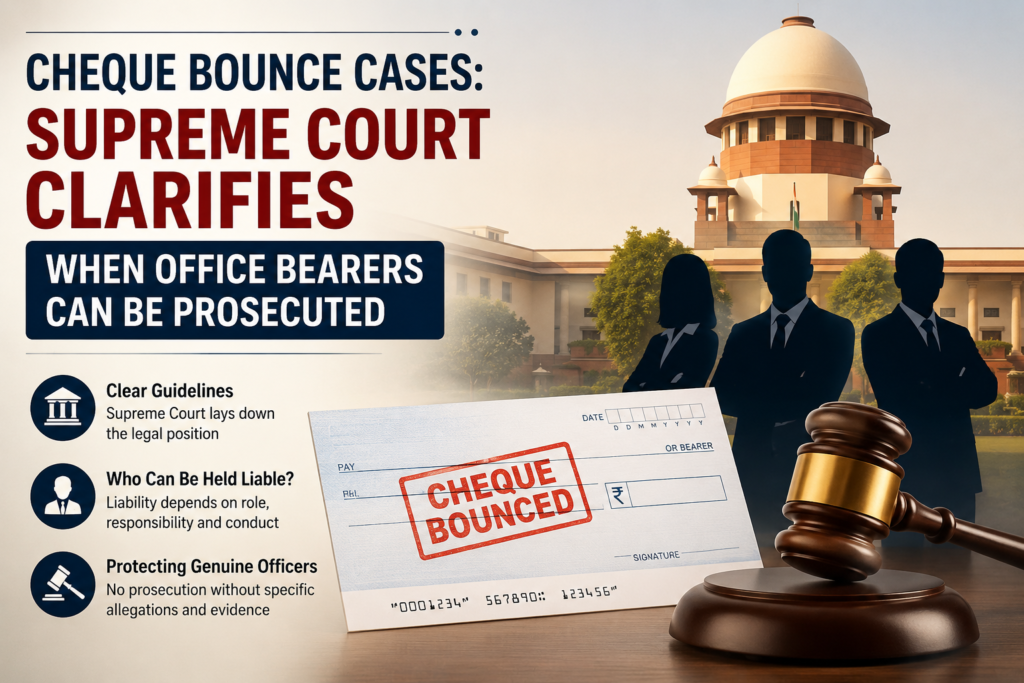
Supreme Court Draws the Line Between Mere Designation and Actual Responsibility
Introduction
In a significant judgment delivered on 26 May 2026 in M/s Mansi Finance (Chennai) Ltd. v. M. Lalitha & Others, the Supreme Court of India clarified an important question relating to cheque bounce cases: Can every office bearer of a society or company be prosecuted merely because they hold a position in the organization?
The Court answered this question in the negative and held that criminal liability cannot be imposed merely on the basis of a person’s designation. However, if there is material showing active involvement in the transaction that led to the issuance of the dishonoured cheque, prosecution can continue against such person.
This decision provides valuable guidance for businesses, societies, educational institutions, directors, managers, and office bearers who are often arrayed as accused in cheque bounce complaints.
What Was the Dispute?
The case arose out of a financial transaction between M/s Mansi Finance (Chennai) Ltd. and a registered educational society.
According to the finance company, the society borrowed approximately ₹4.5 crore for development and business purposes. Several promissory notes and a Memorandum of Understanding (MoU) were executed in relation to the loan.
Later, a cheque for more than ₹5.12 crore was issued towards repayment of the outstanding amount along with interest. When the cheque was presented for encashment, it was dishonoured with the remark “Account Blocked.”
After issuing the statutory legal notice and receiving no payment, the finance company filed a complaint under Sections 138 and 141 of the Negotiable Instruments Act against the society and several of its office bearers.
What Does Section 138 of the Negotiable Instruments Act Say?
Section 138 creates a criminal offence when:
A cheque is issued for payment of a legally enforceable debt or liability;
The cheque is dishonoured by the bank;
A legal demand notice is issued within the prescribed period; and
The drawer fails to make payment within the statutory time.
The provision was enacted to strengthen the credibility of commercial transactions and ensure confidence in banking instruments.
What Is Section 141?
Section 141 deals with situations where the cheque is issued by a company, society, firm, or other juristic entity.
Since such entities act through human beings, the law permits prosecution of individuals who were:
In charge of the affairs of the organization; and
Responsible for conducting its business at the time when the offence was committed.
This is known as vicarious liability, meaning liability for the acts of another.
Why Is Section 141 Important?
Criminal law generally punishes only the person who commits the offence. Vicarious criminal liability is an exception.
Therefore, courts have repeatedly held that Section 141 must be interpreted strictly.
A person cannot be prosecuted merely because he or she is:
A director;
A trustee;
A vice-president;
A treasurer;
A manager; or
An office bearer.
There must be specific material showing their role in the transaction.
What Did the High Court Hold?
The Madras High Court quashed the proceedings against four office bearers of the society.
The High Court observed that the complaint contained only general allegations and did not adequately explain how those individuals were responsible for the conduct of the society’s affairs.
Accordingly, it exercised its powers to quash the proceedings.
What Did the Supreme Court Decide?
The Supreme Court partly disagreed with the High Court.
The Court carefully examined the documents placed on record and found that the position of all four respondents was not identical.
Proceedings Restored Against Three Office Bearers
The Court noted that three of the office bearers had actively participated in the financial transactions.
The record showed that:
One had signed the MoU;
One had signed the dishonoured cheque;
Some had signed promissory notes and other financial documents.
According to the Court, these documents provided sufficient prima facie evidence of their involvement in the transaction.
Therefore, criminal proceedings against these individuals were restored.
Proceedings Quashed Against One Office Bearer
The Court found that one respondent was merely described as an Executive Member of the society.
There was no material showing:
His participation in the borrowing transaction;
His involvement in execution of documents;
His role in issuing the cheque; or
His responsibility in managing the financial affairs of the society.
Since only his designation was mentioned and no specific role was attributed to him, the Supreme Court upheld the quashing of proceedings against him.
Important Principles Laid Down by the Supreme Court
1. Designation Alone Is Not Enough
A person cannot be prosecuted merely because he or she holds an office in a company or society.
The complaint must disclose their actual role.
2. Vicarious Liability Must Be Specifically Pleaded
The complainant must explain:
How the accused was involved;
What responsibility they had; and
How they were connected with the transaction.
3. Documentary Evidence Matters
If documents such as:
Loan agreements,
Promissory notes,
Memoranda of Understanding,
Repayment agreements, or
Cheques
bear the signatures of the accused person, such material may justify continuation of prosecution.
4. Complaints Must Be Read as a Whole
Courts should not adopt a hyper-technical approach.
The complaint must be examined in its entirety along with supporting documents.
5. Quashing Is an Exceptional Remedy
At the stage of quashing, courts are not expected to determine whether the allegations are true.
The only question is whether sufficient foundational material exists to proceed with the trial.
Why Is This Judgment Important?
This judgment strikes a balance between two competing concerns:
Protection Against Frivolous Prosecution
Many individuals are unnecessarily implicated in cheque bounce cases simply because they hold a position in an organization.
The judgment protects such persons from unwarranted criminal prosecution.
Protection of Genuine Creditors
At the same time, the judgment ensures that those who actively participated in financial transactions cannot escape liability merely by arguing that they were not signatories to the cheque.
If documents show their involvement, they may still face prosecution.
Conclusion
The Supreme Court’s decision reinforces a settled but important principle of law: criminal liability under Section 141 of the Negotiable Instruments Act cannot be based on designation alone. There must be specific allegations and supporting material showing that the person was actively involved in the conduct of the organization’s affairs and the transaction in question.
For complainants, the judgment highlights the importance of drafting detailed complaints supported by documents. For directors, trustees, managers, and office bearers, it provides reassurance that mere association with an organization does not automatically make them criminally liable for every dishonoured cheque issued by that entity.
The ruling is likely to have a significant impact on future cheque bounce litigation involving companies, societies, trusts, educational institutions, and other organizations across the country.