
Introduction
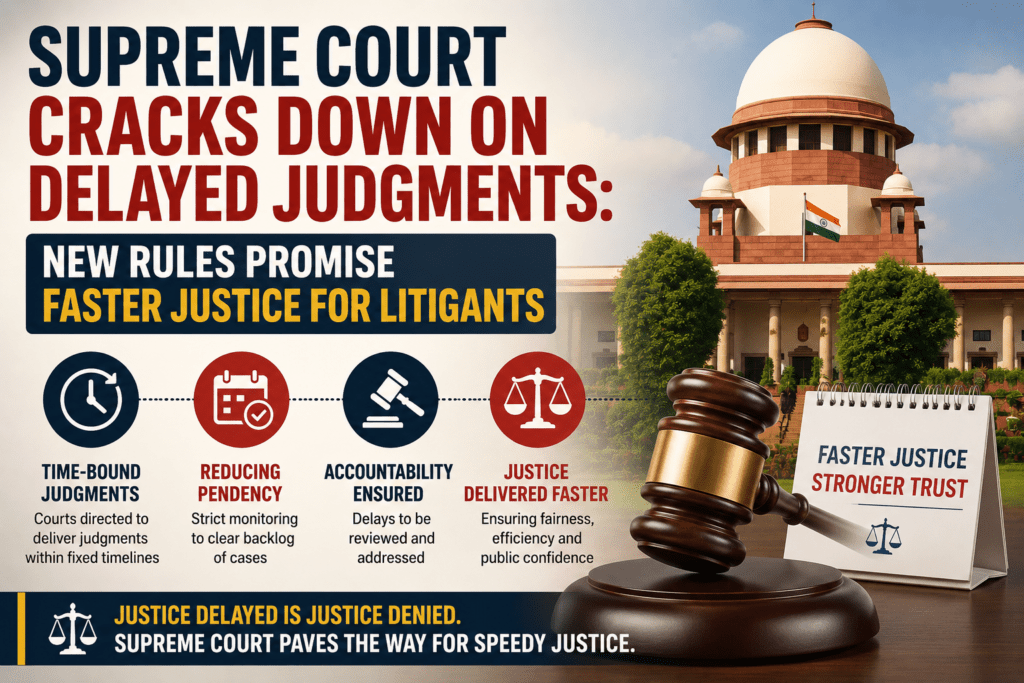
In a significant step towards ensuring speedy justice and strengthening public confidence in the judicial system, the Supreme Court of India has issued a comprehensive set of binding directions to all High Courts across the country regarding the timely pronouncement of judgments.
The directions were issued by a Bench comprising Hon’ble Chief Justice of India Surya Kant and Hon’ble Justice Joymalya Bagchi in Pila Pahan @ Peela Pahan & Ors. v. State of Jharkhand & Anr. (W.P. (Crl.) No. 169/2025).
These guidelines seek to address a long-standing problem in the Indian judicial system—cases being reserved for judgment for months, and sometimes even years, causing immense hardship to litigants, especially those whose personal liberty is at stake.
The Supreme Court has now fixed timelines and created accountability mechanisms to ensure that judgments are delivered within a reasonable period.
What Does “Reserved Judgment” Mean?
After hearing arguments from both sides, a court may not pronounce its decision immediately. Instead, it may reserve the matter for judgment, meaning that the court will consider the arguments and deliver its decision at a later date.
While reserving judgment is a normal judicial practice, prolonged delays in delivering such judgments often create uncertainty and hardship for litigants.
For example:
An accused person seeking bail may remain in jail while waiting for a reserved order.
A family facing demolition may not know whether they can continue occupying their home.
Businesses may suffer financial losses due to pending decisions affecting their operations.
Recognizing these difficulties, the Supreme Court has now laid down strict timelines for High Courts.
Why Did the Supreme Court Intervene?
The Supreme Court observed that justice delayed can effectively become justice denied.
When judgments remain reserved for an indefinite period:
Litigants lose faith in the justice delivery system.
Personal liberty may be adversely affected.
Important civil and commercial disputes remain unresolved.
Judicial transparency and accountability suffer.
The Court emphasized that while judges require adequate time to prepare well-reasoned judgments, such time cannot be unlimited.
A balance must be maintained between judicial independence and the litigants’ right to timely justice.
The New Three-Month Rule
One of the most important directions issued by the Supreme Court is that:
High Courts should endeavour to pronounce reasoned judgments within three months from the date on which judgment is reserved.
This means that once arguments are concluded and judgment is reserved, the parties should ordinarily receive a decision within three months.
Special Protection for Matters Involving Personal Liberty
The Supreme Court has recognized that matters involving personal liberty require urgent attention.
Accordingly, High Courts have been directed to display extra promptness in cases involving:
Regular Bail
Anticipatory Bail
Suspension of Sentence
Habeas Corpus Petitions
Criminal Appeals involving incarcerated persons
The Court emphasized that freedom and liberty cannot remain hostage to administrative delays.
New Timelines for Bail Orders
One of the most citizen-friendly directions concerns bail matters.
The Supreme Court has directed that:
Preferably on the Same Day
Bail applications should be heard and orders should preferably be pronounced and uploaded on the very same day.
If Reserved
Where the Court reserves the bail order, it must:
Pronounce the order on the next day, and
Upload it on the High Court website immediately thereafter.
This direction is expected to significantly reduce unnecessary incarceration caused by delayed pronouncement of bail orders.
Immediate Release After Grant of Bail
The Supreme Court has further directed that once bail or suspension of sentence is granted:
The order should be immediately communicated to jail authorities.
Release of the accused should preferably take place on the same day.
At the latest, release should occur on the next day.
The only exceptions would be:
Where the accused is required in another case, or
Where bail conditions remain unfulfilled.
This is a major step aimed at preventing situations where people remain in jail despite obtaining bail.
What Happens if a Judgment Is Delayed?
The Supreme Court has created a structured mechanism to deal with delayed judgments.
After Three Months
If a judgment remains undelivered for three months after being reserved:
The Registrar General must place the matter before the Chief Justice of the High Court.
The Chief Justice must bring the delay to the notice of the concerned Bench.
After Four Months
If the judgment is still not delivered:
Any party can approach the Chief Justice.
The Chief Justice may withdraw the matter from that Bench.
The case may then be assigned to another Bench for fresh hearing and prompt disposal.
This provision introduces accountability while preserving judicial independence.
Right of Litigants to Seek Release of Judgment
The Supreme Court has empowered litigants themselves.
If a judgment is not delivered within three months:
Any party can file an application seeking release of the judgment.
Such application must be listed within two days.
This ensures that litigants need not remain passive spectators while their cases remain pending indefinitely.
Operative Orders Must Be Followed by Detailed Judgments
In urgent cases, courts sometimes pronounce only the operative portion of the judgment, meaning they announce the result without immediately providing detailed reasons.
Examples include:
Habeas Corpus cases
Criminal Appeals resulting in acquittal
Demolition matters
Other urgent situations
The Supreme Court has now clarified that:
The detailed reasoned judgment should ordinarily be uploaded within seven days.
In exceptional circumstances, the maximum period may extend to fifteen days.
What If the Detailed Judgment Is Not Uploaded?
The Supreme Court has again provided remedies.
If the detailed judgment is not uploaded within fifteen days:
The Registrar General must place the matter before the Chief Justice.
The Chief Justice must bring the issue to the attention of the concerned Bench within two days.
Further, if the reasoned judgment is not uploaded within one month:
Any party may seek withdrawal of the matter from the Bench.
The Chief Justice may assign the case to another Bench.
Monitoring Through Technology
The Supreme Court has also directed High Courts to improve transparency through technology.
High Courts must:
Display Reserved Cases
Court websites must clearly indicate:
Date on which judgment was reserved.
Whether an operative order has been pronounced.
Date on which the final judgment is uploaded.
Automated Alerts
At the end of every month:
Automated emails should be sent to the Chief Justice identifying pending reserved judgments.
Copies should also be sent to the concerned Bench.
This will help in monitoring delayed matters more effectively.
Important Changes in Certified Copies
The Supreme Court has directed that certified copies of judgments must specifically mention:
Date on which judgment was reserved.
Date on which judgment was pronounced.
Date on which judgment was uploaded.
This will ensure transparency and allow parties to easily identify delays, if any.
Why Are These Directions Important?
These directions are significant because they directly address one of the most common grievances of litigants—waiting endlessly for judgments after completion of arguments.
The guidelines are expected to:
Reduce delays in delivery of judgments.
Protect the personal liberty of accused persons.
Improve transparency in judicial administration.
Enhance public confidence in the justice delivery system.
Create accountability while respecting judicial independence.
Ensure that litigants receive timely outcomes.
Most importantly, the directions recognize that justice is meaningful only when delivered within a reasonable time.
Conclusion
The Supreme Court’s decision in Pila Pahan @ Peela Pahan & Ors. v. State of Jharkhand & Anr. marks an important milestone in judicial reform.
For years, litigants have struggled with uncertainty caused by prolonged delays in the pronouncement of judgments. By fixing timelines, empowering litigants, involving Chief Justices in monitoring delays, and introducing technology-driven oversight, the Supreme Court has attempted to ensure that reserved judgments do not remain pending indefinitely.
If implemented effectively across all High Courts, these directions have the potential to make the justice delivery system faster, more transparent, and more responsive to the needs of ordinary citizens.
As the Supreme Court has effectively conveyed through these directions, a judgment reserved cannot become a judgment forgotten.