Introduction
Imagine you are enjoying a cup of coffee in a café when you notice someone secretly taking your photograph.
Or perhaps you’re walking in a market and later discover that your picture has gone viral on social media without your knowledge.
Many people immediately ask:
“Is this legal?”
“Can someone click my photo without asking me?”
“Can I take legal action?”
The answer is not as simple as “Yes” or “No.”
Indian law does not say that every photograph taken without consent is illegal. At the same time, it does not give anyone unlimited freedom to photograph others.
Whether taking someone’s photograph is lawful depends on several factors, including where the photograph was taken, the person’s expectation of privacy, the purpose of taking the photograph, and how that photograph is later used.
This article explains the complete legal position in India regarding photography without consent, the constitutional right to privacy, criminal consequences, civil remedies, social media misuse, and the myths people often believe.
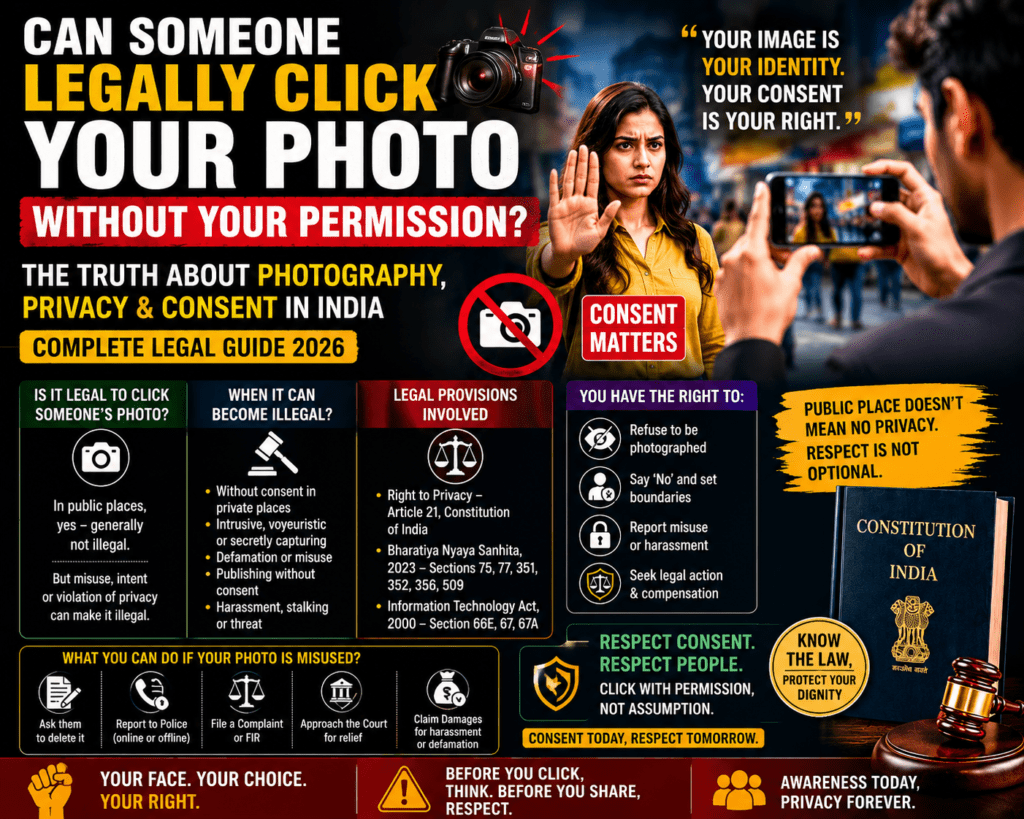
Is It Illegal to Click Someone’s Photo Without Consent?
The answer is:
Sometimes Yes. Sometimes No.
There is no general law in India which says:
“No person shall photograph another person without consent.”
Instead, legality depends upon the surrounding circumstances.
For example:
- Photographing a crowd in a public place is generally lawful.
- Secretly photographing someone inside a bedroom or washroom is clearly illegal.
- Using someone’s photograph to harass, blackmail or defame them can attract serious legal consequences.
Therefore, consent is important, but context is equally important.
The Right to Privacy: The Constitutional Foundation
The law relating to photography without consent is primarily based on the Right to Privacy.
The Supreme Court has recognised privacy as a fundamental right under Article 21 of the Constitution of India.
Privacy protects a person’s:
- Personal autonomy;
- Dignity;
- Bodily integrity;
- Informational privacy;
- Decisional freedom.
Simply put,
Every person has a right to control aspects of their private life.
If photography interferes with this privacy, legal consequences may follow.
Public Place vs Private Place
This is one of the most important distinctions in law.
Photograph Taken in a Public Place
Generally speaking, a person standing in a public place has a lower expectation of privacy.
Examples include:
- Roads
- Parks
- Railway stations
- Public events
- Political rallies
- Markets
Taking photographs in such places is generally lawful, provided the photographs are not used for illegal purposes.
However, even in public places, harassment, stalking, voyeurism, or targeted intrusive photography may still be unlawful.
Photograph Taken in a Private Place
The legal position changes significantly.
Private places include:
- Homes
- Bedrooms
- Hotel rooms
- Trial rooms
- Washrooms
- Private offices
- Changing rooms
A person has a very high expectation of privacy in such places.
Secretly taking photographs in these locations may amount to serious criminal offences.
When Does Taking a Photograph Become Illegal?
Photography may become unlawful if it involves:
Secret Photography
Taking photographs without knowledge in circumstances where privacy is expected.
Voyeurism
Photographing or recording a woman in private circumstances without her consent may amount to a criminal offence.
Stalking
Repeatedly photographing someone to intimidate, harass, or monitor them may amount to stalking.
Criminal Intimidation or Blackmail
Using photographs to threaten or extort someone attracts serious criminal liability.
Defamation
Publishing misleading photographs that harm a person’s reputation may give rise to legal action.
Morphing and Fake Images
Editing or manipulating someone’s photograph to create false or obscene content may attract both civil and criminal consequences.
Is Posting Someone’s Photo on Social Media Legal?
Taking a photograph and publishing it are two different legal issues.
A photograph may have been lawfully taken but unlawfully published.
Problems may arise where the image is used:
- To harass;
- To shame;
- To troll;
- To defame;
- To earn commercial profit without permission;
- To spread misinformation;
- To invade privacy.
The manner of publication often determines legality.
Can You Use Someone’s Photo for Commercial Purposes?
Generally, using another person’s image for:
- Advertisements;
- Product promotion;
- Brand endorsements;
- Commercial marketing;
without appropriate permission may expose the user to legal action.
A person’s image carries commercial as well as personal value.
What About Journalists and Media?
The media enjoys freedom of speech and expression.
However, this freedom is not absolute.
Courts expect the media to balance:
- Public interest;
- Privacy;
- Fair reporting;
- Human dignity.
Public interest is not the same as public curiosity.
Photography by Police
Police may photograph an accused person where authorised by law during investigation.
However, such powers must always be exercised in accordance with statutory provisions and constitutional safeguards.
Arbitrary publication of photographs by investigating agencies may itself raise legal concerns depending on the facts.
Photography in Schools, Hospitals and Private Property
Private establishments may impose reasonable restrictions on photography.
Examples include:
- Hospitals;
- Schools;
- Museums;
- Court premises;
- Airports;
- Defence installations;
- Private clubs.
Violation of such restrictions may have legal consequences.
Legal Remedies Available
If someone has unlawfully photographed you or misused your photograph, several remedies may be available depending upon the facts.
These include:
Police Complaint
Where criminal offences are disclosed.
Civil Suit
To seek damages or injunction against misuse.
Injunction
To restrain publication or circulation of photographs.
Cyber Complaint
Where photographs are circulated online through unlawful means.
Compensation
In appropriate cases involving violation of privacy or reputation.
Important Legal Principles
Indian courts have developed several important principles regarding privacy.
Privacy is a Fundamental Right
Every person has a constitutional right to dignity and privacy.
Context Matters
Photography is not automatically legal or illegal.
The surrounding circumstances determine legality.
Public Place Does Not Mean No Rights
Even in public places, a person may challenge photography that amounts to harassment, stalking, or invasion of privacy.
Misuse Creates Liability
Even if taking the photograph was lawful, its subsequent misuse may attract legal consequences.
Myth vs Reality
| Myth | Reality |
|---|---|
| Anyone can freely photograph anyone because public places have no privacy. | False. Public places involve a lower expectation of privacy, not the complete absence of privacy. Harassment, stalking, voyeurism, or misuse can still be unlawful. |
| If I click someone’s photo, I automatically own all rights over it. | False. Ownership of a photograph does not give unrestricted rights to misuse another person’s identity or violate their privacy. |
| Posting someone else’s photo on Instagram or Facebook is always legal. | Wrong. Publication that invades privacy, defames, harasses, or commercially exploits another person may invite legal action. |
| Only women have privacy rights. | Incorrect. Every individual has a constitutional right to privacy, irrespective of gender. Certain offences like voyeurism specifically protect women, but privacy itself belongs to everyone. |
| Taking a photograph and using it are legally the same thing. | False. The legality of taking a photograph and the legality of publishing or exploiting it are separate legal questions. |
Frequently Asked Questions (FAQs)
Can someone click my photo without asking me?
It depends. In many public places it may be lawful, but if it invades your privacy or is used unlawfully, legal remedies may be available.
Can I stop someone from posting my photograph online?
Yes. Depending upon the circumstances, you may seek removal, injunction, compensation, or criminal action where applicable.
Is secretly taking someone’s photograph a crime?
It can be. Particularly where it amounts to voyeurism, stalking, invasion of privacy, or another recognised offence.
Can I sue someone for misusing my photograph?
Yes. Civil as well as criminal remedies may be available depending upon the facts.
Is taking photographs inside someone’s house without permission legal?
Generally, No. A person enjoys a strong expectation of privacy inside a private residence, and unauthorized photography may attract legal consequences.
Conclusion
Photography is an everyday part of modern life, but the camera does not override the Constitution.
Indian law attempts to strike a careful balance between freedom of expression and the fundamental right to privacy. Whether taking someone’s photograph without consent is lawful depends on where it was taken, why it was taken, how it was taken, and how it was later used.
The guiding principle is simple:
The law protects both the photographer’s freedom and the individual’s dignity. Neither right is absolute, and both must coexist within the framework of the Constitution and the rule of law.
So, before clicking someone’s photograph—or sharing it online—ask yourself one important question:
“Am I capturing a moment, or am I violating someone’s privacy?”
The answer could make all the difference.