- Introduction
- Which Law Governs Hindu Marriages?
- Who Can Marry Under the Hindu Marriage Act?
- What Are the Legal Conditions for a Valid Hindu Marriage?
- What Is the Legal Procedure for Marriage?
- Step 1 – Fulfil the Legal Conditions
- Step 2 – Perform the Marriage According to Customary Rites
- Are Seven Pheras Compulsory?
- Is Registration of Marriage Compulsory?
- Documents Commonly Required for Marriage Registration
- What Is the Importance of Marriage Registration?
- Can an Inter-Caste Marriage Be Performed Under the Hindu Marriage Act?
- What Happens if the Conditions Are Not Fulfilled?
- Jurisprudence Behind the Hindu Marriage Act
- Practical Tips Before Getting Married
- Myth vs Reality
- Frequently Asked Questions (FAQs)
- Key Takeaways
- Conclusion
Introduction
Marriage is one of the most important milestones in a person’s life. While weddings are often celebrated with traditions, rituals, and family gatherings, it is equally important to understand the legal requirements that make a Hindu marriage valid in the eyes of law.
Many people believe that simply performing a wedding ceremony is enough. Others think that marriage registration alone creates a valid marriage. Both assumptions are incomplete.
Under the Hindu Marriage Act, 1955, a marriage must satisfy certain legal conditions and be solemnized according to the customary rites and ceremonies of the parties. Registration, although highly advisable, generally serves as strong proof of marriage and does not replace the essential legal requirements for a valid marriage.
In this guide, we explain the complete legal procedure for getting married under the Hindu Marriage Act, the applicable legal provisions, important judicial principles, registration process, common myths, and practical tips in simple language.
Which Law Governs Hindu Marriages?
The Hindu Marriage Act, 1955 governs marriages between:
- Hindus;
- Buddhists;
- Jains; and
- Sikhs,
provided they are otherwise covered by the Act.
The Act applies to marriages solemnized in accordance with its provisions and subject to the statutory conditions.
Who Can Marry Under the Hindu Marriage Act?
A marriage under the Act is generally available where both parties are governed by the Hindu Marriage Act.
If one or both parties do not fall within its scope, another legal framework—such as the Special Marriage Act, 1954—may apply depending on the circumstances.
What Are the Legal Conditions for a Valid Hindu Marriage?
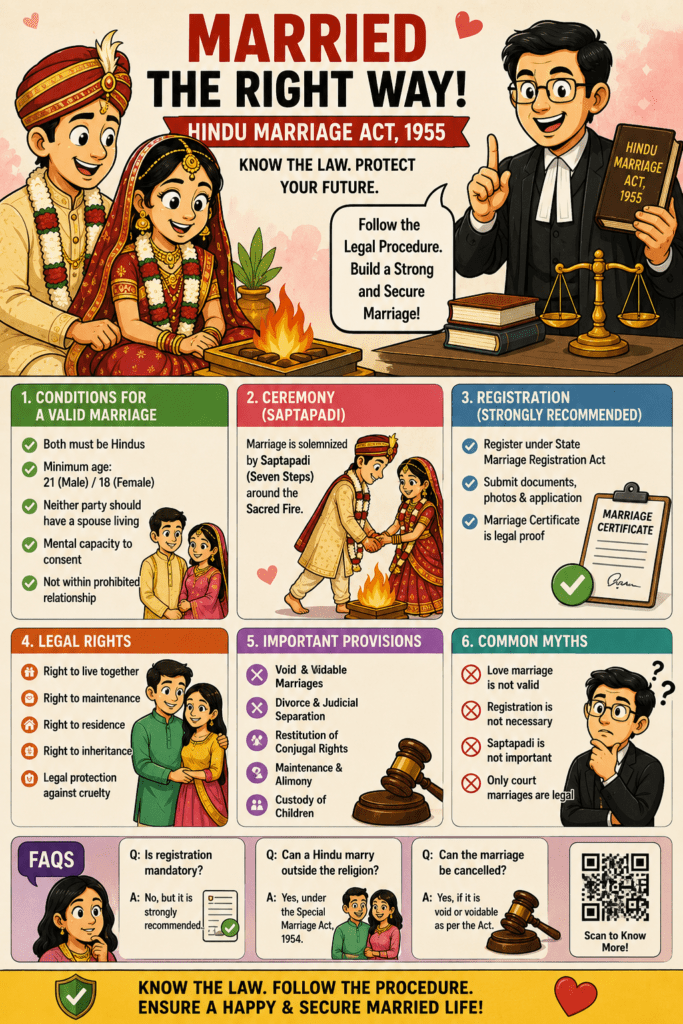
Section 5 of the Hindu Marriage Act, 1955 lays down the essential conditions.
A valid Hindu marriage generally requires that:
1. Neither Party Has a Living Spouse
A Hindu marriage must be monogamous. If either party has a living spouse at the time of marriage, the subsequent marriage may be void, subject to the provisions of the Act.
2. Both Parties Are Capable of Giving Valid Consent
Each party should have the mental capacity required by law to enter into the marriage.
3. Minimum Age Requirement
The legal minimum age is:
- 21 years for the groom.
- 18 years for the bride.
Marriage below the prescribed age may have legal consequences under applicable laws.
4. Parties Should Not Be Within Prohibited Degrees of Relationship
Marriage between persons within prohibited degrees is generally not permitted unless a valid custom governing the parties allows it.
5. Parties Should Not Be Sapindas of Each Other
A marriage between sapindas is generally prohibited unless permitted by a recognised custom.
What Is the Legal Procedure for Marriage?
One of the biggest misconceptions is that the Hindu Marriage Act prescribes a single compulsory wedding ceremony.
It does not.
Step 1 – Fulfil the Legal Conditions
Before the marriage is solemnized, both parties should ensure that the conditions under Section 5 are satisfied.
Step 2 – Perform the Marriage According to Customary Rites
Section 7 of the Hindu Marriage Act provides that a Hindu marriage may be solemnized according to the customary rites and ceremonies of either party.
The law respects different customs followed by different Hindu communities across India.
Are Seven Pheras Compulsory?
Not in every case.
This is one of the most common misconceptions.
If Saptapadi (Seven Steps) forms part of the customary ceremony applicable to the parties, then the marriage becomes complete when the seventh step is taken.
If another recognised custom governs the parties, that custom may determine the solemnization of the marriage.
Is Registration of Marriage Compulsory?
Marriage registration is strongly recommended because it provides reliable documentary proof of marriage and helps avoid future disputes.
The manner of registration may vary depending on the law and the rules applicable in the concerned State or Union Territory.
Documents Commonly Required for Marriage Registration
Although requirements may vary across States, the following documents are commonly required:
- Aadhaar Card or other identity proof;
- PAN Card (where required);
- Proof of age;
- Address proof;
- Passport-size photographs;
- Wedding photographs;
- Marriage invitation card (if available);
- Identity documents of witnesses;
- Proof of solemnization, where required.
It is advisable to verify the specific requirements with the local Marriage Registrar.
What Is the Importance of Marriage Registration?
Registration helps in:
- obtaining a marriage certificate;
- visa and immigration applications;
- passport-related matters;
- bank nominations;
- insurance claims;
- inheritance issues;
- property disputes;
- maintenance and matrimonial proceedings.
Although registration is valuable evidence, the validity of a Hindu marriage primarily depends on compliance with the Act and the applicable ceremonies.
Can an Inter-Caste Marriage Be Performed Under the Hindu Marriage Act?
Yes.
The Hindu Marriage Act does not prohibit marriage merely because the parties belong to different castes, provided they satisfy the legal requirements under the Act.
What Happens if the Conditions Are Not Fulfilled?
Depending on the nature of the defect, a marriage may be:
- void;
- voidable; or
- otherwise subject to legal consequences under the Hindu Marriage Act and other applicable laws.
The legal effect depends on the specific facts and statutory provisions.
Jurisprudence Behind the Hindu Marriage Act
The Act reflects several important legal principles.
1. Marriage Is a Social Institution Recognised by Law
While Hindu marriage has deep cultural and religious significance, the law regulates it to protect the rights of both spouses and ensure legal certainty.
2. The Law Respects Custom
Instead of imposing a uniform ceremony, Section 7 recognises the diverse customs and traditions followed by different Hindu communities.
3. Equality and Protection of Rights
The Act seeks to protect the legal rights of both spouses by prescribing essential conditions and providing remedies relating to matrimonial disputes.
4. Registration Promotes Legal Certainty
A marriage certificate serves as strong evidence of marriage and helps avoid unnecessary disputes in the future.
Practical Tips Before Getting Married
- Verify that both parties satisfy the legal age requirement.
- Ensure that neither party has a living spouse.
- Follow the customary ceremonies applicable to the parties.
- Preserve photographs and other evidence of the marriage ceremony.
- Register the marriage at the earliest opportunity.
- Keep copies of the marriage certificate safely.
Myth vs Reality
| Myth | Reality |
|---|---|
| Every Hindu marriage must involve seven pheras. | False. Seven pheras are legally significant only where Saptapadi forms part of the customary ceremony applicable to the parties. |
| Registration alone creates a valid marriage. | Incorrect. Registration is important evidence, but the marriage must also satisfy the legal requirements of the Hindu Marriage Act. |
| Inter-caste marriages are not valid under Hindu law. | Wrong. Inter-caste marriages are legally valid if the statutory conditions are fulfilled. |
| A lavish wedding automatically means a valid marriage. | False. Legal validity depends on compliance with the Act and the applicable customary rites, not on the scale of the celebration. |
| Marriage registration is unnecessary. | Incorrect. Registration provides valuable legal proof and is strongly advisable. |
Frequently Asked Questions (FAQs)
Which law governs Hindu marriages in India?
The Hindu Marriage Act, 1955 governs marriages between Hindus, Buddhists, Jains, and Sikhs covered by the Act.
Are seven pheras compulsory for every Hindu marriage?
No. They are compulsory only if Saptapadi forms part of the customary rites applicable to the parties.
Can I register my marriage after the wedding?
Yes. The procedure and documentation depend on the applicable State rules and the office of the Marriage Registrar.
Is a marriage certificate important?
Yes. It is often required for immigration, passports, banking, insurance, inheritance, and various legal proceedings.
Can two Hindus from different castes marry under the Hindu Marriage Act?
Yes. Caste alone does not invalidate a marriage under the Hindu Marriage Act if all statutory conditions are satisfied.
Key Takeaways
- Hindu marriages are governed by the Hindu Marriage Act, 1955.
- Section 5 lays down the essential conditions for a valid marriage.
- Section 7 recognises marriages solemnized according to the customary rites and ceremonies of either party.
- Seven pheras are not universally mandatory; their legal significance depends on the applicable custom.
- Marriage registration is highly recommended as it provides strong legal proof of the marriage.
Conclusion
A Hindu marriage is not merely a ceremonial event—it is also a legal relationship governed by the Hindu Marriage Act, 1955. While traditions and customs remain central to the institution of marriage, the law ensures that certain essential conditions are fulfilled to protect the rights of both spouses.
Understanding the legal requirements before marriage can prevent future disputes and provide certainty regarding matrimonial rights, inheritance, maintenance, and other legal consequences. By complying with the statutory conditions, following the applicable customary ceremonies, and registering the marriage, couples can ensure that their union is recognised both socially and legally.
Marriage is a lifelong commitment. Ensuring that it is legally valid is one of the most important steps towards protecting your future rights and responsibilities.