- Introduction
- Which Law Governs Christian Marriages in India?
- Who Can Get Married Under the Indian Christian Marriage Act?
- Who Can Solemnize a Christian Marriage?
- What Are the Essential Conditions for a Valid Christian Marriage?
- Step-by-Step Procedure for a Christian Marriage
- Is Registration of a Christian Marriage Necessary?
- Is a Church Marriage Alone Sufficient?
- Jurisprudence Behind Christian Marriage Law
- Practical Tips Before Marriage
- Myth vs Reality
- Frequently Asked Questions (FAQs)
- Key Takeaways
- Conclusion
Introduction
A Christian wedding is much more than a beautiful church ceremony. It is also a legal relationship that creates important rights and responsibilities between the husband and wife.
Many people believe that once a priest conducts the wedding in a church, there is nothing more to do. Others think that every church marriage is automatically registered with the Government. These assumptions are not always legally correct.
In India, Christian marriages are governed primarily by the Indian Christian Marriage Act, 1872, which prescribes who can solemnize a Christian marriage, the legal conditions for its validity, and the procedure for maintaining marriage records. Understanding these legal requirements is essential to avoid future disputes relating to passports, visas, inheritance, insurance, banking, property, and matrimonial rights.
This article explains the complete legal procedure for Christian marriages in India, registration, legal provisions, important principles, myths, FAQs, and practical tips in simple language.
Which Law Governs Christian Marriages in India?
Christian marriages in India are primarily governed by the Indian Christian Marriage Act, 1872.
The Act regulates:
- who can solemnize a Christian marriage;
- the procedure for solemnization;
- marriage registers;
- issuance of marriage certificates; and
- legal validity of Christian marriages.
Issues relating to divorce, judicial separation, nullity, and dissolution of marriage are generally governed by the Divorce Act, 1869.
Who Can Get Married Under the Indian Christian Marriage Act?
Generally, the Act applies where one or both parties are Christians, and the marriage is solemnized in accordance with the provisions of the Act.
The marriage must satisfy the statutory requirements regarding age, consent, and legal capacity.
Who Can Solemnize a Christian Marriage?
Under the Indian Christian Marriage Act, a Christian marriage may be solemnized by authorised persons, including:
- a Minister of Religion licensed under the Act;
- a Clergyman of the Church of England (where applicable under the Act);
- a Marriage Registrar authorised under the Act; or
- other persons authorised in accordance with the provisions of the Act.
The person solemnizing the marriage must have the legal authority prescribed by law.
What Are the Essential Conditions for a Valid Christian Marriage?
For a marriage to be legally valid, certain basic conditions should generally be fulfilled.
1. Free Consent
Both parties should voluntarily agree to marry.
A marriage obtained by force, fraud, or coercion may have legal consequences.
2. Legal Capacity
The parties should be legally capable of entering into marriage.
3. Minimum Age
The parties should satisfy the minimum age prescribed by the applicable law.
If either party is below the prescribed age, additional legal requirements and consequences may arise.
4. No Existing Valid Marriage
A person who already has a living spouse generally cannot contract another valid marriage during the subsistence of the first marriage.
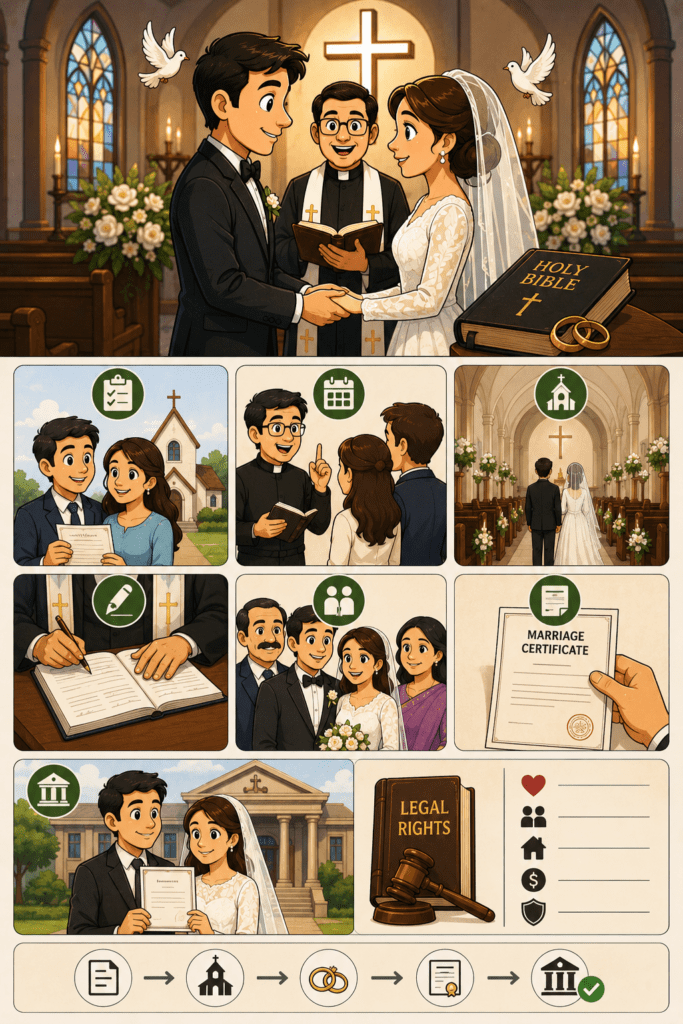
Step-by-Step Procedure for a Christian Marriage
Although practices may differ slightly among denominations, the legal process broadly involves the following steps.
Step 1 – Meet the Legal Requirements
Ensure that both parties satisfy the legal conditions relating to age, consent, and capacity.
Step 2 – Approach the Church or Marriage Authority
The couple should contact the church or authorised Marriage Registrar where the marriage is intended to be solemnized.
The concerned authority will explain the applicable legal and procedural requirements.
Step 3 – Submission of Documents
Commonly required documents include:
- Aadhaar Card or Passport;
- proof of age;
- address proof;
- passport-size photographs;
- baptism certificate (where required by the church);
- confirmation certificate (if required by the denomination);
- identity documents of witnesses.
Document requirements may vary depending on the church and local rules.
Step 4 – Publication of Notice (Where Required)
In certain cases under the Act, notice requirements may apply before the marriage is solemnized.
The applicable procedure depends on the authority conducting the marriage and the relevant statutory provisions.
Step 5 – Solemnization of Marriage
The marriage is performed in accordance with Christian religious ceremonies by an authorised person.
The parties exchange vows in the presence of witnesses.
Step 6 – Entry in the Marriage Register
After the marriage is solemnized, the details are entered into the prescribed Marriage Register maintained under the Act.
The parties and witnesses sign the register.
Step 7 – Marriage Certificate
The authorised person issues a Marriage Certificate or records the marriage in accordance with the provisions of the Act.
The certificate serves as important legal evidence of the marriage.
Is Registration of a Christian Marriage Necessary?
Yes, maintaining proper registration records is an important feature of the Indian Christian Marriage Act.
The Marriage Register and Marriage Certificate provide legal proof of the marriage.
They are often required for:
- passports;
- visas;
- immigration;
- bank nominations;
- insurance claims;
- inheritance matters;
- property transactions;
- matrimonial proceedings.
Couples should always obtain and safely preserve their marriage certificate.
Is a Church Marriage Alone Sufficient?
A marriage solemnized in accordance with the Indian Christian Marriage Act by a person authorised under the Act is legally recognised.
However, couples should ensure that the marriage has been duly recorded in the prescribed register and that the marriage certificate has been issued, as these documents are invaluable in proving the marriage.
Jurisprudence Behind Christian Marriage Law
The law governing Christian marriages is founded on several important legal principles.
1. Marriage Creates Legal Rights and Obligations
A Christian marriage is not merely a religious ceremony. It creates a legally recognised relationship carrying rights and responsibilities under the law.
2. Registration Ensures Legal Certainty
Maintaining official marriage records helps prevent disputes regarding marital status and protects the interests of both spouses.
3. Free Consent Is Essential
The law recognises marriage as a voluntary union. Genuine consent of both parties is fundamental.
4. Public Records Promote Transparency
The maintenance of marriage registers under the Act promotes authenticity, accountability, and legal certainty.
Practical Tips Before Marriage
- Verify that the officiating minister or authority is authorised under the law.
- Keep copies of all submitted documents.
- Ensure that the marriage is entered in the prescribed Marriage Register.
- Collect the Marriage Certificate immediately after the ceremony, where applicable.
- Preserve multiple certified copies of the certificate for future legal use.
- Verify the spellings of names, dates, and other particulars before leaving the church or registrar’s office.
Myth vs Reality
| Myth | Reality |
|---|---|
| Every church wedding is automatically registered with the Government. | Not always. Couples should ensure that the marriage has been properly recorded and obtain the Marriage Certificate in accordance with the applicable law. |
| Only the religious ceremony matters. | Incorrect. Proper legal solemnization and official records are equally important. |
| A marriage certificate is unnecessary. | False. It is one of the most important legal documents for proving the marriage. |
| Anyone can conduct a legally valid Christian marriage. | Wrong. The marriage should be solemnized by a person authorised under the Indian Christian Marriage Act, 1872. |
| Once married in church, no further documentation is required. | Incorrect. Proper registration and preservation of the Marriage Certificate are strongly recommended. |
Frequently Asked Questions (FAQs)
Which law governs Christian marriages in India?
The Indian Christian Marriage Act, 1872 primarily governs the solemnization and registration of Christian marriages.
Is registration compulsory after a church marriage?
The Act provides for maintenance of marriage records and issuance of marriage certificates. Couples should ensure that the marriage has been properly entered into the prescribed register and obtain the certificate.
Can a church marriage be used for passport and visa purposes?
Yes. The Marriage Certificate issued under the applicable legal procedure is commonly relied upon for passports, visas, immigration, and other official purposes.
Who can solemnize a Christian marriage?
Only persons authorised under the Indian Christian Marriage Act, 1872, such as specified ministers of religion, authorised Marriage Registrars, and other legally recognised authorities.
Why is the Marriage Certificate important?
It serves as legal proof of marriage and is frequently required in government, financial, immigration, inheritance, and matrimonial matters.
Key Takeaways
- Christian marriages in India are primarily governed by the Indian Christian Marriage Act, 1872.
- The marriage must be solemnized by an authorised person under the Act.
- Free consent, legal capacity, and compliance with statutory requirements are essential.
- Proper entry in the Marriage Register and obtaining the Marriage Certificate are extremely important.
- Registration and documentary proof help safeguard the rights of both spouses and prevent future legal disputes.
Conclusion
A Christian marriage is a sacred union as well as a legally recognised institution. While the religious ceremony is central to the wedding, complying with the legal requirements of the Indian Christian Marriage Act, 1872 is equally important. Ensuring that the marriage is solemnized by an authorised person, properly recorded in the Marriage Register, and supported by a valid Marriage Certificate protects the couple’s legal rights for years to come.
Whether you are planning a church wedding or advising someone who is, understanding the legal procedure can save time, avoid future complications, and provide peace of mind.
A beautiful wedding lasts a day—but a legally valid marriage protects your rights for a lifetime.