
- Introduction
- What is MRP?
- Which Law Governs MRP?
- Can Every Shop Charge Above MRP?
- Can a Shop Charge Less Than MRP?
- What If a Shopkeeper Says "Cooling Charges" or "Service Charges"?
- Can Restaurants Charge More Than MRP?
- Can Hotels Charge More Than MRP?
- What About Cinema Halls?
- What Should You Do If Someone Charges More Than MRP?
- Where Can You File a Complaint?
- Can You Get Compensation?
- What Are the Legal Consequences for the Seller?
- Jurisprudence Behind MRP Laws
- Practical Tips for Consumers
- Myth vs Reality
- Frequently Asked Questions (FAQs)
- Key Takeaways
- Conclusion
Introduction
Imagine walking into a shop, buying a bottle of water worth ₹20 MRP, and the shopkeeper demands ₹40. You pay because you don’t want an argument.
Later, you wonder:
- Can a shopkeeper charge above MRP?
- Is charging more than MRP illegal?
- Can I file a complaint?
- Will I get compensation?
- What law protects me?
The answer is simple:
In most situations, charging more than the printed Maximum Retail Price (MRP) on a packaged commodity is illegal.
Indian law protects consumers from unfair pricing and unfair trade practices. If any seller charges more than the MRP without legal justification, you have the right to seek a refund, compensation, and legal action.
This guide explains everything you need to know in simple language.
What is MRP?
MRP means Maximum Retail Price.
It is the highest price that can legally be charged from a consumer for a packaged commodity, inclusive of all taxes.
This means that unless permitted by law, no retailer can charge even ₹1 more than the printed MRP.
However, a retailer is always free to sell below the MRP by offering discounts.
Which Law Governs MRP?
Several laws protect consumers against overcharging.
The important ones are:
- Consumer Protection Act, 2019
- Legal Metrology Act, 2009
- Legal Metrology (Packaged Commodities) Rules, 2011
These laws require manufacturers to print the MRP on packaged commodities and prohibit retailers from charging more than that amount, except where the law specifically permits.
Can Every Shop Charge Above MRP?
No.
If the product is a pre-packaged commodity carrying an MRP, the retailer generally cannot charge more than the printed MRP.
Examples include:
- bottled water
- cold drinks
- chocolates
- biscuits
- packaged snacks
- medicines
- toothpaste
- soaps
- packaged groceries
The printed MRP is the maximum price payable by the consumer.
Can a Shop Charge Less Than MRP?
Yes.
The MRP is the maximum price, not the minimum.
Retailers may legally offer:
- discounts;
- festive offers;
- clearance sales;
- promotional pricing.
Consumers benefit from these reduced prices.
What If a Shopkeeper Says “Cooling Charges” or “Service Charges”?
This is a common excuse.
A retailer cannot simply add “cooling charges,” “refrigeration charges,” “handling charges,” or similar amounts to the MRP of a packaged commodity sold across the counter.
The MRP already represents the maximum retail price payable by the consumer.
Can Restaurants Charge More Than MRP?
The answer depends on the nature of the transaction.
If a customer purchases a packaged commodity as part of restaurant or hospitality services, courts have recognised that the overall transaction may differ from a simple retail sale because the customer also receives services such as seating, ambience, cutlery, air conditioning, and service.
However, if a restaurant merely sells a packaged product across the counter without providing such services, different considerations may apply.
The legality depends upon the facts of each case.
Can Hotels Charge More Than MRP?
Similar principles apply.
The legality depends on whether the customer is merely purchasing a packaged commodity or receiving a composite hospitality service.
Courts have examined these situations on their individual facts.
What About Cinema Halls?
The issue has been the subject of litigation in different States.
Some State Governments have issued specific directions regulating the sale of packaged drinking water and other items inside cinema halls.
The legal position may therefore vary depending upon the applicable law and judicial decisions in the concerned jurisdiction.
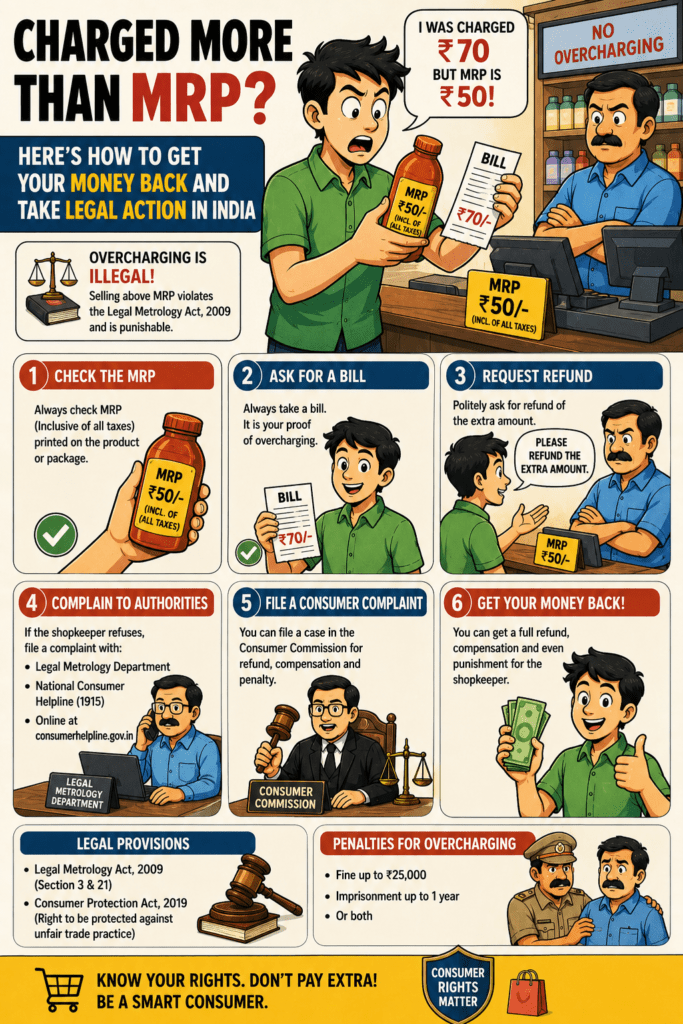
What Should You Do If Someone Charges More Than MRP?
Do not panic.
Follow these simple steps.
Step 1 – Keep the Bill
Always collect:
- cash memo;
- invoice;
- receipt;
- digital payment proof.
Without proof, your case becomes more difficult.
Step 2 – Preserve the Product
Do not throw away:
- the packet;
- the bottle;
- the wrapper;
- the printed MRP.
It is important evidence.
Step 3 – Take a Photograph
Photograph:
- the MRP printed on the product;
- the bill;
- the price displayed in the shop.
Step 4 – Ask for a Refund
Many disputes end immediately once the shopkeeper realises that the consumer knows the law.
Step 5 – File a Complaint
If the retailer refuses, you can approach the appropriate authorities.
Where Can You File a Complaint?
You have several options.
1. National Consumer Helpline (NCH)
Consumers may lodge complaints through the National Consumer Helpline.
2. Legal Metrology Department
Every State has Legal Metrology authorities empowered to examine violations relating to packaged commodities and MRP.
3. Consumer Commission
If you suffer financial loss or unfair treatment, you may file a complaint before the appropriate Consumer Commission under the Consumer Protection Act, 2019.
You may seek:
- refund;
- compensation;
- litigation costs;
- other appropriate relief.
Can You Get Compensation?
Yes.
If overcharging amounts to an unfair trade practice or causes loss or harassment, the Consumer Commission may grant appropriate relief, including compensation, depending on the facts of the case.
What Are the Legal Consequences for the Seller?
Depending on the nature of the violation, the seller may face:
- consumer complaints;
- monetary penalties under applicable laws;
- action by Legal Metrology authorities;
- directions to refund the excess amount;
- compensation to consumers;
- prosecution in appropriate cases.
Jurisprudence Behind MRP Laws
The law relating to MRP is based on important constitutional and consumer protection principles.
1. Consumer Protection
The law aims to ensure that consumers are not exploited through unfair pricing.
2. Transparency
Consumers should know the maximum amount payable before making a purchase.
3. Fair Trade Practices
Businesses are expected to compete fairly rather than exploit consumers through arbitrary pricing.
4. Equality in the Marketplace
Every consumer deserves equal protection against unfair commercial practices.
Practical Tips for Consumers
- Always ask for a bill.
- Check the printed MRP before paying.
- Preserve the packaging.
- Avoid purchasing from sellers who refuse to issue receipts.
- Pay digitally whenever possible to create a payment record.
- Report repeated violations.
Myth vs Reality
| Myth | Reality |
|---|---|
| A shopkeeper can charge any price if the customer agrees. | False. A retailer generally cannot charge more than the printed MRP for a packaged commodity, except where the law permits otherwise. |
| MRP is only a suggestion. | Wrong. MRP means the maximum retail price that can ordinarily be charged from a consumer. |
| No bill means no legal rights. | Incorrect. Although a bill greatly strengthens your case, other evidence such as digital payments, CCTV footage, witnesses, or photographs may also help. |
| Small overcharging is not illegal. | False. Even charging ₹1 above the applicable MRP may constitute a violation if not legally justified. |
| Only expensive products are protected. | Wrong. Consumer laws protect all consumers irrespective of the value of the product. |
Frequently Asked Questions (FAQs)
Can a retailer charge more than the printed MRP?
Generally, no. For pre-packaged commodities, the printed MRP is the maximum price payable, unless a specific legal exception applies.
Can I get a refund if I was charged above MRP?
Yes. Depending on the facts, you may seek a refund, compensation, or other relief through the appropriate legal forum.
Which authority should I approach?
You may approach the Legal Metrology Department, the National Consumer Helpline, or the appropriate Consumer Commission, depending on the nature of the grievance.
Is charging more than MRP a consumer law issue?
Yes. It may amount to an unfair trade practice and may also violate the Legal Metrology laws governing packaged commodities.
Should I always ask for a bill?
Absolutely. A bill is one of the strongest pieces of evidence in any consumer dispute.
Key Takeaways
- MRP means Maximum Retail Price.
- Retailers generally cannot charge more than the printed MRP for packaged commodities.
- Consumers have legal protection under the Consumer Protection Act, 2019 and the Legal Metrology Act, 2009.
- Preserve bills, packaging, and photographs if you are overcharged.
- You may seek a refund, compensation, and legal remedies through the appropriate authorities.
Conclusion
Every consumer has the right to pay a fair price for the products they purchase. Charging more than the printed MRP is not merely an inconvenience—it may amount to a violation of consumer protection and legal metrology laws. By understanding your rights, preserving evidence, and using the remedies provided by law, you can challenge unfair pricing and help create a more transparent marketplace.
The next time someone demands more than the printed MRP, remember: you are not powerless. The law is designed to protect consumers, and knowing your rights is the first step towards enforcing them.