
- Introduction
- What Is the RTI Act?
- What Is "Information" Under the RTI Act?
- Who Can File an RTI Application?
- Which Authorities Come Under RTI?
- Who Is a Public Information Officer (PIO)?
- How to File an RTI Application?
- Can RTI Be Filed Online?
- What Is the Time Limit for Reply?
- What If Information Is Not Supplied?
- First Appeal Under RTI Act
- Second Appeal Under RTI Act
- Powers of the Information Commission
- Can Penalty Be Imposed on Officers?
- What Information Cannot Be Obtained Under RTI?
- Can RTI Be Used Against Private Persons?
- Can RTI Solve Personal Grievances?
- Jurisprudence Behind RTI Act
- Practical Tips for Successful RTI Applications
- Myth vs Reality
- Frequently Asked Questions (FAQs)
- Key Takeaways
- Conclusion
Introduction
Imagine being able to ask a government department:
- Why was my file delayed?
- Where was public money spent?
- What action was taken on my complaint?
- Why was my application rejected?
- What are the rules governing a particular decision?
And imagine the government being legally required to answer.
That is exactly what the Right to Information Act, 2005 (RTI Act) was created for.
The RTI Act is often called the citizen’s most powerful weapon against secrecy, corruption, delay, and administrative arbitrariness.
It transformed governance in India by giving ordinary citizens a legal right to access information held by public authorities.
This guide explains everything about the RTI Act in simple language.
What Is the RTI Act?
The Right to Information Act, 2005 is a law that gives citizens the legal right to seek information from public authorities.
The objective of the Act is:
- transparency;
- accountability;
- good governance;
- reduction of corruption;
- informed citizen participation.
The Act recognizes that information held by the government belongs to the public unless specifically exempted by law.
What Is “Information” Under the RTI Act?
The word “information” is very broad.
It includes:
- records;
- documents;
- orders;
- circulars;
- reports;
- contracts;
- file notings;
- emails;
- opinions available on record;
- correspondence;
- data;
- inspection of records;
- certified copies.
If a public authority possesses the information, it can generally be requested unless exempted under the Act.
Who Can File an RTI Application?
Any Indian citizen can file an RTI application.
You do not need:
- a lawyer;
- a special reason;
- any personal connection;
- any justification for seeking information.
One of the strongest features of the RTI Act is that you are generally not required to explain why you want the information.
Which Authorities Come Under RTI?
The RTI Act applies to most public authorities, including:
- Central Government departments;
- State Government departments;
- Municipal Corporations;
- Development Authorities;
- Public Sector Undertakings (PSUs);
- Government schools and colleges;
- Government hospitals;
- Statutory authorities;
- Regulatory bodies;
- Local authorities.
Any body substantially financed by the government may also fall within the scope of the Act.
Who Is a Public Information Officer (PIO)?
Every public authority designates a Public Information Officer (PIO).
The PIO is responsible for:
- receiving RTI applications;
- processing requests;
- collecting information;
- supplying information to applicants;
- communicating decisions under the Act.
The PIO is the first official you interact with under the RTI framework.
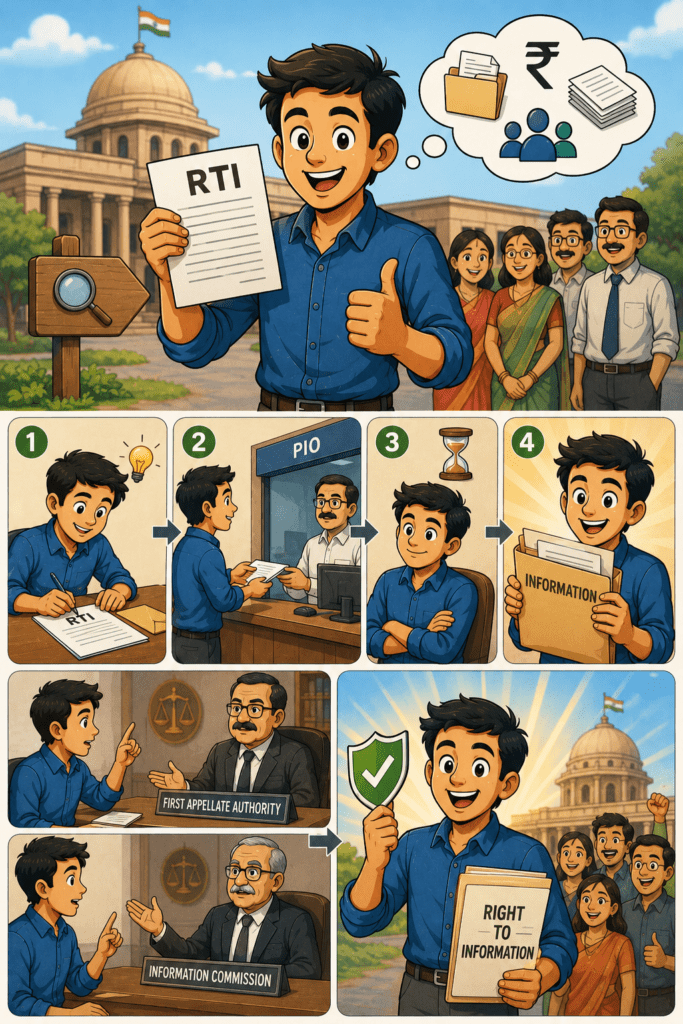
How to File an RTI Application?
The process is simple.
Step 1: Identify the Department
Determine which government department possesses the information.
For example:
- Property tax → Municipal Corporation.
- Passport matter → Passport Office.
- Police investigation records → Police Department.
- Revenue records → Revenue Department.
Step 2: Draft the RTI Application
Mention:
- Your name.
- Address.
- Contact details.
- Information sought.
Ask specific questions.
Good Example
Kindly provide a certified copy of the sanction order dated 15.03.2025.
Bad Example
Why is your department corrupt?
RTI seeks information available on record, not personal opinions.
Step 3: Pay Prescribed Fee
The prescribed application fee is generally ₹10, subject to applicable rules.
Different States may have different payment procedures.
Step 4: Submit the Application
The RTI application can usually be filed:
- physically;
- by post;
- online (where available).
Can RTI Be Filed Online?
Yes.
Many Central Government authorities accept RTI applications through the official RTI online portal.
Several State Governments have also introduced online RTI systems.
Online filing is often faster and easier.
What Is the Time Limit for Reply?
Normally, information must be provided within:
30 Days
The general rule.
48 Hours
Where the information concerns:
- life; or
- personal liberty.
These cases receive priority treatment.
What If Information Is Not Supplied?
This is where the appeal mechanism becomes important.
The RTI Act provides a structured remedy.
First Appeal Under RTI Act
If:
- information is denied;
- incomplete information is supplied;
- incorrect information is supplied;
- no reply is received,
you may file a First Appeal.
The appeal lies before the First Appellate Authority (FAA) designated within the same public authority.
This is the first statutory remedy available under the Act.
Second Appeal Under RTI Act
If you remain dissatisfied after the First Appeal, you may file a Second Appeal.
The Second Appeal lies before:
Central Information Commission (CIC)
For Central Government authorities.
State Information Commission (SIC)
For State Government authorities.
The Information Commission possesses significant powers under the Act.
Powers of the Information Commission
The Commission can:
- summon officials;
- examine records;
- direct disclosure of information;
- hear appeals;
- decide complaints;
- impose penalties where legally justified.
The Commission acts as an independent watchdog for transparency.
Can Penalty Be Imposed on Officers?
Yes.
One of the strongest features of the RTI Act is its penalty mechanism.
Where the statutory requirements are satisfied, penalties may be imposed for:
- unreasonable refusal of information;
- delay in providing information;
- providing incorrect information;
- providing misleading information;
- destroying information.
This provision ensures accountability.
What Information Cannot Be Obtained Under RTI?
Not every piece of information can be disclosed.
Certain categories are exempt.
Examples include:
- national security information;
- intelligence and security matters;
- trade secrets in certain situations;
- privileged information;
- information affecting sovereignty and integrity of India;
- certain personal information where disclosure has no public interest justification.
These exemptions are mainly contained in Section 8 of the RTI Act.
Can RTI Be Used Against Private Persons?
Generally, RTI applies to public authorities.
It cannot ordinarily be used directly against a private individual.
However, if a government department possesses information relating to a private entity and such information is accessible under law, disclosure may sometimes be possible.
Can RTI Solve Personal Grievances?
This is one of the biggest misconceptions.
RTI is designed to obtain information.
RTI is not a grievance redressal mechanism.
It cannot:
- punish officials directly;
- cancel government orders;
- grant compensation;
- decide disputes.
However, the information obtained through RTI can often help you pursue other legal remedies.
Jurisprudence Behind RTI Act
The RTI Act is rooted in constitutional principles.
1. Right to Know
The Supreme Court has repeatedly recognized that the right to know is closely connected with freedom of speech and expression.
An informed citizenry is essential for democracy.
2. Transparency in Governance
Government actions should ordinarily be open to public scrutiny.
Transparency reduces arbitrariness.
3. Accountability of Public Authorities
Citizens cannot effectively hold authorities accountable without access to information.
4. Participatory Democracy
The RTI Act empowers citizens to actively participate in governance rather than remaining passive observers.
Practical Tips for Successful RTI Applications
✅ Ask specific questions.
✅ Seek documents and records.
✅ Mention dates wherever possible.
✅ Avoid lengthy narratives.
✅ Request certified copies when required.
✅ Keep proof of filing.
✅ Track limitation periods for appeals.
❌ Do not ask hypothetical questions.
❌ Do not ask for personal opinions.
❌ Do not seek explanations not available on record.
Myth vs Reality
| Myth | Reality |
|---|---|
| RTI can be filed only through a lawyer. | False. Any citizen can file RTI personally. |
| Government must answer every question. | Incorrect. Only information available on record must generally be supplied. |
| RTI can solve all disputes. | False. RTI provides information, not dispute resolution. |
| Officers can ignore RTI applications. | Wrong. The Act provides appeals and penalty provisions. |
| RTI can obtain any information whatsoever. | Incorrect. Certain information is exempt under the Act. |
Frequently Asked Questions (FAQs)
Can I file RTI online?
Yes. Many authorities accept RTI applications through online platforms.
Is a lawyer required?
No.
Any citizen can file an RTI application.
What is the RTI fee?
Generally ₹10, subject to applicable rules and exemptions.
Can information be denied?
Yes, but only in accordance with the exemptions provided under the Act.
Where do I appeal if RTI is rejected?
First Appeal before the First Appellate Authority and thereafter Second Appeal before the Central or State Information Commission, as applicable.
Key Takeaways
- RTI Act empowers citizens to access government information.
- No reason is generally required for seeking information.
- Applications are filed before the Public Information Officer (PIO).
- First Appeal lies before the First Appellate Authority.
- Second Appeal lies before the Information Commission.
- Officers may face penalties for unjustified refusal or delay.
- RTI promotes transparency, accountability, and good governance.
Conclusion
The Right to Information Act, 2005 is one of the most powerful democratic tools available to Indian citizens. It transforms ordinary individuals into informed participants in governance by allowing them to access records, documents, decisions, and information held by public authorities.
Whether you want to know the status of a government file, understand how public money was spent, obtain copies of official records, or hold authorities accountable, the RTI Act provides a lawful and effective mechanism to do so.
In a democracy, information is power. The RTI Act ensures that this power belongs not only to the government—but also to the citizens it serves.