
- Introduction
- What Is a Cheque Bounce?
- Which Law Governs Cheque Bounce Cases?
- When Does a Cheque Bounce Become a Criminal Offence?
- What Should You Do Immediately After the Cheque Bounces?
- Can You Also File a Civil Recovery Case?
- Can Interest Also Be Claimed?
- What If the Drawer Says the Cheque Was Given Only as Security?
- What If the Person Stops Payment?
- What If the Cheque Is Issued by a Company?
- Can the Matter Be Settled?
- What Punishment Can the Drawer Face?
- Jurisprudence Behind Cheque Bounce Law
- Practical Tips
- Myth vs Reality
- Frequently Asked Questions (FAQs)
- Key Takeaways
- Conclusion
Introduction
You trusted someone.
They borrowed money, purchased goods, paid an advance, or promised to clear a business liability. To assure you that payment would be made, they handed over a cheque.
You deposited the cheque in your bank.
A few days later, the bank returned it with the remark:
- “Insufficient Funds”
- “Account Closed”
- “Payment Stopped by Drawer”
- “Exceeds Arrangement”
- “Refer to Drawer”
Now the person is avoiding your calls and refusing to pay.
What should you do?
Can you send a legal notice?
Can you file a criminal case?
Can you recover your money with interest?
The answer is yes, provided you follow the legal procedure correctly.
This guide explains everything you need to know about cheque bounce cases in India.
What Is a Cheque Bounce?
A cheque is said to have bounced or been dishonoured when the bank refuses to honour it and returns it unpaid.
Common reasons include:
- insufficient funds;
- account closed;
- payment stopped by the drawer;
- signature mismatch;
- exceeds arrangement;
- account frozen;
- other banking reasons.
Not every dishonour automatically results in criminal liability. The reason for dishonour and the surrounding facts are important.
Which Law Governs Cheque Bounce Cases?
Cheque bounce cases are primarily governed by:
- Section 138 of the Negotiable Instruments Act, 1881 (criminal liability for dishonour of cheque in specified circumstances);
- Sections 139 to 147 of the Negotiable Instruments Act, which deal with presumptions, offences by companies, cognizance, jurisdiction, compounding, and related matters;
- General civil law relating to recovery of money.
When Does a Cheque Bounce Become a Criminal Offence?
A criminal complaint under Section 138 of the Negotiable Instruments Act generally arises where:
- the cheque was issued towards a legally enforceable debt or liability;
- the cheque was presented within its period of validity;
- the cheque was dishonoured;
- the payee issued a statutory legal notice within the prescribed time after receiving information of dishonour;
- the drawer failed to make payment within 15 days of receiving the notice.
Only after these legal requirements are satisfied does the cause of action arise to file a complaint under Section 138.
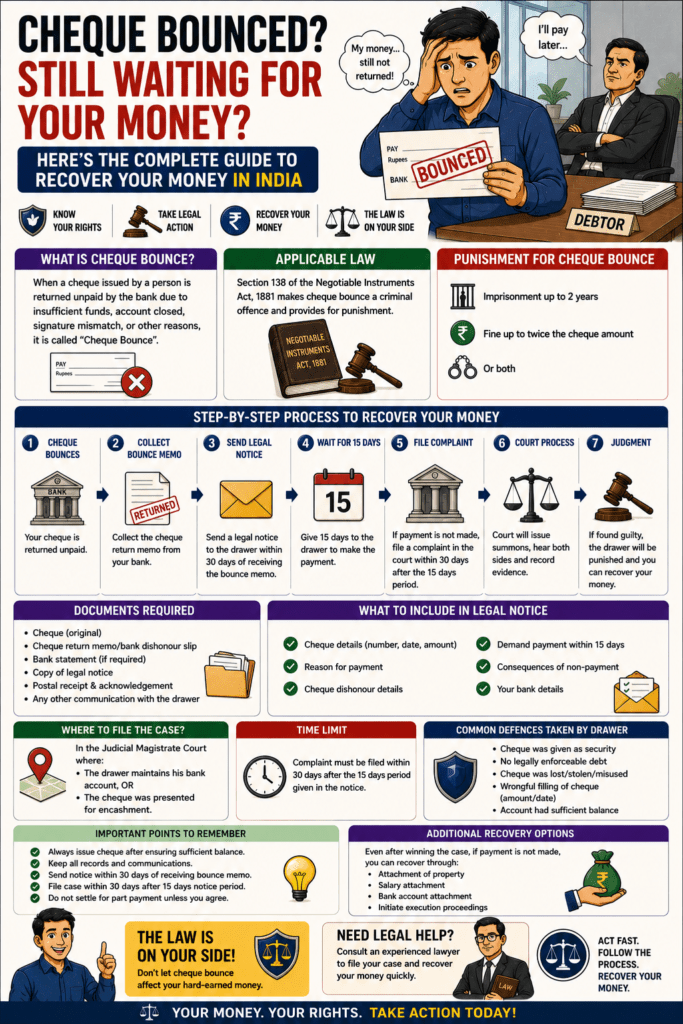
What Should You Do Immediately After the Cheque Bounces?
Step 1: Obtain the Cheque Return Memo
Collect the cheque return memo issued by your bank.
This document records the reason why the cheque was dishonoured and is an important piece of evidence.
Step 2: Preserve All Documents
Keep safely:
- original cheque (if returned);
- bank return memo;
- account statement;
- loan agreement (if any);
- invoices;
- bills;
- WhatsApp chats;
- emails;
- receipts;
- promissory notes;
- any acknowledgment of debt.
Step 3: Send a Legal Notice
This is one of the most important steps.
The payee must send a statutory demand notice within 30 days from the date of receiving information from the bank regarding dishonour of the cheque.
The notice should demand payment of the cheque amount and comply with the requirements of the Negotiable Instruments Act.
Step 4: Wait for 15 Days
After the drawer receives the legal notice, the law grants 15 days to make payment.
If payment is made within this period, criminal liability under Section 138 ordinarily does not arise.
If payment is not made within the prescribed time, the complainant becomes entitled to initiate criminal proceedings, subject to limitation.
Step 5: File the Complaint
If payment is still not made, a complaint under Section 138 of the Negotiable Instruments Act may be filed before the competent Magistrate within the limitation period prescribed by law.
Can You Also File a Civil Recovery Case?
Yes.
A cheque bounce case under Section 138 is a criminal proceeding intended to address the dishonour of a cheque issued towards a legally enforceable debt or liability.
In addition, you may also have a civil remedy for recovery of the money, interest, and other reliefs, depending on the facts of the case.
In appropriate cases, criminal and civil proceedings may proceed simultaneously because they serve different legal purposes.
Can Interest Also Be Claimed?
Depending on the nature of the transaction, the agreement between the parties, and applicable law, a claimant may seek interest in civil proceedings.
The grant and rate of interest are ultimately determined by the competent court.
What If the Drawer Says the Cheque Was Given Only as Security?
A common defence is that the cheque was issued merely as a “security cheque.”
Whether such a defence succeeds depends on the facts.
If the cheque was issued towards a legally enforceable debt or liability when presented, merely describing it as a “security cheque” does not automatically defeat a claim under Section 138.
Courts examine the surrounding circumstances and evidence.
What If the Person Stops Payment?
Many people believe that instructing the bank to stop payment protects them from legal action.
This is incorrect.
A “stop payment” instruction does not automatically prevent proceedings under Section 138 if the legal requirements of the provision are otherwise satisfied.
What If the Cheque Is Issued by a Company?
Where a company issues a dishonoured cheque, liability may extend not only to the company but also, in appropriate circumstances, to persons responsible for the conduct of its business, subject to the requirements of the Negotiable Instruments Act.
Can the Matter Be Settled?
Yes.
Cheque bounce cases are compoundable under the Negotiable Instruments Act.
This means that the parties may settle the dispute, and the criminal proceedings may be disposed of in accordance with law.
Many cases are resolved through negotiated settlements.
What Punishment Can the Drawer Face?
If convicted under Section 138 of the Negotiable Instruments Act, the court may impose punishment as provided under the Act, which includes imprisonment, fine, or both.
The precise sentence depends on the facts and the court’s discretion within the statutory framework.
Jurisprudence Behind Cheque Bounce Law
The law relating to dishonoured cheques is based on important legal principles.
1. Promoting Commercial Confidence
Cheques are widely used in trade and business.
The law seeks to maintain confidence in cheque-based transactions.
2. Ensuring Financial Discipline
A person should not issue a cheque without intending or being able to honour it.
The law encourages responsible financial conduct.
3. Protecting Genuine Creditors
The law provides an effective remedy to persons who have accepted cheques in discharge of legally enforceable debts or liabilities.
4. Fair Opportunity to Pay
The statutory notice and the 15-day payment period provide the drawer with an opportunity to honour the payment before criminal proceedings are initiated.
Practical Tips
✅ Deposit the cheque within its validity period.
✅ Preserve the original cheque and return memo.
✅ Send the statutory legal notice within the prescribed time.
✅ Keep proof of dispatch and delivery of the notice.
✅ Maintain copies of all communications and financial records.
❌ Do not delay sending the legal notice.
❌ Do not alter the cheque after it has been signed.
❌ Do not rely only on verbal promises after the cheque has bounced.
Myth vs Reality
| Myth | Reality |
|---|---|
| Every bounced cheque is automatically a criminal offence. | False. Criminal liability under Section 138 arises only if the statutory conditions are satisfied. |
| A security cheque can never result in legal action. | Incorrect. The nature of the underlying liability and the facts determine whether Section 138 applies. |
| If I stop payment, I cannot be prosecuted. | False. A stop-payment instruction does not automatically defeat proceedings under Section 138. |
| Only a criminal case can be filed. | Incorrect. Civil recovery proceedings may also be available. |
| If the drawer ignores the legal notice, nothing happens. | Wrong. Failure to pay within 15 days after receipt of the statutory notice may give rise to a cause of action under Section 138. |
Frequently Asked Questions (FAQs)
How many days do I have to send the legal notice?
The statutory demand notice must generally be issued within 30 days from receiving information from the bank regarding dishonour of the cheque.
How much time does the drawer get to pay?
The drawer is granted 15 days from receipt of the statutory notice to make payment.
Can I file both a civil recovery suit and a cheque bounce case?
Yes. Subject to the facts, both remedies may be pursued because they serve different legal purposes.
Is a WhatsApp promise to pay useful?
It may be relevant evidence depending on the facts, but the court will assess all evidence collectively.
Can I recover legal expenses?
Depending on the proceedings and the court’s orders, costs may be awarded in appropriate cases.
Key Takeaways
- A bounced cheque does not automatically result in criminal liability; the statutory requirements of Section 138 of the Negotiable Instruments Act must be fulfilled.
- Send the statutory legal notice within 30 days of receiving information about dishonour.
- The drawer has 15 days after receiving the notice to make payment.
- If payment is not made, a complaint under Section 138 may be filed before the competent Magistrate within the prescribed limitation period.
- Civil recovery proceedings may also be available in appropriate cases.
- Timely legal action significantly improves the chances of effective recovery.
Conclusion
A dishonoured cheque is not merely a banking inconvenience—it can have serious legal consequences when issued towards a legally enforceable debt or liability. The Negotiable Instruments Act provides a structured mechanism to protect honest creditors while also giving the drawer a final opportunity to make payment before criminal proceedings begin.
If someone has issued you a cheque that has bounced and continues to avoid repayment, do not ignore the situation or rely indefinitely on verbal assurances. Preserve your documents, comply with the statutory timelines, issue the legal notice within time, and pursue the appropriate legal remedies.
Remember: success in a cheque bounce case often depends not only on the strength of your claim but also on following the correct legal procedure within the prescribed time limits.