
- Introduction
- What Does "Conviction" Mean?
- Is Conviction the End of the Case?
- Step 1: Obtain the Certified Copy of the Judgment
- Step 2: Consult a Criminal Lawyer Immediately
- Step 3: File an Appeal
- Step 4: Apply for Suspension of Sentence
- Step 5: Seek Bail Pending Appeal
- Step 6: Can the Conviction Itself Be Stayed?
- Legal Consequences of Conviction
- Can a Conviction Be Reversed?
- Relevant BNSS Provisions
- Jurisprudence Behind Appeals After Conviction
- Myth vs Reality
- Frequently Asked Questions
- Practical Example
- Key Takeaways
- Conclusion
Introduction
Imagine that after years of facing a criminal trial, the judge pronounces:
“The accused is convicted.”
For most people, this is one of the most frightening moments of their lives. Many assume that the case is over, that there is nothing left to do, or that they will immediately be taken to prison.
That is not the complete legal position.
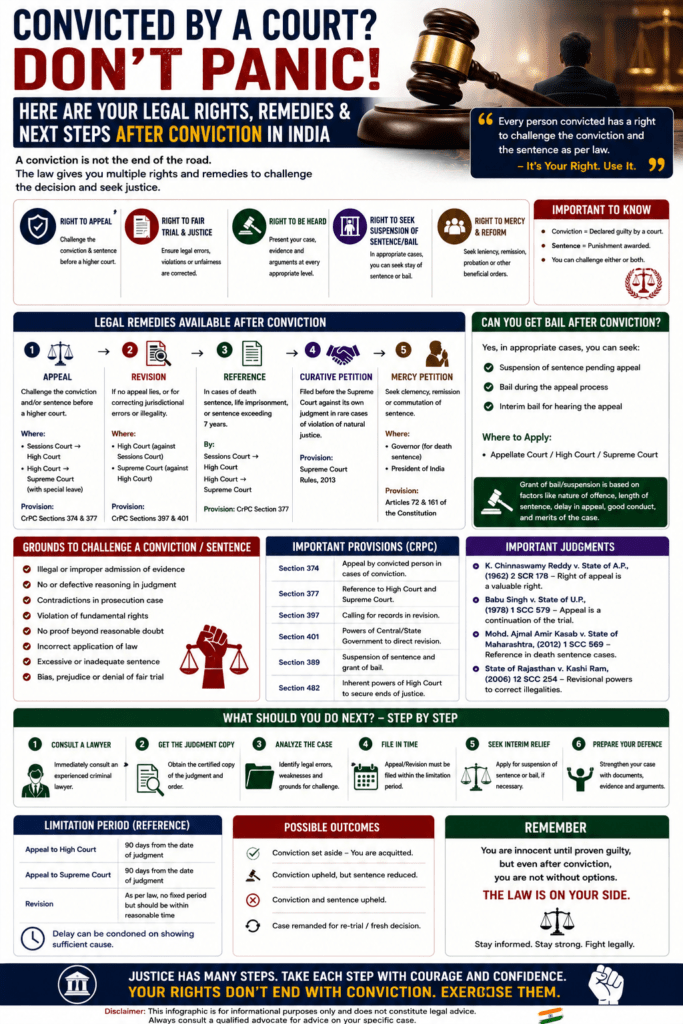
A conviction is undoubtedly serious, but it is not always the end of the road. Indian criminal law provides several legal remedies to ensure that an erroneous conviction or an excessive sentence can be reviewed by a higher court.
If you or someone you know has been convicted, it is important to understand what legal options are available, what rights continue to exist, and what steps should be taken immediately.
What Does “Conviction” Mean?
A conviction means that the criminal court has found the accused guilty of the offence after evaluating the evidence.
However, conviction is different from sentencing.
- Conviction determines guilt.
- Sentence determines the punishment.
In many cases, the court first records the conviction and then hears the accused before deciding the appropriate sentence.
Is Conviction the End of the Case?
Absolutely Not.
A conviction by the trial court does not necessarily mean the matter has finally concluded.
The law provides several remedies, including:
- filing an appeal;
- seeking suspension of sentence;
- applying for bail during the appeal;
- in exceptional cases, seeking suspension of conviction;
- approaching higher courts where necessary.
Many convictions are modified, reduced, or even set aside by appellate courts.
Step 1: Obtain the Certified Copy of the Judgment
The first practical step is to obtain:
- the judgment;
- the order of conviction;
- the order of sentence; and
- any other relevant orders passed by the trial court.
These documents are essential for preparing an appeal.
Step 2: Consult a Criminal Lawyer Immediately
Time is extremely important after a conviction.
An experienced criminal lawyer can:
- analyse the judgment;
- identify legal errors;
- examine procedural irregularities;
- assess the evidence;
- prepare the appeal; and
- advise on interim relief such as bail or suspension of sentence.
Delays may affect the availability of certain remedies.
Step 3: File an Appeal
One of the most important statutory remedies after conviction is an appeal.
The appellate court has wide powers and may:
- acquit the accused;
- set aside the conviction;
- alter the conviction;
- reduce the sentence;
- enhance the sentence after following due process where legally permissible;
- order a retrial; or
- dismiss the appeal.
An appeal is not a mere formality. It is a substantive legal remedy that enables a higher court to examine the correctness of the trial court’s decision.
Step 4: Apply for Suspension of Sentence
A conviction does not automatically prevent the court from granting interim relief.
The appellate court may, in appropriate cases, suspend the sentence pending disposal of the appeal.
If the sentence is suspended, the appellant may be released on bail, subject to the court’s order.
This is one of the most frequently sought remedies after conviction.
Step 5: Seek Bail Pending Appeal
Many people believe:
“Once I am convicted, I can never get bail.”
This is incorrect.
Depending upon:
- the offence;
- the sentence imposed;
- the facts of the case; and
- the applicable statutory provisions,
the appellate court may grant bail during the pendency of the appeal after suspending the sentence.
Step 6: Can the Conviction Itself Be Stayed?
Yes—but only in exceptional circumstances.
There is an important legal distinction between:
Suspension of Sentence
and
Suspension of Conviction.
A court may suspend the sentence in appropriate cases pending appeal.
However, suspension of conviction is granted only in rare and exceptional cases where special reasons exist, particularly when the conviction would result in irreversible consequences that cannot be adequately remedied later.
Legal Consequences of Conviction
A conviction may have several consequences beyond imprisonment.
These may include:
- creation of a criminal record;
- disqualification from certain public offices;
- consequences under service rules;
- impact on government employment;
- effects on professional licences;
- reputational harm;
- possible electoral disqualifications where applicable.
The exact consequences depend on the nature of the offence and the relevant statutory provisions.
Can a Conviction Be Reversed?
Yes.
The appellate court may find that:
- the evidence was insufficient;
- the prosecution failed to prove guilt beyond reasonable doubt;
- important evidence was ignored;
- legal principles were incorrectly applied;
- procedural safeguards were violated; or
- the conviction is otherwise unsustainable.
If so, the appellate court may acquit the accused or otherwise interfere with the conviction.
Relevant BNSS Provisions
The Bharatiya Nagarik Suraksha Sanhita, 2023 (BNSS) provides a comprehensive framework governing criminal appeals and the powers of appellate courts.
Among other things, the appellate court may:
- admit the appeal;
- suspend the execution of the sentence in appropriate cases;
- release the appellant on bail where permissible;
- confirm, reverse, or modify the conviction;
- alter the sentence; or
- order a retrial where warranted.
Jurisprudence Behind Appeals After Conviction
The criminal justice system recognises that trial courts, despite their diligence, may occasionally commit factual or legal errors.
The appellate process exists to ensure:
Fairness
Every convicted person should have an opportunity to challenge an adverse judgment before a higher court, subject to the governing law.
Protection of Personal Liberty
Article 21 of the Constitution protects life and personal liberty.
Appellate remedies serve as an important safeguard against wrongful deprivation of liberty.
Correcting Judicial Errors
Appeals help maintain consistency, accuracy, and public confidence in the administration of criminal justice.
Myth vs Reality
| Myth | Reality |
|---|---|
| Once convicted, the case is over forever. | False. The law provides appeals and several post-conviction remedies. |
| A convicted person can never get bail. | Incorrect. Bail pending appeal may be granted in appropriate cases after suspension of sentence. |
| Every conviction is final. | Wrong. Convictions can be modified, set aside, or reversed by appellate courts. |
| Suspension of sentence means the conviction disappears. | False. Suspension of sentence does not automatically suspend the conviction. |
| Appeals are only a formality. | Incorrect. Appeals are substantive judicial proceedings where convictions and sentences are thoroughly re-examined. |
Frequently Asked Questions
Can I appeal immediately after conviction?
Yes. Subject to the applicable limitation period and procedural requirements, a convicted person generally has the right to file an appeal.
Can I remain out of jail during the appeal?
In appropriate cases, the appellate court may suspend the sentence and grant bail pending disposal of the appeal.
Can the appellate court reduce my punishment?
Yes. It may reduce, modify, or otherwise alter the sentence in accordance with law.
Can the appellate court acquit me completely?
Yes. If it finds that the conviction is legally unsustainable, it may set aside the conviction and acquit the accused.
Is suspension of conviction common?
No. Suspension of conviction is an exceptional remedy granted only where special circumstances justify such relief.
Practical Example
Suppose Mr. A is convicted by the Sessions Court for an offence punishable with five years’ imprisonment.
He should promptly:
- Obtain the certified copy of the judgment.
- Consult a criminal lawyer.
- File a criminal appeal before the appropriate appellate court.
- Apply for suspension of sentence.
- Seek bail pending appeal.
- If exceptional circumstances exist (such as imminent statutory disqualification), consider seeking suspension of conviction.
The appellate court will independently examine the legality and correctness of the trial court’s decision.
Key Takeaways
- A conviction is serious, but it is not necessarily the end of the criminal case.
- Appeals are a valuable statutory safeguard against legal or factual errors.
- Suspension of sentence and bail pending appeal may be available in appropriate cases.
- Suspension of conviction is a distinct and exceptional remedy.
- Prompt legal action after conviction significantly improves the ability to protect one’s legal rights.
Conclusion
A conviction by a criminal court is undoubtedly a significant turning point, but it should never be viewed as the final chapter without understanding the remedies available under the law. The Indian criminal justice system recognises that justice does not end with the trial court’s judgment. Through appeals, suspension of sentence, bail pending appeal, and, in exceptional cases, suspension of conviction, the law seeks to balance the need to punish offenders with the equally important need to prevent miscarriages of justice.
The most important step after a conviction is not to panic, but to act promptly and lawfully. Timely legal advice, a well-prepared appeal, and a clear understanding of your rights can make a substantial difference to the outcome of the case.
A conviction is a judicial finding—not necessarily the final word. In many cases, the appellate process is where justice is ultimately achieved.