
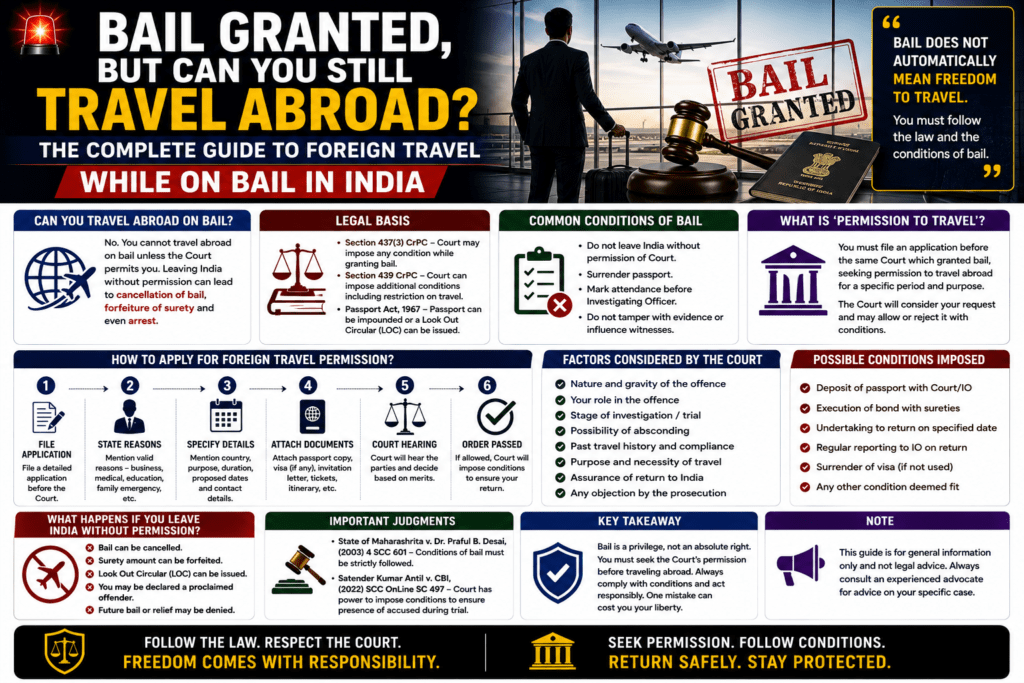
- 1. Is travelling abroad while on bail legally allowed?
- 1. Purpose of travel
- 2. Destination
- 3. Period of travel
- 4. Previous compliance with bail
- 5. Assurance of return
- A. Nature and seriousness of the offence
- B. Stage of the proceedings
- C. Conduct of the accused
- D. Risk of absconding
- E. Purpose of travel
- F. Duration
- G. Roots in India
- H. Cooperation with investigation and trial
- A. Maneka Gandhi v. Union of India
- B. Satwant Singh Sawhney v. D. Ramarathnam
- C. Suresh Nanda v. CBI
- D. Recent Supreme Court approach
- MYTH 1: “Once bail is granted, I can travel anywhere.”
- MYTH 2: “If I have a valid passport, nobody can stop me from travelling.”
- MYTH 3: “If my passport is renewed, I automatically have permission to travel.”
- MYTH 4: “The court will never allow an accused to travel abroad.”
- MYTH 5: “I can travel first and seek permission later.”
- MYTH 6: “A foreign job means the court has to permit me to leave India.”
- Yes—but do not assume that bail itself gives you unrestricted permission to leave India.
- Frequently Asked Questions — FAQs
- Can I travel abroad after getting bail in India?
- Can I travel abroad if my passport is with me?
- Can I get my passport renewed while my criminal case is pending?
- Can I travel abroad for work while on bail?
- Can I travel abroad for medical treatment while on bail?
- What happens if I travel abroad without permission?
- Can the court allow foreign travel for a limited period?
Can I travel abroad if I am on bail?
Can the court stop me from leaving India after granting bail?
Can I get my passport back while my criminal case is pending?
What if I need to travel abroad for work, business, medical treatment or family reasons?
These are common questions for a person facing criminal proceedings in India.
The short answer is:
Yes, a person on bail can seek permission to travel abroad. But bail by itself does not automatically give an accused an unrestricted right to leave India.
Whether you can travel depends primarily on the conditions of your bail order, the nature of the criminal case, the stage of proceedings and the reasons for which you want to travel.
The Supreme Court has recently reiterated an important distinction: holding or renewing a passport is different from having permission to travel abroad. The criminal court can regulate foreign travel through appropriate bail conditions.
1. Is travelling abroad while on bail legally allowed?
There is no blanket rule that every person on bail is prohibited from travelling abroad.
At the same time, there is also no automatic right to travel abroad merely because bail has been granted.
The first document you should examine is your bail order.
For example, a bail order may say:
- the accused shall not leave India without prior permission of the Court;
- the accused shall surrender his passport;
- the accused shall not leave the territorial jurisdiction without permission;
- the accused shall appear before the Investigating Officer as and when required;
- the accused shall furnish details of foreign travel;
- or the order may contain no specific restriction on foreign travel.
Therefore, the answer depends substantially upon the exact terms of the bail order.
2. Bail and permission to travel are two different things
This is one of the most important points.
A person may be:
On bail + holding a valid passport ≠ automatically entitled to travel abroad.
The Supreme Court has recently emphasised the distinction between possession of a passport and permission to travel abroad. A passport is a civil document; the question whether an accused facing criminal proceedings can actually leave India is primarily one for the competent criminal court.
Therefore, even if:
- your passport is valid;
- your visa is valid;
- you have been granted bail; and
- your employer requires you to travel,
you may still require prior permission of the criminal court if your bail order contains such a restriction.
3. Why do courts restrict foreign travel after granting bail?
The purpose is not to punish the accused.
The principal concern is to ensure that the accused remains available to face investigation and trial.
A criminal court may be concerned that an accused might:
- leave India and not return;
- become difficult to locate;
- avoid investigation;
- fail to appear before the court;
- influence witnesses from abroad;
- interfere with the investigation;
- or otherwise frustrate the criminal proceedings.
The Supreme Court has recognised that restrictions may be imposed to preserve the jurisdiction of the criminal court and to ensure the accused remains available when required.
But that does not mean that every accused must be permanently confined to India.
The restriction must serve a legitimate purpose and should not become an unnecessarily punitive condition.
4. Can the court release the passport but still prohibit foreign travel?
Yes.
This distinction is extremely important.
A court may permit an accused to:
retain or renew the passport
while simultaneously directing:
“The accused shall not travel abroad without prior permission of the Court.”
The two directions are not contradictory.
The Supreme Court has recently clarified that renewal or possession of a passport does not by itself authorise foreign travel where the criminal court has retained control over the accused’s travel.
Therefore:
Passport renewed → does not necessarily mean → permission to travel.
5. What if the bail order specifically says “shall not leave India”?
This is a serious restriction.
If your bail order states:
“The accused shall not leave the country without prior permission of the Court,”
you should not travel abroad without first obtaining permission.
Leaving India in violation of such a condition can create serious legal complications.
The appropriate course is to approach the same criminal court or the competent court having jurisdiction over the case and seek permission for foreign travel.
Do not assume that having a valid passport or visa overrides the bail condition.
6. What if the bail order does not mention foreign travel?
This situation requires careful examination of the complete bail order.
There may be no express prohibition against foreign travel.
However, the absence of an express condition should not be treated as an invitation to ignore the criminal proceedings.
The accused must continue complying with every other condition, including:
- appearing before the court;
- joining investigation;
- appearing before the Investigating Officer;
- not tampering with evidence;
- not influencing witnesses; and
- furnishing or updating required contact details.
If there is uncertainty, seeking clarification or permission from the court can avoid unnecessary complications.
7. How do you seek permission to travel abroad while on bail?
Usually, an accused can file an application for permission to travel abroad before the competent criminal court.
The application should clearly explain:
1. Purpose of travel
For example:
- employment;
- business;
- conference;
- education;
- medical treatment;
- family emergency;
- marriage;
- visiting family;
- professional assignment; or
- any other genuine reason.
2. Destination
The application should mention the country or countries proposed to be visited.
3. Period of travel
Specify:
- date of departure;
- date of return; and
- total duration.
A vague request such as “I want to travel abroad” is generally less persuasive than a specific and supported request.
4. Previous compliance with bail
This is extremely important.
The applicant should demonstrate that he has:
- appeared before the court whenever required;
- joined investigation;
- complied with previous directions;
- not misused the liberty of bail; and
- not attempted to evade the proceedings.
5. Assurance of return
The applicant can offer an undertaking that he will return to India within the permitted period and comply with the court’s directions.
8. What conditions can the court impose while permitting foreign travel?
The court may balance the accused’s liberty against the interests of the investigation and trial.
Depending upon the facts, the court may require:
- surrender of the passport after returning;
- furnishing a bond;
- providing the complete foreign address;
- furnishing contact details;
- specifying the travel itinerary;
- undertaking to return within a particular period;
- informing the Investigating Officer;
- appearance before the court after returning;
- or other safeguards considered appropriate.
The Supreme Court itself has passed orders permitting travel subject to disclosure of the destination, duration, purpose and contact details.
The conditions will depend upon the facts of each case.
9. What factors does the court consider before allowing foreign travel?
There is no single mechanical formula.
Courts generally examine the overall circumstances, including:
A. Nature and seriousness of the offence
A court may exercise greater caution in serious offences, particularly where there is a substantial risk of evasion.
B. Stage of the proceedings
The court may consider whether:
- investigation is pending;
- the charge-sheet has been filed;
- charges have been framed;
- evidence is being recorded; or
- the trial is nearing completion.
C. Conduct of the accused
Previous compliance with bail conditions is highly relevant.
D. Risk of absconding
The court may examine whether there is any genuine possibility that the accused will not return.
E. Purpose of travel
A genuine medical emergency may be treated differently from an unexplained request for a prolonged foreign stay.
F. Duration
A short and definite trip is generally easier to assess than an indefinite request.
G. Roots in India
Employment, family, business, property and other circumstances may be relevant to assessing whether the accused is likely to return.
H. Cooperation with investigation and trial
A person who has consistently complied with court directions is in a stronger position than someone who has repeatedly violated them.
10. Can an accused travel abroad for employment while on bail?
Yes, it can be permitted in an appropriate case.
Employment requirements can constitute a genuine ground for seeking permission.
For example, an accused may be required to:
- attend an overseas business meeting;
- join an international assignment;
- perform contractual work;
- attend a conference;
- travel for employment;
- or resume employment outside India.
But the accused must approach the court with complete details and a reasonable travel plan.
The existence of employment abroad does not automatically create an unrestricted right to leave India.
11. What if the accused needs to travel abroad for medical treatment?
This can be a particularly strong ground where supported by genuine medical documents.
The application should ideally contain:
- medical reports;
- doctor’s recommendation;
- details of the hospital;
- proposed treatment;
- expected duration;
- appointment documents; and
- travel details.
The court can then balance the medical requirement against the need to secure the accused’s presence in the proceedings.
12. What happens if you travel abroad without court permission?
This can be a serious mistake.
If the bail order specifically prohibits foreign travel without permission, violating that condition may expose the accused to proceedings concerning breach of bail conditions.
The prosecution may seek appropriate orders, including:
- cancellation or modification of bail;
- recall of permission;
- coercive steps for securing presence;
- or other consequences permitted by law.
The Supreme Court has recognised that violation of bail conditions can justify appropriate action by the concerned criminal court.
Therefore, the safest rule is:
If your bail order requires prior permission, obtain the permission before leaving India—not after reaching the airport.
13. What if the passport has been deposited in court?
This is a common bail condition.
If the passport has been deposited with the court, the accused cannot simply take it back and travel.
An application may be made seeking:
- release of the passport;
- permission to travel abroad;
- permission for a specified period; and
- direction regarding re-deposit of the passport after return.
The court may release the passport temporarily subject to conditions.
14. Can the Passport Office itself allow foreign travel?
This is where people frequently misunderstand the law.
The passport authority and the criminal court perform different functions.
A passport authority deals with the issuance, renewal and related statutory aspects of a passport.
The criminal court deals with the accused’s obligation to remain subject to the criminal proceedings.
The Supreme Court has recently reiterated that renewal of a passport and permission to travel abroad are distinct questions.
Therefore, even if your passport is renewed, you may still need the criminal court’s permission to actually travel.
15. What is the role of Article 21?
The right to travel abroad has been recognised as part of the broader protection of personal liberty under Article 21 of the Constitution.
However, Article 21 does not mean that the right is completely unrestricted.
The Supreme Court has repeatedly recognised that personal liberty can be regulated through a procedure that satisfies constitutional requirements.
In the context of a person facing criminal proceedings, the court therefore has to strike a balance between:
Individual liberty
and
the administration of criminal justice.
The Supreme Court has recently reiterated that individual liberty must be balanced against legitimate societal and judicial interests.
16. Important Supreme Court jurisprudence
The jurisprudence surrounding foreign travel and criminal proceedings has developed around several important principles.
A. Maneka Gandhi v. Union of India
The landmark judgment in Maneka Gandhi v. Union of India expanded the understanding of Article 21 and established that restrictions upon personal liberty must satisfy constitutional standards of fairness, reasonableness and non-arbitrariness.
The right to travel abroad is therefore not merely an administrative privilege.
B. Satwant Singh Sawhney v. D. Ramarathnam
The Supreme Court recognised the importance of the right to travel abroad and treated it as connected with the protection of personal liberty.
This case forms an important part of the constitutional foundation of the right to travel.
C. Suresh Nanda v. CBI
The Supreme Court examined the relationship between the Passports Act and criminal proceedings and explained the distinction between the powers concerning a passport and the powers of a criminal court.
The decision is particularly relevant where an accused has been directed to surrender a passport.
D. Recent Supreme Court approach
The more recent jurisprudence makes the position even clearer:
Possession or renewal of a passport and permission to travel abroad are separate questions.
The criminal court can retain control over foreign travel through appropriate bail conditions, even where the passport itself is permitted to be renewed.
17. Can the court impose a blanket prohibition on foreign travel?
The answer depends upon the circumstances and the precise legal basis for the restriction.
A bail condition should have a rational connection with the purpose for which bail is being regulated.
The object is ordinarily to secure:
- presence of the accused;
- cooperation with investigation;
- conduct of the trial;
- protection of witnesses; and
- administration of justice.
A restriction should not unnecessarily become a punishment imposed before conviction.
The constitutional principle of proportionality therefore becomes relevant.
18. What if the court has rejected permission to travel abroad?
A rejection is not necessarily the end of the matter.
Depending upon the circumstances, the accused may consider:
- filing a fresh application if circumstances have materially changed;
- placing additional documents before the court;
- explaining the urgency or necessity of travel;
- narrowing the requested period;
- offering additional safeguards; or
- challenging an legally unsustainable order before the appropriate superior court.
The remedy depends upon which court passed the order and the reasons for rejection.
19. Can a person on anticipatory bail travel abroad?
It depends upon the conditions of anticipatory bail.
Anticipatory bail does not create an automatic exemption from travel restrictions.
If the anticipatory bail order says:
“The applicant shall not leave India without prior permission of the Court,”
the applicant must obtain permission before travelling.
Even where the order does not expressly restrict travel, the applicant must continue complying with all other conditions.
20. What about cases under PMLA, NDPS, UAPA, Customs or other special laws?
The issue can become more sensitive in cases involving:
- Prevention of Money Laundering Act;
- Narcotic Drugs and Psychotropic Substances Act;
- Unlawful Activities (Prevention) Act;
- Customs Act;
- economic offences;
- serious organised crime allegations; or
- cases involving substantial foreign transactions.
In such matters, courts may examine the possibility of flight from justice, the nature of the allegations, the investigation and the accused’s connections outside India more closely.
But even in serious cases, the application has to be decided on the facts and circumstances of the individual case.
21. Myth vs Reality
MYTH 1: “Once bail is granted, I can travel anywhere.”
REALITY: Not necessarily. Bail and permission to travel abroad are separate issues.
MYTH 2: “If I have a valid passport, nobody can stop me from travelling.”
REALITY: A valid passport does not override a criminal court’s bail condition restricting foreign travel.
MYTH 3: “If my passport is renewed, I automatically have permission to travel.”
REALITY: No. Passport renewal and permission to travel are legally distinct.
MYTH 4: “The court will never allow an accused to travel abroad.”
REALITY: Courts can permit foreign travel subject to appropriate safeguards.
MYTH 5: “I can travel first and seek permission later.”
REALITY: If your bail order requires prior permission, this can amount to a violation of the bail condition.
MYTH 6: “A foreign job means the court has to permit me to leave India.”
REALITY: Employment can be a relevant ground, but permission remains discretionary and depends upon the circumstances.
22. Practical checklist before travelling abroad on bail
Before booking your international flight, check:
- Read the complete bail order.
- Check whether there is a restriction on leaving India.
- Check whether your passport has been deposited with the court.
- Check whether prior permission is required.
- Prepare the purpose of travel.
- Mention the exact destination.
- Mention departure and return dates.
- Provide foreign address and contact details.
- Explain why the travel is necessary.
- Attach supporting documents.
- Show your previous compliance with bail conditions.
- Offer an undertaking to return.
- Seek a specific order permitting travel.
- Do not leave India until the required permission has actually been obtained.
23. So, can you travel abroad while on bail?
Yes—but do not assume that bail itself gives you unrestricted permission to leave India.
The correct legal approach is to examine the bail order first.
If the order restricts foreign travel, file an appropriate application before the competent criminal court explaining:
where you want to go + why you want to go + how long you will stay + when you will return + why your presence in India will not be compromised.
The court may then permit travel subject to appropriate safeguards.
The modern legal position can therefore be summed up in one sentence:
Bail gives you liberty from custody; it does not necessarily give you an unrestricted liberty to leave the country.
At the same time, restrictions on foreign travel should serve a legitimate judicial purpose and should not become an unnecessary punishment before conviction. The Supreme Court’s recent jurisprudence reinforces the need to distinguish between passport possession and actual permission to travel, while preserving the criminal court’s power to regulate foreign travel where necessary.
Frequently Asked Questions — FAQs
Can I travel abroad after getting bail in India?
Yes, subject to the conditions of your bail order. If prior permission is required, you must obtain it before travelling.
Can I travel abroad if my passport is with me?
Not necessarily. A passport does not override a judicial restriction on foreign travel.
Can I get my passport renewed while my criminal case is pending?
Possibly. Pending criminal proceedings do not automatically mean that passport renewal must always be refused. Recent Supreme Court jurisprudence distinguishes passport renewal from permission to travel abroad.
Can I travel abroad for work while on bail?
You can seek permission from the competent court. Employment and business requirements may be relevant grounds.
Can I travel abroad for medical treatment while on bail?
Yes, an accused can seek permission, particularly where the medical necessity is supported by appropriate documents.
What happens if I travel abroad without permission?
If your bail order prohibits foreign travel without prior permission, doing so may constitute a breach of the bail conditions and may lead to appropriate proceedings.
Can the court allow foreign travel for a limited period?
Yes. Courts may grant permission for a specified period and impose conditions to ensure the accused returns and remains available for the proceedings.
Final Takeaway
Being on bail does not mean that you have lost all your fundamental freedoms. But it also does not mean that every restriction connected with the criminal proceedings disappears.
Foreign travel is therefore a question of balance.
The court must protect the integrity of the criminal process, while also recognising the accused’s personal liberty and genuine need to travel.
If you are on bail and need to travel abroad, the safest approach is simple:
Read the bail order → identify the travel restriction → file a proper application → disclose complete travel details → offer safeguards → obtain permission → travel only within the permission granted.