
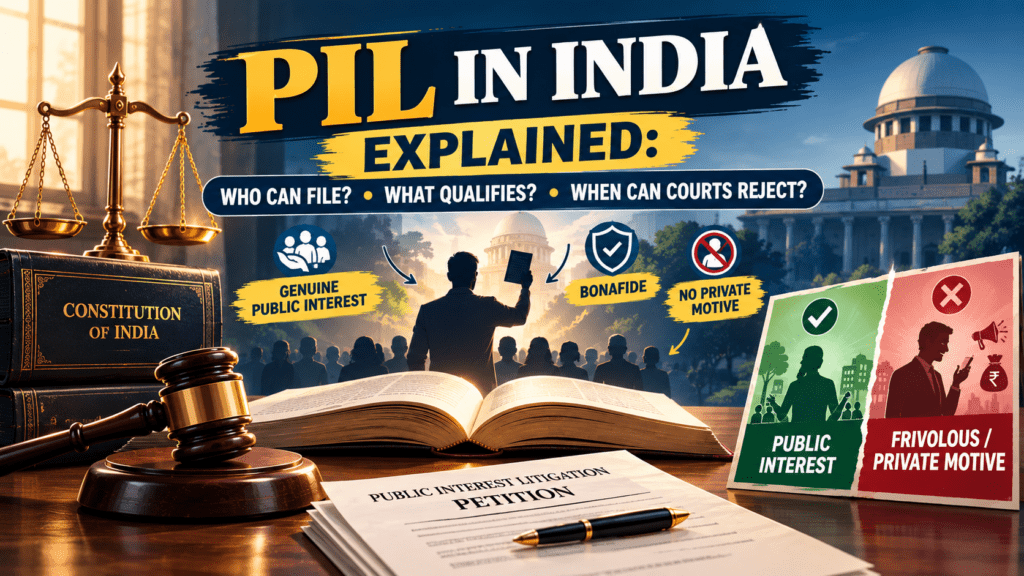
- Public Interest Litigation (PIL): The Complete Guide to Who Can File It, What It Is Used For, Its Limits, Misuse, Costs & Supreme Court Rules
- 1. Public-spirited individual
- 2. Group of persons
- 3. NGO or public-interest organisation
- 4. Association or body
- 5. Court itself
- No, not necessarily.
- No.
- 1. Environmental Protection
- 2. Rights of Children
- 3. Rights of Prisoners
- 4. Bonded Labour and Exploitation
- 5. Public Health
- 6. Public Administration
- 7. Illegal or Unauthorised Construction
- 8. Police Inaction
- 9. Fundamental Rights of Vulnerable Groups
- Yes.
- Generally, no.
- Supreme Court — Article 32
- High Courts — Article 226
- No.
- Yes.
- Yes, in appropriate circumstances.
- 1. Encourage genuine PILs
- 2. Verify the petitioner's credentials
- 3. Examine the correctness of the allegations
- 4. Ensure substantial public interest
- 5. Examine whether public harm is involved
- 6. Examine motive
- 7. Discourage busybodies
- No.
- Yes.
- No.
- A genuine public issue can obviously have political implications.
- Generally, PIL is not the appropriate remedy for individual service disputes.
- Sometimes, but with considerable caution.
- Yes.
- Private Interest
- Public Interest
- MYTH 1: Anyone can file a PIL about anything.
- MYTH 2: You must personally suffer the injury to file a PIL.
- MYTH 3: Every public problem can be converted into a PIL.
- MYTH 4: A PIL is the same as an ordinary writ petition.
- MYTH 5: PIL can be used to settle a personal dispute.
- MYTH 6: If the court dismisses a PIL, nothing happens to the petitioner.
- MYTH 7: A PIL automatically succeeds if the cause sounds socially important.
- MYTH 8: PIL means the court can run the government.
- REALITY
- 1. Protect a class of persons
- 2. Enforce a public duty
- 3. Protect the environment
- 4. Require systemic reforms
- 5. Establish legal principles
- 6. Require continuing compliance
- If dismissed by a High Court
- If dismissed by the Supreme Court
- 1. Is this genuinely a public issue?
- 2. Who has suffered the public injury?
- 3. What public duty has been violated?
- 4. What constitutional or statutory provision is involved?
- 5. Why can't ordinary individual litigation adequately address the problem?
- 6. What is my connection with the issue?
- 7. Do I have any personal, financial, political or business interest?
- 8. Have I disclosed that interest completely?
- 9. Have I approached the concerned authority where appropriate?
- 10. Do I have documentary material supporting the allegations?
- 11. Is the relief legally capable of being granted by the court?
- 12. Is there an alternative statutory remedy?
- 13. Is there another proceeding already pending on the same issue?
- 14. Am I asking the court to enforce law or asking it merely to adopt my preferred policy?
- 15. Can I honestly certify that the petition is being filed bona fide and in public interest?
- PUBLIC ISSUE
- LEGAL/CONSTITUTIONAL DUTY
- FAILURE OR VIOLATION
- PUBLIC INJURY
- DOCUMENTARY MATERIAL
- SPECIFIC RELIEF
- Genuine PIL → Encourage
- Frivolous PIL → Discourage
- Motivated PIL → Costs and other appropriate consequences
- Public injury → Judicial protection
- Private dispute disguised as PIL → Ordinary remedy
- 1. S.P. Gupta v. Union of India, 1981 Supp SCC 87
- 2. People's Union for Democratic Rights v. Union of India, (1982) 3 SCC 235
- 3. Bandhua Mukti Morcha v. Union of India, (1984) 3 SCC 161
- 4. Sheela Barse v. State of Maharashtra, (1983) 2 SCC 96
- 5. M.C. Mehta v. Union of India
- 6. Janata Dal v. H.S. Chowdhary, (1992) 4 SCC 305
- 7. Guruvayoor Devaswom Managing Committee v. C.K. Rajan, (2003) 7 SCC 546
- 8. Ashok Kumar Pandey v. State of West Bengal, (2004) 3 SCC 349
- 9. State of Uttaranchal v. Balwant Singh Chaufal, (2010) 3 SCC 402
- 10. State of Jharkhand v. Shiv Shankar Sharma
- “Am I approaching the court to protect a genuine public interest, or am I using public interest as a label for a private grievance?”
- What is PIL in India?
- Who can file a PIL?
- Can an NGO file a PIL?
- Can a common person file a PIL?
- Can a PIL be filed in the Supreme Court?
- Can a PIL be filed in the High Court?
- Can a PIL be filed against a government department?
- Can PIL be filed against a private company?
- Can PIL be filed for personal property disputes?
- Can a PIL be filed in service matters?
- Can a PIL be dismissed with costs?
- Can a PIL be filed anonymously?
- Can a newspaper report become the basis of PIL?
Public Interest Litigation (PIL): The Complete Guide to Who Can File It, What It Is Used For, Its Limits, Misuse, Costs & Supreme Court Rules
What if a person is suffering a legal wrong but cannot approach the court himself?
What if an entire community is affected by illegal government action?
What if pollution is damaging a river, children are being subjected to exploitation, prisoners are being denied basic rights, or a public authority is failing to perform a statutory duty?
Must every affected person individually approach the court?
Not necessarily.
This is where Public Interest Litigation, commonly known as PIL, becomes important.
PIL transformed the traditional concept of locus standi in Indian constitutional law. In appropriate cases, a person who is not personally affected may approach the court to protect a genuine public interest.
But PIL is not a licence to file any petition against anyone.
The Supreme Court has repeatedly warned that PIL is a powerful judicial tool which must be used carefully. Petitions filed for publicity, private gain, political motives, business rivalry or other oblique purposes can be dismissed, and courts may impose costs.
So, what exactly is a PIL?
Who can file it?
What matters can be brought through PIL?
Can a PIL be filed against a private person?
Can a PIL challenge government inaction?
What happens if a PIL is false or motivated?
Let’s understand everything in simple language.
What Is PIL?
PIL means Public Interest Litigation.
It is a form of constitutional litigation through which a person or organisation may approach a constitutional court for the protection or enforcement of a public right, public duty or public interest, even where the petitioner is not personally the direct victim of the alleged violation.
The traditional rule of litigation was based on locus standi.
In simple words:
The person whose legal right was violated should normally approach the court.
PIL relaxed this traditional rule in appropriate cases.
The Supreme Court itself explains that a writ petition may be moved not only by an aggrieved individual but also by a public-spirited individual or group where the interest of the public at large is involved. The Supreme Court has also historically treated letters, postcards and other communications as writ petitions in appropriate public-interest situations.
Therefore, PIL is essentially a mechanism through which public interest can be brought before constitutional courts even when the person approaching the court is not the direct victim.
What Does “Public Interest” Actually Mean?
This is the most important question.
Public interest does not simply mean that the petitioner is interested in the subject.
A matter may be interesting to the public without being a genuine public-interest matter.
Public interest ordinarily concerns an issue affecting:
- the public at large;
- a substantial section of society;
- disadvantaged or vulnerable groups;
- public rights;
- public duties;
- constitutional rights;
- environmental protection;
- public administration; or
- the lawful functioning of public authorities.
The Supreme Court in Janata Dal v. H.S. Chowdhary, (1992) 4 SCC 305, explained the distinction between private litigation and public-interest litigation and recognised the relaxed rule of locus standi for bona fide persons acting for redressal of public injury.
Who Can File a PIL in India?
There is a common misconception:
“Only the person who has suffered the injury can file the case.”
That is generally the rule in ordinary private litigation.
But PIL operates differently.
A PIL may be initiated by a:
1. Public-spirited individual
A person genuinely concerned with a public issue may approach the court.
2. Group of persons
A group or organisation may approach the court where the issue involves a genuine public cause.
3. NGO or public-interest organisation
An organisation working on a genuine public issue may, depending upon the circumstances, institute a PIL.
4. Association or body
An association may approach the court where the issue affects a sufficiently identifiable public interest.
5. Court itself
In appropriate circumstances, constitutional courts have also taken cognisance of matters involving public injury through letters, communications, reports or other material.
The Supreme Court expressly recognises that PIL has relaxed the traditional requirement of personal injury and that a public-spirited individual or group can invoke writ jurisdiction where public interest is genuinely involved.
Does the PIL Petitioner Have to Be Personally Affected?
No, not necessarily.
That is one of the defining features of PIL.
For example:
Suppose a large number of children are being subjected to an unlawful practice.
A public-spirited person may approach the court even though the petitioner is not personally one of those children.
Similarly, an environmental organisation may challenge serious environmental degradation affecting a community.
The purpose is not to provide a private remedy to the petitioner.
The purpose is to bring a public wrong before the court.
But Does Anyone Have Automatic Locus Standi to File a PIL?
No.
The relaxation of locus standi does not mean that every person automatically becomes entitled to invoke PIL jurisdiction.
The court may examine:
- the petitioner’s credentials;
- the petitioner’s connection with the subject;
- whether the petitioner is acting bona fide;
- whether the information supplied is reliable;
- whether substantial public interest is involved;
- whether there is a personal or private motive;
- whether the litigation is politically motivated;
- whether the petition is intended to gain publicity; and
- whether the petition is being used to settle a private dispute.
In State of Uttaranchal v. Balwant Singh Chaufal, (2010) 3 SCC 402, the Supreme Court issued important safeguards to protect PIL from misuse. It directed courts to examine the petitioner’s credentials, the correctness of the allegations, the existence of substantial public interest and the possibility of personal, private or oblique motives.
What Kind of Matters Can Be Filed as PIL?
PIL is generally appropriate where the issue involves a genuine public wrong or public interest.
Some common areas include:
1. Environmental Protection
Examples:
- pollution;
- destruction of forests;
- unlawful mining;
- contamination of rivers;
- ecological damage;
- environmental violations.
2. Rights of Children
Examples:
- child labour;
- exploitation of children;
- abuse or neglect;
- failure of authorities to protect children.
3. Rights of Prisoners
Examples:
- custodial violence;
- inhuman prison conditions;
- unlawful detention;
- denial of basic rights;
- custodial deaths.
4. Bonded Labour and Exploitation
PIL has historically played an important role in protecting vulnerable and economically disadvantaged persons.
5. Public Health
Where governmental inaction creates a substantial public-health issue, PIL may be maintainable depending upon the facts.
6. Public Administration
A PIL may address serious failures by public authorities where the issue affects the public and involves enforceable legal or constitutional duties.
7. Illegal or Unauthorised Construction
Where the issue involves substantial public consequences, environmental concerns, planning violations or systemic administrative failure, PIL jurisdiction may potentially be invoked.
8. Police Inaction
Where allegations concern systemic or serious public injury and failure of statutory/public duties, constitutional courts may entertain appropriate proceedings.
9. Fundamental Rights of Vulnerable Groups
PIL has historically been used to advance constitutional rights of persons who are unable to effectively approach the courts themselves.
The Supreme Court’s own case classification recognises PIL categories across areas including environmental matters, child labour, prisoners, unauthorised constructions, essential amenities, social justice and other matters of public importance.
Can a PIL Be Filed Against the Government?
Yes.
Government action and government inaction are both capable of being challenged through constitutional proceedings where the requirements of PIL jurisdiction are satisfied.
For example, a PIL may challenge:
- failure to perform a statutory duty;
- unlawful government policy;
- environmental inaction;
- failure to protect constitutional rights;
- systemic administrative failure;
- arbitrary exercise of public power; or
- failure of a public authority to comply with law.
However, the petitioner must still establish a genuine public-interest issue.
Simply disagreeing with a government decision does not automatically convert a dispute into a PIL.
Can a PIL Be Filed Against a Private Person or Company?
This requires caution.
PIL is principally concerned with public rights, public duties and matters having a genuine public dimension.
A purely private dispute between:
- two individuals;
- two companies;
- landlord and tenant;
- business competitors; or
- private contractual parties
does not ordinarily become a PIL merely because the petitioner describes it as being in the “public interest.”
Where a dispute is essentially private, the ordinary legal remedy is generally the appropriate route.
Can a PIL Be Filed for a Personal Grievance?
Generally, no.
Suppose a person says:
“My property has been illegally demolished.”
That may be a genuine grievance.
But if the dispute concerns only that person’s individual property, the appropriate proceeding may ordinarily be a civil suit or individual writ petition, depending upon the circumstances.
It does not automatically become a PIL merely because the petitioner describes the demolition as illegal.
However, if the same facts reveal a systemic public issue affecting a large class of persons or a wider statutory/public duty, the legal character of the proceeding may be different.
The court looks at the substance of the litigation, not merely the label placed on the petition.
What Is the Difference Between a PIL and an Ordinary Writ Petition?
| Ordinary Writ Petition | PIL |
|---|---|
| Usually filed by an aggrieved person | May be filed by a public-spirited person/group |
| Personal legal right commonly involved | Public right/public injury/public duty involved |
| Traditional locus standi | Relaxed locus standi |
| Remedy generally concerns petitioner | Remedy may benefit a wider class |
| Facts generally concern individual grievance | Facts concern public/systemic issue |
| Private interest may be central | Public interest must be genuine |
The distinction is not merely about the title of the petition.
A petition does not become a PIL simply because the words “Public Interest Litigation” appear on its first page.
PIL Under Article 32 and Article 226
PIL is principally exercised through the constitutional writ jurisdiction of the:
Supreme Court — Article 32
Article 32 enables enforcement of fundamental rights before the Supreme Court.
High Courts — Article 226
Article 226 gives High Courts a wider writ jurisdiction, extending not only to fundamental rights but also, subject to the constitutional framework, to other legal rights.
Therefore, depending upon the nature and territorial connection of the matter, a PIL may be instituted before the appropriate High Court or the Supreme Court.
The Supreme Court officially recognises PIL as part of its writ jurisdiction and explains that public-spirited individuals or groups may invoke that jurisdiction where public interest is involved.
Is PIL a Separate Statute?
No.
There is no single central “Public Interest Litigation Act” creating PIL as an independent statutory remedy.
PIL developed primarily through constitutional judicial practice and the relaxation of traditional locus standi.
Its principal constitutional foundations include:
- Article 32;
- Article 226;
- fundamental rights;
- constitutional duties and principles;
- statutory/public duties; and
- judicial review.
Therefore, PIL is better understood as a form of constitutional litigation, rather than an ordinary statutory cause of action.
How Did PIL Develop in India?
The development of PIL is closely connected with the expansion of access to justice.
Traditional litigation assumed that:
The person whose right was violated must approach the court.
But this approach created a problem.
What about people who:
- were poor;
- were illiterate;
- were imprisoned;
- were socially marginalised;
- lacked access to lawyers; or
- were otherwise unable to approach the court?
The Supreme Court gradually relaxed the traditional rules of locus standi and procedure.
Important decisions in the development of Indian PIL jurisprudence include:
- S.P. Gupta v. Union of India, 1981 Supp SCC 87
- People’s Union for Democratic Rights v. Union of India, (1982) 3 SCC 235
- Bandhua Mukti Morcha v. Union of India, (1984) 3 SCC 161
- Sheela Barse v. State of Maharashtra, (1983) 2 SCC 96
- M.C. Mehta v. Union of India
- Rural Litigation and Entitlement Kendra v. State of U.P.
These cases demonstrate how PIL developed into a mechanism for addressing issues affecting vulnerable groups, environmental protection, labour rights and constitutional governance.
Bandhua Mukti Morcha: PIL and Vulnerable Persons
Bandhua Mukti Morcha v. Union of India, (1984) 3 SCC 161 is one of the landmark decisions in the development of Indian PIL.
The case concerned bonded labour and the constitutional rights of persons who were unable to effectively approach the court themselves.
The case demonstrated that constitutional courts could respond to violations affecting vulnerable persons even when the directly affected individuals were not themselves before the court in the traditional sense.
This was one of the major steps in transforming access to constitutional justice.
M.C. Mehta: PIL and Environmental Protection
The M.C. Mehta line of cases became one of the most important chapters in Indian environmental jurisprudence.
Environmental PILs have addressed issues involving:
- industrial pollution;
- river pollution;
- hazardous industries;
- air pollution;
- ecological protection;
- public health; and
- environmental accountability.
These cases demonstrate that PIL can be used not merely to resolve an individual dispute but to address a continuing public wrong requiring structural or regulatory directions.
Can PIL Result in Continuing Directions?
Yes.
Some PILs involve a continuing public problem rather than a single event.
In such cases, courts may issue directions requiring:
- compliance reports;
- monitoring;
- implementation by government authorities;
- periodic status reports;
- constitution of committees;
- institutional reforms; or
- continued compliance with judicial directions.
This is one reason PIL can sometimes continue for years.
The court may retain oversight where necessary to ensure that its directions are implemented.
However, courts must also remain conscious of the limits of judicial power and the institutional roles of the legislature and executive.
What Is the Role of the Petitioner in a PIL?
The PIL petitioner is not supposed to behave like a private claimant seeking personal compensation or advantage.
The petitioner is expected to assist the court in identifying and presenting a genuine public issue.
This means the petitioner should:
- disclose relevant facts;
- present accurate information;
- disclose personal interest;
- disclose relevant litigation;
- avoid exaggeration;
- provide supporting documents;
- identify the public injury;
- identify the public authority/duty involved; and
- suggest legally workable relief.
The Supreme Court’s PIL procedures require disclosure of important information concerning the petitioner’s identity, occupation, income, personal interest, other litigation and the nature of the public injury alleged.
Can a PIL Be Filed on the Basis of Newspaper Reports?
Yes, in appropriate circumstances.
Indian PIL jurisprudence has historically permitted courts to take cognisance of public-interest issues based upon:
- letters;
- newspaper reports;
- communications;
- reports; and
- other material.
The Supreme Court itself notes that it has, on several occasions, treated letters, telegrams, postcards and news reports as writ petitions in appropriate public-interest matters.
But this does not mean that every newspaper article automatically becomes evidence sufficient to establish a PIL.
The court may require:
- verification;
- affidavits;
- official records;
- independent material; and
- responses from concerned authorities.
Can a PIL Be Filed Without First Approaching the Government?
This depends upon the nature of the issue and the applicable High Court/Supreme Court procedure.
In many public-interest matters, it is prudent to first make a representation to the competent authority, particularly where:
- the authority has statutory power to act;
- the issue concerns administrative inaction;
- the grievance can potentially be resolved administratively; or
- the court would benefit from the authority’s response.
A representation also helps create a factual record.
However, the absence of a prior representation does not create a universal rule that every PIL is automatically non-maintainable.
The urgency, nature of the violation, statutory framework and applicable court rules must be examined.
What Are the Supreme Court’s PIL Guidelines?
In State of Uttaranchal v. Balwant Singh Chaufal, the Supreme Court issued important directions to protect the PIL jurisdiction from misuse.
Among other things, courts were directed to:
1. Encourage genuine PILs
Genuine and bona fide public-interest litigation should be encouraged.
2. Verify the petitioner’s credentials
The court should prima facie examine who is approaching it.
3. Examine the correctness of the allegations
The court should be satisfied, at the threshold, about the prima facie correctness of the contents.
4. Ensure substantial public interest
The petition must involve genuine substantial public interest.
5. Examine whether public harm is involved
The proceeding should seek redressal of genuine public harm or public injury.
6. Examine motive
The court should ensure that there is no personal gain, private motive or oblique motive.
7. Discourage busybodies
Petitions filed for extraneous or ulterior purposes may be dismissed and may attract exemplary costs.
The Supreme Court continues to publish formal PIL Guidelines on its official website.
What Is PIL Misuse?
PIL misuse occurs when a petition is presented as being in the public interest but is actually filed for an ulterior or private purpose.
Examples may include filing a PIL to:
- settle a personal dispute;
- settle a business rivalry;
- obtain publicity;
- advance a political objective;
- harass a rival;
- obstruct a lawful project for private reasons;
- obtain a commercial advantage;
- interfere with another person’s legitimate rights; or
- use the court process for an ulterior purpose.
The Supreme Court has repeatedly expressed serious concern about such misuse.
In State of Uttaranchal v. Balwant Singh Chaufal, the Court specifically directed courts to discourage petitions filed for personal gain, private motive or oblique purposes.
PIL Filed for Publicity — Is It Allowed?
No.
Publicity cannot convert a private interest into a public interest.
In Ashok Kumar Pandey v. State of West Bengal, (2004) 3 SCC 349, the Supreme Court cautioned that PIL is a powerful weapon which must be used with great care and circumspection.
The Court stressed that the judiciary must ensure that private malice, vested interest or publicity does not hide behind the façade of public interest.
What Happens to a Frivolous PIL?
A frivolous or motivated PIL can be:
- dismissed at the threshold;
- dismissed with costs;
- subjected to adverse judicial observations;
- treated as an abuse of process; and
- in appropriate cases, followed by other procedural consequences.
The Supreme Court has repeatedly imposed costs in cases where PIL jurisdiction was found to have been misused.
For example, in a 2022 decision, the Supreme Court dismissed frivolous PIL proceedings with ₹1 lakh costs in each appeal, observing that such litigation consumes valuable judicial time and can obstruct genuine public causes.
Can a Court Impose Exemplary Costs in a PIL?
Yes.
This is an important safeguard.
The Supreme Court has specifically recognised the use of exemplary costs to discourage frivolous and motivated PILs.
The rationale is straightforward:
If someone deliberately abuses the extraordinary jurisdiction of constitutional courts, the consequences should not be limited to simply losing the case.
Otherwise, a litigant could repeatedly file baseless proceedings without meaningful consequences.
Can PIL Be Used to Settle Business Rivalries?
No.
This is one of the clearest forms of PIL abuse.
If Company A files a so-called PIL against Company B but the real objective is to damage Company B’s commercial interests, the petition may be treated as a private-interest litigation disguised as a PIL.
The Supreme Court has expressly warned against PIL being used by business or political rivals to settle scores.
Can PIL Be Used to Achieve a Political Objective?
A genuine public issue can obviously have political implications.
But there is an important distinction between:
a genuine public-law challenge
and
using PIL jurisdiction as a political weapon.
The Supreme Court has repeatedly cautioned that courts should not permit their process to be used for political objectives or extraneous purposes.
Are Service Matters Maintainable as PIL?
Generally, PIL is not the appropriate remedy for individual service disputes.
The Supreme Court has repeatedly cautioned against PILs concerning service matters.
A person challenging:
- his termination;
- promotion;
- seniority;
- appointment;
- transfer;
- salary; or
- disciplinary action
ordinarily has to pursue the appropriate individual legal remedy.
A person cannot ordinarily convert a personal service grievance into a PIL simply by describing it as a matter of public interest.
Can a PIL Be Filed Against a Judicial Order?
PIL cannot ordinarily be used as a substitute for an appeal or other remedy available against a judicial order.
A person aggrieved by a judicial order generally has to pursue the legally prescribed remedy.
A PIL is not a shortcut around:
- appeal;
- review;
- revision;
- statutory remedies; or
- other procedural avenues.
Can PIL Be Filed in Criminal Matters?
Sometimes, but with considerable caution.
PIL may be appropriate where the issue concerns a genuine public wrong or systemic failure.
Examples may include:
- systemic custodial abuse;
- rights of prisoners;
- systemic failure affecting vulnerable victims;
- serious public injury;
- failure of public authorities to discharge constitutional/statutory duties.
But PIL should not ordinarily be used to settle a private criminal dispute or interfere with criminal proceedings merely because one party describes the matter as a public cause.
The Supreme Court has cautioned against using PIL to interfere with individual criminal proceedings without a genuine public-interest basis.
What Relief Can a Court Grant in a PIL?
The relief depends upon the nature of the public wrong.
A constitutional court may, depending upon the case, issue:
- writs;
- directions;
- mandamus;
- guidelines;
- orders requiring statutory authorities to perform their duties;
- environmental directions;
- compensation in appropriate constitutional cases;
- investigation-related directions in appropriate circumstances;
- institutional or systemic directions;
- monitoring directions;
- compliance directions; or
- other appropriate relief within constitutional jurisdiction.
The relief must, however, remain connected with the legal and factual foundation of the PIL.
A PIL is not a licence for a court to administer every aspect of government.
Can a PIL Seek a Policy Change?
This requires careful distinction.
Courts can examine whether government action or policy:
- violates the Constitution;
- violates statutory law;
- is arbitrary;
- is discriminatory;
- violates fundamental rights; or
- suffers from another recognised public-law defect.
But courts ordinarily do not substitute their own policy preferences for those of the elected branches merely because another policy appears preferable.
The judicial role is generally one of constitutional and legal review, not ordinary policy-making.
Can a PIL Be Filed Against Government Inaction?
Yes.
In fact, government inaction is a common subject of public-law litigation.
For example, where a statutory authority:
- fails to enforce environmental laws;
- fails to protect vulnerable persons;
- fails to implement statutory safeguards;
- fails to discharge a public duty; or
- allows a continuing public wrong despite having statutory powers,
a PIL may, depending upon the facts, seek appropriate directions.
The key is to establish:
public injury + legal/public duty + failure to act + appropriate relief.
What Is Locus Standi in PIL?
Locus standi means the legal standing or entitlement of a person to approach a court.
Traditional litigation follows a stricter rule.
PIL relaxed this requirement.
A public-spirited person may approach the court where:
- the issue concerns public injury;
- the affected persons may be unable to approach the court;
- the petitioner is acting bona fide; and
- the litigation is genuinely in the public interest.
But relaxed locus standi does not mean no scrutiny of the petitioner.
The Supreme Court has specifically recognised the importance of examining the petitioner’s credentials and bona fides in PIL proceedings.
What Is the Difference Between Public Interest and Private Interest?
Private Interest
A dispute primarily concerning the petitioner’s own:
- property;
- employment;
- contract;
- money;
- business;
- personal rights.
Public Interest
A dispute concerning:
- public rights;
- public injury;
- constitutional rights of a class;
- public duties;
- environmental protection;
- systemic administrative failure; or
- vulnerable sections of society.
The distinction is not always black and white.
A case may begin with an individual grievance but reveal a wider public issue.
The court examines the substance and effect of the litigation.
MYTH VS REALITY
MYTH 1: Anyone can file a PIL about anything.
REALITY
No.
The petitioner must demonstrate a genuine public-interest basis. Courts scrutinise credentials, bona fides, public injury and the possibility of private or oblique motives.
MYTH 2: You must personally suffer the injury to file a PIL.
REALITY
No.
PIL relaxes traditional locus standi and allows a bona fide public-spirited person or organisation to approach the court in appropriate public-interest matters.
MYTH 3: Every public problem can be converted into a PIL.
REALITY
No.
The issue must fall within the court’s constitutional jurisdiction and involve a genuine legal/public injury capable of judicial redress.
MYTH 4: A PIL is the same as an ordinary writ petition.
REALITY
Both may invoke constitutional writ jurisdiction, but PIL involves a relaxed approach to standing because the litigation is directed towards a public wrong or public interest rather than merely the petitioner’s individual grievance.
MYTH 5: PIL can be used to settle a personal dispute.
REALITY
No.
Using PIL to settle personal, business or political disputes can amount to abuse of the court’s process.
MYTH 6: If the court dismisses a PIL, nothing happens to the petitioner.
REALITY
A frivolous or motivated PIL may attract costs, including exemplary costs, particularly where the court finds abuse of its process.
MYTH 7: A PIL automatically succeeds if the cause sounds socially important.
REALITY
No.
The petitioner still has to establish a legally cognisable public wrong, supported by credible material and an appropriate legal basis for the relief sought.
MYTH 8: PIL means the court can run the government.
REALITY
No.
Courts can enforce constitutional and statutory duties, but judicial review is different from ordinary policy-making or administration.
What Are the Legal Consequences of a Successful PIL?
A successful PIL can have consequences far beyond the individual petitioner.
The court may:
1. Protect a class of persons
The benefit may extend to people who were not individually before the court.
2. Enforce a public duty
A government authority may be directed to perform a statutory or constitutional obligation.
3. Protect the environment
Directions may affect industries, government departments and the public.
4. Require systemic reforms
The court may issue directions designed to correct continuing institutional failures.
5. Establish legal principles
A PIL judgment may clarify the constitutional or statutory rights of a larger class.
6. Require continuing compliance
In appropriate cases, the court may monitor implementation.
This is why PIL can have consequences much broader than ordinary private litigation.
What Happens If a PIL Is Dismissed?
A PIL may be dismissed because:
- no public interest is established;
- the petitioner lacks bona fides;
- the issue is essentially private;
- an alternative remedy is appropriate;
- the allegations are unsupported;
- the petition is premature;
- the matter involves disputed facts unsuitable for PIL;
- the petition seeks policy choices beyond judicial review;
- the petition is motivated; or
- the relief sought is legally impermissible.
The court may dismiss the petition with or without costs depending upon the circumstances.
What Is the Remedy Against Dismissal of a PIL?
The remedy depends upon the court that passed the order.
If dismissed by a High Court
Depending upon the circumstances, the petitioner may consider:
- review before the same High Court;
- appeal where legally available; or
- Special Leave Petition under Article 136 before the Supreme Court.
If dismissed by the Supreme Court
The applicable remedies may include:
- review petition;
- curative petition in the exceptional circumstances recognised by law.
However, the remedy depends entirely upon the nature of the order and the applicable procedural law.
Can the Respondent Challenge a Frivolous PIL?
Yes.
A respondent may place before the court:
- evidence showing absence of public interest;
- the petitioner’s personal interest;
- prior litigation;
- political/business connections, where relevant;
- suppression of material facts;
- inaccurate documents;
- contradictory statements;
- lack of locus;
- availability of an alternative remedy; and
- evidence demonstrating that the petition is motivated.
The objective should be to demonstrate why the proceeding is not genuinely public-interest litigation.
What If the PIL Petitioner Suppresses Material Facts?
This can be extremely serious.
A person approaching a constitutional court claiming to represent the public is expected to make full and candid disclosure of material facts.
Suppression of:
- previous proceedings;
- personal interest;
- relevant documents;
- connected litigation;
- adverse orders; or
- material relationships
can seriously affect the court’s assessment of the petitioner’s bona fides.
The Supreme Court has repeatedly emphasised the importance of bona fides in PIL proceedings.
A Practical Checklist Before Filing a PIL
Before filing a PIL, ask:
1. Is this genuinely a public issue?
2. Who has suffered the public injury?
3. What public duty has been violated?
4. What constitutional or statutory provision is involved?
5. Why can’t ordinary individual litigation adequately address the problem?
6. What is my connection with the issue?
7. Do I have any personal, financial, political or business interest?
8. Have I disclosed that interest completely?
9. Have I approached the concerned authority where appropriate?
10. Do I have documentary material supporting the allegations?
11. Is the relief legally capable of being granted by the court?
12. Is there an alternative statutory remedy?
13. Is there another proceeding already pending on the same issue?
14. Am I asking the court to enforce law or asking it merely to adopt my preferred policy?
15. Can I honestly certify that the petition is being filed bona fide and in public interest?
If these questions cannot be answered satisfactorily, filing a PIL requires serious reconsideration.
What Makes a Strong PIL?
A good PIL should not merely contain allegations.
It should establish a clear chain:
PUBLIC ISSUE
↓
LEGAL/CONSTITUTIONAL DUTY
↓
FAILURE OR VIOLATION
↓
PUBLIC INJURY
↓
DOCUMENTARY MATERIAL
↓
SPECIFIC RELIEF
This structure makes the petition easier for the court to understand.
What Should the Prayer in a PIL Contain?
The prayer should be:
- specific;
- legally permissible;
- connected with the pleadings;
- capable of implementation;
- proportionate to the public wrong; and
- within the court’s jurisdiction.
For example, instead of merely asking:
“Pass appropriate orders in the public interest.”
a properly framed PIL should ordinarily identify the actual relief sought.
Depending upon the issue, the petitioner may seek:
- mandamus;
- directions to perform a statutory duty;
- constitution of a committee;
- investigation;
- implementation of statutory safeguards;
- enforcement of environmental standards;
- protection of vulnerable persons;
- formulation of guidelines where legally appropriate; or
- other constitutionally permissible directions.
PIL Is a Powerful Remedy — But It Is Also a Serious Responsibility
The Supreme Court has described PIL as an important instrument for preserving the rule of law, accountability and transparency in governance.
At the same time, the Court has warned that PIL can be misused by persons pursuing publicity, private interests, business rivalries or political objectives.
This creates an important balance:
Genuine PIL → Encourage
Frivolous PIL → Discourage
Motivated PIL → Costs and other appropriate consequences
Public injury → Judicial protection
Private dispute disguised as PIL → Ordinary remedy
That balance protects both access to justice and the credibility of the judicial process.
Important Supreme Court Cases on PIL
1. S.P. Gupta v. Union of India, 1981 Supp SCC 87
One of the foundational decisions in the development of relaxed locus standi and public-interest litigation in India.
2. People’s Union for Democratic Rights v. Union of India, (1982) 3 SCC 235
An important PIL concerning labour rights and enforcement of constitutional protections.
3. Bandhua Mukti Morcha v. Union of India, (1984) 3 SCC 161
A landmark case concerning bonded labour and the rights of vulnerable persons.
4. Sheela Barse v. State of Maharashtra, (1983) 2 SCC 96
Important PIL jurisprudence concerning prisoners and vulnerable persons in custody.
5. M.C. Mehta v. Union of India
The M.C. Mehta cases are central to Indian environmental PIL jurisprudence and the development of constitutional environmental remedies.
6. Janata Dal v. H.S. Chowdhary, (1992) 4 SCC 305
An important authority explaining the nature of PIL, relaxed locus standi and the requirement of bona fide public interest.
7. Guruvayoor Devaswom Managing Committee v. C.K. Rajan, (2003) 7 SCC 546
The Supreme Court cautioned that PIL jurisdiction should not be used where the statutory framework and ordinary remedies govern the dispute, and emphasised the need for genuine public-interest circumstances.
8. Ashok Kumar Pandey v. State of West Bengal, (2004) 3 SCC 349
A leading authority on preventing frivolous and publicity-oriented PILs and ensuring that the PIL mechanism is used carefully.
9. State of Uttaranchal v. Balwant Singh Chaufal, (2010) 3 SCC 402
One of the most important authorities on PIL guidelines and prevention of misuse.
The Supreme Court directed courts to scrutinise credentials, correctness, substantial public interest and possible personal or oblique motives.
10. State of Jharkhand v. Shiv Shankar Sharma
The Supreme Court has continued to reiterate that PIL is an extraordinary jurisdiction which cannot be permitted to become a vehicle for private disputes, political rivalry or other ulterior objectives.
Final Takeaway: PIL Is for Public Interest — Not Personal Interest Disguised as Public Interest
Public Interest Litigation is one of the most significant developments in Indian constitutional law.
It has enabled courts to address issues involving:
- environmental protection;
- bonded labour;
- prisoners;
- children;
- vulnerable communities;
- public administration;
- constitutional rights; and
- systemic failures of public authorities.
But the very flexibility that makes PIL powerful also creates the possibility of abuse.
That is why the Supreme Court has repeatedly emphasised that genuine PIL must be encouraged, while frivolous, motivated and privately driven PIL must be discouraged.
The simplest way to understand PIL is:
PIL is not litigation merely because the petitioner says it is in the public interest. It is litigation where a genuine public wrong, public injury, public duty or constitutional concern is brought before the court by a bona fide person or organisation.
And the most important question before filing a PIL should therefore be:
“Am I approaching the court to protect a genuine public interest, or am I using public interest as a label for a private grievance?”
That distinction can determine whether a petition becomes a meaningful constitutional proceeding—or an abuse of the extraordinary jurisdiction of the court.
Frequently Asked Questions About PIL
What is PIL in India?
PIL means Public Interest Litigation. It is a form of constitutional litigation through which a public-spirited person or organisation may approach a constitutional court concerning a genuine public wrong, public injury, public duty or constitutional issue.
Who can file a PIL?
A bona fide public-spirited individual, group, association or organisation may file a PIL where genuine public interest is involved. Personal aggrievement is not always necessary.
Can an NGO file a PIL?
Yes, an NGO or organisation may file a PIL where it genuinely represents a public cause and satisfies the applicable procedural and judicial requirements.
Can a common person file a PIL?
Yes. A person does not have to be a famous social activist or organisation. What matters is the genuineness of the public interest, the petitioner’s bona fides and compliance with the applicable procedure.
Can a PIL be filed in the Supreme Court?
Yes, appropriate PIL matters may be brought before the Supreme Court under its constitutional jurisdiction, particularly under Article 32 where fundamental rights are involved.
Can a PIL be filed in the High Court?
Yes. High Courts exercise broad writ jurisdiction under Article 226 and may entertain PILs concerning appropriate public-interest issues within their jurisdiction.
Can a PIL be filed against a government department?
Yes, where there is a genuine public-law issue involving governmental action or inaction and an appropriate constitutional remedy is available.
Can PIL be filed against a private company?
A purely private dispute is generally not suitable for PIL. A private entity may, however, become involved in a PIL where the matter has a genuine public-law dimension and falls within the court’s jurisdiction.
Can PIL be filed for personal property disputes?
Ordinarily, a purely personal property dispute should be pursued through the appropriate individual civil or writ remedy rather than being converted into a PIL.
Can a PIL be filed in service matters?
Generally, PIL is not the appropriate remedy for individual service disputes such as transfer, promotion, termination or seniority.
Can a PIL be dismissed with costs?
Yes. Courts may impose costs, including exemplary costs, where a PIL is found to be frivolous, motivated or an abuse of judicial process.
Can a PIL be filed anonymously?
Ordinarily, constitutional courts require disclosure of the petitioner’s identity and relevant particulars. PIL procedures are designed to permit scrutiny of the petitioner’s credentials and bona fides.
Can a newspaper report become the basis of PIL?
In appropriate circumstances, yes. Indian PIL jurisprudence has recognised that courts may take cognisance of public-interest issues from newspaper reports and other communications, although the court may require verification and supporting material.
Disclaimer: This article is intended for general legal awareness and educational purposes. The maintainability of a PIL depends upon the facts, nature of the public injury, applicable constitutional provisions, court rules, alternative remedies and the circumstances of the particular case. It should not be treated as case-specific legal advice.