
- 1. Who is an Executive Magistrate?
- 2. Who is a Judicial Magistrate?
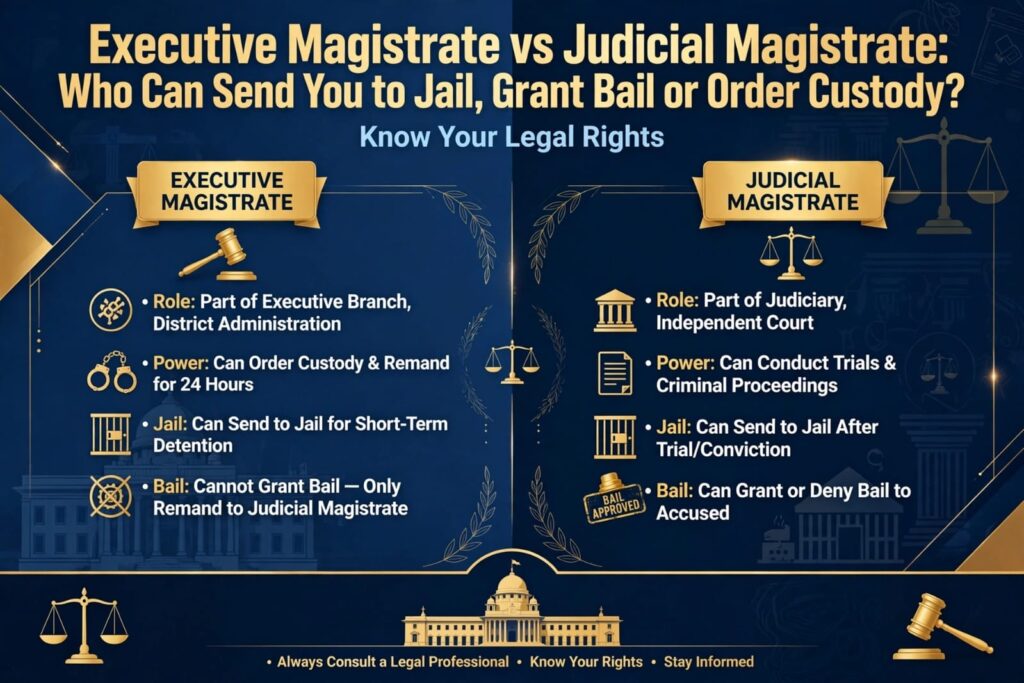
- 3. Executive Magistrate vs Judicial Magistrate: Key differences
- 4. Can an Executive Magistrate send a person to jail?
- 5. Can a Judicial Magistrate grant bail and order police custody?
- 6. Can an Executive Magistrate issue a Section 163 BNSS order?
- 7. What happens if an Executive Magistrate acts beyond their powers?
- 8. What legal remedies are available?
- 9. Important Supreme Court judgments and jurisprudence
- 10. Myth vs Reality: Executive Magistrate and Judicial Magistrate
- 11. Frequently Asked Questions
- What is the main difference between an Executive Magistrate and a Judicial Magistrate?
- Who appoints an Executive Magistrate?
- Who appoints a Judicial Magistrate?
- Can an Executive Magistrate grant regular bail?
- Can an Executive Magistrate order judicial custody?
- Can an Executive Magistrate issue prohibitory orders during a protest?
- Can an Executive Magistrate's order be challenged in the High Court?
- Does an Executive Magistrate have judicial powers at all?
- 12. Conclusion: The title “Magistrate” does not mean unlimited power
Can an Executive Magistrate send you to jail? Can a Judicial Magistrate cancel your liberty? Who has the power to grant bail, order police custody or pass a prohibitory order during a protest?
The word Magistrate appears frequently in police notices, court orders and criminal proceedings. However, not every Magistrate has the same powers. An Executive Magistrate and a Judicial Magistrate perform different legal functions, follow different administrative structures and exercise authority under different provisions of the Bharatiya Nagarik Suraksha Sanhita, 2023 (BNSS).
This distinction becomes particularly important when a person is detained during a protest, asked to furnish a peace bond, produced before a Magistrate after arrest, or told that they are being sent to custody.
The short answer: A Judicial Magistrate ordinarily exercises judicial powers in criminal cases, including remand and bail within their jurisdiction. An Executive Magistrate primarily exercises executive and preventive powers, including certain orders concerning public peace. The BNSS also provides a narrow exception under which an appropriately empowered Executive Magistrate may authorise detention for up to seven days in aggregate when a Judicial Magistrate is unavailable and the statutory conditions are met.
This article explains the difference between an Executive Magistrate and a Judicial Magistrate, their powers under the BNSS, the consequences of exceeding those powers, important Supreme Court judgments and the legal remedies available to an affected person.
1. Who is an Executive Magistrate?
An Executive Magistrate is an officer appointed under the statutory framework to exercise specified executive and preventive powers.
Under Section 14 of the BNSS, the State Government may appoint Executive Magistrates in a district and must appoint one of them as the District Magistrate. An Executive Magistrate may also be appointed as an Additional District Magistrate, and the State Government may place an Executive Magistrate in charge of a subdivision as a Sub-Divisional Magistrate (SDM).
Section 15 provides for the appointment of Special Executive Magistrates for specified areas or purposes.
Depending on the State’s administrative structure, these offices may include:
- District Magistrate (DM).
- Additional District Magistrate (ADM).
- Sub-Divisional Magistrate (SDM).
- Other duly appointed Executive Magistrates.
- Special Executive Magistrates appointed under Section 15 BNSS.
The precise powers of an officer depend on the statute, appointment and powers conferred. A designation such as SDM or Special Executive Magistrate does not, by itself, confer unlimited authority to arrest, remand or imprison a person.
What does an Executive Magistrate do?
An Executive Magistrate’s principal responsibilities concern administration, public peace and prevention of certain anticipated unlawful conduct.
Depending on the applicable provision, an Executive Magistrate may:
- Initiate proceedings requiring a person to show cause why they should not furnish security for keeping the peace.
- Pass specified preventive orders concerning public nuisance or apprehended danger.
- Take action in certain disputes involving land or water that may lead to a breach of peace.
- Exercise specified powers concerning public order and the prevention of offences.
- Exercise the exceptional detention power under Section 187(6) BNSS if the statutory conditions are satisfied.
For example, if the authorities receive information suggesting that a particular situation may lead to a breach of peace, an Executive Magistrate may be able to initiate preventive proceedings. However, the action must be authorised by law and must follow the procedure prescribed by the relevant provision.
2. Who is a Judicial Magistrate?
A Judicial Magistrate is an officer exercising judicial powers within the criminal justice system.
Under Section 9 of the BNSS, Courts of Judicial Magistrates of the First Class and Second Class are established in districts. Their presiding officers are appointed by the High Court. Section 10 provides for the appointment of a Chief Judicial Magistrate (CJM) and, where appropriate, an Additional Chief Judicial Magistrate.
Judicial Magistrates exercise powers within their statutory jurisdiction. Depending on the court and the relevant law, these functions may include taking cognizance of offences, conducting criminal proceedings, deciding bail applications, authorising custody during investigation and trying offences.
What does a Judicial Magistrate do?
A Judicial Magistrate may, within the limits of their jurisdiction and the applicable law:
- Consider requests for police or judicial custody under Section 187 BNSS.
- Decide bail applications under the applicable provisions.
- Take cognizance of offences where legally authorised.
- Conduct criminal trials within the court’s competence.
- Examine the legality of particular procedural steps placed before the court.
- Pass judicial orders in criminal proceedings.
A Judicial Magistrate must independently apply the law to the material placed before the court. The police cannot demand custody as a matter of right, and the Magistrate cannot treat a remand request as a mere administrative formality.
The Judicial Magistrate’s role is therefore central to judicial oversight of criminal investigation and the deprivation of personal liberty.
3. Executive Magistrate vs Judicial Magistrate: Key differences
The following comparison explains the practical distinction.
| Point | Executive Magistrate | Judicial Magistrate |
|---|---|---|
| Main function | Executive administration and preventive action | Judicial proceedings in criminal cases |
| Governing provisions | Principally Sections 14–15 and other applicable BNSS provisions | Principally Sections 9–13 and other applicable BNSS provisions |
| Appointment structure | State Government appoints Executive Magistrates | Presiding officers of Judicial Magistrate courts are appointed by the High Court |
| Administrative role | May perform executive functions, depending on office and powers conferred | Functions within the judicial hierarchy |
| Criminal trials | Does not ordinarily conduct criminal trials in the capacity of a Judicial Magistrate | Conducts trials within the court’s jurisdiction |
| Police custody and remand | No general power to authorise ordinary criminal remand; limited exception under Section 187(6) | May authorise custody under Section 187, subject to jurisdiction and statutory requirements |
| Bail | Does not exercise the general bail jurisdiction of a Judicial Magistrate merely by being an Executive Magistrate | May decide bail within the jurisdiction conferred by law |
| Peace-bond proceedings | Exercises preventive powers where the relevant provision authorises it | Exercises only those preventive or bond-related powers expressly conferred by law |
| Urgent prohibitory orders | Specified Executive Magistrates may act under Section 163 BNSS | Does not exercise Section 163 powers merely by virtue of being a Judicial Magistrate |
| Primary legal purpose | Preventive and executive functions | Adjudication and judicial supervision of criminal proceedings |
The distinction is not that an Executive Magistrate has no legal authority or that a Judicial Magistrate can do everything. Each authority must remain within its jurisdiction and the specific powers granted by law.
4. Can an Executive Magistrate send a person to jail?
This is one of the most important questions, and the answer requires a distinction between ordinary criminal remand and detention arising from preventive proceedings.
A. Ordinary criminal remand
When a person is arrested in a criminal case, Section 187 BNSS governs the authorisation of further custody where the investigation cannot be completed within the prescribed initial period.
Ordinarily, the police must produce the arrested person before a competent Magistrate and seek the necessary authorisation. The Magistrate must consider the request according to law.
An Executive Magistrate does not ordinarily have the same general remand jurisdiction as a competent Judicial Magistrate.
B. The limited exception under Section 187(6) BNSS
Section 187(6) provides an exceptional arrangement for a situation where a Judicial Magistrate is unavailable.
Where the statutory requirements are met, an appropriately empowered Executive Magistrate may authorise detention for no more than seven days in aggregate. The provision requires reasons to be recorded in writing and contains safeguards concerning the transmission of records to the nearest Judicial Magistrate and the expiry of the authorised period.
This is not a general authority to order indefinite detention or to exercise every power of a Judicial Magistrate.
The legality of detention under this subsection depends on whether the Executive Magistrate was duly empowered, whether a Judicial Magistrate was unavailable, whether the prescribed material was transmitted, whether reasons were recorded and whether the time limit was observed.
C. Detention following preventive proceedings
A different situation arises where an Executive Magistrate initiates proceedings requiring security for keeping the peace or good behaviour.
Sections 126 onwards of the BNSS govern specified preventive proceedings. In the circumstances provided by law, failure to furnish security pursuant to a lawful order may result in detention or imprisonment.
Such detention must not be confused with ordinary judicial remand during a criminal investigation. The legal basis, purpose and procedural requirements are different.
Therefore, if someone is told that an Executive Magistrate has “sent them to jail”, the first question should be: Under which section, and by what written order?
5. Can a Judicial Magistrate grant bail and order police custody?
Yes, within the court’s jurisdiction and subject to the governing law.
Section 187 BNSS deals with remand during investigation. The Magistrate must examine whether the legal conditions for custody are met and must exercise independent judicial judgment.
Bail is governed by the relevant provisions of the BNSS, including Sections 478–483, depending on the nature of the offence and the court approached. Special statutes may impose additional restrictions.
A Judicial Magistrate cannot grant relief that falls outside their jurisdiction, nor can the Magistrate disregard a statutory restriction on bail. Similarly, the fact that police custody is sought does not mean it must automatically be granted.
The court must act in accordance with the law applicable to the case.
6. Can an Executive Magistrate issue a Section 163 BNSS order?
Yes, where the statutory conditions are satisfied and the officer is authorised to exercise the power.
Section 163 BNSS empowers a District Magistrate, Sub-Divisional Magistrate or another Executive Magistrate specially empowered by the State Government to issue certain urgent written orders in cases of nuisance or apprehended danger.
These orders may direct a person to abstain from a particular act or to take certain action concerning property where the statutory requirements are met.
Section 163 broadly corresponds to the former Section 144 of the Code of Criminal Procedure, 1973.
However, Section 163 is not an unlimited power to prohibit any activity merely because an authority considers it inconvenient. The order must be supported by the statutory conditions and comply with the procedure and duration limits prescribed by law.
A Judicial Magistrate does not acquire Section 163 powers simply by holding judicial office. The relevant power is conferred on the specified executive authorities.
7. What happens if an Executive Magistrate acts beyond their powers?
If an Executive Magistrate acts without jurisdiction or fails to comply with mandatory legal requirements, the order may be open to challenge.
The legal consequences depend on the provision invoked, the nature of the defect and the relief sought.
Examples of potentially challengeable action include:
- Authorising ordinary criminal remand without the required statutory authority.
- Exceeding the limits of the exceptional detention power under Section 187(6).
- Passing a preventive order without satisfying the applicable statutory conditions.
- Failing to follow a mandatory inquiry or hearing procedure.
- Imposing a restriction that is unsupported by the material or disproportionate to the statutory purpose.
- Continuing detention beyond the period lawfully authorised.
- Using a preventive provision as a substitute for the procedure applicable to a criminal prosecution.
A defect does not automatically mean that every subsequent proceeding is void. The legal effect must be determined by the competent court in light of the relevant law and facts.
The same principle applies to Judicial Magistrates: judicial office does not permit a court to exceed its jurisdiction or disregard statutory safeguards.
8. What legal remedies are available?
The appropriate remedy depends on whether the issue concerns a criminal remand order, a peace-bond proceeding, an urgent prohibitory order or unlawful detention.
A. Obtain the written order and supporting record
The first step is to identify the legal basis for the action. Obtain the notice, order, police report, arrest memo, bond proceedings and custody authorisation, as applicable.
Do not rely solely on an oral explanation that a person has been “sent to custody”.
B. Challenge an unlawful detention
Where detention is alleged to be without lawful authority, a writ of habeas corpus may be considered before the competent High Court under Article 226 of the Constitution. The Supreme Court has jurisdiction under Article 32 in relation to enforcement of fundamental rights.
The appropriate forum and relief depend on the circumstances and the legal basis of the detention.
C. Challenge a preventive order
Where the issue concerns a peace-bond proceeding or a prohibitory order under Section 163 BNSS, the available statutory remedies and the possibility of approaching the High Court should be assessed in light of the particular provision and order.
Section 163 contains mechanisms for rescinding or altering certain orders and for approaching the State Government or the competent court in the circumstances specified by the provision.
D. Seek bail in a criminal case
If a separate criminal case exists, a bail application may be filed before the competent court under the applicable provisions of the BNSS or special statute.
A challenge to preventive action does not necessarily dispose of a separate criminal case. Each proceeding must be examined independently.
E. Preserve evidence and act promptly
Keep copies of all orders and notices, record the dates and times of arrest and production, preserve available CCTV footage or videos, and identify witnesses.
Where detention is continuing, urgent legal advice is important. Filing a representation or petition does not automatically suspend an order; interim relief may need to be sought expressly.
9. Important Supreme Court judgments and jurisprudence
A. Madhu Limaye v. Sub-Divisional Magistrate, Monghyr
Citation: (1970) 3 SCC 746; AIR 1971 SC 2486.
This Supreme Court decision is a leading authority on preventive powers under the former Code of Criminal Procedure, including proceedings intended to prevent breaches of peace.
The Court recognised that preventive powers serve a legitimate purpose, but emphasised that the statutory procedure and safeguards must be followed. In discussing interim security and detention pending an inquiry, the judgment underscored the importance of a proper inquiry and recorded reasons.
The case also recognised that preventive orders can be challenged before superior courts where the authority has acted outside the law.
Why it matters: Preventive powers are not a blank cheque. Their exercise must remain within the statutory framework and be open to legal scrutiny. <Cite refs={[“turn728082search0″,”turn720114search4”]} />
B. Babulal Parate v. State of Maharashtra
Citation: AIR 1961 SC 884; (1961) 3 SCR 423.
The Supreme Court considered the constitutional validity of Section 144 of the former CrPC, which authorised urgent preventive orders in specified circumstances.
The decision is relevant to the principle that preventive restrictions can be lawful, but must be exercised within the scope of the power conferred by the statute.
Why it matters: The existence of preventive authority does not eliminate the need to examine whether the particular order was legally justified.
C. D.K. Basu v. State of West Bengal
Citation: (1997) 1 SCC 416.
The Supreme Court laid down important safeguards concerning arrest and detention.
The judgment is relevant when examining whether the authorities complied with the applicable legal protections during arrest and custody. It does not make every arrest unlawful; rather, it reinforces the importance of lawful procedure and accountability.
D. Maneka Gandhi v. Union of India
Citation: (1978) 1 SCC 248.
The Supreme Court explained the constitutional significance of Article 21 and the requirement that a procedure affecting personal liberty meet constitutional standards.
Why it matters: Executive and judicial orders affecting liberty must be assessed against the Constitution as well as the statute under which the action is taken.
E. Arnesh Kumar v. State of Bihar
Citation: (2014) 8 SCC 273.
The Supreme Court emphasised that arrest should not be made mechanically and that statutory safeguards governing arrest must be followed.
Although the judgment arose under the former CrPC, its principles remain relevant when considering corresponding arrest safeguards under the BNSS.
Important note: These judgments provide principles concerning preventive powers, arrest, detention and personal liberty. Their application to a particular BNSS provision must be assessed carefully, including any changes in statutory wording.
10. Myth vs Reality: Executive Magistrate and Judicial Magistrate
Myth 1: Both Magistrates have the same powers.
Reality: Their powers and functions differ. Executive Magistrates exercise executive and preventive powers, while Judicial Magistrates exercise judicial powers within the criminal justice system.
Myth 2: An Executive Magistrate can never send anyone to jail.
Reality: That is too broad. Section 187(6) BNSS provides a limited detention power when a Judicial Magistrate is unavailable and statutory conditions are satisfied. Separate preventive provisions may also provide for detention or imprisonment in specified circumstances.
Myth 3: A Judicial Magistrate must grant police custody whenever the police request it.
Reality: No. The court must independently examine the request and comply with the applicable law.
Myth 4: An Executive Magistrate can issue any order in the name of public order.
Reality: The officer must have the relevant statutory authority and satisfy the conditions of the provision invoked.
Myth 5: A peace-bond proceeding means the person has been convicted of a crime.
Reality: Preventive proceedings are distinct from a criminal conviction. Their purpose is to prevent specified future conduct, subject to the procedure prescribed by law.
Myth 6: Orders passed by an Executive Magistrate cannot be challenged in court.
Reality: Depending on the nature of the order and the applicable provision, statutory remedies and constitutional remedies may be available.
Myth 7: A Judicial Magistrate can exercise every power of a Sessions Judge or High Court.
Reality: Judicial powers are also limited by jurisdiction, statute and the applicable procedural framework.
11. Frequently Asked Questions
What is the main difference between an Executive Magistrate and a Judicial Magistrate?
An Executive Magistrate primarily exercises executive and preventive powers, while a Judicial Magistrate exercises judicial powers in criminal proceedings within the court’s jurisdiction.
Who appoints an Executive Magistrate?
Under Section 14 BNSS, the State Government appoints Executive Magistrates and appoints one as the District Magistrate. Section 15 provides for Special Executive Magistrates.
Who appoints a Judicial Magistrate?
Under Section 9 BNSS, the presiding officers of Courts of Judicial Magistrates are appointed by the High Court. Section 10 provides for the appointment of a Chief Judicial Magistrate.
Can an Executive Magistrate grant regular bail?
An Executive Magistrate does not possess the general bail jurisdiction of a Judicial Magistrate merely by virtue of being an Executive Magistrate. Bail must be sought before a court or authority empowered under the applicable law.
Can an Executive Magistrate order judicial custody?
An Executive Magistrate does not ordinarily have the general power to order criminal remand. Section 187(6) BNSS provides a limited exception, subject to the statutory conditions and a maximum of seven days in aggregate.
Can an Executive Magistrate issue prohibitory orders during a protest?
A duly empowered Executive Magistrate may issue an order under Section 163 BNSS where the statutory conditions are met. Such an order must comply with the law and may be challenged through the appropriate remedies.
Can an Executive Magistrate’s order be challenged in the High Court?
Depending on the order and circumstances, a person may seek appropriate relief before the High Court, including constitutional relief where the requirements are met. The correct remedy should be determined from the actual order and governing provision.
Does an Executive Magistrate have judicial powers at all?
An Executive Magistrate may perform functions requiring application of legal standards and compliance with procedural safeguards under particular provisions. That does not make the officer equivalent to a Judicial Magistrate for all purposes.
12. Conclusion: The title “Magistrate” does not mean unlimited power
The distinction between an Executive Magistrate and a Judicial Magistrate is fundamental to understanding criminal procedure in India.
An Executive Magistrate principally exercises executive and preventive powers. A Judicial Magistrate exercises judicial powers in criminal cases, including remand and bail within the jurisdiction conferred by law.
The BNSS recognises limited exceptions and assigns particular powers to particular authorities. That is why the legality of an order cannot be determined merely by looking at the officer’s title.
Whenever a person is detained, directed to furnish a peace bond, placed in custody or subjected to a prohibitory order, the essential questions are:
- Which statutory provision was invoked?
- Did the authority possess the relevant power?
- Were the legal conditions satisfied?
- Was the prescribed procedure followed?
- Is the order consistent with constitutional protections?
The law gives Magistrates important powers, but those powers are not interchangeable. The legality of each action depends on jurisdiction, procedure and the safeguards protecting personal liberty.
Disclaimer: This article is for general legal information and educational purposes. It is not a substitute for advice based on the actual order, notice or case record. The applicable BNSS provisions and relevant judgments should be verified before taking legal action.