
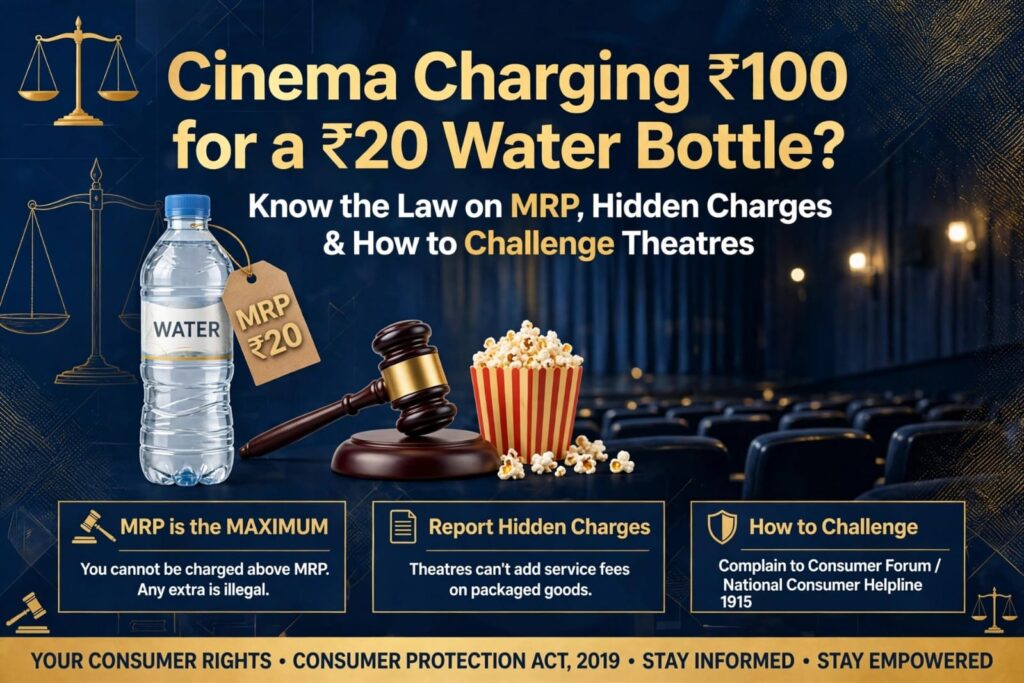
- 1. What Is MRP, and Why Does It Matter?
- 2. Can Cinema Theatres Charge More Than MRP?
- 3. What Does the Supreme Court Say About Cinema-Hall Pricing?
- 4. What Laws Can You Rely Upon to Challenge Overcharging?
- 5. What Can You Do If a Cinema Charges Above MRP?
- 6. Can You Claim Compensation?
- 7. What Are the Legal Consequences of Unlawful Overcharging?
- 8. Myth vs Reality: Cinema Food Prices and MRP
- 9. Frequently Asked Questions
- Can a cinema charge ₹50 for a water bottle whose MRP is ₹20?
- Can I complain against PVR, INOX, or another cinema chain for overcharging?
- Can a cinema charge ₹300 for popcorn?
- Must cinema halls provide free drinking water?
- Where should I complain if a cinema charges more than MRP?
- Can I claim compensation as well as a refund?
- Conclusion: Is Overcharging at Cinema Halls Legal?
Paying ₹250 for popcorn or ₹100 for a bottle of water at a cinema? Is it illegal to charge more than MRP, or can a theatre set its own prices?
You book a movie ticket, enter the cinema, and decide to buy a bottle of water or some popcorn. Then you notice that the price is substantially higher than what you would pay at a neighbourhood shop.
A bottle of water that costs ₹20 outside may be sold for ₹60 or ₹100 inside the cinema. Popcorn and other snacks can also cost several times their usual retail price.
This raises an important legal question: Can a cinema theatre charge more than the Maximum Retail Price (MRP) printed on a packaged product? If it can, why? If it cannot, how can a consumer challenge the practice?
The answer requires a careful reading of the Legal Metrology Act, 2009, the Legal Metrology (Packaged Commodities) Rules, 2011, the Consumer Protection Act, 2019, and Supreme Court decisions concerning cinema halls and the sale of food and beverages.
The law distinguishes between a packaged commodity sold as an ordinary retail product and a transaction that forms part of a service. The distinction can affect whether the MRP restriction applies.
This article explains the legal position, the important judgments, where to complain, and the remedies available to consumers.
1. What Is MRP, and Why Does It Matter?
MRP means Maximum Retail Price. It is the maximum retail sale price declared for a packaged commodity under the applicable legal metrology framework, inclusive of taxes.
For example, suppose a sealed bottle of water bears an MRP of ₹20.
- If it is sold for ₹20, the price does not exceed the declared MRP.
- If it is sold for ₹15, the seller has charged less than MRP.
- If it is sold for ₹30, the transaction raises a question about whether the sale is legally permitted above MRP.
The MRP declaration is not merely a suggested price. For an ordinary retail sale of a packaged commodity governed by the Legal Metrology (Packaged Commodities) Rules, 2011, Rule 18(2) prohibits a retail dealer or other covered person from selling the packaged commodity above its retail sale price.
However, the legal position can be different where a product is supplied as part of a service transaction. That distinction has been considered by the Supreme Court in cases concerning hotels and restaurants, and it must not be ignored when analysing cinema-hall pricing.
2. Can Cinema Theatres Charge More Than MRP?
There is no safe, universally applicable answer that treats every item sold inside a cinema as an ordinary retail sale—or automatically exempts every cinema sale from MRP rules.
The legal analysis depends on the nature of the transaction, the product, the applicable statutory framework, and relevant judicial decisions.
Situation A: A Sealed Packaged Product Sold as an Ordinary Retail Item
Suppose a theatre sells a sealed bottle of water bearing an MRP of ₹20 for ₹50.
If the transaction is an ordinary retail sale of a packaged commodity covered by Rule 18(2), selling it above MRP would ordinarily be prohibited.
The relevant evidence includes the bottle’s label, the invoice, the price charged, and the nature of the transaction.
However, cinema operators may rely on judicial decisions concerning goods sold as part of a service. Consequently, a complaint involving a cinema cannot always be resolved simply by quoting Rule 18(2) without examining the applicable precedent.
Situation B: Food and Beverages Supplied as Part of a Service
The Supreme Court has recognised that certain transactions in hotels and restaurants may form part of a composite service rather than an ordinary retail sale of packaged goods.
This issue was examined in Federation of Hotel and Restaurant Associations of India v. Union of India, Civil Appeals Nos. 21790–21791 of 2017, decided on 12 December 2017.
The Court held that the Legal Metrology legislation in question did not prohibit hotels and restaurants from charging above MRP for packaged mineral water supplied in the circumstances before it.
However, the judgment concerned the hotel and restaurant context. Its application to a particular cinema-hall transaction must be considered carefully rather than assumed automatically.
Situation C: Food and Beverages Sold Inside a Cinema Hall
In K.C. Cinema v. State of Jammu and Kashmir, the Supreme Court considered the rights of cinema owners to regulate food and beverage sales inside their premises.
The Court recognised that cinema operators may determine their commercial model, including the sale of food and beverages and the price points at which those goods and services are offered, subject to applicable law.
The Court also held that cinema operators must provide hygienic drinking water without charge. It did not, however, expressly decide every question concerning the application of MRP rules to every packaged product sold inside a cinema.
The practical takeaway: A theatre’s commercial freedom to set prices does not, by itself, answer every statutory MRP question. Equally, the ordinary retail rule should not be applied to a cinema transaction without examining the relevant Supreme Court decisions and the precise facts.
3. What Does the Supreme Court Say About Cinema-Hall Pricing?
K.C. Cinema v. State of Jammu and Kashmir
Citation: 2023 SCC OnLine SC 22
Decision date: 3 January 2023
The dispute arose from a public interest challenge to the practice of cinema halls prohibiting moviegoers from bringing food and beverages from outside.
The Supreme Court set aside the Jammu and Kashmir High Court’s directions that had prevented cinema operators from imposing such restrictions.
The Court recognised that a cinema hall is private property and that its owner may determine the conditions of entry, subject to applicable law and public interest, safety, and welfare requirements.
The judgment also addressed the commercial logic of selling food and beverages inside cinema halls. It recognised the operator’s ability to determine its business model and the price points at which goods and services are offered.
At the same time, the Court recorded the importance of providing hygienic drinking water free of charge. It also requested cinema operators to consider requests from people with chronic illnesses or dietary restrictions on a case-by-case basis.
Why this judgment matters: It confirms that cinema operators have commercial freedom in operating their premises. But it should not be inaccurately cited as a categorical ruling that every packaged product may always be sold above its printed MRP, irrespective of the applicable legal metrology provisions.
Read the judgment: K.C. Cinema v. State of Jammu and Kashmir.
Federation of Hotel and Restaurant Associations of India v. Union of India
Decision date: 12 December 2017
In this case, the Supreme Court examined whether the Legal Metrology legislation prohibited hotels and restaurants from charging more than MRP for packaged mineral water supplied during services rendered to their customers.
The Court held that the legislation in question did not prohibit such pricing in the circumstances before it.
This decision is important because it demonstrates that the legal character of a transaction can matter. A transaction involving a packaged product is not necessarily treated identically in every commercial setting.
However, the decision arose from the hotel and restaurant context. Whether a particular sale inside a cinema falls within a comparable legal analysis must be assessed on its own facts and the applicable law.
Read the judgment: Federation of Hotel and Restaurant Associations of India v. Union of India.
Big Cinemas v. Manoj Kumar
Forum: National Consumer Disputes Redressal Commission
Revision Petition No.: 2038 of 2015
Decision date: 1 February 2016
The dispute concerned a bottle of Aquafina water purchased at Big Cinemas in Jaipur. The complainant alleged that the bottle’s MRP was ₹16, but the cinema charged ₹30.
The consumer fora had directed the cinema operators to refund the excess ₹14, pay ₹5,000 as compensation, and pay ₹1,500 in litigation costs. The matter reached the National Consumer Disputes Redressal Commission.
The Commission rejected the operators’ unsupported claim that a different MRP applied to bottles sold inside the cinema and criticised the failure to substantiate their defence with adequate evidence.
The Commission’s order is a significant consumer-law decision concerning overcharging at a cinema. However, it predates the Supreme Court’s December 2017 decision in the hotel and restaurant MRP dispute.
Accordingly, it should be read alongside the later Supreme Court jurisprudence, rather than presented as a universal answer for every cinema-hall sale today.
Read the order: Big Cinemas v. Manoj Kumar.
4. What Laws Can You Rely Upon to Challenge Overcharging?
Depending on the transaction, the following legal provisions may be relevant.
A. Legal Metrology Act, 2009
Section 18 deals with declarations on pre-packaged commodities and requires compliance with the prescribed declaration requirements.
The Act, read with the applicable rules, regulates the sale of packaged commodities and their declared retail sale prices.
Official text: Legal Metrology Act, 2009.
B. Rule 18(2) of the Legal Metrology (Packaged Commodities) Rules, 2011
Rule 18(2) states that a retail dealer or other covered person cannot sell a packaged commodity above its retail sale price.
This is the starting point when a consumer alleges that a sealed packaged product has been sold above MRP.
However, the applicability of the rule must be examined alongside relevant judicial decisions concerning transactions that form part of services.
Official text: Legal Metrology (Packaged Commodities) Rules, 2011.
C. Consumer Protection Act, 2019
The Consumer Protection Act may provide an additional route where the conduct amounts to deficiency in service or an unfair trade practice.
Depending on the evidence, a consumer may seek appropriate relief before the Consumer Commission, including compensation for legally recognised loss or injury and other relief permitted by law.
The fact that a price is high does not automatically establish an unfair trade practice. The relevant conduct, representations, legal requirements, and circumstances must be examined.
5. What Can You Do If a Cinema Charges Above MRP?
If you believe that a cinema has unlawfully overcharged you, take the following steps.
Step 1: Preserve the Product and Bill
Keep the product packaging and the receipt.
The receipt should identify the item, the price charged, the date, and the seller wherever possible. A photograph of the MRP declaration can also be useful.
Step 2: Ask the Theatre to Explain the Price
Make a written request to the manager or customer-support team asking why the amount charged exceeds the printed MRP.
Ask the theatre to identify the legal basis on which it claims to be entitled to charge that amount.
Keep a copy of the response. Do not rely solely on a verbal conversation.
Step 3: Complain to the Legal Metrology Department Where Appropriate
If the transaction appears to be an ordinary retail sale of a packaged commodity governed by Rule 18(2), you may submit a complaint to the appropriate State or Union Territory Legal Metrology authority.
Include the product label, bill, photographs, and details of the outlet.
The authority can examine whether the relevant legal metrology provisions apply and whether a violation has occurred.
Step 4: Approach the National Consumer Helpline
You may register a grievance through the National Consumer Helpline at consumerhelpline.gov.in or call 1915.
The Helpline can facilitate grievance resolution, but it does not guarantee compensation and is not a substitute for a binding order from a Consumer Commission.
Step 5: File a Consumer Complaint if Legally Justified
If the grievance remains unresolved, you may consider filing a consumer complaint before the appropriate Consumer Commission.
The complaint should explain:
- What product you purchased.
- What MRP was printed on the package.
- How much you paid.
- Why the transaction is alleged to violate the applicable law.
- What evidence supports the allegation.
- What relief you seek.
A complaint based on the exact transaction and relevant legal provisions is stronger than a general assertion that cinema food is expensive.
6. Can You Claim Compensation?
Potentially, yes, where the facts establish a legally actionable wrong and the requirements for the particular remedy are satisfied.
Depending on the case, you may seek:
- Refund of the amount charged in excess, where legally recoverable.
- Compensation for proven loss or injury.
- Litigation costs.
- Other appropriate relief available under the applicable law.
In Big Cinemas v. Manoj Kumar, the consumer fora had directed a refund of the alleged excess ₹14, along with ₹5,000 compensation and ₹1,500 litigation costs.
That award is an example from a specific case. It is not a guaranteed compensation amount for every consumer who disputes a cinema-hall price.
If you seek compensation, explain the basis of your claim and preserve the evidence supporting it.
7. What Are the Legal Consequences of Unlawful Overcharging?
The consequences depend on which law applies and what the authority or court finds.
Where a sale violates the applicable Legal Metrology provisions, the responsible person may face statutory enforcement action and penalties in accordance with the Act and rules.
Where the conduct amounts to deficiency in service or an unfair trade practice, a Consumer Commission may grant appropriate relief under the Consumer Protection Act.
However, it would be inaccurate to state that every instance of a cinema charging more than the MRP automatically attracts the same penalty. The nature of the transaction, the applicable legal regime, and the relevant judicial decisions must be considered.
8. Myth vs Reality: Cinema Food Prices and MRP
Myth: Every product sold inside a cinema can automatically be sold above MRP.
Reality: The answer depends on the nature of the transaction and the applicable legal framework. The Supreme Court’s decisions on service transactions must be read alongside the Legal Metrology Rules.
Myth: Rule 18(2) makes every cinema-hall sale above MRP unlawful.
Reality: Rule 18(2) is important for ordinary retail sales of packaged commodities, but the legal character of a particular transaction and relevant judicial decisions must also be examined.
Myth: The Supreme Court has expressly declared that cinema halls may sell every packaged product above MRP.
Reality: K.C. Cinema recognised the commercial freedom of cinema operators to regulate food and beverage sales. It did not expressly decide every question concerning the application of MRP rules to all packaged products sold in cinemas.
Myth: If popcorn costs ₹300, the cinema must be violating the MRP law.
Reality: A high price alone does not establish an MRP violation. You must identify the product, whether it is a packaged commodity, the declared MRP if any, and the legal character of the transaction.
Myth: There is no point complaining because cinema chains are powerful businesses.
Reality: Consumers can raise grievances with the appropriate authority and seek legal relief where the facts support a valid claim. A properly documented complaint is the best starting point.
9. Frequently Asked Questions
Can a cinema charge ₹50 for a water bottle whose MRP is ₹20?
The answer depends on the nature of the transaction and the applicable legal framework. Rule 18(2) ordinarily prohibits a retail dealer from selling a covered packaged commodity above MRP, but cinema operators may rely on the legal principles governing service transactions. The relevant facts and current law must be examined before concluding that the charge is unlawful.
Can I complain against PVR, INOX, or another cinema chain for overcharging?
Yes, you may raise a complaint if the facts support a legally actionable grievance. Identify the correct operating entity, preserve the product and receipt, and explain the legal basis of the complaint.
Can a cinema charge ₹300 for popcorn?
The price of popcorn alone does not establish an MRP violation. If it is a separately prepared food item rather than a sealed packaged commodity bearing MRP, the legal analysis may differ from the sale of a packaged retail product.
Must cinema halls provide free drinking water?
The Supreme Court in K.C. Cinema v. State of Jammu and Kashmir recognised that cinema halls must provide hygienic drinking water without charge. If the theatre does not provide such water, you may raise the issue with the appropriate authority and rely on the judgment.
Where should I complain if a cinema charges more than MRP?
Depending on the nature of the transaction, you may complain to the appropriate Legal Metrology authority, raise a grievance with the National Consumer Helpline, or file a consumer complaint before the competent Consumer Commission.
Can I claim compensation as well as a refund?
You may seek both where the law permits and the facts justify the relief. Compensation is not automatic; the Commission will consider the evidence, the legal basis, and the circumstances of the case.
Conclusion: Is Overcharging at Cinema Halls Legal?
Cinema operators have commercial freedom to determine their business model and set prices for food and beverages, subject to applicable law. But that freedom should not be confused with a blanket exemption from every statutory requirement governing packaged commodities.
The Legal Metrology framework ordinarily prohibits the sale of covered packaged commodities above MRP. At the same time, the Supreme Court’s decisions concerning hotels, restaurants, and cinema halls require a careful assessment of the nature of the transaction.
If you believe that a cinema has unlawfully charged above MRP, preserve the product, photograph the label, obtain the bill, and make a written complaint. You may approach the appropriate Legal Metrology authority or Consumer Commission where the facts and law support the claim.
The strongest challenge is one based on the exact product, the actual price charged, the applicable legal provision, and the relevant judicial precedents—not merely the fact that cinema food is expensive.
Disclaimer: This article provides general legal information in India and is not a substitute for advice on a specific transaction. The application of MRP provisions to a particular sale inside a cinema may depend on the facts, the applicable rules, and binding judicial decisions.