
- 1. What does it mean when a place is declared a “designated protest site”?
- 2. Who has the power to designate protest sites in Delhi?
- 3. How did Delhi's designated protest sites develop? A brief history
- 4. Why was Jantar Mantar removed and Ramlila Maidan made one of the new designated protest sites?
- 5. Can the government shift a protest site whenever it wants?
- 6. How can the designation or removal of a protest site be challenged?
- 7. Important Supreme Court judgments on designation and regulation of protest sites
- A. Mazdoor Kisan Shakti Sangathan v. Union of India, (2018) 17 SCC 324
- B. Himat Lal K. Shah v. Commissioner of Police, Ahmedabad, (1973) 1 SCC 227
- C. In Re: Ramlila Maidan Incident v. Home Secretary, Union of India, (2012) 5 SCC 1
- D. Amit Sahni v. Commissioner of Police, (2020) 10 SCC 439
- E. Ram Manohar Lohia v. State of Bihar, AIR 1966 SC 740
- 8. What are the legal consequences of holding a protest at a non-designated site?
- 9. Can a designated protest site be changed because residents are inconvenienced?
- 10. Myth vs Reality: Who controls protest sites and can they be changed?
- 11. Frequently Asked Questions (FAQs)
- Q1. Who decides the designated protest sites in Delhi?
- Q2. Why was Jantar Mantar made a protest site?
- Q3. Why has Jantar Mantar been removed as a designated protest site in 2026?
- Q4. Is Ramlila Maidan now a designated protest site?
- Q5. Can the MHA committee itself remove a protest site?
- Q6. Can the government remove a protest site without providing an alternative?
- Q7. Can Jantar Mantar be restored as a protest site?
- Q8. Can the police decide that protests can only take place at designated locations?
- Q9. Can the removal of Jantar Mantar be challenged in court?
- Q10. Does the right to protest mean that protesters can demonstrate anywhere?
- Conclusion: A protest site should regulate dissent, not silence it
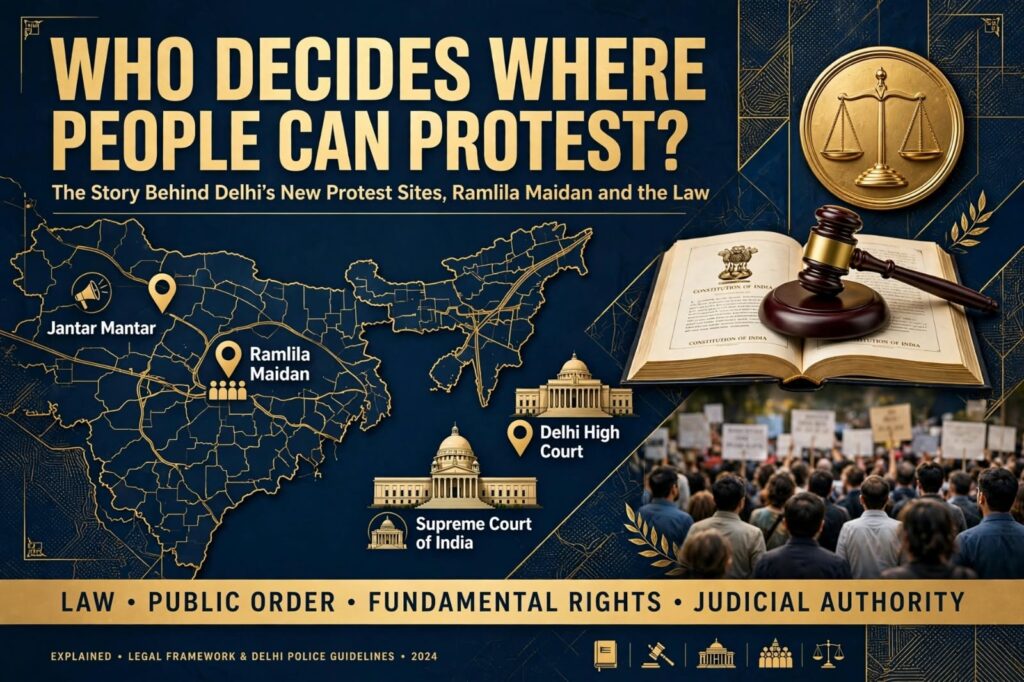
Why can citizens protest at one place but not at another? Who decides that Ramlila Maidan will be a designated protest site? Can the police shift protests from Jantar Mantar to another ground? And can the government decide that people may protest only at locations selected by the authorities?
These questions go to the heart of the constitutional right to peaceful protest.
A protest site is not simply a piece of land where people gather. Its designation involves decisions about public order, traffic, security, land management and, most importantly, the balance between the citizens’ right to express dissent and the rights of the general public.
Delhi’s recent change in its designated protest venues has once again brought these questions into focus. To understand the legal position, it is important to look beyond the latest police order and understand who has the power to designate protest sites, how that power developed, what role the courts have played, and what legal remedies are available when a protest site is changed or a request to hold a demonstration is rejected.
1. What does it mean when a place is declared a “designated protest site”?
A designated protest site is a location identified by the competent authorities where public demonstrations may be organised under a regulated permission system.
The purpose is not supposed to be to take away the right to protest. Rather, the idea is to provide a place where demonstrations can take place while managing:
- Public safety and law and order.
- Traffic movement and access to public places.
- Security around government buildings and important installations.
- Noise, sanitation and other concerns of nearby residents.
- Basic facilities such as drinking water, toilets and emergency access.
However, there is an important constitutional question: if the government decides where people can protest, can it also decide that the protest must take place so far away from the people or institution being addressed that the demonstration loses its practical purpose?
The Supreme Court has recognised that the location of a protest can matter. A demonstration is often intended to communicate a grievance to the public or to the authority concerned. Therefore, the choice of venue cannot always be treated as a mere administrative convenience.
2. Who has the power to designate protest sites in Delhi?
In Delhi, the designation and regulation of protest venues principally involve the Delhi Police and the competent land-owning or venue-managing authority.
Delhi is a Union Territory with a special constitutional arrangement under Article 239AA. The Delhi Legislative Assembly’s power to make laws does not extend to the subjects of public order, police and land, which are excluded from its legislative competence. These subjects remain within the Union’s domain.
Consequently, the Union Ministry of Home Affairs (MHA) has an important administrative role in relation to Delhi Police. The Delhi Police Commissioner and the police administration exercise powers under the applicable laws, rules, orders and standing instructions to regulate public gatherings.
The process may involve more than one authority:
| Authority | Its role |
|---|---|
| Union Ministry of Home Affairs | Administrative oversight of Delhi Police and, where constituted, committees to examine protest-site arrangements. |
| Delhi Police Commissioner | Issues or modifies police standing orders and identifies or regulates designated protest venues. |
| Local police authorities | Process applications, assess security and law-and-order concerns, and enforce lawful conditions. |
| MCD or other land-owning authority | Deals with the use, booking and management of the particular ground where its permission is required. |
| Courts | Examine whether the designation, restrictions or refusal of permission violate the Constitution or applicable law. |
An important distinction: the MHA committee may examine and recommend suitable venues, but the formal police designation is made through the competent police authority. Similarly, a police designation does not, by itself, give an organiser an unconditional right to occupy land controlled by another authority.
In short, the decision is not simply made by a local police station or by a political party. It is an administrative decision taken by the competent authorities under the applicable legal framework, and it remains subject to judicial review.
3. How did Delhi’s designated protest sites develop? A brief history
Delhi’s protest sites have changed over the decades. The movement from one location to another reflects the continuing tension between two competing concerns: allowing citizens to make their voices heard and managing the impact of large demonstrations on the city.
A TIMELINE OF DELHI’S PROTEST SITES
- After Independence – Boat Club LawnsFor several decades, the Boat Club Lawns near India Gate and the central government district were among Delhi’s principal locations for large demonstrations. The location was significant because it was close to Parliament and other important government offices. Protesters could make their demands visible to the political establishment.
- 1988 – The farmers’ protest at Boat ClubThe large farmers’ mobilisation led by Mahendra Singh Tikait in October 1988 brought thousands of farmers to the Boat Club area. The scale and duration of the gathering raised concerns about traffic, access and the use of central public spaces.
- 1993 – Restrictions around Boat Club and the rise of Jantar MantarFollowing restrictions on demonstrations around the Boat Club area, Jantar Mantar emerged as an alternative designated protest location. It was close to Parliament and other institutions, while being more manageable for the authorities than the Boat Club lawns.
- 2011 – Anna Hazare’s anti-corruption movementJantar Mantar became nationally prominent during the India Against Corruption movement. It hosted demonstrations and hunger strikes that attracted widespread public attention. Ramlila Maidan also became a major venue during the movement, particularly for the large August 2011 gathering.
- 2017 – National Green Tribunal’s interventionFollowing complaints about noise, waste, traffic and inconvenience to residents, the National Green Tribunal directed that protest activities at Jantar Mantar be stopped and that protesters be shifted to Ramlila Maidan. The restrictions were subsequently challenged.
- 2018 – Supreme Court protects regulated demonstrations at Jantar MantarIn Mazdoor Kisan Shakti Sangathan v. Union of India, the Supreme Court rejected the idea that a blanket prohibition was the appropriate solution. It recognised the need to balance the right to protest with the rights of residents and permitted regulated demonstrations in a limited area of Jantar Mantar.
- 2022 – Revised police frameworkDelhi Police issued a revised standing order on 28 April 2022 governing demonstrations at Jantar Mantar. The site continued to function as a regulated location for smaller protests, while larger gatherings could be organised at Ramlila Maidan, subject to permission.
- October 2026 – Jantar Mantar de-notifiedDelhi Police issued Standing Order No. L&O/48/2026, removing Jantar Mantar from the list of designated protest sites and identifying Ramlila Ground, Burari Ground and CBD Ground in East Delhi as alternative venues. The decision followed recommendations of a committee constituted by the Union Ministry of Home Affairs. The change has since been challenged before the Supreme Court.
This history is important because it shows that the designation of a protest site is not permanent or beyond change. Authorities may change the arrangements, but the decision must remain consistent with constitutional protections and judicial principles. The Indian Express+3
4. Why was Jantar Mantar removed and Ramlila Maidan made one of the new designated protest sites?
On 11 October 2026, Delhi Police issued Standing Order No. L&O/48/2026. The order removed Jantar Mantar as a designated protest venue and identified three alternative locations:
1. Ramlila Ground – Central Delhi
A historically significant venue for large political rallies, public demonstrations and social movements.
2. Burari Ground – North Delhi
Identified as an alternative venue for demonstrations, particularly larger gatherings.
3. CBD Ground – East Delhi
Another alternative venue identified under the revised arrangement.
The stated administrative basis for the change was the recommendation of a committee constituted by the Union Ministry of Home Affairs to examine alternative venues for citizens to organise protests and demonstrations.
But why is this change legally significant?
Because the issue is not merely whether Delhi has three alternative grounds.
The real question is whether those alternatives provide a meaningful opportunity to exercise the right to protest.
For example:
- Is the proposed location reasonably accessible to the public?
- Can the protesters reach the authority whose attention they seek?
- Does the location have sufficient capacity and basic facilities?
- Are the restrictions proportionate to the concerns raised?
- Does the new arrangement effectively prevent certain groups from holding demonstrations?
These are legitimate questions for constitutional scrutiny.
The Supreme Court has previously recognised that a protest venue’s location can have an important bearing on the effectiveness of a demonstration. In Mazdoor Kisan Shakti Sangathan, the Court considered the argument that shifting protests away from Jantar Mantar to Ramlila Maidan could reduce their proximity to the centres of power. The Court’s approach was to balance competing rights, rather than impose a complete prohibition. National Digital Library of India+1
5. Can the government shift a protest site whenever it wants?
The authorities can change the designated protest sites, but the power to change a venue is not the same as an unrestricted power to take away the right to protest.
A decision to shift or remove a protest site should be examined on the following considerations:
- Legal authority: Was the decision taken by the competent authority under the applicable legal framework?
- Relevant reasons: Was the decision based on genuine concerns such as public safety, traffic, security or inadequate facilities?
- Application of mind: Did the authority actually examine the suitability of the existing and proposed venues?
- Alternative arrangements: Do the new locations provide a meaningful opportunity to organise peaceful demonstrations?
- Proportionality: Could the concerns have been addressed through reasonable restrictions instead of removing the existing venue altogether?
- Practical accessibility: Can the public, protesters and concerned authorities reasonably access the proposed site?
For example, suppose Jantar Mantar is removed as a designated site and protesters are directed to a location much farther away from Parliament or the government office against which they wish to demonstrate.
The question would not simply be whether another ground has been provided. It would also be whether the alternative is genuinely capable of serving the purpose of a peaceful demonstration.
The authorities may have legitimate reasons to relocate a protest. But the decision should not be used to make peaceful dissent ineffective or inaccessible.
What is the current legal position on the October 2026 change?
There have been important judicial developments:
- On 9 October 2026, the Supreme Court observed that a suitable alternative site with basic amenities should be identified for peaceful and lawful protesters. The Court referred to facilities such as toilets, drinking water, medical assistance and adequate space. It left the competent authority to consider the suggestion and take an appropriate decision. The New Indian Express+1
- On 11 October 2026, Delhi Police issued the standing order changing the designated protest venues.
- On 15 October 2026, the Supreme Court issued notice on petitions challenging the removal of Jantar Mantar as a designated protest site. The Court indicated that it would examine whether the authority had applied its mind to the decision. Notice is not a final judgment, and the validity of the new arrangement has not thereby been conclusively decided. Live Law+1
The legal challenge raises an important question: whether providing alternative grounds is sufficient, or whether the authorities must also demonstrate that the new arrangement preserves a meaningful opportunity to exercise the constitutional right to protest.
6. How can the designation or removal of a protest site be challenged?
A person or organisation whose right to organise a peaceful demonstration is affected may consider approaching the appropriate court.
In Delhi, a writ petition under Article 226 of the Constitution before the Delhi High Court may be an appropriate remedy. Depending on the nature of the challenge, proceedings may also be instituted before the Supreme Court under Article 32.
The challenge may be directed against:
- An order removing an existing protest site.
- A decision designating alternative locations without adequate justification.
- A policy that effectively prevents peaceful demonstrations.
- A refusal to permit a demonstration at an otherwise designated venue.
- Conditions that are arbitrary, unreasonable or disproportionate.
- A prohibitory order that unlawfully restricts peaceful assembly.
What grounds can be taken in a writ petition?
The following grounds may be relevant, depending on the facts and documents.
A. Violation of Articles 19(1)(a) and 19(1)(b)
The right to freedom of speech and expression and the right to assemble peacefully are fundamental rights. A policy that substantially restricts these rights without a constitutionally permissible justification may be challenged.
B. Arbitrary exercise of administrative power
If the authority changes a designated site without properly examining the relevant circumstances, the decision may be challenged as arbitrary and unreasonable.
C. Failure to consider the practical purpose of a protest
A protest is often organised to communicate a grievance to a particular public authority or institution. A venue that makes such communication practically ineffective may raise a serious constitutional concern.
D. Disproportionate restrictions
If traffic, security or public-safety concerns can be addressed by limiting the number of participants, regulating timings or prescribing safety conditions, a complete prohibition or relocation may be challenged as disproportionate.
E. Failure to provide a meaningful alternative
Merely naming another location may not be sufficient in every situation. The alternative should be reasonably capable of accommodating the demonstration and should not make the exercise of the right illusory.
What relief can the High Court grant?
Depending on the circumstances, the petitioner may seek:
- Quashing of the order removing or restricting the protest site.
- A direction to the authorities to reconsider the decision.
- Restoration of the earlier protest site, where legally justified.
- A direction to provide suitable alternative venues.
- A direction to frame fair and transparent guidelines for designating protest sites.
- A direction to decide individual applications for protest permission within a reasonable time.
- Interim protection against arbitrary interference with a proposed peaceful demonstration.
The court may also direct the authorities to consider the matter afresh instead of itself selecting a particular protest site.
Important: Filing a writ petition does not automatically suspend the police order or grant permission to hold a protest. Interim relief must be specifically sought and granted by the court.
7. Important Supreme Court judgments on designation and regulation of protest sites
The following judgments provide the legal foundation for understanding who can regulate public demonstrations and how far that power can extend.
A. Mazdoor Kisan Shakti Sangathan v. Union of India, (2018) 17 SCC 324
Most important judgment on Delhi protest sites
This is the leading Supreme Court judgment concerning the regulation of demonstrations at Jantar Mantar and the Boat Club area in Delhi.
The case arose after restrictions were imposed on demonstrations at Jantar Mantar and the National Green Tribunal directed that protest activities there be stopped.
The petitioners argued that shifting demonstrations to Ramlila Maidan would affect the effectiveness of protests because Jantar Mantar was closer to Parliament and the centres of government.
The Supreme Court recognised that peaceful demonstrations are protected under Articles 19(1)(a) and 19(1)(b).
The Court also acknowledged the concerns of residents who were affected by noise, traffic and other difficulties arising from demonstrations.
Rather than completely prohibiting demonstrations, the Court adopted a balancing approach. It permitted regulated peaceful gatherings in a limited portion of Jantar Mantar and directed the authorities to frame appropriate guidelines.
Legal principle: The State can earmark particular areas for demonstrations and regulate their use, but the regulation must preserve the meaningful exercise of the right to peaceful protest.
This judgment is particularly important when challenging the removal of an existing protest site or the creation of restrictions that make peaceful demonstrations practically impossible. National Digital Library of India+1
B. Himat Lal K. Shah v. Commissioner of Police, Ahmedabad, (1973) 1 SCC 227
This judgment is important for understanding the power of the State to regulate public meetings on public streets.
The Supreme Court recognised that the authorities may regulate public meetings and require prior permission. However, the power to regulate cannot be converted into a power to prohibit all public meetings.
In simple words, the government can prescribe reasonable rules for holding public meetings, but it cannot use those rules to completely take away the right of peaceful assembly.
Legal principle: Regulation of public spaces is permissible; destruction of the constitutional right to assemble is not.
C. In Re: Ramlila Maidan Incident v. Home Secretary, Union of India, (2012) 5 SCC 1
This judgment arose from the police action during the gathering at Ramlila Maidan in June 2011.
The Supreme Court examined the right to peaceful assembly, the freedom of expression and the limits of police powers.
The Court recognised that citizens have a constitutional right to assemble peacefully and express their grievances. It also emphasised that the authorities must act lawfully and proportionately when dealing with public gatherings.
The judgment is important when examining whether police action against a demonstration, including its dispersal or the use of force, was justified.
Legal principle: The State has the power to maintain public order, but that power must be exercised consistently with fundamental rights. Sci API+1
D. Amit Sahni v. Commissioner of Police, (2020) 10 SCC 439
This judgment arose from the Shaheen Bagh protest, where a public road was occupied for a prolonged period.
The Supreme Court held that the right to protest cannot be exercised in a manner that indefinitely blocks public roads and prevents other citizens from using public spaces.
The Court recognised that peaceful protests are protected, but public places cannot be occupied indefinitely to the exclusion of everyone else.
Legal principle: The right to protest must be balanced against the rights of commuters, residents and other members of the public. Explained-law News – The Indian Express+1
E. Ram Manohar Lohia v. State of Bihar, AIR 1966 SC 740
This judgment is important for understanding the meaning of public order.
The Supreme Court explained the distinction between:
- Law and order.
- Public order.
- Security of the State.
The Court described these concepts as three concentric circles, with law and order being the broadest and security of the State being the narrowest.
Not every minor disturbance of law and order amounts to a disturbance of public order.
Legal principle: Authorities cannot automatically justify restrictions on fundamental rights by referring to a general possibility of disturbance. The nature and seriousness of the threat must be examined.
8. What are the legal consequences of holding a protest at a non-designated site?
The fact that a location is not a designated protest site does not automatically mean that every gathering there is a criminal offence. However, where prior permission is required, or a valid prohibitory order applies, organisers and participants may face legal consequences if they disregard the applicable requirements.
Depending on the facts, the following provisions may become relevant:
| Provision | Legal relevance |
|---|---|
| Section 163, BNSS, 2023 | Urgent preventive orders in cases of nuisance or apprehended danger. |
| Section 223, BNS, 2023 | Disobedience to an order duly promulgated by a public servant, where the statutory ingredients are established. |
| Section 189, BNS, 2023 | Unlawful assembly and related offences. |
| Section 191, BNS, 2023 | Rioting, where the statutory requirements are fulfilled. |
| Other applicable BNS provisions | Assault, criminal intimidation, mischief or other offences, depending on individual conduct. |
There are some important legal distinctions:
- Non-designated location: Holding a gathering at a non-designated location does not, by itself, establish every ingredient of a criminal offence. The applicable permission requirements and orders must be examined.
- Section 163 BNSS: This provision does not automatically apply to every protest. There must be a legally sustainable basis for passing the preventive order.
- Section 223 BNS: The prosecution must establish disobedience of an order duly promulgated by a public servant and the other statutory ingredients.
- Unlawful assembly: A gathering of five or more people does not automatically become an unlawful assembly. The common object must fall within the statutory definition.
- Violence or damage: Individuals who commit identifiable criminal acts may face separate criminal proceedings.
Can the police arrest organisers and protesters?
The police may take lawful steps to prevent a breach of peace, enforce valid orders and investigate cognizable offences.
However, arrest is not automatic merely because someone attended a demonstration or because the gathering was held at a non-designated location.
The police must comply with the applicable provisions governing arrest, including the safeguards under the BNSS and the Constitution.
9. Can a designated protest site be changed because residents are inconvenienced?
Yes, genuine concerns of residents are relevant and may justify reasonable regulation or even relocation in an appropriate case.
For example, authorities may consider:
- Excessive noise.
- Traffic congestion.
- Blockage of residential entrances.
- Accumulation of garbage.
- Lack of sanitation facilities.
- Safety and emergency access.
- Prolonged occupation of public space.
However, the authorities should examine whether these problems can be addressed through reasonable conditions.
For example, they may:
- Limit the number of participants.
- Restrict the hours of the demonstration.
- Prohibit overnight occupation.
- Regulate loudspeakers.
- Require organisers to arrange sanitation and waste disposal.
- Mark a specific area for demonstrations.
A complete prohibition should not be treated as the automatic solution to every inconvenience.
This is precisely the balancing approach adopted by the Supreme Court in Mazdoor Kisan Shakti Sangathan.
10. Myth vs Reality: Who controls protest sites and can they be changed?
| Myth | Reality |
|---|---|
| Protest sites are permanently fixed by the Constitution. | The Constitution protects peaceful assembly; the competent authorities regulate and designate venues. |
| Only the MHA can designate a protest site. | In Delhi, the MHA has administrative oversight, while the formal police designation is made by the competent police authority. |
| MCD alone decides where protests can be held. | Police regulation and permission to use the land are distinct matters involving different authorities. |
| Once a place is designated, it can never be removed. | A site may be changed, but the decision must remain legally and constitutionally sustainable. |
| The government can shift all protests far away from Parliament. | Authorities can regulate locations, but the availability and effectiveness of alternatives may be examined by courts. |
| Providing any alternative ground is sufficient. | The alternative should be meaningful and reasonably capable of accommodating peaceful demonstrations. |
| The right to protest gives people an unrestricted right to occupy any road. | Peaceful assembly is protected, but it remains subject to reasonable restrictions and the rights of others. |
| A protest at a non-designated location is automatically a criminal offence. | Criminal liability depends on the applicable law, orders and individual conduct. |
| Courts cannot interfere with the selection of protest sites. | Administrative decisions affecting fundamental rights remain subject to judicial review. |
11. Frequently Asked Questions (FAQs)
Q1. Who decides the designated protest sites in Delhi?
Delhi Police, acting through the competent police authority, formally designates and regulates protest venues. The Union Ministry of Home Affairs has an important administrative role, and other authorities may be involved where the use and management of the land requires their permission.
Q2. Why was Jantar Mantar made a protest site?
Jantar Mantar emerged as a designated protest location after restrictions were imposed around the Boat Club area in the early 1990s. It provided a location relatively close to Parliament and the central government district where demonstrations could be regulated.
Q3. Why has Jantar Mantar been removed as a designated protest site in 2026?
Delhi Police issued Standing Order No. L&O/48/2026 following recommendations of a committee constituted by the Union Ministry of Home Affairs. Ramlila Ground, Burari Ground and CBD Ground were identified as alternative protest venues.
Q4. Is Ramlila Maidan now a designated protest site?
Yes. Under the October 2026 Delhi Police standing order, Ramlila Ground is one of the designated protest venues, along with Burari Ground and CBD Ground in East Delhi.
Q5. Can the MHA committee itself remove a protest site?
The committee may examine the suitability of venues and make recommendations. The formal police order changing the designated sites is issued by the competent police authority under the applicable administrative and legal framework.
Q6. Can the government remove a protest site without providing an alternative?
The legality of such a decision would depend on its facts and constitutional implications. A decision that effectively prevents peaceful demonstrations may be challenged. The Supreme Court has emphasised the need to preserve a meaningful opportunity for peaceful protest.
Q7. Can Jantar Mantar be restored as a protest site?
A person or organisation affected by the removal may challenge the decision before the appropriate court. The court may examine the legality of the order and grant suitable relief. However, restoration is not automatic.
Q8. Can the police decide that protests can only take place at designated locations?
The authorities can regulate demonstrations in public spaces and require permission where legally justified. However, they cannot use the designation system to effectively extinguish the constitutional right to peaceful assembly.
Q9. Can the removal of Jantar Mantar be challenged in court?
Yes. The October 2026 decision has already been challenged before the Supreme Court. On 15 October 2026, the Supreme Court issued notice on petitions challenging the change. The notice does not mean that the order has been struck down; the challenge remains to be adjudicated.
Q10. Does the right to protest mean that protesters can demonstrate anywhere?
No. The right to peaceful assembly is subject to reasonable restrictions. The authorities can regulate location, timing, crowd size and other safety requirements, provided the restrictions are lawful and proportionate.
Conclusion: A protest site should regulate dissent, not silence it
The history of Delhi’s protest sites shows that the places where citizens assemble have changed repeatedly — from the Boat Club Lawns to Jantar Mantar and now to the newly designated venues, including Ramlila Maidan.
These changes reflect the practical difficulties of managing large demonstrations in a busy capital. At the same time, they raise an important constitutional question: how can the State regulate public demonstrations without weakening the citizens’ right to make their voices heard?
The answer lies in a fair balance.
The authorities have the power to regulate protest sites, manage crowds and protect public order. But the right to peaceful protest is not a favour granted by the government. It is a fundamental right protected by the Constitution.
A designated protest site should be a place where citizens can exercise their democratic rights in an orderly manner — not a place selected merely to make their voices less visible.
Any decision to designate, relocate or remove such a site must therefore be supported by lawful reasons and must preserve a meaningful opportunity for peaceful dissent.