
A Landmark Judgment on Delay, Abuse of Criminal Law, and Civil-Criminal Disputes
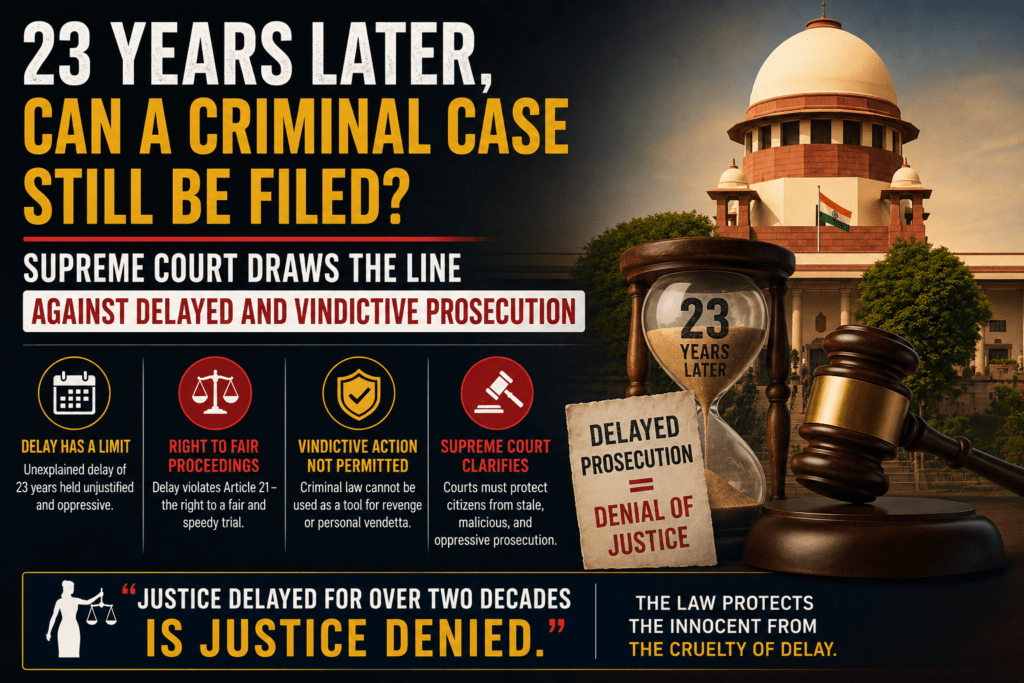
The Supreme Court of India has delivered an important judgment that will have a significant impact on cases where criminal proceedings are initiated after an extraordinary delay, particularly when civil disputes between the parties have been pending for years. In Nazibul Rahim Khan & Ors. v. State of Uttar Pradesh & Anr., the Court quashed an FIR that had been lodged nearly 23 years after the complainant admittedly became aware of the alleged wrongdoing.
The judgment serves as a strong reminder that while criminal law is meant to punish genuine offences, it cannot be used as a weapon of harassment, retaliation, or pressure in long-standing civil disputes.
Understanding the Background of the Case
The dispute revolved around agricultural land and allegations of impersonation, forged documents, and fraudulent sale transactions.
The complainant had filed a civil suit as early as 2001, alleging that the accused had forged a Power of Attorney and used it to execute a sale deed relating to her property. Thus, the complainant admittedly had knowledge of the alleged fraud and disputed documents since at least 2001.
However, despite this knowledge, no criminal case was filed for more than two decades.
In 2024, the complainant suddenly lodged an FIR alleging offences of cheating, forgery, use of forged documents, and criminal intimidation against the accused. The accused approached the High Court seeking quashing of the FIR, but the High Court refused to interfere. The matter eventually reached the Supreme Court.
What Was the Main Issue Before the Supreme Court?
The central question before the Court was:
Can a person who was aware of the alleged criminal acts since 2001 suddenly initiate criminal proceedings in 2024 without offering any satisfactory explanation for the delay?
The Supreme Court answered this question in the negative.
Civil and Criminal Remedies Can Co-Exist — But Not After Unexplained Delay
The Court clarified an important principle of law.
A person is not barred from pursuing both civil and criminal remedies based on the same set of facts. Many disputes may contain both civil and criminal elements. However, if criminal proceedings are initiated after an unreasonable and unexplained delay, courts are entitled to examine whether such proceedings are genuine or merely intended to pressurize the opposite party.
The Court observed that criminal law should not become a tool for obtaining advantages in civil litigation.
Why Did the Supreme Court Find the FIR Suspicious?
The Court noted several important circumstances:
1. Knowledge Since 2001
The complainant had already filed a civil suit in 2001 alleging forgery and fraudulent execution of documents. Therefore, she was fully aware of the alleged acts at least from that year onward.
2. No Explanation for 23 Years of Silence
The Court found that there was no satisfactory explanation as to why criminal proceedings were not initiated for more than two decades.
3. Timing Raised Serious Doubts
The Court noticed that several litigations were already pending between the parties. The FIR appeared to have been lodged at a stage when other proceedings initiated by the accused against the complainant were actively continuing. This created a strong impression that the criminal case may have been filed as a counterblast or pressure tactic.
Supreme Court’s Strong Warning Against Misuse of Criminal Law
The Supreme Court relied upon earlier precedents and reiterated that criminal proceedings should not be allowed to degenerate into instruments of harassment.
The Court observed that where a frustrated litigant fails to achieve the desired result in civil proceedings and subsequently initiates criminal proceedings merely to harass the opposite party, courts must intervene. It emphasized that criminal courts should not be used as forums for settling personal scores or exerting pressure.
This observation is particularly important because it reflects a growing judicial concern regarding the misuse of criminal law in property disputes, family disputes, business conflicts, and other civil disagreements.
What Did the Court Say About Delay in Filing FIRs?
The Supreme Court reiterated a settled legal principle:
Delay by itself may not always be fatal to a criminal case. However, where there is a substantial delay and no plausible explanation is offered, courts are justified in examining whether the allegations are genuine or whether the proceedings are motivated by mala fide intentions.
In the present case, the delay was not a few months or a few years—it was approximately 23 years.
The Court found that such extraordinary delay, coupled with surrounding circumstances, made the prosecution highly doubtful.
What Was the Final Decision?
After examining the entire factual background, the Supreme Court concluded that continuation of the criminal proceedings would amount to abuse of the process of law.
Accordingly, the Court:
- Set aside the judgment of the Allahabad High Court;
- Allowed the appeal filed by the accused persons;
- Quashed FIR No. 172 of 2024;
- Quashed all consequential proceedings arising from the FIR.
At the same time, the Court clarified that it was not expressing any opinion on the merits of the other pending civil or criminal disputes between the parties. Those proceedings would continue independently according to law.
Why This Judgment Matters
This decision is significant for several reasons:
Protection Against Vexatious Litigation
The judgment protects individuals from being dragged into criminal proceedings after decades without any valid explanation.
Prevents Misuse of Criminal Law
The Court has reinforced that criminal law cannot be used as a bargaining tool or pressure mechanism in civil disputes.
Encourages Timely Legal Action
Victims of genuine offences are expected to approach law enforcement authorities within a reasonable time and not wait for decades unless exceptional circumstances exist.
Strengthens Judicial Scrutiny
Courts are reminded to carefully examine delayed criminal complaints and assess whether they are bona fide or motivated by ulterior considerations.
Key Takeaway
The Supreme Court’s ruling sends a clear message: criminal law is a shield for genuine victims, not a sword for settling old scores. While civil and criminal proceedings may coexist, a person who sits on alleged criminal grievances for decades and then suddenly initiates prosecution must provide a convincing explanation. Otherwise, courts will not hesitate to quash such proceedings to prevent abuse of the legal process.
This judgment is another important step in ensuring that criminal courts are used for the administration of justice and not as instruments of harassment, retaliation, or strategic litigation.