
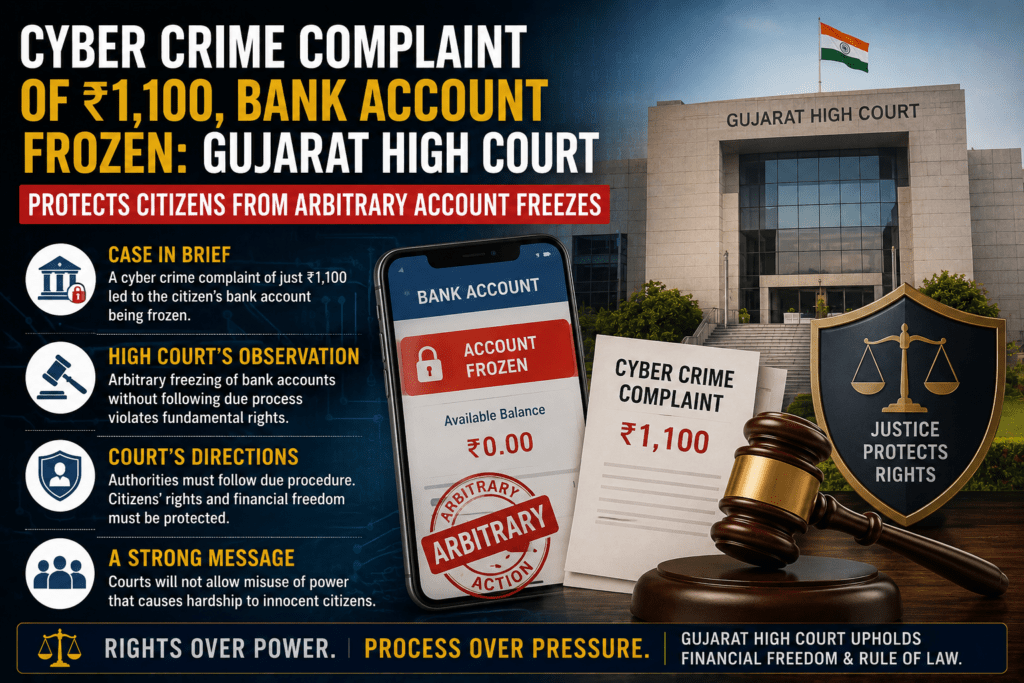
In a significant judgment safeguarding the rights of ordinary bank account holders, the Gujarat High Court has ruled that authorities cannot freeze an entire bank account merely because a small disputed amount is under investigation in a cybercrime case. The Court emphasized that while investigating agencies have the power to freeze bank accounts during criminal investigations, such power must be exercised reasonably, proportionately, and in accordance with law.
The judgment was delivered by Justice Niral R. Mehta in a case where a citizen’s bank account was frozen because two transactions amounting to only ₹1,100 were found in a cybercrime transaction trail.
Why Was the Bank Account Frozen?
The petitioner maintained a savings account with HDFC Bank, which was his primary account for receiving salary, paying rent, EMIs, household expenses, and meeting day-to-day financial needs.
The account was suddenly debit-frozen after cybercrime authorities informed the bank that two transactions of ₹500 and ₹600 had allegedly passed through the account in connection with cybercrime complaints under investigation.
As a result, the account holder lost access not only to the disputed amount of ₹1,100 but also to his entire salary, savings, and other legitimate funds lying in the account.
What Was the Petitioner’s Argument?
The petitioner approached the Gujarat High Court and argued that:
- He was neither an accused nor a suspect in any criminal case.
- He had no involvement in any cybercrime activity.
- The disputed transactions amounted to only ₹1,100.
- Despite repeated requests, authorities failed to provide adequate reasons for freezing the entire account.
- The freezing of the entire account caused serious financial hardship and prevented him from using his lawful earnings.
The petitioner therefore sought directions for de-freezing his bank account.
What Did the State and Bank Say?
The State submitted that the account had been frozen during the course of a cybercrime investigation.
The bank clarified that it had merely acted upon instructions received from the investigating agency and would comply with any directions issued by the Court.
What Did the Gujarat High Court Observe?
The Court acknowledged that investigating agencies possess the legal authority to freeze bank accounts during criminal investigations. However, the Court made it clear that such powers cannot be exercised arbitrarily.
According to the Court, freezing an entire bank account without properly assessing the extent of the alleged suspicious amount can cause severe hardship to innocent individuals.
The Court observed that the alleged suspicious transactions in the present case were limited to only ₹1,100. Yet, the authorities had frozen the entire account, including the petitioner’s salary and lawful savings.
The Court held that such action was disproportionate and unreasonable.
Importance of the Principle of Proportionality
One of the most significant aspects of the judgment is the Court’s reliance on the principle of proportionality.
The principle of proportionality requires that any action taken by authorities must be proportionate to the objective sought to be achieved.
In simple terms, if authorities suspect only ₹1,100, they cannot ordinarily block access to lakhs of rupees belonging to a citizen unless there are compelling reasons to do so.
The Court emphasized that investigative powers must be balanced against the rights of individuals.
Article 21 and the Right to Livelihood
The Court further observed that freezing an entire bank account can directly affect a person’s ability to survive and maintain a dignified life.
Article 21 of the Constitution of India guarantees the right to life and personal liberty. Over the years, courts have interpreted this provision broadly to include:
- Right to livelihood.
- Right to dignity.
- Right to live with basic financial security.
The Court held that indiscriminate freezing of a person’s bank account, particularly where the individual is not an accused and the disputed amount is minimal, can adversely affect these constitutional rights.
Relief Granted by the High Court
After considering the facts of the case, the Gujarat High Court directed:
- The bank account should be de-frozen.
- A lien should be marked only for the disputed amount of ₹1,100.
- The account holder should be allowed to freely operate the remaining balance.
- The petitioner must cooperate with the investigating agency whenever required.
- The order should not be treated as an opinion on the merits of the investigation.
Thus, while protecting the investigation, the Court simultaneously protected the rights of the account holder.
Why This Judgment Matters
This decision is particularly relevant in today’s digital era, where bank accounts are frequently frozen during cybercrime investigations.
Many individuals discover that their accounts have been frozen merely because some amount allegedly linked to a suspicious transaction has passed through their account. In several cases, the account holder may not even be aware of the source of the transaction.
The judgment sends a clear message that:
- Investigative powers are not unlimited.
- Citizens cannot be deprived of access to their lawful funds without justification.
- Authorities must adopt proportionate measures.
- Entire bank accounts should not be frozen when the disputed amount is identifiable and limited.
Key Takeaway
The Gujarat High Court’s decision reinforces an important constitutional principle: the fight against cybercrime cannot come at the cost of the fundamental rights of innocent citizens.
While authorities have every right to investigate suspicious transactions, such investigations must be conducted in a fair, balanced, and proportionate manner. Freezing an entire bank account for a disputed amount of merely ₹1,100 was found to be excessive, and the Court rightly intervened to protect the account holder’s right to livelihood and dignity.
This judgment is likely to serve as an important precedent for individuals facing arbitrary bank account freezes in cybercrime investigations across the country.