
Introduction
Despite the rise of digital payments, cheques continue to be widely used in business transactions, loans, property dealings, and personal financial arrangements. A cheque is often considered a symbol of trust and financial commitment. However, when a cheque issued by a person is dishonoured or “bounced” by the bank, it can lead to serious legal consequences.
Cheque bounce is not merely a banking issue. In many cases, it constitutes a criminal offence under Indian law and may result in prosecution, monetary penalties, and even imprisonment.
This article provides a complete guide to cheque bounce laws in India, the legal procedure, rights of the payee, defences available to the drawer, and recent developments in the law.
What is a Cheque Bounce?
A cheque is said to have bounced when the bank refuses to honour or clear the cheque presented for payment.
In simple terms, the cheque bounce occurs when the person who issued the cheque does not have sufficient funds in their bank account or when the bank rejects the cheque for certain reasons.
The bank returns the cheque along with a document known as a “Cheque Return Memo” mentioning the reason for dishonour.
Common Reasons for Cheque Bounce
Some of the most common reasons include:
1. Insufficient Funds
The balance available in the account is less than the cheque amount.
2. Account Closed
The drawer has already closed the bank account from which the cheque was issued.
3. Payment Stopped by Drawer
The account holder instructs the bank not to honour the cheque.
4. Signature Mismatch
The signature on the cheque does not match the specimen signature available with the bank.
5. Alteration in Cheque
Material alterations made without proper authentication.
6. Exceeds Arrangement
The cheque amount exceeds the overdraft or credit limit sanctioned by the bank.
Legal Provision Governing Cheque Bounce
Cheque bounce cases in India are primarily governed by:
The Negotiable Instruments Act, 1881
The most important provision is:
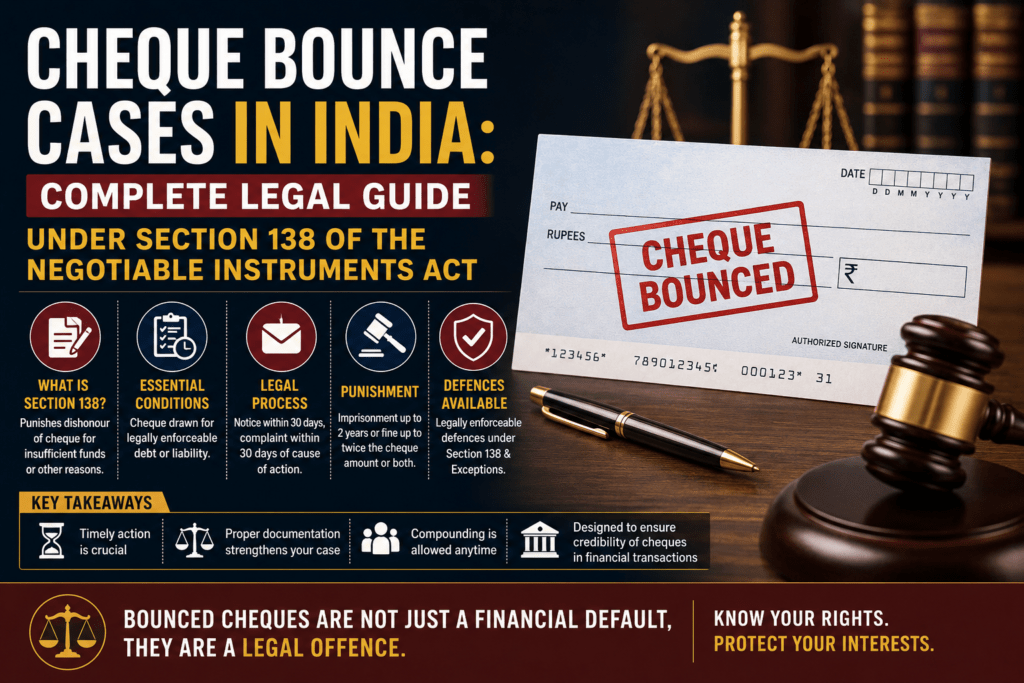
Section 138 – Dishonour of Cheque for Insufficiency of Funds
Section 138 makes cheque dishonour a criminal offence when the cheque was issued towards discharge of a legally enforceable debt or liability.
The objective behind this provision is to enhance the credibility of cheques as a mode of payment and ensure financial discipline.
Essential Ingredients of Section 138 NI Act
For a person to be prosecuted under Section 138, the following conditions must be fulfilled:
1. Issuance of Cheque
The cheque must have been issued by the accused.
2. Legally Enforceable Debt or Liability
The cheque must have been issued towards repayment of an existing debt, liability, loan, business transaction, or any legally recoverable amount.
3. Presentation Within Validity Period
The cheque must be presented to the bank within its validity period.
4. Dishonour of Cheque
The cheque must be returned unpaid by the bank.
5. Service of Legal Demand Notice
The payee must send a legal demand notice within 30 days from receiving information about dishonour.
6. Failure to Make Payment
The drawer must fail to make payment within 15 days from the date of receipt of the legal notice.
Only after these conditions are satisfied does the offence under Section 138 arise.
Step-by-Step Legal Procedure in Cheque Bounce Cases
Step 1: Cheque is Dishonoured
The bank returns the cheque and issues a cheque return memo specifying the reason for dishonour.
Step 2: Legal Notice is Sent
The payee must issue a legal demand notice to the drawer within 30 days from the date of receiving the return memo.
The notice must clearly demand payment of the cheque amount.
Step 3: Waiting Period of 15 Days
The drawer gets a statutory opportunity to make payment within 15 days of receiving the notice.
If payment is made, the matter ends.
Step 4: Filing of Complaint
If payment is not made within 15 days, the complainant may file a complaint before the competent Magistrate within one month.
Step 5: Trial Before Court
The Court examines the complaint and supporting documents and may summon the accused.
The matter then proceeds as a criminal trial.
Punishment for Cheque Bounce
A person found guilty under Section 138 may face:
- Imprisonment up to 2 years; or
- Fine up to twice the cheque amount; or
- Both imprisonment and fine.
In many cases, courts also direct compensation to be paid to the complainant.
Important Documents Required
To initiate a cheque bounce case, the following documents are generally required:
- Original cheque
- Cheque return memo
- Copy of legal notice
- Postal receipts or delivery proof
- Bank statement (if required)
- Any agreement or document showing liability
- Affidavit and complaint
Proper documentation significantly strengthens the complainant’s case.
Can a Security Cheque Lead to Criminal Liability?
One of the most frequently asked questions is whether a security cheque can result in prosecution.
The answer depends on the facts of the case.
If on the date of presentation there exists a legally enforceable debt or liability, even a cheque initially issued as a security cheque may attract Section 138 proceedings.
Courts examine the actual nature of the transaction rather than merely the label attached to the cheque.
Presumption in Favour of the Holder
A unique feature of cheque bounce law is that the law presumes the cheque was issued for a legally enforceable debt.
This means that once issuance and signature are admitted, the burden shifts upon the accused to rebut the presumption.
This legal presumption gives substantial protection to the holder of the cheque.
Common Defences Taken by the Accused
The accused may raise various legal defences, such as:
- No legally enforceable debt existed.
- The cheque was stolen or misused.
- The cheque was issued as a blank security cheque.
- The debt had already been paid.
- Signature on the cheque is disputed.
- Notice was never received.
- Complaint was filed beyond limitation.
However, such defences must be supported by credible evidence.
Can a Civil Case Also Be Filed?
Yes.
The remedy under Section 138 is in addition to civil remedies.
A person may:
- File a criminal complaint under Section 138 NI Act; and
- File a civil suit for recovery of money.
Both proceedings can continue simultaneously because they serve different purposes.
Cheque Bounce by a Company
When a cheque is issued by a company and gets dishonoured, not only the company but also certain responsible officers may be prosecuted.
Directors, Managing Directors, Partners, or authorised signatories who were responsible for the conduct of business at the relevant time may be held liable under the law.
Territorial Jurisdiction in Cheque Bounce Cases
The complaint is generally filed before the Court having jurisdiction over the branch of the bank where the payee presented the cheque for collection.
This position was clarified to make cheque bounce litigation more convenient for the payee.
Frequently Asked Questions (FAQs)
Is cheque bounce a criminal offence?
Yes. Dishonour of a cheque for legally enforceable debt can attract criminal liability under Section 138 of the Negotiable Instruments Act.
Can a case be filed if the cheque amount is small?
Yes. The law does not prescribe any minimum cheque amount.
What happens if the drawer pays after receiving the notice?
If payment is made within 15 days from receipt of notice, no offence under Section 138 is committed.
Can a cheque bounce case be settled?
Yes. Cheque bounce cases are compoundable offences and can be settled at any stage.
How long does a cheque bounce case take?
The duration varies depending on the facts, court workload, and conduct of parties. Many cases are resolved through settlement during the proceedings.
Practical Tips for Businesses and Individuals
- Always maintain written records of transactions.
- Preserve copies of agreements and invoices.
- Send legal notices promptly after dishonour.
- Keep postal receipts and delivery proofs safely.
- Avoid issuing cheques without sufficient funds.
- Verify details before signing any cheque.
These precautions can help prevent lengthy litigation and financial losses.
Conclusion
A cheque is more than just a piece of paper—it represents trust, commitment, and financial responsibility. When a cheque is dishonoured, the law provides a strong mechanism to protect the interests of the payee through Section 138 of the Negotiable Instruments Act, 1881.
Understanding the legal requirements, timelines, and procedures is crucial for both businesses and individuals. Whether you are a person seeking recovery of your money or someone facing a cheque bounce complaint, timely legal advice can make a significant difference.
If you are dealing with a cheque bounce matter, it is advisable to consult an experienced legal professional to evaluate your rights, obligations, and available remedies under the law.