
Introduction
Imagine being arrested for an offence and spending weeks, months, or even years in jail before a court determines whether you are guilty or innocent. Such a situation would not only affect your freedom but also your family, career, reputation, and future.
To prevent unnecessary detention and protect individual liberty, the law provides a mechanism known as bail.
Bail is one of the most important safeguards in the criminal justice system. It ensures that a person accused of an offence is not deprived of liberty unnecessarily while the investigation or trial is pending.
In India, the law relating to bail is presently governed by the Bharatiya Nagarik Suraksha Sanhita, 2023 (BNSS). The provisions seek to balance two important objectives—protecting society from crime and safeguarding the constitutional rights of individuals.
This article explains everything you need to know about bail, including its meaning, legal provisions, types of bail, important principles, and recent developments under the BNSS.
What is Bail?
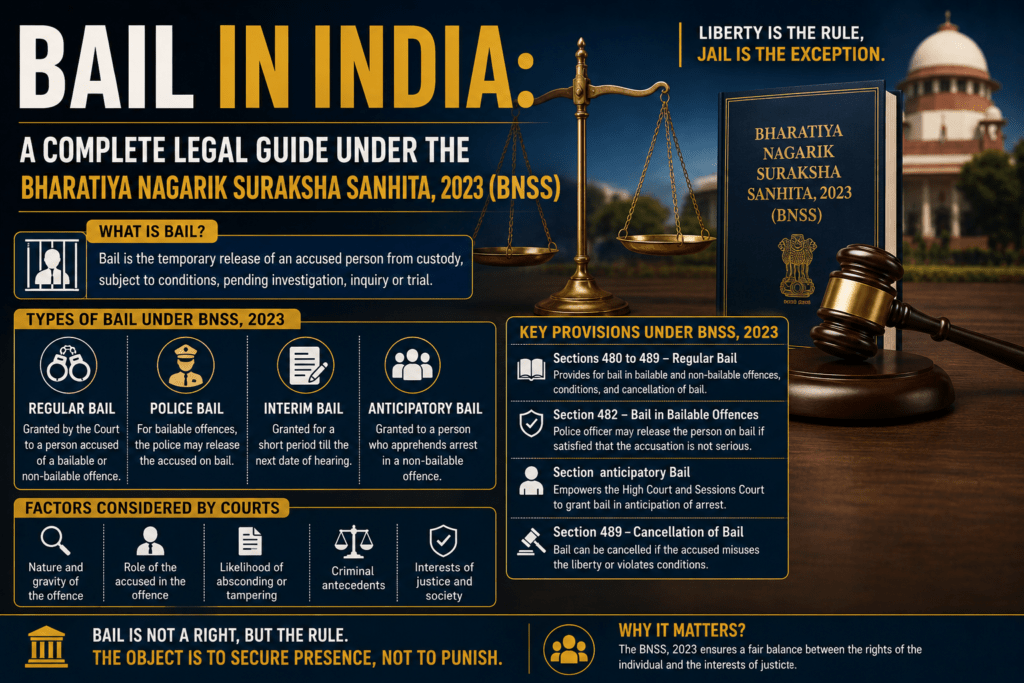
In simple terms, bail is the temporary release of an accused person from custody upon certain conditions imposed by the Court.
The person released on bail undertakes to appear before the Court whenever required and to cooperate with the investigation and trial.
It is important to understand that bail does not amount to acquittal. Grant of bail merely means that the accused is allowed to remain free while the criminal proceedings continue.
Why Does Bail Exist?
The criminal justice system is founded on the principle that every person is presumed innocent until proven guilty.
An accusation alone does not make a person a criminal.
Since criminal trials may take considerable time, the law recognizes that keeping an accused person in jail for an indefinite period before conviction may result in serious injustice.
Therefore, bail serves as a protection against unnecessary deprivation of liberty.
Constitutional Foundation of Bail
The concept of bail is deeply connected with Article 21 of the Constitution of India, which guarantees protection of life and personal liberty.
Indian courts have repeatedly emphasized that personal liberty is one of the most valuable constitutional rights.
The Supreme Court has consistently held that the purpose of detention before conviction is not punishment but only to ensure a fair investigation and trial.
This philosophy gave rise to the well-known principle:
“Bail is the Rule, Jail is the Exception.”
This principle continues to guide courts across the country while deciding bail applications.
Bail Jurisprudence in India
Bail jurisprudence refers to the legal principles developed by courts over the years regarding the grant or refusal of bail.
Courts generally examine:
- Nature and gravity of the offence;
- Strength of the prosecution case;
- Possibility of the accused absconding;
- Chances of tampering with evidence;
- Possibility of influencing witnesses;
- Criminal antecedents of the accused;
- Conduct of the accused;
- Length of custody already undergone;
- Stage of investigation or trial.
The purpose is not to determine guilt or innocence but to decide whether continued detention is necessary.
Legal Provisions Relating to Bail Under BNSS, 2023
The law relating to bail is primarily contained in Sections 478 to 483 of the Bharatiya Nagarik Suraksha Sanhita, 2023.
Section 478 – In What Cases Bail to be Taken
This provision deals with bail in bailable offences.
Where a person is accused of a bailable offence and is arrested or detained, he is generally entitled to be released on bail as a matter of right upon furnishing the required bond.
The police officer or the Court cannot ordinarily refuse bail in such cases.
Section 479 – Maximum Period for Which an Under-Trial Prisoner Can Be Detained
This is one of the most significant reforms introduced under the BNSS.
The provision seeks to address the problem of prolonged incarceration of under-trial prisoners.
Broadly speaking, where an under-trial prisoner has undergone detention extending up to one-half of the maximum period of imprisonment prescribed for the offence, the Court may direct release on bail, subject to certain conditions and exceptions.
The provision reinforces the constitutional commitment to personal liberty and speedy justice.
Section 480 – When Bail May Be Taken in Case of Non-Bailable Offence
This provision governs regular bail in non-bailable offences.
Unlike bailable offences, bail is not an absolute right.
The Court exercises judicial discretion after considering factors such as:
- Nature of allegations;
- Gravity of offence;
- Possibility of absconding;
- Criminal antecedents;
- Likelihood of tampering with evidence;
- Chances of influencing witnesses.
Each case is decided on its own facts and circumstances.
Section 481 – Bail to Require Accused to Appear Before Next Appellate Court
This provision empowers the Court to require an accused person to execute bonds ensuring appearance before the appellate court whenever necessary.
The objective is to ensure the presence of the accused during appellate proceedings and to prevent evasion of the judicial process.
Section 482 – Direction for Grant of Bail to Person Apprehending Arrest
This provision deals with anticipatory bail.
Where a person has reason to believe that he may be arrested for a non-bailable offence, he may approach the Sessions Court or the High Court seeking pre-arrest protection.
If anticipatory bail is granted, the person receives protection against arrest subject to conditions imposed by the Court.
Anticipatory bail acts as an important safeguard against false, motivated, or malicious criminal proceedings.
Section 483 – Special Powers of High Court or Court of Session Regarding Bail
This provision grants extensive powers to the High Court and the Court of Session regarding bail.
These courts may grant bail, modify conditions, or release a person in custody depending upon the facts and circumstances of the case.
This section forms the primary statutory basis for regular bail applications before superior criminal courts.
Types of Bail in India
1. Regular Bail
Regular bail is sought after arrest.
It enables an accused person who is already in custody to secure release during the pendency of investigation or trial.
2. Anticipatory Bail
Anticipatory bail is sought before arrest.
It provides protection to a person who apprehends arrest for a non-bailable offence.
The purpose is to prevent arbitrary or unjustified arrest.
3. Interim Bail
Interim bail is temporary bail granted for a limited duration until the final disposal of a regular or anticipatory bail application.
It provides immediate relief in urgent circumstances.
4. Statutory or Default Bail
Default bail arises when the investigating agency fails to complete the investigation within the period prescribed by law.
The right to default bail is considered a valuable legal safeguard against indefinite detention during investigation.
Factors Considered While Granting Bail
When deciding a bail application, courts generally consider:
Nature of the Offence
Serious offences attract greater scrutiny.
Strength of Evidence
The Court may examine whether there is prima facie material against the accused.
Possibility of Absconding
Whether the accused is likely to evade the judicial process.
Influence Over Witnesses
Whether the accused may intimidate or influence prosecution witnesses.
Tampering with Evidence
Whether release may adversely affect the investigation.
Period of Custody
Long incarceration without progress in trial may favour grant of bail.
Conduct of the Accused
The overall conduct and criminal history of the accused may also be considered.
Conditions Commonly Imposed While Granting Bail
Courts often impose conditions such as:
- Furnishing personal bonds and sureties;
- Appearing before the investigating officer whenever required;
- Cooperating with the investigation;
- Not leaving India without permission;
- Not contacting witnesses;
- Not committing any similar offence.
Violation of these conditions may result in cancellation of bail.
Can Bail Be Cancelled?
Yes.
Bail can be cancelled if the accused misuses the liberty granted by the Court.
Common grounds for cancellation include:
- Threatening witnesses;
- Tampering with evidence;
- Absconding;
- Violating bail conditions;
- Committing another offence while on bail.
The Court always retains the power to revoke bail where circumstances justify such action.
Rights of an Accused During Bail Proceedings
Every accused person has important legal rights, including:
- Right to seek bail;
- Right to legal representation;
- Right to seek anticipatory bail where permissible;
- Right to seek statutory/default bail;
- Right to challenge rejection of bail before a higher court;
- Right to a fair and impartial hearing.
These safeguards form an essential part of the criminal justice system.
Why Bail is Important in a Democratic Society
A fair legal system does not punish individuals merely because allegations have been made against them.
Many accused persons are ultimately acquitted after trial. If such individuals were forced to spend years in prison before their guilt was established, the damage caused to their lives would often be irreversible.
Bail protects human dignity, personal liberty, and the presumption of innocence. It ensures that imprisonment before conviction remains an exception rather than a routine practice.
Frequently Asked Questions (FAQs)
Does grant of bail mean the accused is innocent?
No. Bail only allows temporary release from custody. The criminal case continues.
Can bail be denied?
Yes. Courts may refuse bail where the allegations are serious or where there is a risk of absconding, influencing witnesses, or tampering with evidence.
Can a person apply for bail more than once?
Yes. Fresh bail applications may be filed if circumstances change.
What happens if bail conditions are violated?
The prosecution may seek cancellation of bail, and the accused may be taken back into custody.
Is anticipatory bail available in every case?
No. The grant of anticipatory bail depends upon the facts of each case and the discretion of the Court.
Conclusion
Bail is not merely a procedural remedy—it is a reflection of the constitutional values of liberty, fairness, and justice. The Bharatiya Nagarik Suraksha Sanhita, 2023 continues the long-standing principle that an accused person should not be unnecessarily deprived of freedom before conviction.
By providing mechanisms such as regular bail, anticipatory bail, and protection against prolonged detention, the law seeks to strike a balance between the interests of society and the fundamental rights of individuals.
Understanding the law of bail is essential because liberty, once lost, cannot easily be restored. Whether you are facing criminal proceedings or simply seeking to understand your legal rights, knowledge of bail law remains one of the most important aspects of criminal justice in India.