
Introduction
Arrest is often one of the most stressful experiences a person can face. The moment someone is taken into custody, the immediate concern of the accused and his family is usually one question:
“How can bail be obtained?”
While Magistrates possess powers to grant bail in many cases, the law also gives extensive powers to the High Court and the Court of Session to protect personal liberty and ensure justice.
These powers are contained in Section 483 of the Bharatiya Nagarik Suraksha Sanhita, 2023 (BNSS).
Section 483 is one of the most important provisions in criminal law because it empowers superior courts to grant bail even in serious criminal cases where the circumstances justify such relief.
This article explains Section 483 BNSS in simple language, its legal significance, judicial principles, important court decisions, and the circumstances in which the High Court or Sessions Court may grant bail.
What is Section 483 BNSS?
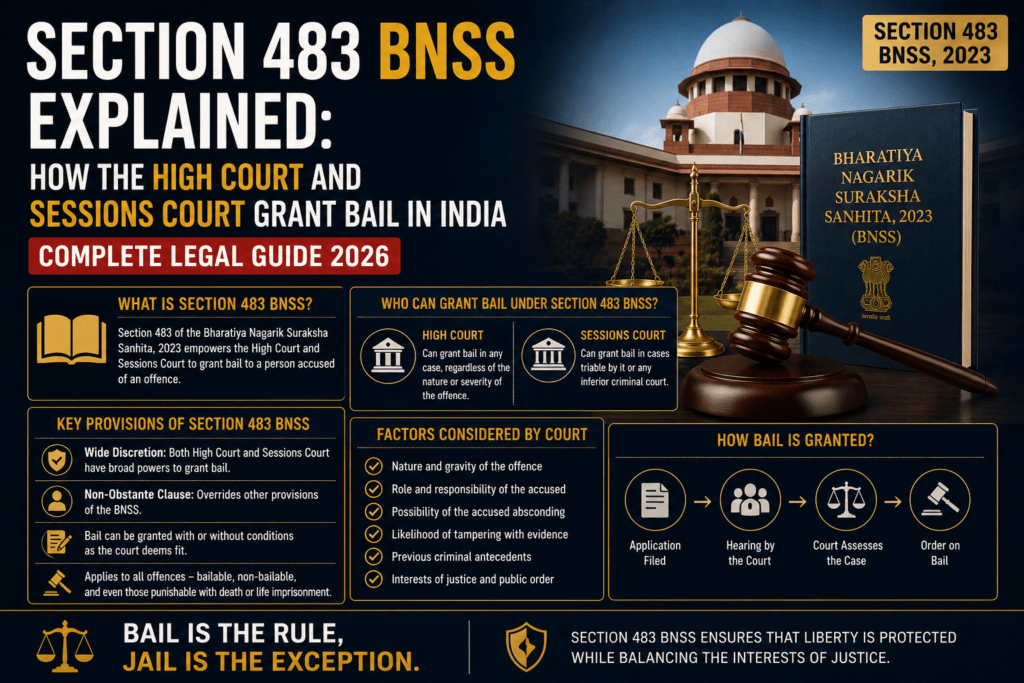
Section 483 of the Bharatiya Nagarik Suraksha Sanhita, 2023 confers special powers upon the High Court and the Court of Session regarding bail.
The provision empowers these courts to:
- Grant bail to a person accused of an offence and in custody;
- Impose conditions while granting bail;
- Modify or relax bail conditions;
- Set aside unreasonable conditions;
- Direct release of an accused where continued detention is not justified.
In simple terms, Section 483 acts as a powerful safeguard against unnecessary incarceration and ensures that personal liberty is protected by superior courts.
Why is Section 483 Important?
Not every accused person can obtain bail from a Magistrate.
Many serious offences involve allegations that require consideration by higher courts.
Section 483 ensures that a person is not left without a remedy merely because the offence is serious or because bail has been denied at a lower level.
The provision reflects the constitutional commitment to liberty and fairness.
It serves as a judicial check against arbitrary detention and prolonged incarceration.
The Constitutional Philosophy Behind Section 483
Section 483 cannot be understood without understanding Article 21 of the Constitution of India.
Article 21 guarantees that no person shall be deprived of life or personal liberty except according to procedure established by law.
The Supreme Court has repeatedly held that personal liberty is one of the most cherished constitutional rights.
A criminal accusation does not automatically make a person guilty.
Until guilt is established through a fair trial, every accused enjoys the presumption of innocence.
This constitutional philosophy forms the foundation of bail jurisprudence in India.
“Bail is the Rule, Jail is the Exception”
One of the most famous principles governing bail law is:
“Bail is the Rule, Jail is the Exception.”
This principle has guided Indian courts for decades.
The rationale is simple.
A person should not ordinarily be punished before conviction.
Pre-trial detention is justified only when it becomes necessary for the administration of justice.
Section 483 embodies this principle by empowering superior courts to intervene wherever liberty is being unnecessarily restricted.
When Can a Person Apply Under Section 483 BNSS?
An application under Section 483 may generally be filed when:
- The accused is in judicial custody;
- Bail has been refused by a lower court;
- The offence is non-bailable;
- The accused seeks regular bail from the Sessions Court or High Court;
- Exceptional circumstances justify release;
- Prolonged incarceration has occurred;
- Investigation is substantially complete.
The provision acts as a legal remedy for persons seeking release from custody pending trial.
What Factors Do Courts Consider While Granting Bail?
Grant of bail is not automatic.
The Court carefully evaluates various factors before exercising its discretion.
1. Nature and Gravity of the Offence
The seriousness of the allegations plays an important role.
More serious offences generally invite greater scrutiny.
2. Strength of the Prosecution Case
The Court may consider whether there is prima facie material connecting the accused to the offence.
3. Possibility of Absconding
The Court examines whether the accused is likely to flee from justice if released.
4. Chances of Tampering with Evidence
If release may adversely affect the investigation or trial, bail may be refused.
5. Influence Over Witnesses
The Court considers whether the accused may threaten, induce, or influence witnesses.
6. Criminal Antecedents
Previous criminal conduct may be relevant in assessing the risk posed by release.
7. Period of Custody
Long incarceration without conclusion of trial is often an important factor favouring bail.
8. Health and Humanitarian Considerations
Age, illness, medical conditions, and other humanitarian factors may also be considered.
Bail is a Matter of Judicial Discretion
One of the most important aspects of Section 483 is that bail is based on judicial discretion.
This does not mean arbitrary decision-making.
The discretion must be exercised:
- Fairly;
- Reasonably;
- Judicially;
- On settled legal principles.
Courts are required to balance individual liberty against the interests of society and the administration of justice.
Can Bail Be Granted in Serious Offences?
Yes.
A common misconception is that bail cannot be granted in serious offences.
The law does not impose such an absolute prohibition.
Even in cases involving grave allegations, courts may grant bail depending upon:
- Available evidence;
- Stage of investigation;
- Length of custody;
- Delay in trial;
- Individual circumstances of the accused.
Every case is assessed on its own merits.
Prolonged Incarceration and Bail
Modern bail jurisprudence increasingly recognizes that prolonged incarceration without conclusion of trial can itself become a ground for granting bail.
Criminal trials often take years to conclude.
Keeping an accused person behind bars indefinitely before conviction may undermine the constitutional guarantee of personal liberty.
Courts have therefore repeatedly emphasized that delay in trial is a relevant factor while considering bail applications.
Conditions That May Be Imposed While Granting Bail
The High Court or Sessions Court may impose conditions such as:
- Furnishing bail bonds;
- Providing sureties;
- Surrendering passport;
- Appearing before the investigating officer;
- Not leaving India without permission;
- Not contacting witnesses;
- Cooperating with the investigation and trial.
These conditions are intended to ensure that the accused remains available for the judicial process.
Can Bail Granted Under Section 483 Be Cancelled?
Yes.
Grant of bail does not provide permanent immunity from custody.
Bail may be cancelled if the accused:
- Violates bail conditions;
- Threatens witnesses;
- Tampers with evidence;
- Commits another offence;
- Attempts to evade the judicial process.
The power to cancel bail exists to protect the integrity of the criminal justice system.
Difference Between Section 482 and Section 483 BNSS
Many people confuse these two provisions.
Section 482 BNSS
Deals with anticipatory bail.
It is invoked before arrest when a person apprehends being arrested.
Section 483 BNSS
Deals primarily with regular bail powers of the High Court and Court of Session after arrest and custody.
In simple words:
Section 482 protects a person from arrest.
Section 483 helps secure release after arrest.
Frequently Asked Questions (FAQs)
Can the High Court grant bail directly?
Yes. Section 483 empowers the High Court to grant bail in appropriate cases.
Can the Sessions Court grant bail in serious offences?
Yes. Depending on the nature of allegations and facts of the case, the Sessions Court may grant bail.
Does grant of bail mean the accused is innocent?
No. Bail only allows temporary release during the pendency of proceedings.
Can a bail application be filed again after rejection?
Yes. A fresh bail application may be filed if there is a substantial change in circumstances.
Is long custody a ground for bail?
Yes. Prolonged incarceration and delay in trial are important considerations while deciding bail applications.
Practical Importance of Section 483 BNSS
For thousands of accused persons across India, Section 483 serves as the primary legal remedy for securing release from custody.
The provision plays a crucial role in:
- Protecting personal liberty;
- Preventing unnecessary detention;
- Ensuring fairness in criminal proceedings;
- Balancing societal interests with individual rights;
- Upholding constitutional values.
Without such a provision, many individuals would remain incarcerated for extended periods before their guilt is established.
Conclusion
Section 483 of the Bharatiya Nagarik Suraksha Sanhita, 2023 is much more than a procedural provision. It is a powerful legal safeguard designed to protect personal liberty and prevent unnecessary incarceration.
The provision empowers the High Court and the Court of Session to act as guardians of individual freedom while simultaneously ensuring that the interests of justice are protected.
At its core, Section 483 reflects a fundamental principle of Indian criminal law: an accused person remains innocent until proven guilty, and detention before conviction should never become a substitute for punishment.
Understanding the scope and importance of Section 483 BNSS is essential for every citizen because the right to liberty lies at the heart of a fair and democratic legal system.