
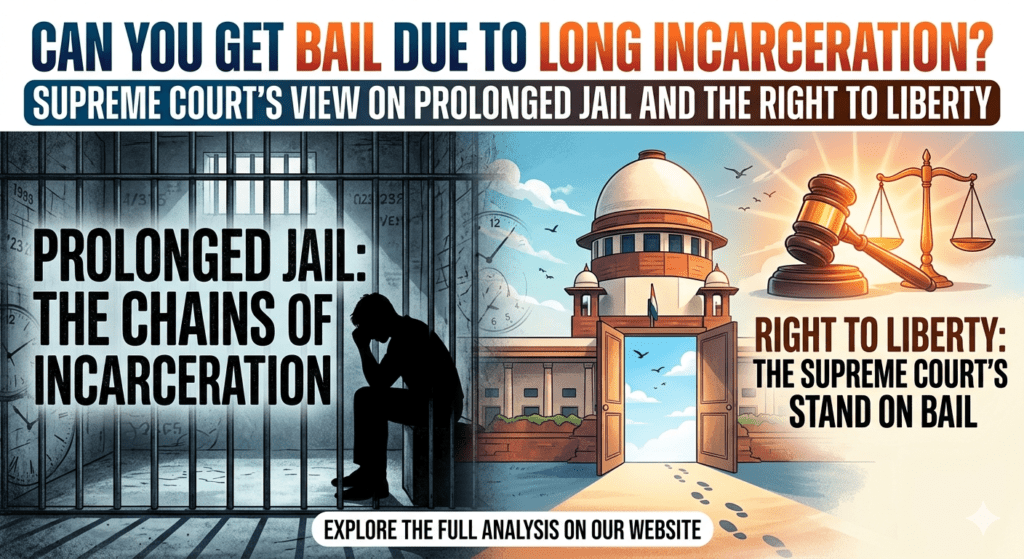
Introduction
Imagine spending years in jail without being convicted of any offence.
No judgment.
No finding of guilt.
No sentence.
Just waiting for your trial to conclude.
Unfortunately, this is a reality for thousands of undertrial prisoners across India. Criminal trials often take several years due to overloaded courts, lengthy investigations, and procedural delays. As a result, many accused persons remain behind bars for periods longer than the sentence they might ultimately receive if convicted.
Recognizing this serious problem, Indian courts have consistently held that prolonged incarceration can itself become a valid ground for granting bail.
In recent years, the Supreme Court and various High Courts have repeatedly emphasized that an accused person cannot be kept in custody indefinitely merely because the trial has not concluded.
This article explains the law relating to long incarceration and bail, the constitutional principles involved, important judicial precedents, Section 479 of the Bharatiya Nagarik Suraksha Sanhita, 2023 (BNSS), and why prolonged custody has become one of the strongest grounds for obtaining bail.
What is Long Incarceration?
In simple terms, long incarceration means prolonged detention of an accused person in jail before the conclusion of the trial.
The law does not prescribe a fixed number of months or years after which incarceration automatically becomes “long incarceration.”
Rather, courts examine:
- Total period spent in custody;
- Nature of allegations;
- Maximum punishment prescribed;
- Progress of trial;
- Number of witnesses examined;
- Reasons for delay;
- Possibility of trial concluding soon.
The longer a person remains in custody without conclusion of trial, the stronger becomes the argument for bail.
Why Does Long Incarceration Matter?
The answer lies in a simple but powerful legal principle:
An accused person is presumed innocent until proven guilty.
A criminal trial exists to determine guilt.
If a person spends years in jail before guilt is established, detention effectively becomes punishment before conviction.
The criminal justice system does not permit such a result except in exceptional circumstances.
Therefore, courts have repeatedly intervened to protect personal liberty where incarceration becomes excessive.
Constitutional Foundation: Article 21
The jurisprudence relating to long incarceration originates from Article 21 of the Constitution of India.
Article 21 guarantees:
No person shall be deprived of his life or personal liberty except according to procedure established by law.
The Supreme Court has interpreted Article 21 broadly to include:
- Right to personal liberty;
- Right to fair procedure;
- Right to speedy investigation;
- Right to speedy trial;
- Right against arbitrary detention.
When an accused remains in jail for an unreasonably long period and the trial does not conclude, Article 21 comes into direct play.
The Principle of Speedy Trial
One of the most important constitutional principles developed by Indian courts is the right to a speedy trial.
Justice delayed is not merely injustice to the victim.
It is also injustice to an accused person who remains incarcerated while waiting for the legal process to conclude.
The Supreme Court has repeatedly held that unreasonable delay in trial can violate fundamental rights.
This principle forms the backbone of modern bail jurisprudence relating to prolonged custody.
“Bail is the Rule, Jail is the Exception”
Indian bail jurisprudence is guided by a famous principle:
“Bail is the Rule, Jail is the Exception.”
This principle reflects the belief that liberty should ordinarily prevail unless detention is necessary.
When an accused has already spent several years in custody and the trial is nowhere near completion, continued detention becomes increasingly difficult to justify.
Courts therefore often consider prolonged incarceration as a significant factor favouring bail.
Supreme Court’s Approach Towards Long Incarceration
In recent years, the Supreme Court has repeatedly granted bail in cases where:
- The accused had spent substantial time in custody;
- The trial was progressing slowly;
- Large numbers of witnesses remained to be examined;
- The possibility of early conclusion of trial was remote.
The Court has consistently emphasized that incarceration pending trial should not become punitive in nature.
Even in serious criminal cases, prolonged custody has been treated as a relevant consideration while deciding bail applications.
Long Incarceration and Serious Offences
Many people believe that long incarceration becomes irrelevant in serious offences such as:
- Murder;
- Organised crime;
- Economic offences;
- Narcotics offences;
- Terror-related offences.
This is incorrect.
While the seriousness of the offence remains an important factor, courts have repeatedly recognized that prolonged incarceration cannot be ignored merely because the allegations are serious.
The balancing exercise becomes more delicate, but the right to personal liberty continues to remain relevant.
Every case is assessed on its own facts.
Section 479 BNSS: A Major Reform
One of the most significant provisions introduced under the Bharatiya Nagarik Suraksha Sanhita, 2023 is Section 479.
The provision seeks to address the problem of undertrial prisoners remaining in custody for excessive periods.
Broadly speaking, where an undertrial prisoner has undergone detention extending up to one-half of the maximum punishment prescribed for the offence, the Court may direct release on bail, subject to statutory conditions and exceptions.
The provision reflects legislative recognition of a long-standing problem within the criminal justice system.
Its objective is clear:
No person should remain in prison indefinitely while waiting for trial to conclude.
Factors Considered by Courts While Granting Bail on the Ground of Long Incarceration
Long custody alone is important, but courts generally examine additional factors as well.
1. Duration of Custody
The actual period spent behind bars is the starting point.
2. Progress of Trial
Courts examine:
- Number of witnesses cited;
- Number of witnesses examined;
- Stage of evidence;
- Likelihood of early conclusion.
3. Maximum Punishment
If the accused has already spent a substantial portion of the maximum prescribed sentence in custody, courts are more likely to consider bail.
4. Delay Not Attributable to the Accused
Courts generally examine whether the delay has been caused by:
- Prosecution;
- Systemic factors;
- Court congestion;
or whether the accused himself is responsible.
5. Conduct of the Accused
Good conduct during incarceration may support a bail claim.
6. Possibility of Absconding
The Court evaluates whether release would adversely affect the judicial process.
Why Long Incarceration Strengthens a Bail Application
A bail application based on prolonged custody carries substantial legal force because it invokes constitutional considerations rather than merely factual arguments.
Such an application essentially argues:
- Liberty has already been curtailed for a significant period;
- Trial is not concluding soon;
- Continued detention serves no useful purpose;
- The accused remains presumed innocent;
- Article 21 requires protection of personal liberty.
These arguments often receive serious consideration from constitutional courts.
Can Bail Be Refused Despite Long Incarceration?
Yes.
Long incarceration is a strong ground, but not an automatic ground.
The Court may still refuse bail if:
- There is a significant threat to witnesses;
- The accused is likely to abscond;
- There is evidence of tampering with the investigation;
- Statutory restrictions apply;
- Exceptional circumstances justify continued detention.
Each case ultimately depends on its individual facts.
Practical Situations Where Long Incarceration Becomes Relevant
Courts frequently consider prolonged custody where:
- The accused has spent several years in prison;
- Charges have been framed but evidence has barely commenced;
- Hundreds of witnesses remain to be examined;
- Trial is expected to take many more years;
- The accused has no criminal antecedents;
- Investigation is already complete.
In such circumstances, continued incarceration often becomes difficult to justify.
Frequently Asked Questions (FAQs)
Is long incarceration a legal ground for bail?
Yes. Indian courts have repeatedly recognized prolonged custody as a relevant and important factor while considering bail.
Does long incarceration guarantee bail?
No. It is a strong consideration but not an absolute right.
Does this principle apply only to minor offences?
No. Courts have considered long incarceration even in serious criminal cases.
What constitutional right supports this principle?
Article 21 of the Constitution, which guarantees personal liberty and the right to a speedy trial.
Which provision of BNSS addresses prolonged detention of undertrial prisoners?
Section 479 of the Bharatiya Nagarik Suraksha Sanhita, 2023.
Conclusion
The law does not permit an accused person to be forgotten in prison while waiting endlessly for a trial to conclude. The constitutional promise of liberty under Article 21 requires that criminal proceedings move with reasonable speed and fairness.
Over the years, Indian courts have developed a strong jurisprudence recognizing that prolonged incarceration can become a compelling ground for grant of bail. The introduction of Section 479 BNSS further strengthens this principle by providing statutory safeguards against excessive detention of undertrial prisoners.
At its heart, the doctrine of long incarceration reflects a simple but fundamental truth: a person who has not yet been convicted should not be made to suffer punishment merely because the legal system is unable to conclude the trial within a reasonable time.
In a constitutional democracy governed by the rule of law, liberty cannot remain hostage to delay.