
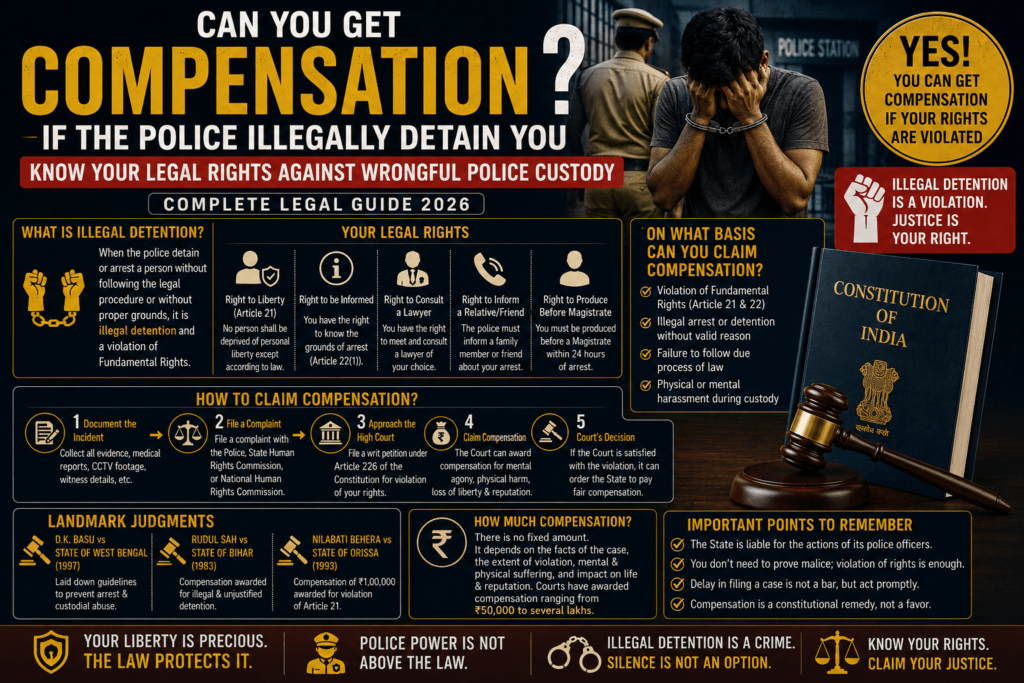
Introduction
Imagine being picked up by the police without any lawful reason.
You spend hours—or even days—in police custody.
You are not produced before a Magistrate within 24 hours.
Your family does not know where you are.
Your reputation suffers, your job is affected, and your mental peace is shattered.
Later, the Court finds that your detention was illegal.
Now the question is:
Can you claim compensation from the Government or the Police?
The answer is Yes.
Indian law recognises that when the State unlawfully deprives a person of his or her liberty, monetary compensation may be awarded as a remedy for the violation of fundamental rights.
Over the years, the Supreme Court and various High Courts have developed a powerful body of law holding that illegal detention is not merely a procedural mistake—it is a constitutional wrong.
This article explains the law relating to compensation for illegal detention, the constitutional principles behind it, landmark judicial developments, available legal remedies, and the circumstances in which compensation may be awarded.
What is Illegal Detention?
Illegal detention means keeping a person in custody without lawful authority or in violation of the procedure established by law.
Examples include:
- Arrest without legal authority.
- Failure to inform the grounds of arrest.
- Failure to produce the arrested person before a Magistrate within 24 hours.
- Continuing custody without a valid remand order.
- Detention after the expiry of authorised custody.
- Secret or unofficial police custody.
- Detention motivated by malice or abuse of power.
Whenever the State deprives a person of liberty contrary to law, the detention becomes unlawful.
Can You Really Claim Compensation?
Yes.
One of the most remarkable developments in Indian constitutional law is the recognition that fundamental rights must have effective remedies.
If a person’s liberty has been unlawfully taken away by the State, merely declaring the detention illegal may not be enough.
Courts have repeatedly held that where there is a gross violation of fundamental rights, monetary compensation may be awarded to provide immediate public law relief.
The Constitutional Foundation
The right to claim compensation is rooted in the Constitution of India.
Article 21 – Right to Life and Personal Liberty
Article 21 provides:
No person shall be deprived of his life or personal liberty except according to procedure established by law.
The Supreme Court has interpreted this provision broadly.
The expression “life” means much more than mere physical existence.
It includes:
- Human dignity.
- Personal freedom.
- Reputation.
- Privacy.
- Freedom from arbitrary detention.
When these rights are violated by the State, constitutional courts may grant compensation.
Article 22 – Protection Against Arbitrary Arrest
Article 22 guarantees important safeguards to every arrested person, including:
- The right to know the grounds of arrest.
- The right to consult a lawyer.
- The right to be produced before a Magistrate within 24 hours.
Violation of these safeguards strengthens the claim that the detention was unconstitutional.
The Jurisprudence of Constitutional Compensation
Many people believe that compensation can only be claimed by filing a civil suit.
That is not entirely correct.
The Supreme Court has evolved the doctrine of constitutional compensation, also known as a public law remedy, under Articles 32 and 226 of the Constitution.
This means that constitutional courts can award monetary compensation directly where there has been a clear and serious violation of fundamental rights by State authorities.
The purpose is not merely to compensate the victim but also to ensure that public authorities remain accountable for unlawful actions.
Constitutional Compensation vs Civil Damages
This distinction is important.
Constitutional Compensation
- Awarded by the High Court or Supreme Court.
- Based on violation of fundamental rights.
- Public law remedy.
- Intended to provide immediate relief.
Civil Damages
- Claimed through a civil suit.
- Based on tort or other civil causes of action.
- Requires a separate trial.
- May involve detailed evidence regarding loss and damages.
A person may, in appropriate cases, pursue both remedies.
Why Do Courts Award Compensation?
Compensation is not awarded merely because an arrest has taken place.
It is awarded where there has been a serious abuse of State power.
The objectives include:
Protecting Personal Liberty
Liberty is one of the highest constitutional values.
Holding Public Authorities Accountable
State officials must act within the limits of law.
Preventing Abuse of Police Powers
Compensation discourages arbitrary arrests and unlawful detention.
Restoring Public Confidence
Courts ensure that constitutional rights remain meaningful and not merely theoretical.
In What Situations Can Compensation Be Awarded?
Although every case depends on its own facts, compensation may be considered where there is:
- Illegal detention.
- Custodial violence.
- Detention beyond the authorised period.
- Failure to produce the accused before a Magistrate within 24 hours.
- Arrest without following mandatory legal safeguards.
- Violation of Article 21 or Article 22.
- Mala fide or malicious exercise of police powers.
The more serious the violation, the stronger the case for constitutional compensation.
Does Every Illegal Arrest Result in Compensation?
No.
Compensation is not automatic.
Courts examine several factors, including:
- Nature of the violation.
- Duration of illegal detention.
- Conduct of the police.
- Impact on the victim.
- Whether the violation was deliberate, reckless, or technical.
- Overall facts and circumstances.
The court exercises its discretion carefully.
Important Principles Developed by Indian Courts
Over the years, constitutional courts have evolved certain well-settled principles.
1. Liberty is Priceless
No amount of money can truly compensate for the loss of personal liberty.
Compensation is therefore symbolic as well as remedial.
2. Rights Without Remedies Are Meaningless
A constitutional right must have an effective remedy.
Otherwise, it becomes an empty promise.
3. The State is Accountable
When public officials misuse legal powers, the State cannot simply deny responsibility.
Courts have repeatedly held that the Government must answer for serious violations of fundamental rights.
4. Compensation Promotes Good Governance
Awarding compensation sends a clear message that abuse of power will not be tolerated.
It also encourages better policing and respect for constitutional values.
How Can You Claim Compensation?
Depending upon the facts, a person may approach:
The High Court under Article 226
Seeking:
- Declaration that detention was illegal.
- Compensation.
- Departmental action.
- Other appropriate directions.
The Supreme Court under Article 32
Where there has been a direct violation of fundamental rights.
Civil Court
For damages arising out of wrongful detention, mental agony, loss of reputation, or financial loss.
Can Police Officers Be Personally Liable?
In appropriate cases, courts may direct:
- Departmental inquiry.
- Disciplinary action.
- Criminal investigation where warranted.
- Recovery of compensation from erring officials in accordance with law.
Police officers are expected to exercise their powers responsibly and within constitutional limits.
Practical Tips If You Have Been Illegally Detained
If you believe that you have been unlawfully detained:
- Preserve all documents relating to your arrest.
- Record the dates and times of detention and release.
- Obtain copies of remand orders, if any.
- Collect medical records if you suffered injuries.
- Speak to a lawyer immediately.
- File an appropriate petition before the High Court where necessary.
Early legal action often strengthens the case.
Myth vs Reality
| Myth | Reality |
|---|---|
| Police can never be ordered to pay compensation. | False. Constitutional courts have repeatedly awarded compensation for serious violations of fundamental rights caused by unlawful detention. |
| Only rich or influential people can get compensation. | Incorrect. Every citizen enjoys the same constitutional protection, regardless of status or background. |
| If the criminal case continues, compensation cannot be claimed. | Wrong. The legality of detention and the merits of the criminal case are separate issues. |
| Compensation is automatic whenever someone is arrested. | False. It is awarded only where there is an unlawful or unconstitutional deprivation of liberty or another serious violation of rights. |
| An apology from the police ends the matter. | Not necessarily. Courts may still grant compensation and issue directions if constitutional rights have been violated. |
Frequently Asked Questions (FAQs)
Can I claim compensation if I was illegally detained by the police?
Yes. If your detention violated constitutional or statutory safeguards, you may seek compensation before the appropriate court.
Which court can award compensation?
The High Court under Article 226 and the Supreme Court under Article 32 may award constitutional compensation in appropriate cases. Civil courts may also award damages in suitable proceedings.
Will every illegal arrest result in compensation?
No. The court examines the seriousness of the violation, its impact, and all surrounding circumstances before granting relief.
Can I seek compensation even if the criminal case is still pending?
Yes. The issue of illegal detention is distinct from the question of guilt or innocence in the criminal case.
Can compensation be claimed along with bail or other remedies?
Yes. Depending on the facts, a person may seek bail, challenge the legality of detention, and pursue compensation through appropriate legal proceedings.
Conclusion
The power to arrest is one of the most significant powers entrusted to the State, but it is not an unlimited power. Every arrest and every period of detention must comply with the Constitution and the law.
When the police or any public authority unlawfully deprives a person of liberty, the injury is not merely personal—it is constitutional. Recognising this, Indian courts have evolved the doctrine of constitutional compensation to ensure that fundamental rights remain real, effective, and enforceable.
While no amount of money can truly restore the lost days, damaged reputation, or emotional trauma caused by illegal detention, compensation serves a vital purpose. It acknowledges the wrong suffered by the victim, holds the State accountable, and reinforces the principle that no authority is above the Constitution.
In a democracy governed by the rule of law, liberty is not a privilege granted by the State—it is a fundamental right. And when that right is violated, the law provides not only a remedy but also a measure of justice.