
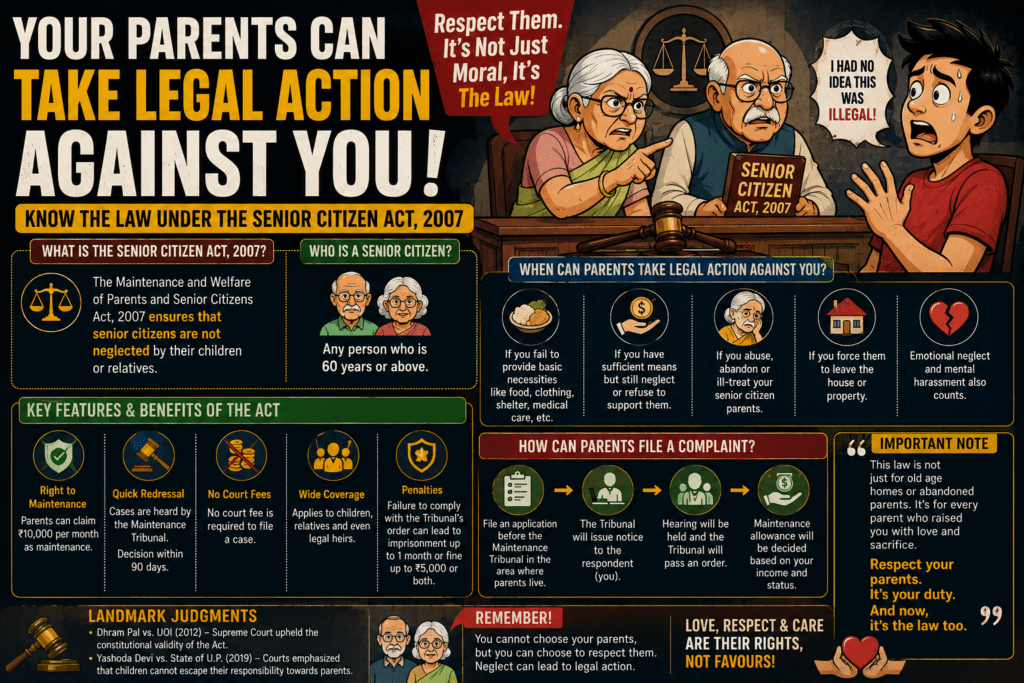
Introduction
Many people believe that taking care of ageing parents is only a moral responsibility.
But did you know that in India, it is also a legal obligation?
If children neglect, abandon, or refuse to maintain their parents, the law empowers senior citizens to seek maintenance, reclaim property in certain situations, and even initiate legal proceedings against their own children.
The Maintenance and Welfare of Parents and Senior Citizens Act, 2007 was enacted to ensure that elderly parents and senior citizens are not left helpless during the later years of their lives. The Act recognises that every senior citizen deserves to live with dignity, security, and respect.
This article explains the complete law relating to the Senior Citizen Act, 2007, the legal obligations of children and relatives, maintenance rights, property disputes, eviction, important judicial principles, and common myths surrounding the legislation.
What is the Senior Citizen Act, 2007?
The Maintenance and Welfare of Parents and Senior Citizens Act, 2007 is a welfare legislation enacted to protect parents and senior citizens from neglect, abandonment, and financial insecurity.
Its primary objectives are:
- To ensure maintenance of parents and senior citizens.
- To provide a simple and speedy legal remedy.
- To protect elderly persons from exploitation.
- To promote dignity and welfare in old age.
The Act is a social welfare legislation and therefore receives a liberal interpretation from courts to advance its purpose.
Who Can Claim Protection Under the Act?
The Act applies to:
Parents
Both biological and adoptive parents are entitled to seek maintenance.
The law also covers step-parents in appropriate cases.
Senior Citizens
A senior citizen generally means a person who has attained the age of 60 years or above.
Even if a senior citizen has no children, certain relatives who are expected to inherit the property may, in appropriate cases, have maintenance obligations under the Act.
Is It a Legal Duty to Maintain Parents?
Yes.
One of the most important features of the Act is that it creates a legal obligation upon children and, in certain circumstances, relatives to maintain parents and senior citizens who are unable to maintain themselves.
Maintenance is not limited to money alone.
It includes providing for the basic necessities of life, such as:
- Food;
- Clothing;
- Residence;
- Medical treatment;
- Daily care and support.
The objective is to ensure that elderly persons can live a life of dignity.
Can Parents File a Case Against Their Children?
Absolutely.
If children neglect or refuse to maintain their parents, the parents may approach the Maintenance Tribunal established under the Act.
The Tribunal has the power to:
- Hear the complaint.
- Conduct summary proceedings.
- Pass maintenance orders.
- Grant appropriate relief.
The procedure is designed to be quicker and less complicated than ordinary civil litigation.
What is the Maintenance Tribunal?
The Maintenance Tribunal is a special forum created under the Act for speedy disposal of disputes relating to maintenance of parents and senior citizens.
Unlike lengthy civil proceedings, the Tribunal follows a summary procedure so that elderly persons are not forced to spend years seeking relief.
This reflects the welfare-oriented nature of the legislation.
Can Parents Claim Monthly Maintenance?
Yes.
Where parents or senior citizens are unable to maintain themselves from their own income or property, they may seek maintenance from their children or relatives who are legally bound to support them.
The amount awarded depends upon the facts and circumstances of each case, including the financial capacity of the person liable to pay.
The purpose is not to punish children but to ensure that elderly parents can live with dignity.
Can Parents Evict Their Children From Their Property?
This is one of the most frequently asked questions.
The answer is:
Yes, in appropriate cases.
Where children or relatives occupy the property of senior citizens and subject them to harassment, abuse, intimidation, or neglect, many States have framed Rules empowering authorities to order eviction in appropriate circumstances.
Courts have repeatedly recognised that senior citizens should not be compelled to live in fear or humiliation inside their own homes.
However, every case depends upon its own facts, the applicable State Rules, and the nature of the property rights involved.
What Happens if Parents Transfer Property to Their Children?
Many elderly parents transfer their house or property to their children believing that they will be looked after in return.
Unfortunately, in some cases, the children stop caring for the parents after receiving the property.
To address this problem, the Act contains an important safeguard.
Where property is transferred subject to the condition that the transferee will provide basic amenities and physical needs to the transferor, and the transferee fails to do so, the transfer may be declared void in accordance with the provisions of the Act.
This protection discourages exploitation of elderly persons.
The Jurisprudence Behind the Act
The philosophy behind the legislation extends beyond family obligations.
Indian courts have repeatedly observed that:
Parents Deserve to Live With Dignity
Old age should not become a period of neglect or humiliation.
The law seeks to preserve dignity and self-respect.
Welfare Legislation Must Receive Liberal Interpretation
Since the Act is beneficial legislation, courts generally interpret it in favour of protecting senior citizens.
Family Responsibility Has Legal Recognition
The Act transforms what was traditionally regarded as a moral duty into a legally enforceable obligation.
Property Cannot Become a Tool of Exploitation
The law discourages situations where children obtain property from elderly parents but thereafter neglect or abandon them.
Does the Act Override Family Disputes?
The existence of family disagreements does not automatically defeat the rights of senior citizens.
Courts examine:
- Whether neglect exists;
- Whether maintenance is required;
- Whether the senior citizen is unable to maintain himself or herself;
- Whether the statutory requirements are satisfied.
The welfare of the senior citizen remains the primary consideration.
Rights of Senior Citizens Under the Act
Senior citizens enjoy several important rights, including:
- Right to seek maintenance.
- Right to approach the Maintenance Tribunal.
- Right to live with dignity.
- Right to seek protection against neglect.
- Right to challenge certain property transfers made on conditions of care and maintenance.
- Right to seek relief in accordance with the Act and applicable Rules.
Duties of Children and Relatives
Children are expected to:
- Provide financial support where required.
- Ensure proper food and shelter.
- Arrange necessary medical care.
- Treat parents with dignity and respect.
- Avoid abandonment or neglect.
- Honour commitments made in return for transfer of property.
These duties are both moral and legal.
Can the Act Be Misused?
Like every law, allegations of misuse may arise.
However, courts decide each case on the basis of evidence.
Relief is not granted merely because allegations are made.
The Tribunal examines the facts, hears both sides, and then passes appropriate orders.
The existence of possible misuse does not diminish the importance of protecting genuinely vulnerable senior citizens.
Myth vs Reality
| Myth | Reality |
|---|---|
| Looking after parents is only a moral duty. | False. Under the Maintenance and Welfare of Parents and Senior Citizens Act, 2007, it is also a legal obligation in appropriate cases. |
| Only fathers can claim maintenance. | Incorrect. Mothers, fathers, and eligible senior citizens can seek relief under the Act. |
| Parents must first file a civil suit. | Wrong. The Act provides a specialised Maintenance Tribunal for quicker relief. |
| If parents gifted their property to their children, they can never get it back. | False. In certain circumstances, a transfer made subject to the condition of providing care and maintenance may be declared void if that condition is breached. |
| Senior citizens have no remedy if they are harassed in their own house. | Incorrect. Depending on the facts and applicable State Rules, they may seek legal protection, maintenance, and other relief, including eviction of abusive occupants in appropriate cases. |
Frequently Asked Questions (FAQs)
Can parents legally claim maintenance from their children?
Yes. If they are unable to maintain themselves and the statutory conditions are fulfilled, they may approach the Maintenance Tribunal.
Can a mother file a case against her son or daughter?
Yes. The Act applies equally to eligible mothers and fathers.
Can senior citizens cancel a property transfer?
In appropriate cases, yes. Where property was transferred subject to the condition that the transferee would provide care and maintenance, and that obligation is not honoured, the transfer may be declared void under the Act.
Can parents evict a son or daughter from their house?
Depending on the facts of the case, the nature of the property, and the applicable State Rules, authorities may order eviction where the law permits and the circumstances justify such relief.
Is this Act applicable only to poor parents?
No. The Act is intended to protect all eligible parents and senior citizens who satisfy the statutory requirements, irrespective of their social status.
Conclusion
The Maintenance and Welfare of Parents and Senior Citizens Act, 2007 is more than just another statute—it is a recognition that every parent deserves to spend the later years of life with dignity, security, and respect.
The Act acknowledges that caring for parents is not merely a matter of emotion or tradition; in appropriate circumstances, it is a legal responsibility. By providing speedy remedies for maintenance, protecting elderly persons from neglect, and safeguarding them against exploitation in property matters, the law seeks to restore confidence and security to senior citizens.
At the same time, the Act is not intended to punish children indiscriminately. It aims to strike a fair balance between the rights of parents and the legitimate interests of family members, with the ultimate objective of ensuring justice, compassion, and dignity.
A society is judged not only by how it treats its children, but also by how it honours and protects its elderly. The Senior Citizen Act, 2007 is a legal reminder of that enduring responsibility.