
Introduction
Many parents spend their entire lives building a home for their children.
Out of love and affection, they often transfer their house by executing a gift deed, believing that their children will look after them in old age.
Unfortunately, reality is sometimes very different.
After the property is transferred, some parents are neglected, harassed, or even forced to leave their own homes.
This raises one of the most frequently asked legal questions in India:
“Can parents cancel an unconditional gift deed under the Senior Citizen Act, 2007?”
Many people immediately answer “Yes.”
Many others confidently say “No.”
The truth is far more nuanced.
The answer depends upon Section 23 of the Maintenance and Welfare of Parents and Senior Citizens Act, 2007, the language of the gift deed, the surrounding circumstances, and the facts of each case.
This article explains the complete legal position, the jurisprudence developed by Indian courts, the rights of senior citizens, and the common misconceptions surrounding cancellation of gift deeds.
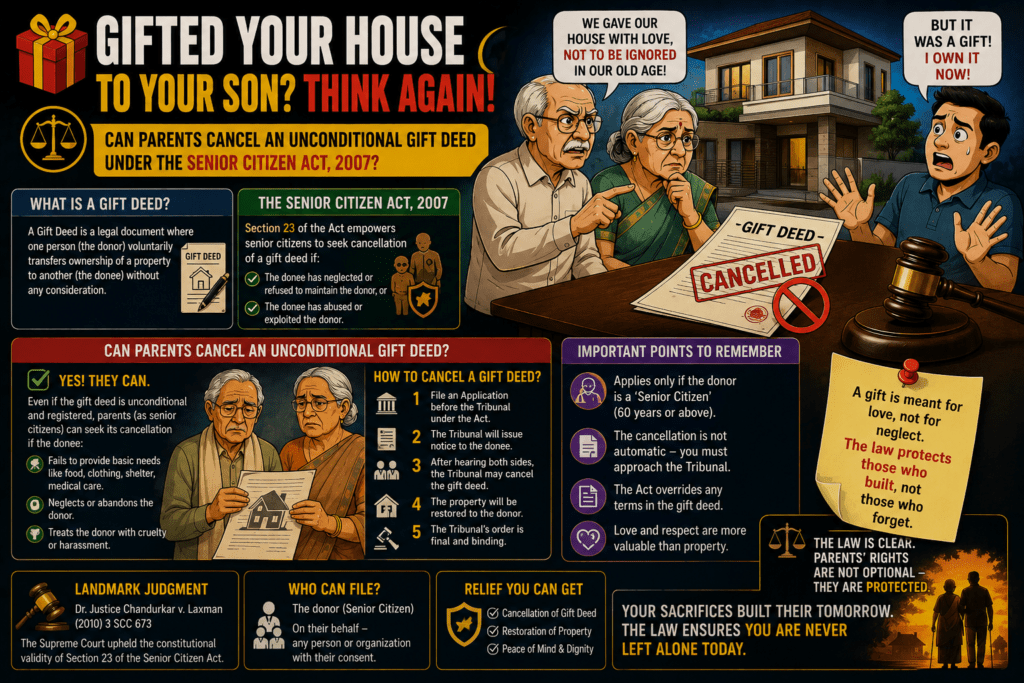
What is a Gift Deed?
A gift deed is a legal document through which one person voluntarily transfers ownership of property to another without receiving any monetary consideration.
Once a valid gift deed is:
- Executed,
- Accepted by the donee, and
- Registered (where registration is required),
ownership generally passes to the recipient.
Ordinarily, a valid gift cannot be revoked simply because the donor later changes his or her mind.
However, the Senior Citizen Act creates an important statutory protection in certain situations.
What Does Section 23 of the Senior Citizen Act Say?
Section 23 provides that where a senior citizen has transferred property subject to the condition that the transferee will provide the basic amenities and physical needs of the transferor, and the transferee refuses or fails to fulfil that condition, the transfer may be declared void by the Tribunal.
The provision protects elderly persons from being exploited after transferring their property.
Its object is to ensure that parents are not abandoned after giving away their life’s savings or family home.
Does Section 23 Automatically Apply to Every Gift Deed?
No.
This is perhaps the biggest misconception.
The Act does not state that every gift deed executed by a senior citizen can automatically be cancelled.
The law requires the Tribunal to examine whether the statutory requirements of Section 23 are satisfied.
What is an Unconditional Gift Deed?
An unconditional gift deed is one in which the donor transfers ownership without imposing any express condition upon the recipient.
For example:
“I hereby gift my property absolutely to my son.”
If the document contains no condition regarding maintenance, residence, care, or basic amenities, it is generally described as an unconditional gift.
Can an Unconditional Gift Deed Be Cancelled?
The legal position is not always straightforward.
General Rule
Ordinarily, if a gift deed is genuinely unconditional and contains no express or implied obligation relating to the care or maintenance of the senior citizen, Section 23 may not be attracted merely because relations later become strained.
The Senior Citizen Act is not intended to rewrite every unconditional transfer of property.
But There is an Important Qualification
Indian courts have repeatedly observed that the Tribunal should not examine the document in isolation.
The surrounding circumstances also matter.
In appropriate cases, courts have recognised that the obligation to provide care and maintenance may arise not only from the written document but also from the overall understanding between the parties.
Accordingly, some courts have accepted that the condition contemplated by Section 23 may, depending on the facts, be express or implied.
Therefore, every case is decided on its own facts.
Why Did Parliament Enact Section 23?
The legislature recognised a common social problem.
Parents often transfer:
- Houses,
- Agricultural land,
- Family property,
- Savings,
to their children expecting care and support in old age.
Unfortunately, in many cases, the transfer is followed by:
- Neglect,
- Harassment,
- Eviction,
- Emotional abuse,
- Financial exploitation.
Section 23 was enacted to prevent such exploitation and to restore dignity to senior citizens.
The Jurisprudence Behind Section 23
Indian courts have developed several important principles while interpreting this provision.
1. The Act is a Welfare Legislation
The Senior Citizen Act is a beneficial statute.
Its provisions are interpreted liberally to protect elderly persons from neglect and exploitation.
2. Welfare Cannot Override Clear Property Law in Every Case
Although the Act is beneficial legislation, it does not automatically invalidate every transfer made by a senior citizen.
Property rights acquired through a valid transfer are also recognised by law.
Courts therefore attempt to balance:
- Protection of senior citizens, and
- Certainty of property transactions.
3. The Purpose of Section 23 is to Prevent Exploitation
The provision is intended to prevent situations where elderly parents are induced to transfer property on the assurance that they will be looked after, only to be abandoned thereafter.
4. Every Case Depends Upon Its Facts
No universal rule applies.
Courts consider:
- The wording of the gift deed.
- Whether maintenance was part of the understanding.
- Conduct of the parties.
- Evidence of neglect.
- The overall circumstances surrounding the transfer.
What Factors Do Tribunals and Courts Consider?
While deciding whether a transfer should be declared void, authorities may examine:
- Whether the transferor is a senior citizen.
- Whether property was transferred voluntarily.
- Whether maintenance formed part of the arrangement.
- Whether basic amenities have been denied.
- Whether neglect or abandonment has occurred.
- Whether the statutory conditions of Section 23 are satisfied.
Each case is decided independently.
Can Parents Still Have Other Legal Remedies?
Yes.
Even where Section 23 may not apply, parents may have other legal remedies depending upon the facts.
These may include:
- Claiming maintenance under the Senior Citizen Act.
- Seeking eviction under applicable State Rules, where permissible.
- Filing civil proceedings where fraud, coercion, undue influence, or misrepresentation is alleged.
- Seeking injunctions or other appropriate relief.
The availability of one remedy does not always exclude another.
Practical Advice Before Executing a Gift Deed
Parents should never transfer valuable property without carefully considering future consequences.
Where the intention is that the child should provide care and maintenance, it is advisable to clearly record appropriate conditions in the document itself.
Proper legal drafting can avoid years of litigation.
Myth vs Reality
| Myth | Reality |
|---|---|
| Every gift deed executed by parents can be cancelled under the Senior Citizen Act. | False. Section 23 applies only where its statutory requirements are satisfied. |
| If the gift deed is unconditional, parents can never get the property back. | Not always. The issue depends on the facts, the nature of the transaction, and the interpretation of Section 23 by the Tribunal or Court. |
| Children automatically become absolute owners forever after receiving a gift deed. | Not necessarily. In appropriate cases, the transfer may be challenged under the Senior Citizen Act or under general civil law, depending on the facts. |
| The Tribunal only reads the gift deed and ignores everything else. | Incorrect. Courts have recognised that surrounding circumstances and the relationship between the parties may also be relevant. |
| The Senior Citizen Act overrides every property law in India. | Wrong. Courts attempt to harmonise the Act with established principles of property law while protecting senior citizens from exploitation. |
Frequently Asked Questions (FAQs)
Can parents cancel a gift deed merely because they had a dispute with their children?
Generally, No. A family dispute alone does not automatically permit cancellation under Section 23.
Is an express maintenance clause always necessary?
Not necessarily. Courts have, in appropriate cases, examined whether the obligation to provide care and maintenance can be inferred from the overall facts and circumstances.
Can parents approach the Maintenance Tribunal?
Yes. Where the statutory conditions are fulfilled, they may seek relief before the Tribunal established under the Act.
Can a civil court also be approached?
Yes. Depending upon the facts, remedies under general property law, contract law, or other civil principles may also be available.
Does every neglect by children result in cancellation of the gift deed?
No. The Tribunal or Court must examine whether the legal requirements of Section 23 are satisfied before declaring a transfer void.
Conclusion
A gift deed is a serious legal document that ordinarily transfers ownership permanently. However, the Maintenance and Welfare of Parents and Senior Citizens Act, 2007 recognises that elderly parents should not become victims of exploitation after parting with their property.
Section 23 provides an important safeguard, but it is not a blanket power to cancel every gift deed. The law requires a careful examination of the nature of the transfer, the conditions attached to it, the conduct of the parties, and the surrounding circumstances.
The guiding principle developed by Indian courts is one of balance. The law seeks to protect senior citizens from neglect and abuse while also respecting the certainty of genuine property transactions.
For parents, the lesson is clear: never execute a gift deed without understanding its legal consequences. For children, the message is equally important: a property gifted out of love carries not only ownership but also a responsibility to treat one’s parents with dignity, care, and respect.
Property can be gifted—but trust should never be taken for granted.