Introduction
For many parents, gifting their house or other valuable property to their children is an emotional decision. It is often done out of love, trust, and the belief that their children will care for them in their old age.
But what happens when that trust is broken?
Unfortunately, many senior citizens find themselves neglected, harassed, or even forced out of the very home they once gifted to their children.
This naturally raises an important legal question:
Can parents revoke or cancel a gift deed if their children stop taking care of them?
The answer is Yes—but not in every case.
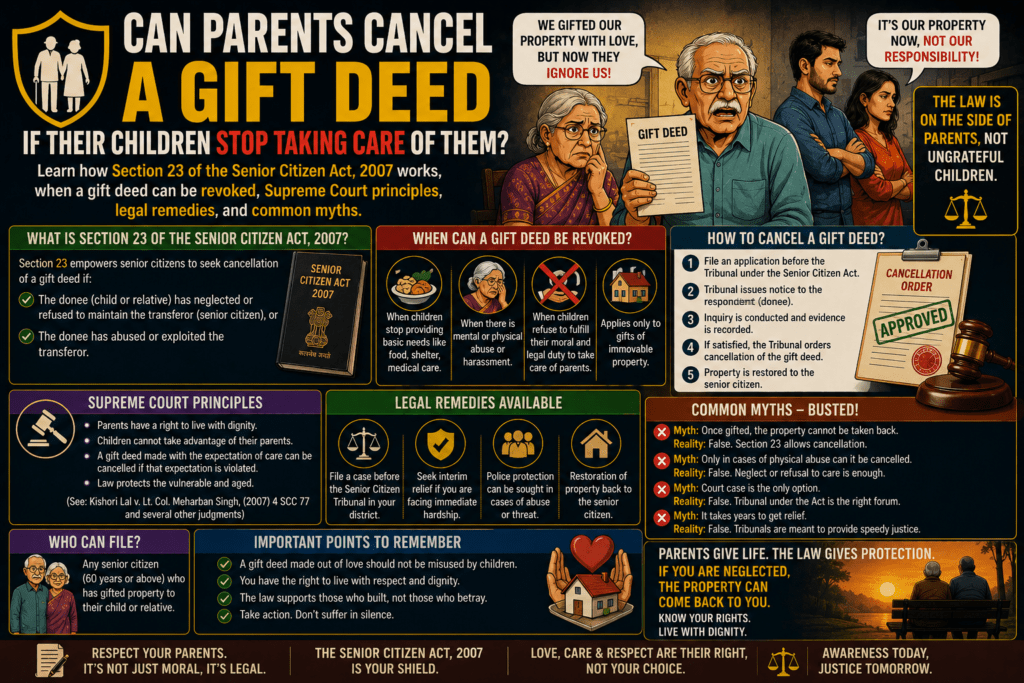
The Maintenance and Welfare of Parents and Senior Citizens Act, 2007 gives important legal protection to senior citizens. Under certain circumstances, a gift deed executed in favour of children or relatives can be declared void by the Maintenance Tribunal.
However, this is not an automatic right. Courts examine the nature of the gift, the intention behind it, and whether the legal requirements of Section 23 are satisfied.
In this article, we explain everything you need to know about cancelling a gift deed under the Senior Citizen Act, the latest legal position, important judicial principles, practical remedies, and common misconceptions.
Why Do Parents Gift Their Property?
In India, parents often transfer property to their children:
- Out of love and affection.
- To avoid future inheritance disputes.
- As part of family arrangements.
- With the expectation that their children will look after them during old age.
Sadly, in some cases, once the property is transferred, the parents are neglected, abused, or left without financial or emotional support.
To protect such vulnerable senior citizens, Parliament enacted the Maintenance and Welfare of Parents and Senior Citizens Act, 2007.
What Does Section 23 of the Senior Citizen Act Say?
Section 23 is one of the most powerful provisions under the Act.
It provides that where a senior citizen transfers property subject to the condition that the transferee shall provide basic amenities and physical needs, and the transferee fails to fulfil that obligation, the transfer may be declared void by the Maintenance Tribunal.
The purpose of this provision is simple:
No senior citizen should lose both their property and their dignity.
Can Parents Cancel Every Gift Deed?
No.
This is the biggest misconception.
The Act does not say that every gift deed executed by parents automatically becomes cancellable if family relations later deteriorate.
Instead, the Tribunal examines whether the statutory requirements of Section 23 are satisfied.
The law protects senior citizens from exploitation, not from every family disagreement.
Does the Gift Deed Have to Contain a Maintenance Clause?
Not necessarily.
Many people believe that unless the gift deed expressly states:
“The son shall maintain his parents.”
the property can never be recovered.
That is not always correct.
Indian courts have repeatedly observed that the obligation to maintain parents may, in appropriate cases, be gathered not only from the document itself but also from the surrounding facts, the conduct of the parties, and the understanding under which the property was transferred.
Whether such an implied condition exists depends entirely on the evidence and the facts of each case.
Why Did Parliament Introduce Section 23?
The legislature recognised a harsh social reality.
Many elderly parents were:
- Transferring houses to their children;
- Becoming financially dependent;
- Being neglected after the transfer;
- Being forced to leave their own homes.
Traditional civil litigation often took years.
The Senior Citizen Act therefore created a faster and welfare-oriented remedy through the Maintenance Tribunal.
The Jurisprudence Behind Section 23
Indian courts have developed several important legal principles while interpreting this provision.
1. The Act is a Social Welfare Legislation
The primary purpose of the Act is to protect elderly persons from neglect and exploitation.
Courts therefore interpret the Act liberally to achieve this objective.
2. Property Law and Welfare Law Must Be Balanced
A valid gift deed creates legal rights in favour of the donee.
However, those rights cannot be used as an instrument to exploit elderly parents.
Courts therefore attempt to balance:
- The sanctity of registered property transactions; and
- The welfare and dignity of senior citizens.
3. Dignity is the Central Theme
The Act is not merely about property.
It is about ensuring that senior citizens can live with:
- Respect;
- Security;
- Shelter;
- Medical care;
- Basic amenities.
Property becomes relevant only because it is often the source of exploitation.
4. Every Case Depends on Its Own Facts
There is no universal rule.
The Tribunal considers:
- The wording of the gift deed.
- The circumstances in which it was executed.
- Whether care and maintenance formed part of the arrangement.
- The conduct of the children after the transfer.
- Evidence of neglect or abandonment.
What Factors Will the Tribunal Consider?
Before declaring a gift deed void, the Tribunal may examine:
- Whether the transferor is a senior citizen.
- Whether the property was transferred voluntarily.
- Whether the transfer was linked to care and maintenance.
- Whether the children failed to provide basic amenities.
- Whether there is evidence of neglect or abuse.
- Whether the requirements of Section 23 are fulfilled.
No single factor is decisive.
What Happens if the Tribunal Cancels the Gift Deed?
If the Tribunal declares the transfer void under Section 23:
- The gift deed may cease to have legal effect.
- Ownership may revert to the senior citizen.
- The children may lose the rights acquired under the transfer.
- The senior citizen may regain legal control over the property.
The exact relief depends upon the order passed by the Tribunal.
Can Parents Seek Other Remedies?
Yes.
Even if cancellation is not granted, parents may still have several legal remedies, including:
- Maintenance proceedings under the Senior Citizen Act.
- Eviction of abusive occupants where permitted by applicable State Rules.
- Civil proceedings where fraud, coercion, undue influence, or misrepresentation is involved.
- Police protection in appropriate cases.
- Injunctions and other relief before competent courts.
Practical Advice Before Gifting Property
Before executing a gift deed, parents should:
- Obtain independent legal advice.
- Clearly understand the legal consequences.
- Consider whether the transfer should include conditions regarding maintenance and residence.
- Avoid executing documents under emotional pressure.
- Preserve copies of all relevant documents.
A carefully drafted gift deed can prevent years of litigation.
Myth vs Reality
| Myth | Reality |
|---|---|
| Parents can always cancel a gift deed whenever they want. | False. A valid gift deed cannot ordinarily be revoked at will. Relief under Section 23 depends on whether the statutory conditions are satisfied. |
| Children become absolute owners forever after receiving gifted property. | Not always. Where Section 23 applies, the Tribunal may declare the transfer void if the legal requirements are met. |
| A written maintenance clause is mandatory in every case. | Incorrect. Courts have, in appropriate cases, examined the overall facts and circumstances to determine whether the transfer was linked to an obligation of care and maintenance. |
| Every family dispute allows cancellation of the gift deed. | Wrong. Mere disagreement is not enough. The Tribunal looks for neglect, failure to provide basic amenities, and compliance with Section 23. |
| The Senior Citizen Act exists only to recover property. | False. The primary purpose of the Act is to protect the dignity, welfare, and maintenance of senior citizens. |
Frequently Asked Questions (FAQs)
Can parents cancel a gift deed after gifting property to their son or daughter?
Yes, but only in appropriate cases where the legal requirements of Section 23 of the Senior Citizen Act are fulfilled.
Can a gift deed be cancelled simply because the children stopped speaking to their parents?
Not necessarily. A strained relationship alone does not automatically justify cancellation.
Which authority decides whether the gift deed should be cancelled?
The Maintenance Tribunal constituted under the Senior Citizen Act ordinarily considers such applications.
Can parents recover their house after gifting it to their children?
Depending on the facts, the Tribunal may declare the transfer void under Section 23 if the statutory requirements are satisfied.
Is filing a civil suit the only option?
No. The Senior Citizen Act provides a specialised and comparatively speedier remedy before the Maintenance Tribunal, without prejudice to other remedies available in law.
Key Takeaways
- The Senior Citizen Act protects elderly parents from exploitation after transferring property.
- A gift deed is not automatically revocable merely because relations deteriorate.
- Section 23 allows cancellation only when its legal conditions are satisfied.
- Courts examine the intention behind the transfer, the surrounding circumstances, and the conduct of the parties.
- Parents may also have remedies for maintenance, eviction, or civil relief depending on the facts.
Conclusion
A house is often the most valuable asset a parent owns, but it is also a symbol of trust, sacrifice, and lifelong effort. The law recognises that no senior citizen should be left homeless or neglected after gifting property to the very children they sought to support.
The Maintenance and Welfare of Parents and Senior Citizens Act, 2007 provides a meaningful safeguard through Section 23, allowing the cancellation of certain gift deeds where children fail to honour their obligation to provide care and basic amenities. At the same time, the law respects the sanctity of genuine property transactions and therefore examines each case carefully on its own facts.
The lesson is simple: Parents should never transfer valuable property without understanding the legal consequences, and children should remember that property received through love carries with it a lifelong responsibility to care for those who made that gift possible.