
Introduction
Many people believe that if they are unhappy with a court order or have suffered injustice, they can simply go directly to the Supreme Court of India.
But is that really true?
Can any citizen directly file a case before the Supreme Court?
The answer is:
Yes—but only in certain situations.
The Supreme Court is the highest constitutional court in India. However, it is not the first court for every dispute. The Constitution carefully defines the types of cases in which a person can directly approach the Supreme Court and those in which one must first approach other courts or authorities.
One of the most important rights guaranteed by the Constitution is the right to approach the Supreme Court directly for the enforcement of Fundamental Rights. At the same time, ordinary civil disputes, criminal cases, family disputes, and property matters generally cannot be filed directly before the Supreme Court.
In this article, we explain when a citizen can directly approach the Supreme Court, the constitutional provisions governing its jurisdiction, important judicial principles, available remedies, and common misconceptions.
Is It Possible to Directly Approach the Supreme Court?
Yes.
But not every case can be filed directly before the Supreme Court.
Whether you can approach the Supreme Court directly depends upon:
- The nature of your grievance.
- The constitutional provision involved.
- The jurisdiction of the Supreme Court.
- The availability of an alternative legal remedy.
Why is the Supreme Court Called the Guardian of the Constitution?
The Supreme Court is not only India’s highest court—it is also the guardian and interpreter of the Constitution.
It ensures that:
- Fundamental Rights are protected.
- Constitutional authorities act within the law.
- The rule of law is maintained.
- Justice is delivered uniformly across the country.
Because of this constitutional role, the Supreme Court has special powers that no other court possesses.
Article 32 – The Heart and Soul of the Constitution
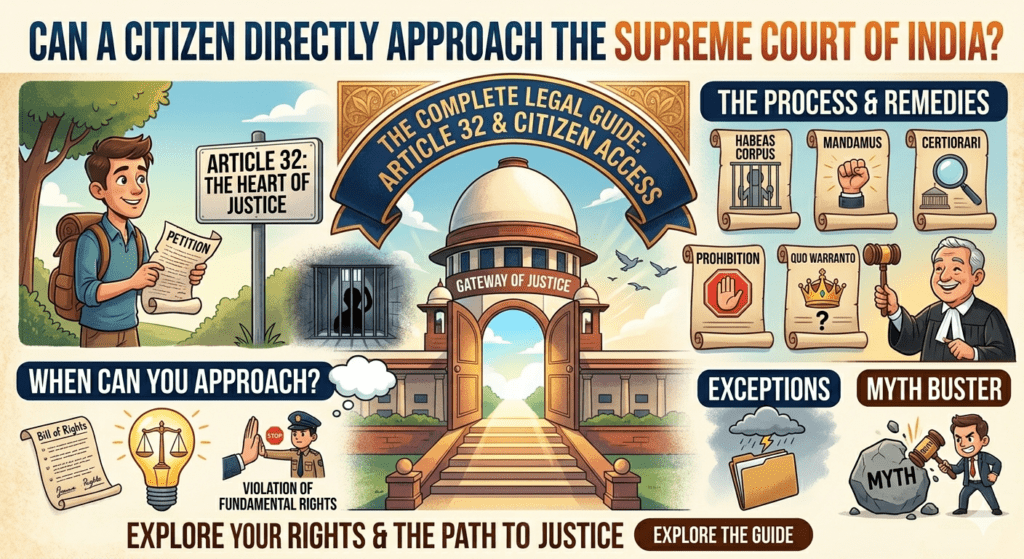
One of the most important provisions is Article 32 of the Constitution of India.
It guarantees every citizen the right to directly approach the Supreme Court for the enforcement of Fundamental Rights.
Dr. B. R. Ambedkar famously described Article 32 as the “heart and soul of the Constitution.”
This is because a right becomes meaningful only when there is an effective remedy to enforce it.
When Can You Directly Approach the Supreme Court?
A citizen may directly approach the Supreme Court in several situations.
1. Violation of Fundamental Rights
This is the most common ground.
If your Fundamental Rights guaranteed under Part III of the Constitution have been violated, you may invoke Article 32.
Examples include:
- Illegal detention.
- Violation of personal liberty.
- Freedom of speech violations.
- Discrimination by State authorities.
- Unlawful restrictions imposed by public authorities.
The Supreme Court may issue appropriate writs to protect those rights.
2. Public Interest Litigation (PIL)
In appropriate cases involving issues of public importance, a Public Interest Litigation may be filed before the Supreme Court.
Examples include:
- Environmental protection.
- Human rights violations.
- Prison reforms.
- Rights of disadvantaged communities.
- Constitutional issues affecting the public at large.
However, not every public grievance qualifies as a PIL. The Court discourages frivolous or publicity-oriented petitions.
3. Matters Falling Within the Supreme Court’s Original Jurisdiction
The Constitution also gives the Supreme Court original jurisdiction over certain disputes, such as disputes between:
- The Union and one or more States.
- Two or more States.
Such matters are filed directly before the Supreme Court because of their constitutional nature.
Can Every Criminal Case Be Filed Directly in the Supreme Court?
No.
This is one of the biggest misconceptions.
Ordinarily:
- A criminal case begins before the appropriate trial court.
- Appeals are heard by the Sessions Court or High Court, depending on the nature of the case.
- Only in appropriate circumstances does the matter reach the Supreme Court.
The Supreme Court is generally not the first forum for ordinary criminal prosecutions.
Can Every Civil Dispute Be Filed Directly?
Again, No.
Property disputes, recovery suits, family disputes, partition suits, landlord-tenant disputes, and similar civil matters usually begin before the competent civil court.
The Supreme Court is not meant to replace the entire judicial hierarchy.
What is a Special Leave Petition (SLP)?
One of the most unique powers of the Supreme Court is found in Article 136 of the Constitution.
Under this provision, the Supreme Court may, in its discretion, grant Special Leave to Appeal against judgments, decrees, or orders passed by courts or tribunals in appropriate cases.
However, it is important to remember:
An SLP is not a matter of right.
The Supreme Court decides whether a case deserves its interference.
What Writs Can the Supreme Court Issue?
While exercising jurisdiction under Article 32, the Supreme Court may issue constitutional writs, including:
- Habeas Corpus – to secure the release of a person unlawfully detained.
- Mandamus – directing a public authority to perform a legal duty.
- Certiorari – quashing an order passed without jurisdiction or in violation of law.
- Prohibition – preventing a lower court or tribunal from exceeding its jurisdiction.
- Quo Warranto – questioning the legality of a person’s claim to a public office.
These writs are powerful constitutional remedies for protecting Fundamental Rights.
Will the Supreme Court Always Entertain a Direct Petition?
Not necessarily.
The Court often examines:
- Whether Fundamental Rights are genuinely involved.
- Whether an effective alternative remedy exists.
- Whether the petition raises constitutional issues.
- Whether the case involves disputed questions of fact.
- Whether the petition is maintainable.
If an adequate alternative remedy is available, the Court may decline to exercise its jurisdiction, depending on the facts.
The Jurisprudence Behind Article 32
Indian constitutional jurisprudence has developed several important principles.
1. Fundamental Rights Must Be Enforceable
The Constitution does not merely grant rights—it provides remedies for enforcing them.
Without an effective remedy, Fundamental Rights would become meaningless.
2. The Supreme Court is the Guardian of Fundamental Rights
The Court acts as the ultimate protector of constitutional freedoms against unlawful State action.
3. Extraordinary Jurisdiction Requires Extraordinary Circumstances
The Supreme Court’s jurisdiction under Article 32 is extraordinary.
It is not intended to bypass ordinary legal procedures in every case.
4. Constitutional Remedies Strengthen Democracy
By allowing citizens to directly approach the Supreme Court for enforcement of Fundamental Rights, the Constitution ensures that governmental power remains subject to judicial review.
When Should You First Approach the High Court?
In many cases, approaching the High Court under Article 226 may be the more appropriate and practical remedy.
High Courts also possess wide powers to issue writs and can grant relief not only for enforcement of Fundamental Rights but also for other legal rights.
Therefore, the availability of Article 226 often influences the Supreme Court’s decision on whether to entertain a petition under Article 32.
Myth vs Reality
| Myth | Reality |
|---|---|
| Anyone can directly file any case in the Supreme Court. | False. The Supreme Court’s jurisdiction is defined by the Constitution and other laws. Ordinary disputes generally begin in lower courts. |
| Article 32 can be used for every legal problem. | Incorrect. Article 32 is specifically meant for enforcement of Fundamental Rights. |
| The Supreme Court is the first court for criminal cases. | Wrong. Criminal cases usually begin before the competent trial court. |
| Every appeal automatically reaches the Supreme Court. | False. Many appeals require statutory provisions or the Court’s discretionary jurisdiction under Article 136. |
| The Supreme Court always hears every petition filed before it. | Incorrect. The Court examines maintainability, jurisdiction, and the availability of alternative remedies before deciding whether to entertain a petition. |
Frequently Asked Questions (FAQs)
Can I directly file a writ petition in the Supreme Court?
Yes, if you seek enforcement of your Fundamental Rights under Article 32.
Can I file a property dispute directly before the Supreme Court?
Generally, no. Such disputes ordinarily begin before the competent civil court.
Can I directly challenge illegal detention before the Supreme Court?
Yes. Where Fundamental Rights are violated, an appropriate writ petition under Article 32 may be maintainable.
What is the difference between Article 32 and Article 226?
Article 32 empowers the Supreme Court to enforce Fundamental Rights, whereas Article 226 empowers High Courts to enforce both Fundamental Rights and other legal rights.
Is approaching the Supreme Court a matter of right in every case?
No. While Article 32 itself is a Fundamental Right for enforcing Fundamental Rights, many other proceedings before the Supreme Court depend upon constitutional or statutory jurisdiction and, in some cases, the Court’s discretion.
Key Takeaways
- Every citizen cannot directly file every type of case before the Supreme Court.
- Article 32 provides a direct constitutional remedy for enforcement of Fundamental Rights.
- Ordinary civil and criminal disputes generally begin before lower courts.
- The Supreme Court exercises original, appellate, advisory, and extraordinary jurisdiction under the Constitution.
- Understanding the correct forum saves time, costs, and unnecessary litigation.
Conclusion
The Supreme Court of India is the constitutional guardian of justice, but it is not a court of first instance for every dispute. The Constitution carefully balances the powers of different courts to ensure an efficient judicial system.
A citizen can directly approach the Supreme Court in specific situations—most notably when Fundamental Rights are violated under Article 32. At the same time, ordinary civil, criminal, and family disputes usually follow the normal judicial hierarchy before reaching the country’s highest court.
The guiding principle is simple: the Supreme Court is always open for the protection of constitutional rights, but it is not meant to replace every other court in the country.
Knowing when you can directly approach the Supreme Court is just as important as knowing how to approach it. Choosing the correct legal remedy and the correct forum is often the first step towards securing effective justice.