
Introduction
Imagine this.
You have been granted bail in a criminal case.
A few weeks later, you receive an opportunity to travel abroad—perhaps for a job, business meeting, higher studies, medical treatment, or even a family vacation.
But then a question arises:
“Can I leave India while I am on bail?”
Many people immediately assume the answer is No.
Others believe that once bail is granted, they are free to travel anywhere in the world.
Both assumptions are incorrect.
The legal position is much more nuanced.
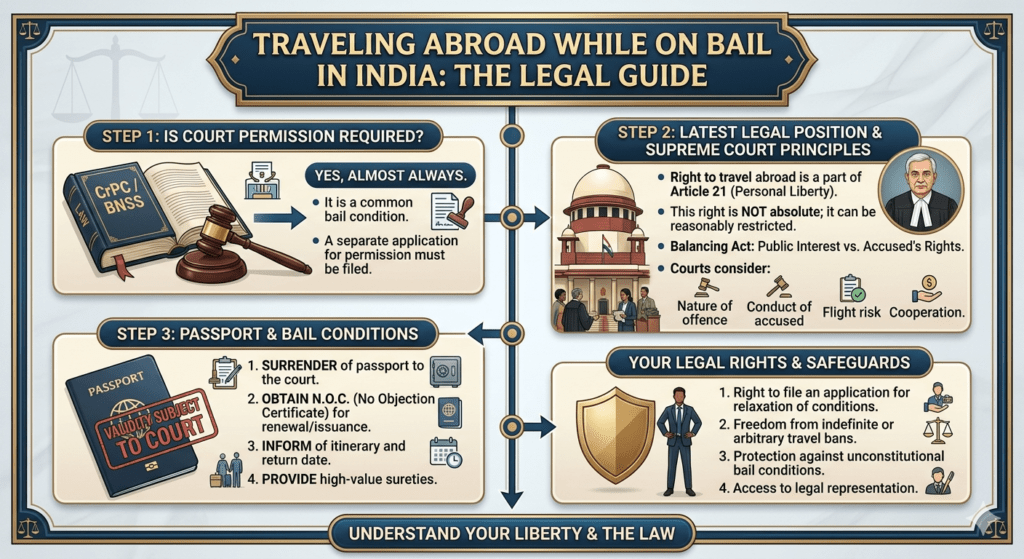
Being released on bail does not automatically prohibit foreign travel, but it also does not give an unrestricted right to leave the country. Whether an accused can travel abroad depends on the conditions of bail, the orders of the court, the facts of the case, and the likelihood of the accused returning to face trial.
In this article, we explain everything you need to know about travelling abroad while on bail, the legal principles, constitutional rights, important judicial developments, practical steps, and common myths.
Can a Person on Bail Travel Abroad?
Yes—but only if the law and the court permit it.
There is no law in India which says that every person released on bail is automatically barred from travelling outside India.
At the same time, bail does not mean unrestricted freedom.
The court granting bail has the power to impose reasonable conditions to ensure that:
- the accused appears before the court whenever required;
- the trial is not delayed;
- evidence is not tampered with;
- witnesses are not influenced; and
- the accused does not abscond.
Therefore, whether foreign travel is permissible depends primarily on the bail order and the facts of the case.
Does Bail Automatically Mean You Can Leave India?
No.
Grant of bail simply means that the accused is released from custody pending investigation or trial.
It does not automatically remove every restriction imposed by law or by the court.
Many bail orders contain conditions such as:
- surrendering the passport;
- not leaving India without prior permission;
- informing the Investigating Officer before travelling;
- appearing before the police at specified intervals.
If such a condition exists, it must be strictly followed.
Is the Right to Travel Abroad a Fundamental Right?
Yes.
The Supreme Court has repeatedly recognised that the right to travel abroad forms part of the right to personal liberty under Article 21 of the Constitution of India.
However, like many constitutional rights, it is not absolute.
The State may impose reasonable restrictions in accordance with law, especially where criminal proceedings are pending or where restrictions are necessary to ensure the administration of justice.
Why Do Courts Restrict Foreign Travel?
Courts impose travel restrictions for legitimate legal reasons.
Some of the important considerations include:
- ensuring the accused is available for trial;
- preventing the possibility of absconding;
- protecting the integrity of the investigation;
- safeguarding witnesses and evidence;
- maintaining public confidence in the criminal justice system.
The objective is not to punish the accused, but to secure the proper administration of justice.
Can the Court Allow Foreign Travel?
Absolutely.
Courts regularly permit accused persons to travel abroad where sufficient grounds are shown.
Examples include:
- employment opportunities;
- business commitments;
- higher education;
- medical treatment;
- international conferences;
- family emergencies;
- religious pilgrimages;
- professional assignments.
The court examines each request individually.
What Factors Will the Court Consider?
Before granting permission, the court may consider:
- the seriousness of the allegations;
- the stage of investigation or trial;
- previous compliance with bail conditions;
- whether the accused has cooperated with the investigation;
- the duration of the proposed visit;
- the purpose of travel;
- whether there is a genuine possibility of absconding;
- the likelihood of returning to India.
No single factor is decisive.
Can the Court Impose Conditions?
Yes.
Even while granting permission, courts often impose safeguards such as:
- furnishing the travel itinerary;
- providing details of the country to be visited;
- disclosing contact information abroad;
- specifying the date of return;
- depositing security where appropriate;
- filing an undertaking to return;
- appearing before the court immediately after returning.
These conditions balance the accused’s liberty with the interests of justice.
What if the Passport Has Been Deposited?
In many criminal cases, the court directs the accused to deposit the passport as a condition of bail.
This does not permanently prevent foreign travel.
The accused may file an application before the court seeking:
- temporary release of the passport; and
- permission to travel abroad for a specified period.
If satisfied, the court may temporarily release the passport subject to appropriate conditions.
Can Permission Be Refused?
Yes.
The court may refuse permission where it believes that:
- the accused is likely to flee from justice;
- the investigation may be affected;
- the accused has previously violated bail conditions;
- there is a genuine apprehension of non-return;
- the proposed travel is not bona fide.
Every decision depends on the facts of the particular case.
The Jurisprudence Behind Foreign Travel While on Bail
Indian constitutional and criminal jurisprudence is based on a careful balance between individual liberty and the administration of justice.
1. Bail is the Rule, Jail is the Exception
Courts have consistently recognised that a person accused of an offence is presumed innocent until proven guilty.
Bail protects personal liberty while ensuring participation in the criminal process.
2. Liberty Does Not Mean Absolute Freedom
Although liberty is protected under Article 21, reasonable restrictions may be imposed to secure the fair administration of justice.
3. Every Restriction Must Be Proportionate
Travel restrictions should not be mechanical or excessive.
The conditions imposed by the court must have a reasonable connection with the purpose they seek to achieve.
4. Each Case Must Be Decided on Its Own Facts
There is no universal rule that every accused can—or cannot—travel abroad.
Judicial discretion plays an important role.
Which Court Should You Approach?
Generally, the application should be filed before the same court that granted bail, unless the circumstances of the case require approaching a higher court.
The application should clearly mention:
- the reason for travel;
- countries proposed to be visited;
- duration of stay;
- return date;
- supporting documents;
- willingness to comply with conditions.
A well-supported application significantly improves the chances of obtaining permission.
Practical Tips Before Planning Foreign Travel
Before booking your tickets:
- Carefully read your bail order.
- Check whether your passport has been deposited.
- Consult your lawyer.
- File an application well in advance.
- Do not leave India without court permission if such permission is required.
- Strictly comply with every condition imposed by the court.
Ignoring bail conditions can have serious legal consequences.
Myth vs Reality
| Myth | Reality |
|---|---|
| A person on bail can never travel abroad. | False. Courts may permit foreign travel depending on the facts and the conditions of bail. |
| Once bail is granted, I am free to leave India whenever I want. | Incorrect. You must comply with the conditions contained in the bail order and any further directions of the court. |
| Depositing my passport means I can never get it back. | Wrong. Courts may temporarily release the passport for genuine travel after considering the circumstances. |
| The court will automatically refuse every foreign travel request. | False. Courts regularly grant permission where the request is genuine and adequate safeguards can be imposed. |
| Travelling abroad without permission cannot affect my bail. | Completely incorrect. Violating bail conditions may lead to cancellation of bail and other legal consequences. |
Frequently Asked Questions (FAQs)
Can I travel abroad while I am on bail?
Yes, if your bail conditions permit it or if the court grants you permission.
Do I always need court permission to leave India?
Not always. It depends on the terms of your bail order and the facts of your case. However, where the bail order restricts foreign travel or your passport has been deposited, you should obtain the court’s permission before travelling.
Can the court temporarily return my passport?
Yes. Courts may direct the temporary release of the passport for genuine travel, subject to suitable safeguards.
Can my bail be cancelled if I travel abroad without permission?
Yes. If foreign travel violates the conditions of your bail, it may lead to cancellation of bail and other legal consequences.
Can I travel abroad for employment or medical treatment while on bail?
Yes. Courts often permit foreign travel for genuine reasons such as employment, business, education, medical treatment, or family emergencies, subject to appropriate conditions.
Key Takeaways
- Being on bail does not automatically prohibit foreign travel.
- The bail order and court’s directions are the most important factors.
- Courts balance the accused’s liberty with the need to ensure a fair trial.
- Permission to travel abroad is often granted for genuine reasons.
- Never travel outside India in violation of bail conditions.
Conclusion
Being granted bail restores an individual’s personal liberty, but that liberty exists within the framework of the law. The right to travel abroad is an important facet of personal freedom under Article 21 of the Constitution, yet it must be balanced against the legitimate interests of the criminal justice system.
Indian courts have consistently adopted a practical approach. They do not treat every accused as a flight risk, nor do they permit unrestricted travel in every case. Instead, they carefully examine the facts, the conduct of the accused, the purpose of travel, and the likelihood of returning to India before granting permission.
If you are on bail and wish to travel abroad, the safest course is simple: read your bail order carefully, seek legal advice, obtain the court’s permission wherever required, and comply with every condition imposed.
Remember: being on bail does not end your freedom to travel—but exercising that freedom lawfully protects both your liberty and your case.