
Introduction
Imagine waking up one morning and discovering that your bank account has suddenly stopped working.
Your salary cannot be withdrawn.
Your business payments fail.
EMIs bounce.
UPI transactions stop.
Debit cards stop working.
When you contact the bank, you are simply told:
“Your account has been frozen.”
No prior notice.
No hearing.
No explanation.
Naturally, the first question that comes to mind is:
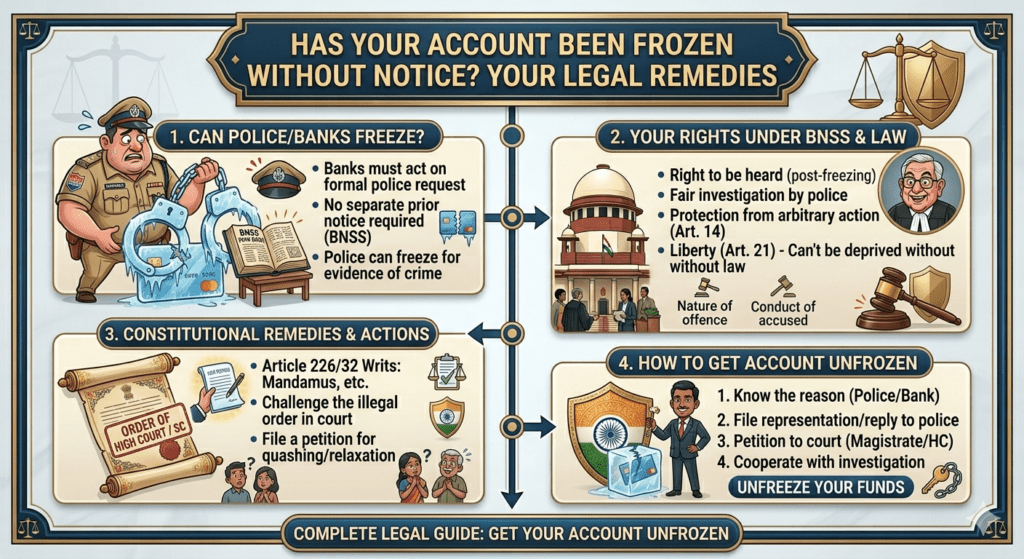
Can the bank or the police legally freeze my bank account without informing me?
The answer is:
Yes, in certain situations—but not without following the procedure established by law.
The power to freeze a bank account is an important investigative tool, particularly in cases involving cyber fraud, money laundering, financial offences, and other criminal investigations. However, this power is not unlimited. It must be exercised fairly, reasonably, and strictly in accordance with law.
If an account is frozen arbitrarily, mechanically, or without legal authority, the affected person has several legal remedies, including approaching the High Court.
In this article, we explain the complete legal position, the constitutional principles, the powers of investigating agencies, the safeguards available to citizens, and the remedies against illegal freezing of bank accounts.
What Does It Mean to Freeze a Bank Account?
A frozen bank account is one in which the account holder is temporarily prevented from operating the account.
Depending upon the order passed, the restriction may include:
- Withdrawal of money.
- Transfer of funds.
- UPI transactions.
- ATM withdrawals.
- Cheque operations.
- Internet banking.
- Debit transactions.
In some cases, only a specified amount is frozen, while in others, the entire account is blocked.
Who Can Freeze a Bank Account?
A bank does not ordinarily freeze an account on its own merely because it suspects wrongdoing.
A bank account may be frozen pursuant to:
- Orders issued by investigating agencies.
- Directions of a competent court.
- Statutory powers exercised under applicable laws.
- Regulatory directions in certain circumstances.
Banks generally act upon lawful directions received from competent authorities.
Can Police Freeze a Bank Account?
Yes.
Investigating agencies have the power to direct the freezing or seizure of property, including bank accounts, where such action is authorised by law and is necessary for the purposes of investigation.
However, this power is not absolute.
The action must satisfy the requirements of the applicable statutory provisions and constitutional safeguards.
Can a Bank Account Be Frozen Without Prior Notice?
In certain urgent situations, yes.
For example, where there is a genuine apprehension that funds may be immediately withdrawn, transferred, or dissipated, prior notice may frustrate the investigation.
Therefore, the law may permit immediate freezing in appropriate cases.
However, the absence of prior notice does not mean the authorities are free from judicial scrutiny.
The action must still be:
- lawful;
- proportionate;
- necessary;
- supported by legal authority; and
- capable of being justified before the court.
Does Every Cyber Complaint Justify Freezing an Entire Bank Account?
No.
This is one of the most important legal principles emerging from recent judicial decisions.
Courts have repeatedly emphasised that:
- every complaint must be examined on its own facts;
- freezing powers cannot be exercised mechanically;
- there must be a rational connection between the investigation and the account sought to be frozen;
- restrictions should not be excessive or arbitrary.
Where only a limited amount is allegedly connected with the offence, freezing an entire business account for months may, in appropriate cases, be found to be disproportionate.
The Constitutional Protection
Although money lying in a bank account is intangible, it is still recognised as property protected by law.
An arbitrary freezing of a bank account may affect several constitutional rights.
Article 300A – Right to Property
A person cannot be deprived of property except by authority of law.
Freezing a bank account interferes with the person’s ability to use and enjoy his or her property.
Therefore, the action must have a valid legal foundation.
Article 21 – Right to Life and Livelihood
For many people, a bank account is essential for:
- earning a livelihood;
- paying salaries;
- receiving pension;
- paying school fees;
- meeting medical expenses;
- conducting business.
An arbitrary freezing of an account may seriously affect the right to live with dignity.
Principles of Natural Justice
Even where prior notice is not possible, the affected person should ordinarily have an opportunity to challenge the freezing before the appropriate authority or court.
The law does not favour indefinite restrictions without effective remedies.
The Jurisprudence Behind Freezing Bank Accounts
Indian courts have developed important principles governing the exercise of this power.
1. Investigation is Important—but So Are Individual Rights
The State has a legitimate interest in investigating offences.
However, investigations must be conducted within the framework of the Constitution.
2. Every Restriction Must Be Proportionate
Authorities should adopt the least restrictive measure necessary for the investigation.
A blanket freezing of the entire account may not always be justified.
3. Reasons Matter
The exercise of statutory powers must be based on relevant material and genuine satisfaction—not on mere suspicion or routine practice.
4. Judicial Review Remains Available
Courts retain the power to examine whether the freezing order:
- was authorised by law;
- followed the statutory procedure;
- was arbitrary;
- violated constitutional rights; or
- imposed disproportionate restrictions.
Can the Account Holder Challenge the Freeze?
Yes.
Depending upon the facts, the account holder may:
- seek clarification from the investigating agency;
- make a representation for de-freezing;
- approach the jurisdictional Magistrate where the statute permits;
- file a writ petition before the High Court challenging arbitrary or illegal action;
- seek interim relief for limited operation of the account in appropriate cases.
The remedy depends on the nature of the freezing order and the governing law.
Can Business Accounts Also Be Frozen?
Yes.
However, courts have recognised that freezing a business account may have serious consequences.
It can affect:
- payment of employees;
- tax compliance;
- contractual obligations;
- suppliers;
- customers;
- ongoing commercial operations.
Authorities are therefore expected to exercise their powers carefully and responsibly.
Practical Steps If Your Bank Account Is Frozen
If you discover that your account has been frozen:
- Do not panic.
- Obtain written confirmation from the bank regarding the reason for the freeze.
- Ascertain which authority issued the direction.
- Collect copies of relevant communications, if available.
- Preserve bank statements and transaction records.
- Consult an advocate at the earliest opportunity.
- Challenge the action before the appropriate forum where necessary.
Early legal action often prevents prolonged hardship.
Myth vs Reality
| Myth | Reality |
|---|---|
| The police can freeze any bank account whenever they want. | False. The power to freeze a bank account must be exercised strictly in accordance with law and is subject to judicial review. |
| If my account is frozen, I have no legal remedy. | Incorrect. Depending on the facts, you may challenge the action before the appropriate authority or the High Court. |
| Every cyber complaint automatically justifies freezing the entire account. | Wrong. Courts have repeatedly stressed that freezing must be necessary, lawful, and proportionate. |
| A frozen bank account means I have been found guilty of a crime. | False. Freezing is an investigative measure. It is not proof of guilt. |
| The authorities can keep my account frozen indefinitely. | Incorrect. Indefinite or arbitrary freezing without legal justification may be challenged before the courts. |
Frequently Asked Questions (FAQs)
Can the police freeze my bank account without informing me?
In urgent cases, a bank account may be frozen without prior notice if the law permits. However, the action must still comply with statutory requirements and constitutional safeguards.
Can I challenge an illegally frozen bank account?
Yes. Depending on the facts, you may seek relief before the appropriate authority, the jurisdictional court, or the High Court through a writ petition.
Does a frozen account mean I have committed a crime?
No. Freezing is an investigative measure and does not establish guilt.
Can my salary account or business account also be frozen?
Yes. However, courts carefully examine the proportionality and legality of such action, particularly where freezing seriously affects livelihood or business operations.
How long can a bank account remain frozen?
There is no universal time limit. The duration depends on the investigation, statutory provisions, and orders passed by the competent authority or court. If the freezing becomes arbitrary or unjustified, appropriate legal remedies are available.
Key Takeaways
- A bank account can be frozen during an investigation, but only in accordance with law.
- Prior notice may not always be required, especially in urgent situations.
- The power to freeze an account is subject to constitutional limitations and judicial review.
- Arbitrary or disproportionate freezing can be challenged before the competent court.
- A frozen account is not proof of guilt.
Conclusion
The power to freeze a bank account is an important investigative tool, particularly in cases involving cybercrime and financial offences. At the same time, it is a power that directly affects a person’s property, livelihood, and financial independence. For this reason, the law insists that such power be exercised fairly, reasonably, and only in accordance with statutory authority.
Indian constitutional jurisprudence strikes a careful balance between the needs of criminal investigation and the protection of individual rights. Investigating agencies are empowered to act swiftly where necessary, but they are equally bound by the Constitution, the principles of natural justice, and judicial oversight.
If your bank account has been frozen without notice, remember that you are not without remedies. Understanding your legal rights, obtaining timely legal advice, and approaching the appropriate court can make the difference between prolonged financial hardship and effective legal relief.
The law permits the freezing of bank accounts—but it does not permit arbitrary exercise of power. In a constitutional democracy, every restriction imposed by the State must ultimately answer to the rule of law.