
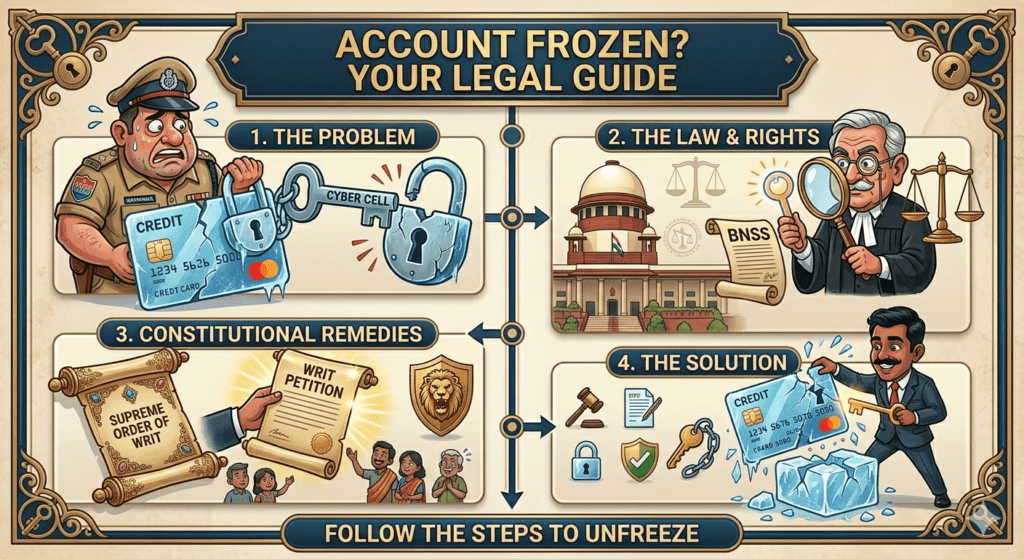
Introduction
Imagine waking up one morning and finding that your bank account no longer works.
Your salary cannot be withdrawn.
Your business payments fail.
UPI transactions are declined.
Your EMI bounces.
The bank simply tells you:
“Your account has been frozen on the instructions of the authorities.”
No further explanation.
No timeline.
No indication of what you should do next.
For most people, this situation creates panic.
The immediate questions are:
- How do I get my bank account unfrozen?
- Can I challenge the freeze?
- Which court should I approach?
- How long will it take?
- Can I recover my money?
The good news is this:
A frozen bank account does not mean your money is gone forever.
Indian law provides several remedies to challenge an illegal, arbitrary, or unnecessary freeze. Even where the initial freezing was lawful, courts can direct the release of the account if the continued restriction is no longer justified.
In this article, we explain the complete legal procedure, the constitutional principles, the rights of account holders, and the practical steps you should take to get your bank account unfrozen.
Why Are Bank Accounts Frozen?
Authorities generally freeze bank accounts during investigations involving:
- Cyber fraud.
- Online scams.
- Financial offences.
- Money laundering investigations.
- Cheating and criminal breach of trust.
- Other offences involving suspected proceeds of crime.
The purpose is to prevent the movement of funds while the investigation is ongoing.
However, every freeze must be authorised by law.
Does a Frozen Account Mean You Have Committed a Crime?
Absolutely not.
This is the biggest misconception.
Many innocent persons discover that their accounts have been frozen merely because:
- money passed through multiple accounts;
- they unknowingly received disputed funds;
- they were victims themselves;
- they were wrongly linked to an investigation.
Freezing is only an investigative measure.
It is not a declaration of guilt.
Step 1: Find Out Why Your Account Was Frozen
Before taking legal action, first determine:
- Which authority issued the freezing direction?
- Which police station is investigating the case?
- What is the FIR or complaint number?
- Which transactions are under investigation?
- Is the entire account frozen or only a specified amount?
Request written information from the bank wherever possible.
Understanding the reason for the freeze is the foundation of every legal remedy.
Step 2: Cooperate With the Investigation
If the investigating agency contacts you:
- respond promptly;
- provide documents honestly;
- explain the transactions;
- preserve all financial records.
Courts generally view cooperation positively.
Non-cooperation may unnecessarily prolong the investigation.
Step 3: Submit a Representation
In many cases, an account holder may submit a representation to the investigating authority explaining:
- the source of funds;
- the purpose of transactions;
- business records;
- invoices;
- bank statements;
- tax documents.
Where the authority is satisfied that continued freezing is unnecessary, appropriate action may be taken in accordance with law.
Step 4: Approach the Appropriate Court
If the freezing continues despite genuine representations, legal remedies are available.
Depending upon the facts, the account holder may approach:
- the jurisdictional Magistrate where the law permits;
- the competent criminal court;
- the High Court under Article 226 of the Constitution through a writ petition.
The appropriate remedy depends upon:
- the statutory provision under which the account was frozen;
- the stage of investigation;
- the nature of the dispute.
Can the High Court Order De-Freezing?
Yes.
High Courts regularly exercise their writ jurisdiction where:
- statutory powers have been exercised illegally;
- constitutional rights have been violated;
- freezing has become arbitrary or disproportionate;
- authorities have failed to follow legal procedure;
- continued freezing causes unjustified hardship.
The High Court examines whether the action satisfies constitutional and statutory requirements.
Can the Court Permit Partial Operation of the Account?
Yes.
In appropriate cases, courts may permit:
- withdrawal of salary;
- payment of employees;
- payment of taxes;
- business expenses;
- operation of the account subject to safeguards.
Every case depends on its own facts.
The Constitutional Protection
Freezing a bank account affects important constitutional rights.
Article 21 – Right to Life and Livelihood
For many individuals and businesses, a bank account is essential for survival.
Arbitrary restrictions may directly affect:
- livelihood;
- business operations;
- education;
- medical treatment;
- family responsibilities.
Article 300A – Right to Property
Money lying in a bank account is property protected by law.
No person can be deprived of property except by authority of law.
Rule of Law
Every exercise of State power must satisfy:
- legality;
- fairness;
- proportionality;
- reasonableness.
The Jurisprudence Behind De-Freezing
Indian courts have consistently recognised that:
1. Investigation Cannot Become Punishment
The purpose of freezing is investigation—not punishment.
An innocent person should not be forced into financial paralysis merely because an investigation is pending.
2. Restrictions Must Be Proportionate
Authorities should adopt the least restrictive measure necessary.
If only a limited amount is disputed, freezing an entire business account indefinitely may be disproportionate.
3. Every Case Requires Independent Application of Mind
Freezing cannot become a routine administrative exercise.
Authorities must examine the facts carefully before restricting access to a person’s property.
4. Judicial Review Protects Citizens
Courts remain the ultimate safeguard against arbitrary exercise of statutory powers.
If the freezing order violates the Constitution or the law, appropriate relief may be granted.
Important Documents to Keep Ready
If your account has been frozen, keep the following documents available:
- Bank statements.
- KYC documents.
- PAN and Aadhaar details.
- Income tax returns.
- GST records (where applicable).
- Business invoices.
- Salary records.
- Correspondence with the bank.
- Communications received from the investigating agency.
Proper documentation often accelerates the resolution process.
Common Mistakes to Avoid
Many people unintentionally weaken their case by:
- ignoring police notices;
- deleting financial records;
- providing inconsistent explanations;
- transferring funds through other accounts to avoid investigation;
- delaying legal advice.
A transparent and lawful approach is always the best strategy.
Myth vs Reality
| Myth | Reality |
|---|---|
| A frozen account means I have committed a crime. | False. Freezing is only an investigative measure and does not establish guilt. |
| Once an account is frozen, it can never be reopened. | Incorrect. Courts and competent authorities may order de-freezing where justified. |
| The police never make mistakes while freezing accounts. | Wrong. Like every administrative action, freezing orders are subject to judicial review and may be challenged if they are illegal or arbitrary. |
| I should ignore notices because the authorities have no power over me. | False. Cooperation with lawful investigation often helps in obtaining faster relief. |
| Only large companies can challenge a frozen bank account. | Incorrect. Every individual and business has the right to challenge unlawful or disproportionate restrictions through appropriate legal remedies. |
Frequently Asked Questions (FAQs)
How do I get my frozen bank account unfrozen?
The process generally involves identifying the authority that issued the freeze, cooperating with the investigation, submitting appropriate representations, and approaching the competent court or the High Court where necessary.
Can I file a writ petition for de-freezing?
Yes. Where the freezing is arbitrary, illegal, or violates constitutional rights, a writ petition before the High Court may be an appropriate remedy.
Can I operate part of my account while the investigation continues?
In appropriate cases, courts may permit limited operation of the account subject to conditions.
How long does it take to unfreeze a bank account?
There is no fixed time limit. The duration depends on the facts, the progress of the investigation, and any orders passed by the competent authority or court.
Should I wait for the investigation to finish?
Not necessarily. If the freezing is causing serious hardship or appears unlawful, you should seek legal advice immediately and explore the remedies available under law.
Key Takeaways
- A frozen bank account is not the end of the road.
- Identify the authority responsible for the freeze before taking action.
- Cooperate fully with the investigation and maintain proper records.
- If the freeze is arbitrary or disproportionate, legal remedies are available.
- High Courts can grant relief where constitutional or statutory safeguards have been violated.
- Timely legal action often results in faster and more effective relief.
Conclusion
Having your bank account frozen can be financially and emotionally overwhelming, especially when it affects your salary, business, or daily life. However, the law does not leave citizens without protection. While investigating agencies have the authority to freeze accounts in appropriate cases, that power is not unlimited. It must always be exercised in accordance with statutory provisions, constitutional guarantees, and the principles of fairness and proportionality.
If your account has been frozen, the most important step is to act promptly. Understand the reason for the freeze, cooperate with the investigation, preserve your financial records, and seek appropriate legal remedies where necessary. Courts have repeatedly recognised that investigative powers should not become instruments of unnecessary hardship or prolonged financial paralysis.
A frozen bank account can often be unfrozen—but success depends on knowing your rights, following the correct legal procedure, and taking timely action.