
Introduction
Imagine this situation.
You filed a civil suit a few years ago.
The case ended.
Now, a new dispute has arisen between the same parties. The facts are different, the events are different, and your legal rights have been affected again.
You file a fresh suit.
The other side immediately objects and says:
“This suit is barred by constructive res judicata. It cannot be entertained.”
Does that argument automatically succeed?
Not necessarily.
One of the most misunderstood principles in civil law is constructive res judicata. Many people believe that once a case has been decided between the same parties, no fresh suit can ever be filed. That is not what the law says.
The doctrine of constructive res judicata is intended to prevent repeated litigation on the same cause of action and issues that ought to have been raised earlier. However, where the cause of action is genuinely different, a subsequent suit is ordinarily not barred merely because the parties are the same.
This article explains the legal position, statutory provisions, jurisprudence, practical examples, and important judicial principles in simple language.
What Is Res Judicata?
The doctrine of res judicata is contained in Section 11 of the Code of Civil Procedure, 1908 (CPC).
The expression literally means:
“A matter already decided.”
Its purpose is simple.
Once a competent court has finally decided an issue between the parties, the same issue should not be litigated repeatedly.
The doctrine promotes:
- finality of litigation;
- judicial discipline;
- certainty in legal rights;
- efficient use of judicial time.
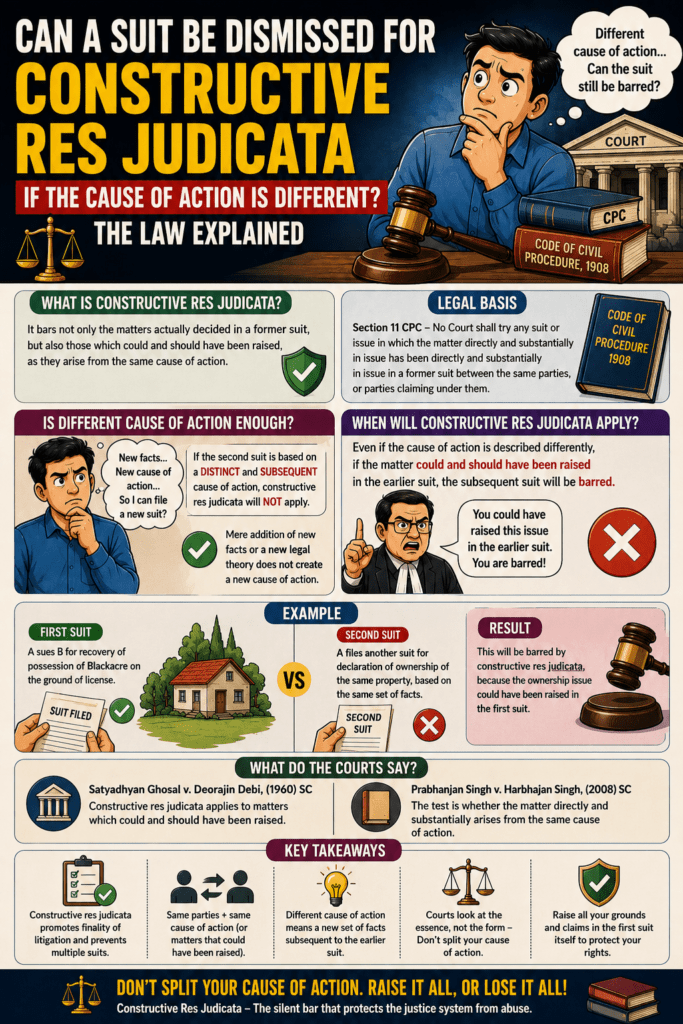
What Is Constructive Res Judicata?
Constructive res judicata is an extension of the doctrine of res judicata.
It is embodied in Explanation IV to Section 11 CPC.
The law states that if a party might and ought to have raised a particular ground or defence in the earlier proceedings but failed to do so, the law treats that issue as having already been decided.
In simple words:
The law does not permit a party to split its case and litigate it in instalments.
Does Constructive Res Judicata Apply to Every Subsequent Suit?
No.
This is where many litigants misunderstand the law.
Constructive res judicata does not apply merely because:
- the parties are the same;
- the property is the same; or
- there was previous litigation.
The court must examine:
- whether the cause of action is the same;
- whether the issue was directly and substantially in issue;
- whether the omitted ground might and ought to have been raised earlier; and
- whether the earlier court was competent to decide it.
What Is a Cause of Action?
A cause of action is the bundle of material facts that gives a person the right to approach the court.
It is not the evidence.
It is not the legal argument.
Rather, it is the set of facts that creates the legal right to sue.
If those material facts change, a fresh cause of action may arise.
Can a Suit Be Dismissed If the Cause of Action Is Different?
Ordinarily, no.
Where the subsequent suit is founded on new material facts, a new legal injury, or events that occurred after the earlier litigation, constructive res judicata generally does not apply.
This is because the later cause of action did not exist when the earlier suit was filed or decided.
The law cannot compel a person to raise a claim that had not yet arisen.
When Does Constructive Res Judicata Apply?
The doctrine generally applies where:
- the cause of action is substantially the same;
- the omitted plea existed during the earlier proceedings;
- the party had an opportunity to raise it;
- the issue ought to have been raised in the earlier litigation;
- permitting a fresh suit would amount to splitting claims or re-agitating the same dispute.
When Does It Not Apply?
Constructive res judicata ordinarily does not apply where:
- a fresh cause of action has arisen after the earlier proceedings;
- new facts create a new legal right;
- subsequent events change the legal position;
- the earlier court lacked jurisdiction to decide the issue;
- the matter could not reasonably have been raised in the previous proceedings.
Each case depends on its own facts.
The Difference Between Res Judicata and Constructive Res Judicata
| Res Judicata | Constructive Res Judicata |
|---|---|
| Applies to issues actually decided. | Applies to issues that ought to have been raised earlier. |
| Prevents re-litigation of decided issues. | Prevents piecemeal litigation of matters that could and should have been raised. |
| Based on actual adjudication. | Based on a legal fiction created by Explanation IV to Section 11 CPC. |
Constructive Res Judicata vs Order II Rule 2 CPC
These two doctrines are often confused.
Although both seek to prevent multiple proceedings, they operate differently.
- Constructive res judicata focuses on issues and grounds that ought to have been raised.
- Order II Rule 2 CPC prevents a plaintiff from splitting claims arising from the same cause of action.
The two doctrines may overlap in certain cases but are conceptually distinct.
The Jurisprudence Behind Constructive Res Judicata
Indian courts have consistently explained that the doctrine serves larger public interests.
1. Litigation Must Come to an End
The law discourages endless litigation over the same dispute.
Finality promotes certainty and stability.
2. Parties Must Raise Their Entire Case
A litigant should not deliberately withhold grounds and raise them later in successive proceedings.
Courts expect parties to present all available grounds in one proceeding, where they properly arise.
3. Different Cause of Action Means a Different Legal Right
When subsequent events create a new legal injury or a new right, the law generally permits a fresh suit because the later dispute is not the same as the earlier one.
4. The Doctrine Is Not Mechanical
Constructive res judicata is not an inflexible rule.
Its application depends on the facts, the pleadings, the issues involved, the relief claimed, and the nature of the cause of action.
Courts apply it cautiously to prevent injustice.
Practical Examples
Example 1
A suit for injunction is decided in 2022.
In 2025, the defendant commits a fresh act of encroachment.
A new cause of action may arise, and a fresh suit may be maintainable.
Example 2
A plaintiff deliberately omits an available legal ground in the first suit despite having full knowledge of it.
After losing, the plaintiff files another suit based on that omitted ground.
The later suit may be barred by constructive res judicata.
Example 3
An agreement executed after the earlier litigation creates new contractual obligations.
Any dispute arising from that later agreement constitutes a fresh cause of action and is ordinarily not barred.
Myth vs Reality
| Myth | Reality |
|---|---|
| Once a suit is decided, no fresh suit can ever be filed between the same parties. | False. A fresh suit may be maintainable if it is based on a genuinely different cause of action. |
| Constructive res judicata applies whenever there was previous litigation. | Incorrect. The court must examine the cause of action, issues, pleadings, and whether the omitted ground ought to have been raised earlier. |
| The same property always means the same cause of action. | Wrong. Different events relating to the same property can give rise to different causes of action. |
| Explanation IV to Section 11 CPC bars every subsequent claim. | False. It bars only those claims or grounds that might and ought to have been raised in the earlier proceedings. |
| A new legal injury can never give rise to a fresh suit. | Incorrect. A subsequent legal injury may create an independent cause of action. |
Frequently Asked Questions (FAQs)
Can a fresh suit be filed if the cause of action is different?
Yes. If the later suit is founded on a genuinely different cause of action, constructive res judicata will ordinarily not apply.
Is constructive res judicata the same as res judicata?
No. Res judicata applies to issues actually decided, whereas constructive res judicata applies to issues that ought to have been raised in the earlier proceedings.
Does the same property mean the second suit is barred?
Not necessarily. The crucial test is whether the cause of action and the issues are substantially the same.
Can new events create a fresh cause of action?
Yes. Subsequent events giving rise to new legal rights or injuries may constitute a fresh cause of action.
Which provision deals with constructive res judicata?
Explanation IV to Section 11 of the Code of Civil Procedure, 1908.
Key Takeaways
- Constructive res judicata is governed by Explanation IV to Section 11 CPC.
- It prevents parties from raising, in later proceedings, matters that might and ought to have been raised earlier.
- A different cause of action generally means the subsequent suit is not automatically barred.
- Courts examine the substance of the dispute, not merely the identity of the parties or property.
- The doctrine promotes finality of litigation but must be applied carefully to avoid denying legitimate claims arising from new facts.
Conclusion
Constructive res judicata is a powerful doctrine that protects the judicial process from repetitive and piecemeal litigation. However, it is not a weapon to defeat every subsequent suit. Its application depends on a careful examination of the earlier proceedings, the issues involved, and, most importantly, the cause of action.
Where a fresh legal injury or subsequent events give rise to a new cause of action, the law ordinarily permits a fresh suit. Courts have consistently recognised that the doctrine cannot be stretched to prevent a litigant from enforcing rights that did not exist or could not reasonably have been asserted in the earlier proceedings.
The key question is not whether there was an earlier suit—it is whether the later suit is truly founded on the same cause of action and on grounds that ought to have been raised before. Understanding this distinction is essential for every litigant, lawyer, and law student navigating civil litigation.