
- Introduction
- What Is a Pre-Deposit Under GST?
- Which Provision Governs Pre-Deposit?
- Why Does the Law Require a Pre-Deposit?
- Is the Pre-Deposit a Penalty?
- Is the Entire GST Demand Required to Be Paid?
- Can the Appellate Authority Waive the Statutory Pre-Deposit?
- Is the Requirement Constitutional?
- The Jurisprudence Behind GST Pre-Deposit
- Does Making a Pre-Deposit Mean You Will Lose the Case?
- Practical Tips Before Filing a GST Appeal
- Myth vs Reality
- Frequently Asked Questions (FAQs)
- Key Takeaways
- Conclusion
Introduction
Imagine this.
You receive a GST demand order for ₹50 lakh.
You strongly believe the order is illegal.
Naturally, you decide to challenge it.
But then your consultant tells you:
“Before your appeal can even be entertained, you must first make a statutory pre-deposit.”
Your immediate reaction is:
- Why should I pay if I believe the order is wrong?
- Isn’t justice supposed to be free?
- Can I appeal without making the pre-deposit?
- Is this amount a penalty?
- Can the court waive the pre-deposit?
These are genuine questions asked by almost every taxpayer facing a GST dispute.
The answer lies in understanding the purpose of the GST appellate system and the legal philosophy behind statutory pre-deposits.
In this article, we explain the legal provisions, constitutional principles, jurisprudence, practical reasons, and taxpayers’ rights relating to GST pre-deposit in simple language.
What Is a Pre-Deposit Under GST?
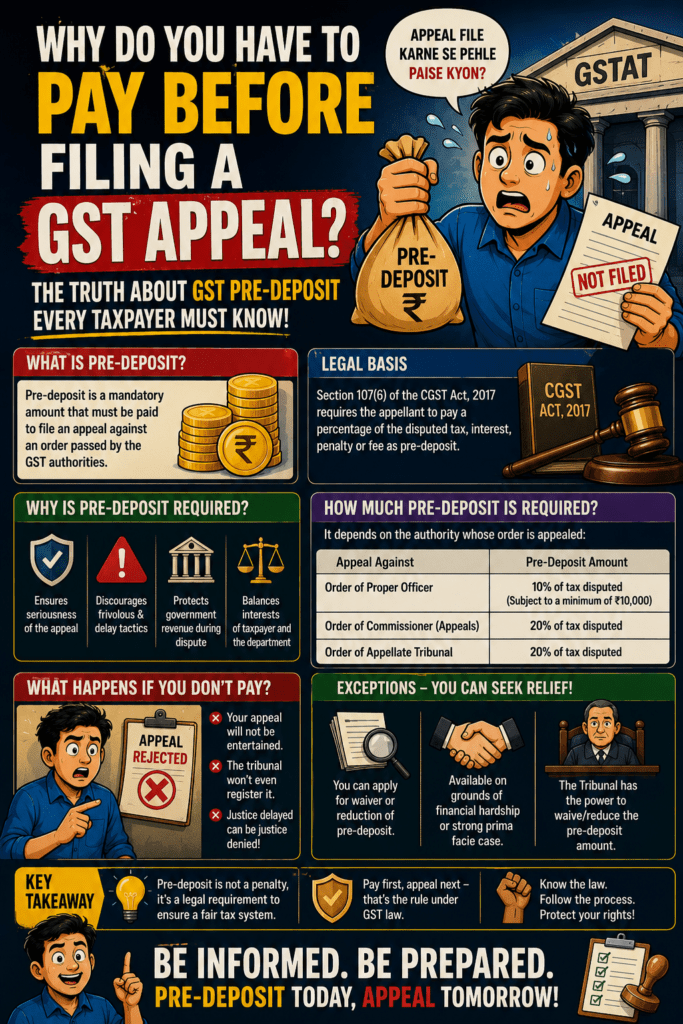
A pre-deposit is the statutory amount that an appellant must deposit before an appeal can be entertained under the GST law.
It is not an admission of liability.
It is not a penalty.
It is not a final payment of tax.
Rather, it is a legal condition prescribed by Parliament to regulate the appellate process.
If the appeal ultimately succeeds, the taxpayer is entitled to the consequences provided under the law.
Which Provision Governs Pre-Deposit?
The requirement for the first appeal is contained in:
Section 107(6) of the Central Goods and Services Tax Act, 2017
This provision prescribes that an appeal shall not ordinarily be entertained unless the appellant complies with the statutory pre-deposit requirements specified in the Act.
For further appeals, the relevant provisions governing appeals before the GST Appellate Tribunal also prescribe statutory pre-deposit requirements.
Why Does the Law Require a Pre-Deposit?
This is perhaps the most important question.
The law requires a pre-deposit for several reasons.
1. To Discourage Frivolous Appeals
If appeals could be filed without any financial consequence, some persons might challenge every order merely to delay recovery.
The pre-deposit requirement discourages appeals that have no genuine legal basis.
2. To Balance the Interests of the Taxpayer and the Government
Tax administration involves public revenue.
While taxpayers have a right to challenge adverse orders, the Government also has a legitimate interest in protecting revenue pending adjudication.
The pre-deposit attempts to strike a balance between these competing interests.
3. To Ensure Seriousness of the Appeal
A statutory pre-deposit demonstrates that the appellant is pursuing the appeal genuinely and is willing to comply with the legal framework governing appellate proceedings.
4. To Reduce Unnecessary Litigation
By requiring a limited statutory deposit, the law seeks to reduce appeals filed only for the purpose of delaying recovery.
This helps appellate authorities focus on genuine disputes.
Is the Pre-Deposit a Penalty?
Absolutely not.
This is one of the biggest misconceptions.
The pre-deposit:
- is not a punishment;
- does not amount to an admission of guilt;
- does not mean that the taxpayer has accepted the demand.
It is simply a statutory condition for maintaining an appeal.
Is the Entire GST Demand Required to Be Paid?
No.
The law generally requires only the statutory pre-deposit prescribed by the CGST Act, and not the entire disputed tax demand, as a condition for filing the appeal.
The exact amount depends on the stage of the appeal and the applicable statutory provisions.
Can the Appellate Authority Waive the Statutory Pre-Deposit?
Generally, no.
Where the statute prescribes a mandatory pre-deposit, the appellate authority is ordinarily bound by the law.
Unlike some earlier tax statutes that allowed discretionary waiver, the GST framework prescribes a fixed statutory mechanism.
Any relaxation must come from the statute itself or through judicial intervention in exceptional cases.
Is the Requirement Constitutional?
Yes.
Indian courts have consistently recognised that:
The right to appeal is not an inherent or fundamental right.
It is a statutory right.
Because it is created by statute, Parliament is competent to prescribe reasonable conditions for exercising that right, including pre-deposit requirements.
This principle has repeatedly been upheld in tax jurisprudence.
The Jurisprudence Behind GST Pre-Deposit
The requirement of pre-deposit is based on several well-established legal principles.
1. Right to Appeal Is a Statutory Right
Unlike fundamental rights, the right to file an appeal exists only because the statute creates it.
The legislature may therefore regulate its exercise through reasonable conditions.
2. Revenue Protection Is a Legitimate State Interest
Taxes finance public infrastructure, healthcare, education, and other governmental functions.
Protecting public revenue during pending litigation is recognised as a legitimate legislative objective.
3. Access to Justice Must Be Balanced With Efficient Administration
The appellate system must remain accessible to genuine litigants while discouraging abuse of the legal process.
The pre-deposit requirement seeks to maintain that balance.
4. Uniformity Creates Predictability
A fixed statutory pre-deposit promotes certainty and reduces disputes about waiver applications.
Taxpayers know in advance the conditions required for maintaining an appeal.
Does Making a Pre-Deposit Mean You Will Lose the Case?
Not at all.
The pre-deposit has no bearing on the merits of the appeal.
The Appellate Authority decides the case independently based on:
- the facts;
- the evidence;
- the applicable law; and
- the arguments advanced by the parties.
Many taxpayers succeed in appeal even after making the statutory pre-deposit.
Practical Tips Before Filing a GST Appeal
- Read the order carefully.
- Verify the limitation period.
- Calculate the statutory pre-deposit correctly.
- Preserve proof of payment.
- File the appeal in the prescribed form with all supporting documents.
- Take professional advice if the dispute involves complex legal or factual issues.
Proper preparation significantly improves the quality of the appeal.
Myth vs Reality
| Myth | Reality |
|---|---|
| The pre-deposit is a penalty imposed by the department. | False. It is a statutory condition for filing an appeal, not a punishment. |
| Paying the pre-deposit means I have admitted the GST demand. | Incorrect. The appeal continues on merits, and the deposit does not amount to acceptance of liability. |
| I must pay the entire tax demand before filing an appeal. | Wrong. The law generally requires only the statutory pre-deposit prescribed under the CGST Act, not the entire disputed demand. |
| The Appellate Authority can ignore the pre-deposit requirement. | Generally false. Where the statute makes pre-deposit mandatory, the authority is ordinarily bound by that requirement. |
| If I lose my appeal, the pre-deposit automatically becomes a penalty. | Incorrect. The deposit is adjusted in accordance with the outcome of the proceedings and the applicable statutory provisions. |
Frequently Asked Questions (FAQs)
Why is pre-deposit mandatory in GST appeals?
Because Section 107(6) of the CGST Act prescribes it as a statutory condition for entertaining the first appeal. The requirement is intended to balance the taxpayer’s right to appeal with the Government’s interest in protecting public revenue.
Is the pre-deposit refundable if I win the appeal?
If the appeal is decided in favour of the taxpayer, the consequences regarding adjustment or refund are governed by the CGST Act and the applicable legal provisions.
Can I file a GST appeal without making the pre-deposit?
Ordinarily, no. The statutory pre-deposit is generally a mandatory requirement for maintaining the appeal.
Is the pre-deposit the same as paying the tax demand?
No. It is only the statutory amount prescribed by law as a condition for filing the appeal and should not be confused with payment of the entire disputed demand.
Can the High Court interfere with the pre-deposit requirement?
In exceptional cases involving constitutional or legal issues, High Courts exercise judicial review. However, they ordinarily respect the statutory scheme enacted by Parliament.
Key Takeaways
- Pre-deposit is a statutory requirement, not a penalty.
- The first appeal is governed by Section 107(6) of the CGST Act, 2017.
- The purpose of pre-deposit is to balance taxpayers’ appellate rights with protection of public revenue.
- The requirement does not amount to an admission of liability.
- Compliance with the statutory pre-deposit is generally essential for maintaining a GST appeal.
Conclusion
At first glance, the requirement to make a pre-deposit before filing a GST appeal may appear harsh, especially when a taxpayer genuinely believes that the demand is unlawful. However, the legal philosophy behind the provision is not to punish taxpayers but to create a balanced and efficient appellate system.
The legislature has consciously treated the right of appeal as a statutory right that can be exercised subject to reasonable conditions. The pre-deposit mechanism seeks to discourage frivolous litigation while preserving the opportunity for genuine taxpayers to challenge adverse orders before an independent appellate forum.
For taxpayers, the key is to understand that a pre-deposit is not a declaration of defeat. It is merely the legal gateway to the appellate process. With proper legal advice, timely filing, and a well-prepared appeal, many taxpayers successfully challenge GST demands despite having made the statutory pre-deposit.
Knowing why the law requires a pre-deposit helps taxpayers approach GST litigation with clarity, confidence, and a better understanding of their legal rights.