
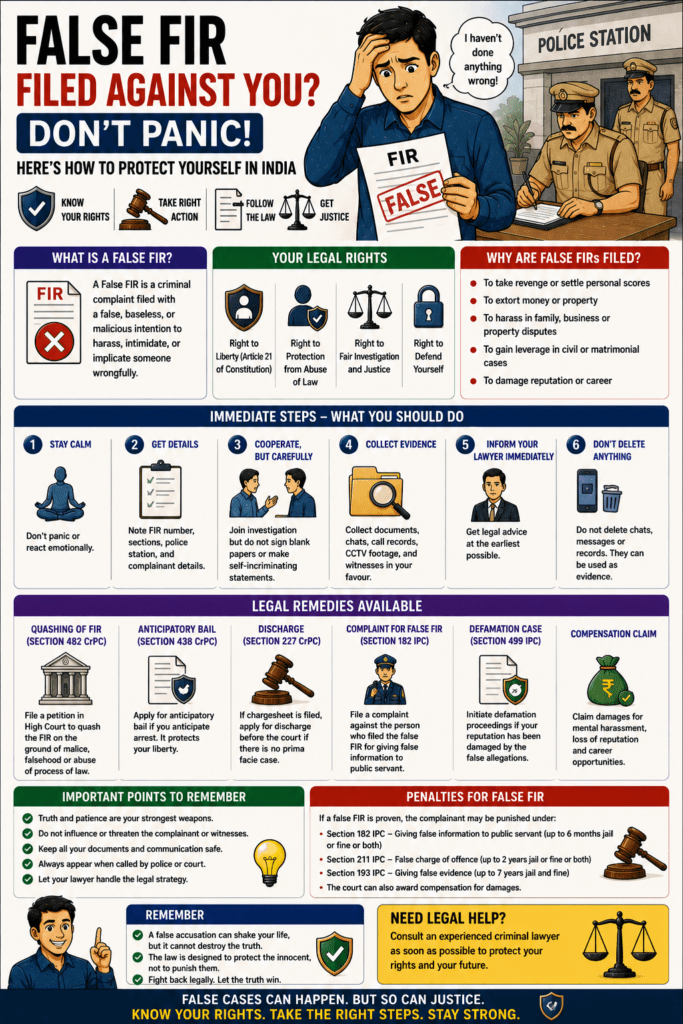
- Introduction
- What Is an FIR?
- What Is a False FIR?
- Can the Police Register an FIR Without Hearing Me?
- Will I Be Arrested Immediately?
- What Should You Do Immediately?
- Legal Remedies Available Against a False FIR
- Can I File a Case Against the Person Who Filed a False FIR?
- Can I Get Compensation?
- Can the Police Cancel an FIR?
- Jurisprudence Behind False FIR Cases
- Practical Tips
- Myth vs Reality
- Frequently Asked Questions (FAQs)
- Key Takeaways
- Conclusion
Introduction
Receiving information that an FIR has been registered against you can be frightening.
Many people immediately worry:
- “Will I be arrested?”
- “Can I go to jail immediately?”
- “How do I prove my innocence?”
- “Can I get the FIR cancelled?”
- “Should I approach the police or the High Court?”
The good news is that an FIR is only the beginning of a criminal investigation. It is not proof of guilt.
Under Indian law, every accused person is presumed innocent until proven guilty through a fair trial.
If you believe the allegations are false, the law provides several legal remedies. The correct remedy depends on the facts of your case.
This guide explains everything in simple language.
What Is an FIR?
An FIR (First Information Report) is information recorded by the police regarding the commission of a cognizable offence.
Its primary purpose is to set the criminal law in motion and enable investigation.
Registration of an FIR does not mean that the allegations have been proved.
What Is a False FIR?
A “false FIR” generally refers to a situation where a person claims that:
- the allegations are fabricated;
- important facts have been concealed;
- the complaint has been filed with an ulterior motive;
- the accused has been falsely implicated.
However, whether an FIR is actually false is ultimately determined through the legal process. Neither the accused nor the complainant can conclusively decide that issue on their own.
Can the Police Register an FIR Without Hearing Me?
Yes.
In many cognizable offences, the police may register an FIR based on the information received if it discloses the commission of such an offence.
The accused is not ordinarily entitled to a pre-registration hearing before the FIR is recorded.
However, the investigation that follows must be fair, impartial, and in accordance with law.
Will I Be Arrested Immediately?
Not necessarily.
Registration of an FIR does not automatically mean arrest.
The investigating officer must exercise the power of arrest in accordance with the Bharatiya Nagarik Suraksha Sanhita, 2023 (BNSS) and applicable judicial principles.
In many cases, especially where arrest is not legally necessary, the accused may not be arrested immediately.
What Should You Do Immediately?
1. Do Not Panic
Do not assume that registration of an FIR means conviction.
Many criminal cases end in closure, discharge, acquittal, or other lawful outcomes depending on the evidence.
2. Consult a Criminal Lawyer Immediately
Early legal advice can help you:
- understand the allegations;
- protect your legal rights;
- decide the appropriate legal remedy;
- avoid unnecessary mistakes.
3. Preserve Evidence
Collect all relevant material, such as:
- documents;
- emails;
- WhatsApp chats;
- CCTV footage;
- travel records;
- location records;
- photographs;
- audio or video recordings;
- names of witnesses.
4. Cooperate with the Investigation
Where legally required, cooperate with the investigation.
Non-cooperation without lawful justification may adversely affect your position.
Legal Remedies Available Against a False FIR
Remedy 1: Apply for Anticipatory Bail
If you have a reasonable apprehension of arrest in a non-bailable case, you may apply for anticipatory bail under Section 483 of the BNSS before the appropriate Court.
Anticipatory bail protects personal liberty while allowing the investigation to continue subject to the court’s conditions.
Remedy 2: Apply for Regular Bail
If arrested, you may seek regular bail under the applicable provisions of the BNSS.
The court considers factors such as:
- seriousness of the allegations;
- possibility of tampering with evidence;
- likelihood of absconding;
- stage of investigation;
- overall facts of the case.
Remedy 3: Seek Quashing of the FIR
In appropriate cases, the High Court may exercise its inherent jurisdiction to quash criminal proceedings where continuation of the prosecution would amount to an abuse of the process of law or where the allegations do not disclose an offence even if accepted at face value.
Quashing is an extraordinary remedy and is granted only in appropriate cases.
Remedy 4: Participate in the Investigation
Provide lawful documents and material supporting your defence.
A fair investigation benefits both genuine complainants and wrongly implicated persons.
Remedy 5: Seek Discharge
If, after investigation, the material is insufficient to proceed, the accused may seek discharge where the applicable procedural law permits.
Remedy 6: Defend the Trial
If the matter proceeds to trial, the prosecution must establish guilt beyond reasonable doubt.
The accused has the right to:
- legal representation;
- cross-examine witnesses;
- produce defence evidence where appropriate;
- challenge the prosecution’s case.
Can I File a Case Against the Person Who Filed a False FIR?
Depending on the outcome of the proceedings and the facts established, legal remedies may be available against a person who has maliciously instituted false criminal proceedings or made false statements.
Such remedies depend on the evidence and applicable law.
Every unsuccessful prosecution does not automatically mean that the complainant acted maliciously.
Can I Get Compensation?
In certain exceptional situations, courts have recognised compensation for unlawful arrest, malicious prosecution, or violation of fundamental rights.
Whether compensation is available depends on the facts and the applicable legal principles.
Can the Police Cancel an FIR?
The police cannot simply “cancel” an FIR because the accused claims that it is false.
After investigation, if the investigating agency concludes that no case is made out, it may file an appropriate final report before the competent Magistrate.
The Magistrate then considers the report in accordance with law.
Jurisprudence Behind False FIR Cases
Indian criminal law balances two equally important objectives:
1. Protection of Genuine Victims
Persons alleging criminal offences must have access to the justice system.
2. Protection of Innocent Persons
No individual should be deprived of liberty on the basis of false or malicious allegations.
3. Presumption of Innocence
Every accused is presumed innocent until guilt is established in accordance with law.
This is a cornerstone of criminal jurisprudence.
4. Fair Investigation
The investigating agency must conduct an impartial investigation and collect both incriminating and exculpatory material where relevant.
5. Personal Liberty
Courts consistently recognise that personal liberty under Article 21 of the Constitution is a fundamental value that must be protected through lawful procedure.
Practical Tips
✅ Obtain legal advice immediately.
✅ Preserve all electronic and documentary evidence.
✅ Cooperate with lawful investigation.
✅ Apply for anticipatory bail where appropriate.
✅ Keep copies of all notices and documents.
❌ Do not threaten the complainant or witnesses.
❌ Do not destroy evidence.
❌ Do not ignore police notices or court summons.
❌ Do not rely solely on social media advice.
Myth vs Reality
| Myth | Reality |
|---|---|
| An FIR means I am guilty. | False. An FIR initiates investigation; guilt is determined only by a court after due process. |
| Police must arrest me after every FIR. | Incorrect. Arrest depends on the facts, the law, and the necessity of arrest under the BNSS. |
| A false FIR is automatically quashed by the High Court. | False. Quashing is an extraordinary remedy granted only in appropriate cases. |
| If I am acquitted, I automatically receive compensation. | Incorrect. Compensation depends on the applicable legal principles and the specific facts. |
| Ignoring the investigation will help my case. | Wrong. Cooperation with lawful investigation is generally advisable while protecting your legal rights. |
Frequently Asked Questions (FAQs)
Can I get anticipatory bail immediately after learning about an FIR?
If you have a reasonable apprehension of arrest in a non-bailable offence, you may approach the appropriate court under Section 483 BNSS, subject to the facts of your case.
Can the High Court quash a false FIR?
Yes, in appropriate cases where the legal requirements for quashing are satisfied.
Is every false allegation dismissed at the investigation stage?
No. Each case is decided on its own evidence and applicable law.
Should I contact the complainant directly?
Generally, it is advisable to avoid direct confrontation, especially if proceedings are pending. Seek legal advice before communicating about the case.
Can both criminal proceedings and civil proceedings arise from the same dispute?
Yes. In some situations, the same set of facts may give rise to both civil and criminal remedies, depending on the nature of the dispute.
Key Takeaways
- An FIR is the beginning of an investigation, not proof of guilt.
- Every accused enjoys the presumption of innocence until proven guilty.
- Anticipatory bail under Section 483 BNSS, regular bail, quashing petitions, discharge, and trial are distinct legal remedies available depending on the facts.
- Preserve evidence and cooperate with lawful investigation.
- Courts—not the police, the complainant, or the accused—ultimately determine criminal liability.
Conclusion
Facing a criminal case can be stressful, particularly when you believe the allegations are false. However, Indian criminal law contains several safeguards to protect individuals from wrongful prosecution while ensuring that genuine complaints are investigated fairly.
The most effective response is not panic, but informed legal action. Understanding your rights, preserving evidence, seeking timely legal advice, and using the appropriate remedies—such as anticipatory bail, quashing where legally justified, or a robust defence during investigation and trial—can significantly strengthen your position.
Remember: an FIR is the start of a legal process, not its conclusion. The justice system is designed to determine the truth through evidence, fair investigation, and due process.