
- Introduction
- What Is the POSH Act?
- Why Was the POSH Act Introduced?
- What Is Sexual Harassment Under the POSH Act?
- Who Is Protected Under the POSH Act?
- What Is Considered a Workplace?
- What Are the Employer's Responsibilities?
- What Is an Internal Committee (IC)?
- What Is a Local Committee?
- How Does the POSH Complaint Procedure Work?
- Can a Criminal Case Also Be Filed?
- What Action Can Be Taken Against the Respondent?
- What Happens If an Employer Does Not Follow the POSH Act?
- Is Confidentiality Important?
- Jurisprudence Behind the POSH Act
- Practical Tips
- Myth vs Reality
- Frequently Asked Questions (FAQs)
- Key Takeaways
- Conclusion
Introduction
Every employee deserves to work in an environment that is safe, respectful, and free from sexual harassment.
Unfortunately, workplace sexual harassment is a reality that affects many women across different professions and industries.
To address this problem, Parliament enacted the Sexual Harassment of Women at Workplace (Prevention, Prohibition and Redressal) Act, 2013, popularly known as the POSH Act.
The objective of the Act is not merely to punish offenders. It is also designed to prevent sexual harassment, ensure a fair inquiry, protect the dignity of women at work, and place legal responsibilities on employers.
Whether you are an employee, employer, HR professional, business owner, or startup founder, understanding the POSH Act is essential.
This guide explains the law in simple language.
What Is the POSH Act?
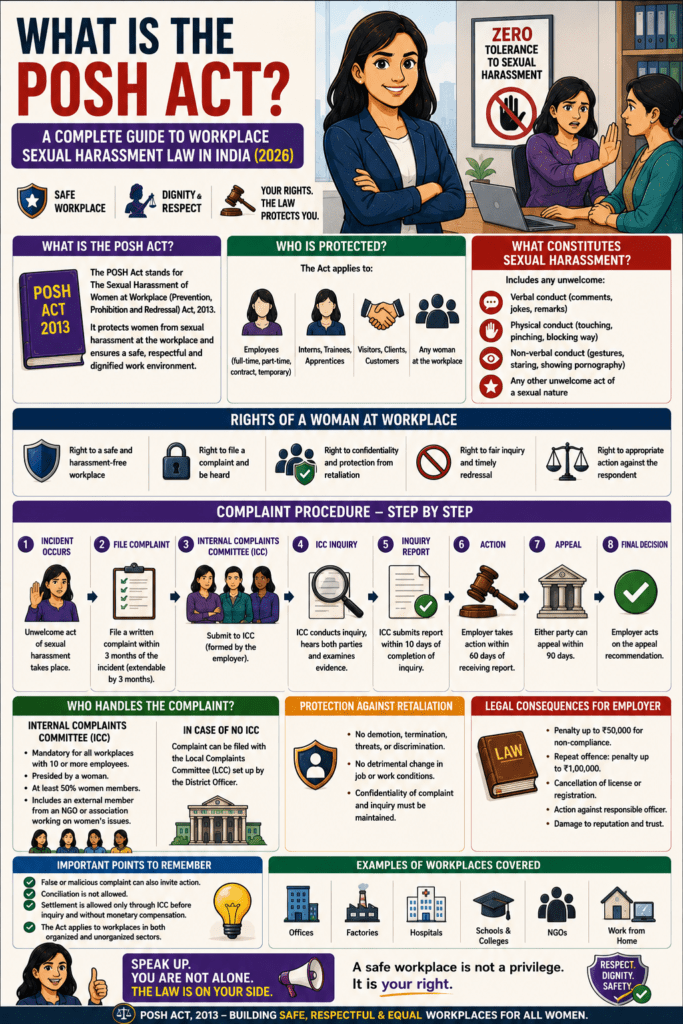
The Sexual Harassment of Women at Workplace (Prevention, Prohibition and Redressal) Act, 2013, commonly known as the POSH Act, is a special law enacted to protect women from sexual harassment at the workplace.
The Act provides a legal framework for:
- preventing sexual harassment;
- prohibiting such conduct;
- providing an internal complaint mechanism;
- ensuring a fair inquiry;
- recommending appropriate action;
- promoting a safe workplace.
Why Was the POSH Act Introduced?
Before the POSH Act came into force, India did not have a comprehensive law dealing specifically with workplace sexual harassment.
In the landmark judgment of Vishaka v. State of Rajasthan (1997), the Supreme Court recognised that sexual harassment at the workplace violates the fundamental rights guaranteed under Articles 14, 15, 19, and 21 of the Constitution of India. The Court framed the Vishaka Guidelines, which remained binding until Parliament enacted the POSH Act in 2013.
The Act is therefore rooted in constitutional principles of equality, dignity, and the right to work in a safe environment.
What Is Sexual Harassment Under the POSH Act?
Sexual harassment includes unwelcome acts or behaviour of a sexual nature.
Depending on the facts, this may include:
- unwelcome physical contact;
- demands or requests for sexual favours;
- sexually coloured remarks;
- showing pornography or sexually explicit material;
- unwelcome verbal or non-verbal conduct of a sexual nature;
- repeated inappropriate messages or communications.
Whether conduct amounts to sexual harassment depends on the circumstances of each case.
Who Is Protected Under the POSH Act?
The POSH Act specifically protects women at the workplace.
Protection extends to a wide range of women, including:
- permanent employees;
- contractual employees;
- trainees;
- interns;
- consultants;
- probationers;
- temporary workers;
- volunteers;
- daily wage workers;
- visitors, in appropriate circumstances.
The law is intended to protect women regardless of the nature of their employment.
What Is Considered a Workplace?
The term “workplace” is interpreted broadly.
It may include:
- offices;
- corporate establishments;
- government departments;
- educational institutions;
- hospitals;
- sports institutions;
- transportation provided by the employer;
- work-related travel;
- off-site meetings;
- virtual work environments, where the facts so warrant.
The scope is much wider than a traditional office building.
What Are the Employer’s Responsibilities?
Every employer has a statutory duty to take reasonable steps to prevent workplace sexual harassment.
These responsibilities include:
- providing a safe working environment;
- displaying information regarding the consequences of sexual harassment;
- constituting an Internal Committee (IC) where required by law;
- organising awareness and training programmes;
- assisting the complainant where criminal proceedings are appropriate;
- ensuring that complaints are handled confidentially and fairly.
Failure to comply with these obligations may attract legal consequences.
What Is an Internal Committee (IC)?
Every employer employing 10 or more employees is generally required to constitute an Internal Committee under the POSH Act.
The Committee is responsible for:
- receiving complaints;
- conducting inquiries;
- examining evidence;
- hearing both parties;
- submitting recommendations to the employer.
The inquiry must follow the principles of natural justice.
What Is a Local Committee?
If an organisation has fewer than 10 employees, or if the complaint is against the employer, the complaint may generally be made before the Local Committee constituted by the appropriate authority under the Act.
This ensures that women working in smaller establishments also have access to a grievance redressal mechanism.
How Does the POSH Complaint Procedure Work?
Step 1: Filing the Complaint
A written complaint should ordinarily be submitted to the Internal Committee or Local Committee within the time prescribed by the Act. The Committee has limited power to extend the period in appropriate cases for sufficient reasons.
Step 2: Preliminary Process
The Committee examines whether the complaint falls within the scope of the Act.
Where appropriate and requested by the complainant, the Act also provides for conciliation, but no monetary settlement can be the basis of conciliation.
Step 3: Inquiry
If the matter proceeds, the Committee:
- hears both parties;
- examines witnesses;
- reviews documents and electronic records;
- provides both sides a reasonable opportunity to present their case.
The inquiry is intended to be impartial and confidential.
Step 4: Report
After completing the inquiry, the Committee submits its findings and recommendations to the employer.
The employer is expected to act in accordance with the recommendations and the Act.
Can a Criminal Case Also Be Filed?
Yes.
If the alleged conduct amounts to an offence under the Bharatiya Nyaya Sanhita, 2023 (BNS) or any other applicable law, the complainant may also approach the police.
A POSH inquiry and a criminal investigation are distinct legal processes and may proceed independently, subject to law.
What Action Can Be Taken Against the Respondent?
If the allegations are established, the employer may take action in accordance with:
- the POSH Act;
- applicable service rules;
- employment contracts;
- disciplinary regulations.
The nature of the action depends on the findings of the inquiry and the governing rules.
What Happens If an Employer Does Not Follow the POSH Act?
Failure to comply with the statutory obligations under the POSH Act may result in legal consequences, including penalties provided under the Act. Repeated non-compliance may also lead to additional consequences, including issues relating to business licences or registrations, where the Act so provides.
Is Confidentiality Important?
Yes.
The POSH Act requires confidentiality regarding the identity of the parties, witnesses, inquiry proceedings, recommendations, and related information, subject to the provisions of the Act.
Maintaining confidentiality protects the integrity of the inquiry and the dignity of everyone involved.
Jurisprudence Behind the POSH Act
The POSH Act is based on important constitutional principles.
1. Right to Dignity
Every woman has the right to work with dignity and without fear of harassment.
2. Equality
Sexual harassment undermines equal opportunity in employment and violates the constitutional guarantee of equality.
3. Safe Working Environment
Employers are legally expected to create and maintain a workplace where employees feel secure.
4. Natural Justice
The inquiry must be fair to both the complainant and the respondent. Both sides should receive notice, an opportunity to present evidence, and an impartial decision.
Practical Tips
✅ Report incidents as early as possible.
✅ Preserve emails, messages, screenshots, and other evidence.
✅ Read your company’s POSH policy.
✅ Cooperate with the Internal Committee during the inquiry.
✅ Maintain confidentiality throughout the proceedings.
❌ Do not ignore workplace harassment.
❌ Do not circulate allegations publicly while the inquiry is pending.
❌ Do not interfere with witnesses or evidence.
Myth vs Reality
| Myth | Reality |
|---|---|
| The POSH Act applies only to large companies. | False. Smaller organisations are covered through the Local Committee mechanism where applicable. |
| Only permanent employees can file a complaint. | Incorrect. The Act extends protection to many categories of women, including interns, trainees, consultants, and contractual workers. |
| A POSH complaint automatically leads to dismissal of the accused. | False. A fair inquiry is mandatory before any action is taken. |
| A POSH inquiry replaces a criminal case. | Incorrect. A workplace inquiry and a criminal investigation are separate legal processes. |
| Everything discussed in a POSH inquiry can be shared publicly. | False. The Act contains confidentiality obligations that protect the parties and the inquiry process. |
Frequently Asked Questions (FAQs)
Who can file a complaint under the POSH Act?
A woman alleging workplace sexual harassment may file a complaint in accordance with the Act.
Is there a time limit for filing a complaint?
Yes. The Act prescribes a time limit for filing complaints, with limited power to extend the period for sufficient reasons.
Can I file both a POSH complaint and a police complaint?
Yes. If the alleged conduct also constitutes a criminal offence, both processes may proceed independently, subject to applicable law.
Is every employer required to have an Internal Committee?
Employers with 10 or more employees are generally required to constitute an Internal Committee under the Act.
Can the complaint remain confidential?
Yes. The POSH Act imposes confidentiality obligations regarding the complaint, inquiry, and related information.
Key Takeaways
- The POSH Act is India’s dedicated law to prevent and address sexual harassment of women at the workplace.
- It was enacted following the Supreme Court’s landmark decision in Vishaka v. State of Rajasthan (1997).
- Employers have legal duties to prevent harassment, establish an Internal Committee where required, and conduct fair inquiries.
- The Act emphasises prevention, protection, fairness, and confidentiality.
- A POSH inquiry does not prevent criminal proceedings where the alleged conduct constitutes an offence under criminal law.
Conclusion
The POSH Act is much more than a complaint mechanism—it is a legal framework that promotes dignity, equality, and safety in the workplace. By imposing responsibilities on employers and providing women with an accessible process for reporting sexual harassment, the Act seeks to foster workplaces where employees can perform their duties without fear or intimidation.
Understanding how the POSH Act works benefits everyone. Employees should know their rights and the procedure for raising concerns, while employers must ensure compliance with the law through effective policies, awareness programmes, and fair inquiries.
A respectful workplace is not only a legal obligation—it is the foundation of a healthy, productive, and professional work environment.