
- Introduction
- Can You Legally File a Complaint Against an Employer or Employee?
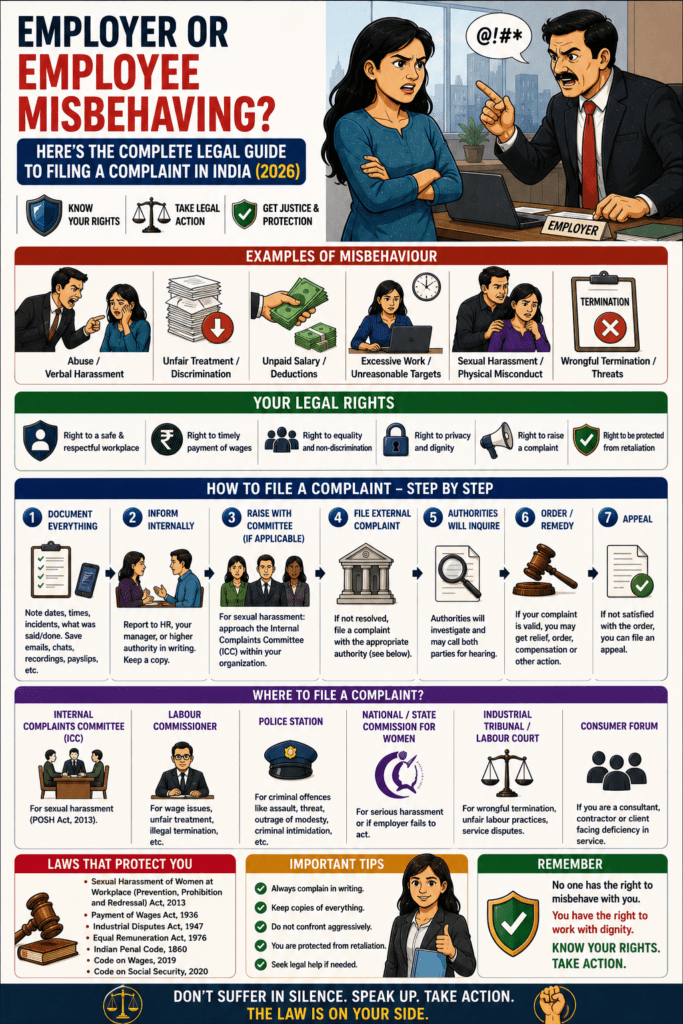
- Common Complaints Against an Employer
- Common Complaints Against an Employee
- Step 1: Identify the Nature of the Dispute
- Step 2: Preserve Evidence
- Step 3: Use the Internal Grievance Mechanism
- Step 4: Send a Legal Notice
- Step 5: Approach the Appropriate Authority
- Can an Employer File a Police Complaint Against an Employee?
- Can an Employee File a Criminal Complaint Against an Employer?
- What If the Employer Terminates Me Illegally?
- What If an Employee Commits Fraud?
- Jurisprudence Behind Workplace Complaint Laws
- Practical Tips
- Myth vs Reality
- Frequently Asked Questions (FAQs)
- Key Takeaways
- Conclusion
Introduction
Every workplace is expected to be safe, fair, and professional. Unfortunately, disputes between employers and employees are common.
Sometimes:
- an employer illegally withholds salary;
- an employee commits fraud;
- a company terminates an employee unfairly;
- an employee leaks confidential information;
- an employer harasses an employee;
- workplace misconduct goes unaddressed.
Many people immediately ask:
- Can I file a police complaint?
- Should I approach the Labour Commissioner?
- Can I sue my employer?
- Can an employer file a criminal case against an employee?
- Which authority should I approach?
The answer depends on the nature of the dispute.
This guide explains the legal remedies available in India in simple language.
Can You Legally File a Complaint Against an Employer or Employee?
Yes.
Both employers and employees have legal rights and legal responsibilities.
However, the appropriate forum depends on the type of dispute.
Not every workplace issue is a criminal offence, and not every dispute requires a civil suit.
Choosing the correct legal remedy is often the most important step.
Common Complaints Against an Employer
An employee may have legal remedies where there are allegations relating to:
- non-payment of salary or wages;
- illegal deduction of wages;
- wrongful termination or dismissal;
- sexual harassment (for women at the workplace);
- workplace discrimination;
- unsafe working conditions;
- breach of employment contract;
- denial of statutory benefits;
- non-payment of gratuity, bonus, or provident fund where applicable.
The remedy depends on the applicable law and the employee’s status.
Common Complaints Against an Employee
An employer may take legal action where there are allegations such as:
- fraud;
- theft;
- criminal breach of trust;
- embezzlement;
- data theft;
- disclosure of confidential information;
- cyber misconduct;
- forgery;
- assault;
- serious workplace misconduct;
- breach of employment agreement.
Some disputes are disciplinary in nature, while others may also involve criminal offences.
Step 1: Identify the Nature of the Dispute
Before taking legal action, determine whether the matter involves:
Employment Issue
Examples include:
- salary disputes;
- leave;
- promotion;
- transfer;
- service conditions;
- resignation;
- termination.
These are generally dealt with under employment contracts or labour laws.
Criminal Offence
Examples include:
- theft;
- cheating;
- fraud;
- criminal intimidation;
- assault;
- sexual offences;
- forgery.
These may justify approaching the police if the facts disclose a cognizable offence.
Civil Dispute
Examples include:
- breach of contract;
- recovery of money;
- damages;
- confidentiality obligations.
Such disputes are generally resolved before civil courts or through arbitration where applicable.
Step 2: Preserve Evidence
Always preserve:
- appointment letter;
- employment agreement;
- salary slips;
- emails;
- WhatsApp messages;
- attendance records;
- CCTV footage, if available;
- witness details;
- notices;
- termination letters;
- internal correspondence.
Good documentation often determines the outcome of the dispute.
Step 3: Use the Internal Grievance Mechanism
Many organisations have:
- HR departments;
- grievance committees;
- disciplinary authorities;
- ethics committees;
- Internal Committees under the POSH Act (where applicable).
Internal resolution is often faster and less expensive than litigation.
Step 4: Send a Legal Notice
If the dispute remains unresolved, a lawyer may issue a legal notice setting out:
- the facts;
- legal violations alleged;
- the relief sought;
- a reasonable period for compliance.
A legal notice is not mandatory in every case but may facilitate settlement.
Step 5: Approach the Appropriate Authority
The forum depends on the issue.
Labour or Employment Authorities
Where the dispute concerns wages, service conditions, or statutory employment rights, the appropriate labour authority or tribunal may have jurisdiction.
Internal Committee (POSH)
Women alleging workplace sexual harassment may approach the Internal Committee or, where applicable, the Local Committee under the POSH Act.
Police
If the facts disclose a criminal offence, a complaint may be made to the police.
Registration of a case depends on the applicable criminal law and the facts presented.
Civil Court or Commercial Court
Contractual disputes, recovery claims, damages, injunctions, or business-related employment disputes may require civil proceedings.
Arbitration
Where the employment contract contains a valid arbitration clause and the dispute is arbitrable, arbitration may be available.
Can an Employer File a Police Complaint Against an Employee?
Yes.
If an employee is alleged to have committed offences such as fraud, theft, forgery, criminal breach of trust, cybercrime, or other offences under the Bharatiya Nyaya Sanhita, 2023 or other applicable laws, the employer may approach the police.
Whether an FIR is registered depends on whether the information discloses a cognizable offence.
Can an Employee File a Criminal Complaint Against an Employer?
Yes.
Where the employer’s conduct amounts to a criminal offence under applicable law, an employee may seek criminal remedies.
Each case depends on its own facts.
What If the Employer Terminates Me Illegally?
The available remedies depend on factors such as:
- the employment contract;
- applicable labour laws;
- the nature of employment;
- the employee’s designation;
- statutory protections.
Relief may include reinstatement, compensation, or other remedies where the law permits.
What If an Employee Commits Fraud?
The employer should:
- secure evidence;
- conduct an internal inquiry where appropriate;
- comply with principles of natural justice in disciplinary proceedings;
- take contractual or disciplinary action;
- consider criminal remedies if the facts justify.
Both disciplinary proceedings and criminal proceedings may, in appropriate cases, proceed independently.
Jurisprudence Behind Workplace Complaint Laws
The law seeks to maintain a balance between:
1. Employee Rights
Employees deserve fair treatment, dignity, and statutory protection.
2. Employer Rights
Employers are entitled to protect their business, property, confidential information, and workplace discipline.
3. Natural Justice
Before serious action is taken, the affected person should ordinarily receive:
- notice of the allegations;
- an opportunity to respond;
- a fair and unbiased decision-making process.
These principles are fundamental to workplace justice.
4. Rule of Law
Workplace disputes should be resolved through lawful procedures rather than arbitrary action.
Practical Tips
✅ Keep copies of every communication.
✅ Preserve emails and digital records.
✅ Read your employment contract carefully.
✅ Follow the company’s grievance process where appropriate.
✅ Obtain legal advice before resigning or terminating employment in contentious situations.
❌ Do not fabricate evidence.
❌ Do not make false allegations.
❌ Do not ignore legal notices or disciplinary proceedings.
Myth vs Reality
| Myth | Reality |
|---|---|
| Every workplace dispute is a criminal case. | False. Many disputes are contractual or employment-related rather than criminal. |
| You must always go directly to court. | Incorrect. Internal mechanisms, labour authorities, or arbitration may provide appropriate remedies. |
| An employer can terminate anyone without following the law or contract. | False. Termination may be subject to contractual terms, labour laws, and principles of natural justice. |
| An employee can never be prosecuted for workplace misconduct. | Incorrect. Criminal liability may arise if the conduct amounts to an offence under applicable law. |
| A legal notice is mandatory before every case. | False. Whether a notice is required depends on the type of dispute and the applicable legal framework. |
Frequently Asked Questions (FAQs)
Can I complain against my employer for not paying my salary?
Yes. The appropriate remedy depends on your employment status, the applicable labour laws, and the terms of your employment contract.
Can an employer file an FIR against an employee?
Yes, if the facts disclose a cognizable criminal offence.
Should I approach HR before going to court?
In many cases, using the internal grievance mechanism is advisable, although urgent criminal matters may require immediate reporting to the police.
Can both civil and criminal proceedings continue together?
In appropriate cases, yes. Civil remedies and criminal proceedings serve different legal purposes.
Do I always need a lawyer?
Not always. However, legal advice is often beneficial, particularly where serious allegations, termination, or litigation is involved.
Key Takeaways
- There is no single procedure for every workplace dispute.
- The correct legal remedy depends on the nature of the complaint.
- Internal grievance mechanisms should be considered where appropriate.
- Labour authorities, civil courts, arbitration, and police each have distinct roles.
- Preserve evidence before initiating legal proceedings.
- Fairness, natural justice, and due process are central principles of Indian employment law.
Conclusion
Disputes between employers and employees are an inevitable part of the modern workplace, but every disagreement does not require immediate litigation. Indian law provides multiple forums to resolve workplace conflicts depending on the nature of the grievance—whether it concerns salary, termination, harassment, contractual obligations, or criminal misconduct.
The most effective approach is to identify the correct legal forum, preserve relevant evidence, follow the applicable procedure, and seek timely legal advice. Acting through the appropriate legal channel not only protects your rights but also increases the likelihood of a fair and efficient resolution.
Knowing where to complain is often just as important as knowing what to complain about. Choosing the correct legal remedy can save time, expense, and unnecessary litigation.