
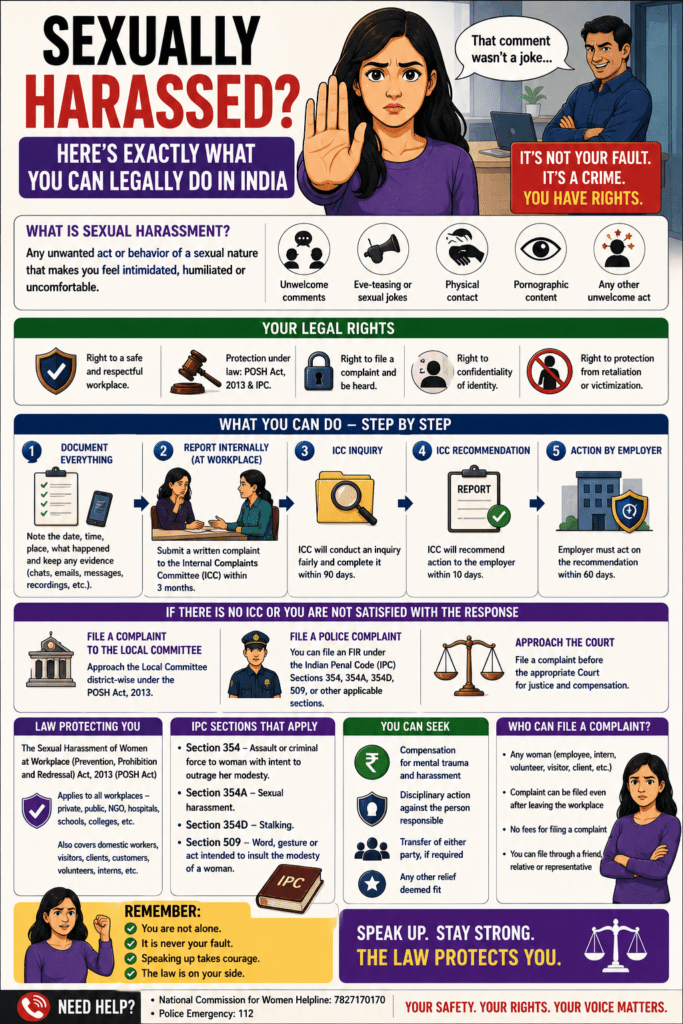
- Introduction
- What Is Sexual Harassment?
- Which Laws Protect Victims?
- What Should You Do Immediately After Sexual Harassment?
- Can You File an FIR?
- What Happens After a Police Complaint?
- What If the Harassment Happened at the Workplace?
- What If My Employer Ignores My Complaint?
- Can Online Sexual Harassment Also Be Punished?
- Can Men Also Face Sexual Harassment?
- What If There Is No Witness?
- Can the Victim Seek Compensation?
- Jurisprudence Behind Sexual Harassment Laws
- Important Supreme Court Contribution
- Practical Tips
- Myth vs Reality
- Frequently Asked Questions (FAQs)
- Key Takeaways
- Conclusion
Introduction
Sexual harassment can happen anywhere—at the workplace, college, public transport, online, on social media, in a neighbourhood, or even by someone you know.
It can leave a person feeling frightened, humiliated, anxious, or unsure about what to do next.
Many people remain silent because they believe:
- “Nobody will believe me.”
- “I don’t have enough evidence.”
- “The harasser is powerful.”
- “I may lose my job.”
- “The police won’t help.”
The law in India provides both criminal remedies and, in many workplace situations involving women, civil and disciplinary remedies. Knowing your rights and acting promptly can make a significant difference.
This guide explains your legal options in simple language.
What Is Sexual Harassment?
Sexual harassment is any unwelcome conduct of a sexual nature.
Depending on the facts, it may include:
- unwelcome physical contact;
- unwanted touching;
- sexually coloured remarks;
- repeated sexual advances;
- demands or requests for sexual favours;
- stalking or following a person;
- sending obscene messages or images;
- making sexually explicit comments;
- online sexual harassment;
- sharing intimate images without consent;
- any other conduct prohibited by law.
Whether conduct amounts to an offence depends on the specific facts and the applicable legal provisions.
Which Laws Protect Victims?
Depending on the situation, protection may arise under:
1. Bharatiya Nyaya Sanhita, 2023 (BNS)
The BNS contains various provisions dealing with offences against women and offences involving sexual misconduct, including sexual harassment, stalking, voyeurism, assault with intent to outrage modesty, and more serious sexual offences where applicable.
The exact provision depends on the facts of each case.
2. Sexual Harassment of Women at Workplace (Prevention, Prohibition and Redressal) Act, 2013 (POSH Act)
The POSH Act protects women against sexual harassment at the workplace.
It requires employers to:
- provide a safe working environment;
- constitute an Internal Committee (IC) where legally required;
- inquire into complaints;
- take appropriate action where allegations are established.
3. Information Technology Law
Where harassment occurs online, other laws relating to electronic evidence and cyber offences may also become relevant depending on the circumstances.
What Should You Do Immediately After Sexual Harassment?
Step 1: Ensure Your Safety
If you are in immediate danger:
- move to a safe place;
- seek help from trusted persons;
- contact the police if necessary.
Your safety should always come first.
Step 2: Preserve Evidence
Evidence can be extremely important.
Preserve:
- WhatsApp chats;
- emails;
- screenshots;
- CCTV footage, if available;
- call records;
- photographs;
- videos;
- social media messages;
- names and contact details of witnesses.
Avoid deleting any relevant material.
Step 3: Write Down What Happened
As soon as possible, record:
- the date;
- time;
- place;
- what happened;
- who was present;
- what was said or done.
Contemporaneous notes may help support your account.
Step 4: Report the Incident
The appropriate forum depends on where and how the harassment occurred.
If It Happened at the Workplace
A woman may submit a complaint under the POSH Act to the employer’s Internal Committee or, where applicable, the Local Committee.
Employers have statutory responsibilities to address such complaints.
If It Is a Criminal Offence
You may approach the police and provide all relevant facts.
Where the information discloses a cognizable offence, the police are required to act in accordance with law.
Can You File an FIR?
Yes, where the facts disclose a cognizable offence under the BNS or other applicable laws.
The police will assess the allegations and register a case where the legal requirements are met.
Each complaint is examined on its own facts.
What Happens After a Police Complaint?
The investigating agency may:
- record your statement;
- collect evidence;
- examine witnesses;
- obtain electronic records where relevant;
- conduct investigation in accordance with law.
If sufficient material is found, further legal proceedings may follow.
What If the Harassment Happened at the Workplace?
The POSH Act creates a specialised mechanism.
The Internal Committee may:
- receive complaints;
- conduct an inquiry;
- hear both parties;
- examine evidence;
- submit recommendations to the employer.
The employer may then take action in accordance with the Act and service rules.
What If My Employer Ignores My Complaint?
Employers are expected to comply with the POSH Act.
Failure to follow statutory obligations may have legal consequences, and appropriate remedies may be available depending on the facts.
Legal advice should be obtained where complaints are not addressed.
Can Online Sexual Harassment Also Be Punished?
Yes.
Harassment through:
- Instagram;
- Facebook;
- WhatsApp;
- Telegram;
- email;
- dating applications;
- other online platforms,
may attract legal consequences depending on the nature of the conduct.
Electronic evidence should be preserved carefully.
Can Men Also Face Sexual Harassment?
Everyone deserves dignity and protection from unlawful conduct.
However, the POSH Act specifically provides a workplace redressal mechanism for women.
Depending on the facts, men or persons of any gender who experience unlawful conduct may have remedies under other applicable criminal, civil, employment, contractual, or service laws.
The available remedy depends on the circumstances.
What If There Is No Witness?
Many incidents occur in private.
The absence of eyewitnesses does not automatically mean that a complaint cannot succeed.
Courts and investigating authorities consider all available evidence, including electronic records, surrounding circumstances, medical evidence where relevant, and witness testimony.
Each case is decided on its own facts.
Can the Victim Seek Compensation?
Depending on the nature of the proceedings and the applicable law, compensation or other relief may be available through the competent forum.
The availability and quantum depend on the facts and the relevant statutory provisions.
Jurisprudence Behind Sexual Harassment Laws
The law seeks to uphold fundamental constitutional values.
1. Right to Dignity
Every individual has the right to live with dignity and respect.
2. Equality
No person should be subjected to discrimination or harassment.
3. Safe Workplace
Employers have a responsibility to maintain a safe working environment, particularly under the POSH Act.
4. Fair Investigation
The legal process protects both complainants and accused persons by requiring a fair, impartial, and lawful inquiry before liability is determined.
Important Supreme Court Contribution
Before the enactment of the POSH Act, the Supreme Court, in the landmark Vishaka v. State of Rajasthan (1997), framed guidelines to protect women from sexual harassment at the workplace. Those principles laid the foundation for the enactment of the Sexual Harassment of Women at Workplace (Prevention, Prohibition and Redressal) Act, 2013, which now governs workplace complaints involving women.
Practical Tips
✅ Report the incident promptly.
✅ Preserve all electronic evidence.
✅ Keep copies of complaints and acknowledgements.
✅ Identify potential witnesses.
✅ Seek legal advice before making detailed public statements.
✅ Cooperate with the investigation.
❌ Do not delete messages or recordings.
❌ Do not fabricate evidence.
❌ Do not ignore repeated harassment.
Myth vs Reality
| Myth | Reality |
|---|---|
| You need eyewitnesses to prove sexual harassment. | False. Cases may be supported by electronic evidence, surrounding circumstances, and other admissible material. |
| Only physical touching amounts to sexual harassment. | Incorrect. Unwelcome verbal, written, online, or visual conduct may also amount to sexual harassment depending on the facts. |
| Complaining at work always means losing your job. | False. Employers have statutory obligations under the POSH Act to address complaints fairly. |
| Online harassment is not punishable. | Wrong. Depending on the conduct, online harassment may attract legal consequences. |
| Every complaint automatically results in conviction. | Incorrect. Every allegation must be investigated fairly, and guilt is determined only through the legal process. |
Frequently Asked Questions (FAQs)
Can I complain if the harassment happened online?
Yes. Online conduct may amount to an offence or workplace misconduct depending on the facts.
Can I file both a workplace complaint and a police complaint?
Yes, where appropriate. A workplace inquiry under the POSH Act and a criminal investigation serve different legal purposes and may proceed independently, subject to applicable law.
What if there is no CCTV footage?
A complaint can still be investigated using other forms of evidence.
Is there a time limit for filing a workplace complaint?
The POSH Act prescribes timelines for making complaints and also allows extension in appropriate cases for reasons recorded. Prompt reporting is advisable.
Can anonymous complaints be investigated?
This depends on the applicable legal framework, workplace policy, and the facts. Formal proceedings generally require sufficient particulars to enable a fair inquiry.
Key Takeaways
- Sexual harassment may attract both criminal and workplace consequences.
- Women at the workplace have statutory protection under the POSH Act, 2013.
- Criminal remedies are available under the Bharatiya Nyaya Sanhita, 2023, depending on the facts.
- Preserve evidence immediately and report the incident through the appropriate legal channel.
- Every complaint should be investigated fairly, and every accused is entitled to due process.
- Timely action often strengthens the ability to protect legal rights.
Conclusion
No one should have to endure sexual harassment in silence. Indian law provides mechanisms to protect victims, punish unlawful conduct, and promote safe workplaces and public spaces. Whether the incident occurs at work, online, in public, or elsewhere, knowing your legal rights is the first step toward seeking justice.
At the same time, the legal system is built on fairness. Complaints should be investigated thoroughly, evidence should be preserved, and liability should be determined through due process rather than assumptions.
If you have experienced sexual harassment, acting promptly, preserving evidence, and using the appropriate legal remedies can help protect your rights and ensure that the matter is addressed according to law.