
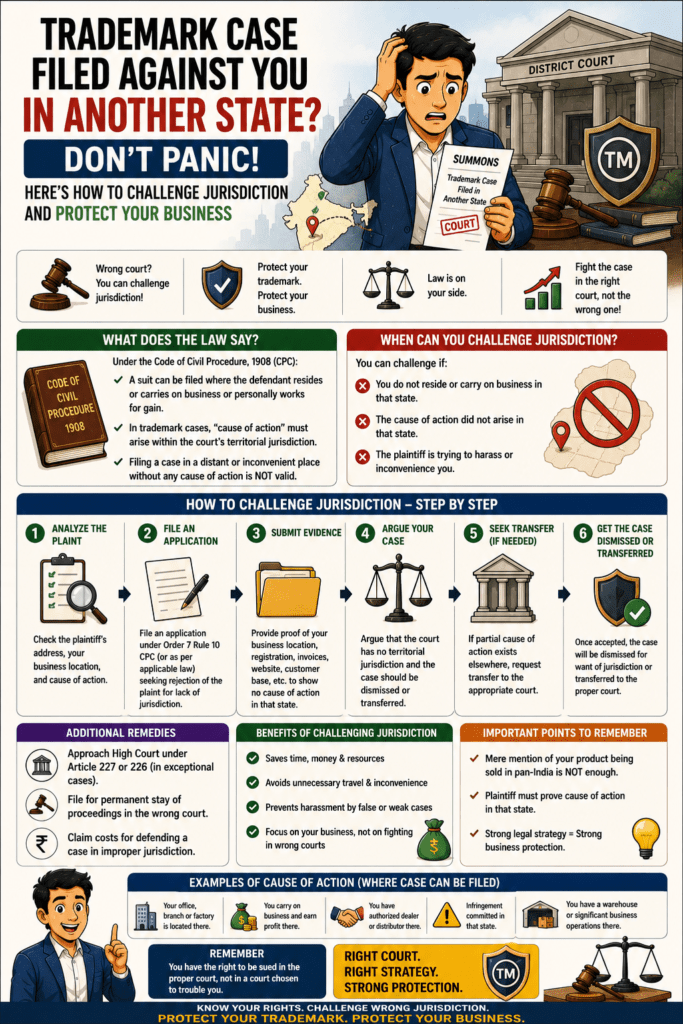
- Introduction
- Can Someone File a Trademark Case Against You in Another State?
- Which Laws Govern Territorial Jurisdiction?
- What Is Territorial Jurisdiction?
- Why Is Jurisdiction So Important?
- Can the Plaintiff Always Sue From Its Own Office?
- What Is Forum Shopping?
- What Should You Do If You Receive a Trademark Suit From Another State?
- Can Online Sales Automatically Give Jurisdiction Everywhere?
- Can an Interim Injunction Still Be Granted?
- Can You Seek Transfer of the Case?
- Important Supreme Court Principles
- Jurisprudence Behind Territorial Jurisdiction
- Practical Tips
- Myth vs Reality
- Frequently Asked Questions (FAQs)
- Key Takeaways
- Conclusion
Introduction
Imagine running your business from Jaipur, Lucknow, Chandigarh, or Kochi, only to receive a court summons from Delhi, Mumbai, or another distant city alleging trademark infringement.
Your first thoughts are likely:
- Can they sue me in another state?
- Do I have to travel every time?
- Is that court even competent?
- Can I challenge the case?
- Can the plaint be returned or transferred?
The answer is not always straightforward.
A plaintiff cannot choose any court in India simply because it is convenient. Jurisdiction in trademark disputes is governed by specific statutory provisions and well-settled judicial principles.
If a case has been filed before a court that lacks territorial jurisdiction, you have important legal remedies.
This guide explains everything you need to know.
Can Someone File a Trademark Case Against You in Another State?
Yes—but only if the law permits it.
A trademark infringement suit cannot be filed at any place chosen by the plaintiff.
The court must possess territorial jurisdiction under the applicable law.
If the chosen court has no jurisdiction, the suit may be liable to be returned or rejected in accordance with law.
Which Laws Govern Territorial Jurisdiction?
Jurisdiction in trademark matters is determined primarily by:
- the Trade Marks Act, 1999;
- the Code of Civil Procedure, 1908 (CPC);
- the Commercial Courts Act, 2015, where applicable.
These laws operate together to determine the proper forum.
What Is Territorial Jurisdiction?
Territorial jurisdiction simply means:
Which court has the legal authority to hear the dispute?
A court cannot decide a case merely because the plaintiff prefers that location.
Jurisdiction depends on legally recognised connecting factors.
Why Is Jurisdiction So Important?
Jurisdiction protects litigants from unnecessary hardship.
Without jurisdictional rules, a business in one corner of India could be forced to defend litigation in any distant city, causing excessive expense and inconvenience.
The law therefore seeks to balance:
- access to justice for the plaintiff; and
- fairness to the defendant.
Can the Plaintiff Always Sue From Its Own Office?
Not necessarily.
Section 134 of the Trade Marks Act, 1999 provides a special forum to the plaintiff in certain circumstances.
However, the Supreme Court has clarified that this provision cannot be misused to create an artificial or oppressive forum when the cause of action substantially arises elsewhere or the plaintiff itself carries on business at the place where the cause of action arose.
Courts discourage forum shopping.
What Is Forum Shopping?
Forum shopping occurs when a litigant deliberately chooses a court perceived to be more favourable, even though another court is more closely connected with the dispute.
Indian courts have repeatedly cautioned against such practices.
Jurisdictional provisions are intended to promote fairness, not tactical advantage.
What Should You Do If You Receive a Trademark Suit From Another State?
Step 1: Do Not Ignore the Summons
Ignoring the proceedings may result in an ex parte order or interim injunction.
Always respond within the prescribed time.
Step 2: Examine the Court’s Jurisdiction
Ask the following questions:
- Where does the plaintiff actually carry on business?
- Where do you carry on business?
- Where did the alleged infringement occur?
- Where were the goods sold?
- Where did the cause of action arise?
- Does the plaint disclose facts giving that court territorial jurisdiction?
These questions often determine whether the chosen forum is legally sustainable.
Step 3: Review the Plaint Carefully
The plaint should disclose the facts on which territorial jurisdiction is claimed.
Look for assertions relating to:
- business activities;
- sales;
- advertisements;
- transactions;
- online operations;
- cause of action.
If these assertions are absent or legally insufficient, the jurisdiction may be open to challenge.
Step 4: Challenge the Jurisdiction
If the court lacks territorial jurisdiction, you may raise the objection at the earliest available opportunity.
Depending on the facts, the court may:
- return the plaint for presentation before the proper court;
- decide the jurisdictional issue before proceeding further;
- reject jurisdictional objections if they are without merit.
The appropriate remedy depends on the pleadings and procedural stage.
Can Online Sales Automatically Give Jurisdiction Everywhere?
Not always.
Merely because a website is accessible across India does not automatically mean that every court in India acquires jurisdiction.
Courts generally examine whether there is a real and substantial connection with the forum, such as targeted commercial activity or transactions giving rise to the cause of action.
Can an Interim Injunction Still Be Granted?
Yes.
If the plaintiff establishes the legal requirements for interim relief, the court may grant a temporary injunction.
However, the defendant can challenge both:
- the territorial jurisdiction; and
- the merits of the injunction.
The two issues are distinct.
Can You Seek Transfer of the Case?
Depending on the facts and the applicable procedural law, transfer of proceedings may be available in appropriate circumstances through the competent forum.
Whether transfer is granted depends on the interests of justice and the statutory framework.
Legal advice should be obtained before pursuing this remedy.
Important Supreme Court Principles
Indian courts have repeatedly clarified that jurisdiction cannot be expanded merely for the convenience of the plaintiff.
The Supreme Court, in Indian Performing Rights Society Ltd. v. Sanjay Dalia (2015), explained that the special jurisdiction available under Section 134 of the Trade Marks Act must be interpreted to prevent abuse and forum shopping. The Court emphasised that where the plaintiff has a principal or subordinate office at the place where the cause of action arises, it should ordinarily institute proceedings there rather than select a distant forum solely for convenience.
Similarly, in Ultra Home Construction Pvt. Ltd. v. Purushottam Kumar Chaubey, the courts reiterated that territorial jurisdiction must have a genuine legal foundation and cannot be based on artificial or insignificant connections.
These decisions continue to guide courts in determining the proper forum for trademark litigation.
Jurisprudence Behind Territorial Jurisdiction
The law on jurisdiction is based on three important objectives.
1. Fairness
Both parties should have a fair opportunity to present their case without unnecessary hardship.
2. Prevention of Forum Shopping
Litigants should not misuse procedural law to harass opponents by selecting distant or inconvenient courts without legal justification.
3. Efficient Administration of Justice
Disputes should ordinarily be decided by courts having the closest connection with the underlying cause of action.
Practical Tips
✅ Read the summons immediately.
✅ Engage a lawyer experienced in intellectual property and commercial litigation.
✅ Examine whether the chosen court has territorial jurisdiction.
✅ Preserve invoices, sales records, GST documents, and business records showing where you operate.
✅ Raise jurisdictional objections promptly where legally available.
❌ Do not ignore the proceedings.
❌ Do not assume that filing in another state automatically makes the suit invalid.
❌ Do not delay obtaining legal advice.
Myth vs Reality
| Myth | Reality |
|---|---|
| A plaintiff can file a trademark case anywhere in India. | False. Territorial jurisdiction must exist under the applicable law. |
| If my business is in another state, I automatically win the jurisdiction issue. | Incorrect. Jurisdiction depends on statutory provisions and the facts of the case. |
| Online accessibility alone gives every court jurisdiction. | Wrong. Courts generally require a meaningful connection with the forum. |
| Receiving a summons from another state means I must accept that court’s jurisdiction. | False. Jurisdiction can be challenged where appropriate. |
| A jurisdiction objection ends the entire case. | Incorrect. If the objection succeeds, the matter may proceed before the competent court rather than being finally dismissed. |
Frequently Asked Questions (FAQs)
Can a trademark infringement suit be filed in another state?
Yes, but only if the chosen court has territorial jurisdiction under the law.
Can I challenge the jurisdiction?
Yes. A defendant may raise jurisdictional objections at the earliest appropriate stage if the court lacks territorial jurisdiction.
Will the case be dismissed immediately?
Not necessarily. Depending on the circumstances, the plaint may be returned for presentation before the proper court or other appropriate orders may be passed.
Does online business give jurisdiction across India?
Not automatically. Courts examine whether there is a sufficient connection between the dispute and the chosen forum.
Should I ignore the summons if I believe the court lacks jurisdiction?
No. Always appear and raise the jurisdictional objection through the proper legal process.
Key Takeaways
- A plaintiff cannot ordinarily choose any court in India for a trademark dispute.
- Territorial jurisdiction is governed by the Trade Marks Act, 1999, the Code of Civil Procedure, 1908, and, where applicable, the Commercial Courts Act, 2015.
- Section 134 of the Trade Marks Act provides a special forum but cannot be used to facilitate forum shopping.
- Jurisdiction should be challenged promptly if the chosen court lacks legal authority.
- Landmark judgments such as Indian Performing Rights Society Ltd. v. Sanjay Dalia (2015) and Ultra Home Construction Pvt. Ltd. v. Purushottam Kumar Chaubey play a central role in interpreting jurisdictional principles.
Conclusion
Receiving a trademark infringement suit from another state can feel overwhelming, particularly for small and medium-sized businesses. However, the mere fact that a case has been filed in a distant court does not mean that the court necessarily has jurisdiction. Indian trademark law carefully balances the rights of plaintiffs with the need to protect defendants from unnecessary hardship and forum shopping.
If you believe the suit has been filed before the wrong court, act promptly. Read the pleadings carefully, gather your business records, seek experienced legal advice, and raise jurisdictional objections at the earliest opportunity. A well-founded challenge can ensure that the dispute is heard by the legally competent court, saving valuable time, expense, and resources.
The location of a lawsuit is not determined by convenience alone—it is determined by law. Understanding the rules of territorial jurisdiction can be just as important as defending the trademark claim itself.