
- Introduction
- Can a Court Grant an Injunction Against a Registered Trademark Owner?
- What Is an Interim Injunction?
- What Is an Ex Parte Injunction?
- Does Trademark Registration Automatically Defeat the Plaintiff's Case?
- What Should You Do Immediately After Receiving the Injunction Order?
- On What Grounds Can an Interim Injunction Be Vacated?
- Can You Appeal Against an Interim Injunction?
- Can You Claim Compensation If the Injunction Was Wrongfully Obtained?
- Does Prior User Have More Rights Than Registration?
- Jurisprudence Behind Interim Injunctions
- Practical Tips
- Myth vs Reality
- Frequently Asked Questions (FAQs)
- Key Takeaways
- Conclusion
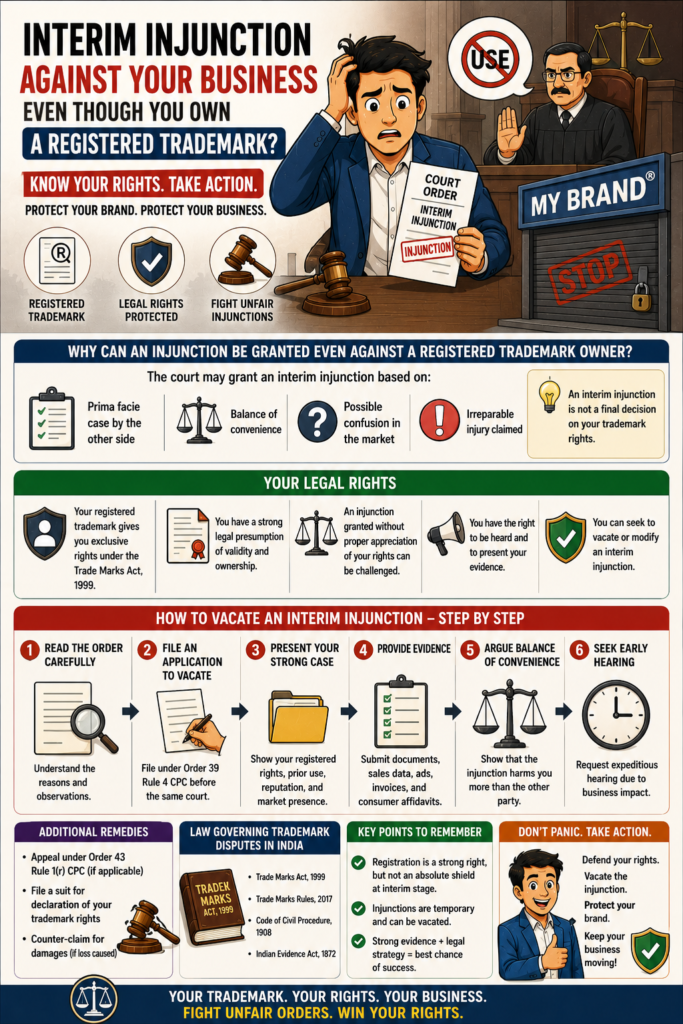
Introduction
Imagine opening your office one morning and receiving a court order stating that you must immediately stop using your own brand name or logo.
The surprising part?
You already have a registered trademark.
Many business owners believe that trademark registration gives absolute protection. Unfortunately, that is not always true.
Indian courts may grant an interim injunction even against a registered trademark proprietor if the facts and law justify such protection.
However, this does not mean that you have lost the case.
An interim injunction is only a temporary arrangement until the court hears both sides.
If the injunction has been obtained by suppression of facts, false allegations, or misleading the court, the law provides several remedies.
This guide explains everything you need to know.
Can a Court Grant an Injunction Against a Registered Trademark Owner?
Yes.
A trademark registration gives valuable statutory rights under Section 28 of the Trade Marks Act, 1999, but those rights are not absolute.
The court may still examine:
- whether another party is a prior user;
- whether there is passing off;
- whether the registration itself is under challenge;
- whether material facts were concealed;
- whether the plaintiff established the requirements for interim relief.
Therefore, registration alone does not guarantee success.
What Is an Interim Injunction?
An interim injunction is a temporary order passed during the pendency of the suit.
Its purpose is to preserve the existing position until the dispute is finally decided.
It is not a final judgment.
The court does not finally determine ownership or infringement at this stage.
What Is an Ex Parte Injunction?
Sometimes the court grants an injunction without hearing the defendant.
This is known as an ex parte interim injunction.
Such orders are generally passed where the court believes that immediate protection is necessary.
However, after receiving notice, the defendant has a right to appear and seek vacation or modification of the order.
Does Trademark Registration Automatically Defeat the Plaintiff’s Case?
No.
This is one of the biggest misconceptions.
Registration creates statutory rights, but courts also recognise:
- prior user rights;
- common law rights through passing off;
- equitable principles;
- public interest;
- honest concurrent use, where applicable.
Every case depends on its own facts.
What Should You Do Immediately After Receiving the Injunction Order?
Step 1: Read the Entire Order Carefully
Do not rely only on the operative portion.
Read:
- the plaint;
- interim application;
- supporting affidavits;
- documents filed by the plaintiff;
- reasons recorded by the court.
Understanding why the injunction was granted is essential before preparing a defence.
Step 2: Collect Your Trademark Documents
Gather:
- trademark registration certificate;
- renewal certificates;
- user affidavit (if any);
- invoices;
- GST records;
- advertisements;
- catalogues;
- website records;
- domain registration details;
- sales figures;
- promotional material.
These documents often establish prior and continuous use.
Step 3: Examine Whether the Plaintiff Suppressed Material Facts
Courts expect every litigant seeking an ex parte injunction to approach the court with clean hands.
If the plaintiff concealed important facts such as:
- your trademark registration;
- previous litigation;
- coexistence between the parties;
- prior correspondence;
- earlier settlements;
- delay in filing the suit;
the court may reconsider the interim relief.
Suppression of material facts can significantly weaken the plaintiff’s case.
Step 4: File an Application to Vacate the Injunction
A defendant may apply before the same court seeking:
- vacation of the injunction;
- modification of the order;
- clarification;
- dismissal of the interim application.
The application should explain why the injunction ought not to continue.
On What Grounds Can an Interim Injunction Be Vacated?
Depending on the facts, possible grounds include:
1. Prior and Honest Use
Indian trademark law recognises that prior use can prevail even against registration in appropriate cases.
Evidence of long-standing commercial use may therefore be crucial.
2. Suppression of Material Facts
A party obtaining an injunction by concealing relevant facts risks losing equitable relief.
3. No Prima Facie Case
An interim injunction should not continue if the plaintiff fails to establish a strong prima facie case.
4. Balance of Convenience
The court weighs which party would suffer greater hardship.
If stopping your business causes disproportionate harm, this factor may favour you.
5. No Irreparable Injury
If monetary compensation would adequately protect the plaintiff, the need for an injunction may diminish.
6. Delay and Acquiescence
If the plaintiff knowingly allowed the alleged use to continue for years without objection, delay may be a relevant consideration while deciding interim relief.
Can You Appeal Against an Interim Injunction?
Yes.
Depending upon the nature of the order and the applicable procedural law, an appeal may be maintainable before the competent appellate court.
The appellate court examines whether the trial court correctly applied the principles governing interim injunctions.
Can You Claim Compensation If the Injunction Was Wrongfully Obtained?
In appropriate cases, the law may permit a claim for damages or other relief if it is ultimately established that the injunction caused unlawful loss.
Whether compensation is available depends upon the facts, the conduct of the parties, and the final outcome of the litigation.
Does Prior User Have More Rights Than Registration?
Indian trademark law places significant importance on prior use.
Under Section 34 of the Trade Marks Act, 1999, the rights of a prior user may prevail over those of a subsequent registered proprietor in appropriate circumstances.
This is one of the foundational principles of Indian trademark jurisprudence.
Jurisprudence Behind Interim Injunctions
Interim injunctions are based on equitable principles.
The court generally considers three well-established tests:
1. Prima Facie Case
Has the plaintiff shown a serious question requiring trial?
2. Balance of Convenience
Which party will suffer greater hardship if the injunction is granted or refused?
3. Irreparable Injury
Will refusal of interim protection cause harm that cannot be adequately compensated by damages?
Unless these principles are satisfied, interim relief may not be justified.
Practical Tips
✅ Engage an experienced trademark litigation lawyer immediately.
✅ File your reply without unnecessary delay.
✅ Preserve all evidence of prior use and registration.
✅ Produce complete commercial records.
✅ Demonstrate the financial impact of the injunction on your business.
✅ Highlight any suppression or misrepresentation by the plaintiff.
❌ Do not ignore the court order.
❌ Do not violate the injunction while it remains in force.
❌ Do not destroy or alter documents.
Myth vs Reality
| Myth | Reality |
|---|---|
| Having a registered trademark means no one can ever obtain an injunction against me. | False. Registration is a strong right but not an absolute defence in every case. |
| An interim injunction means I have already lost the case. | Incorrect. It is only a temporary order pending final adjudication. |
| An ex parte injunction cannot be challenged. | Wrong. You can apply for its vacation, modification, or file an appeal where maintainable. |
| Prior user rights do not matter after registration. | False. Prior user rights continue to enjoy statutory recognition under Section 34 of the Trade Marks Act. |
| If the plaintiff concealed facts, the court cannot revisit the injunction. | Incorrect. Suppression of material facts is a recognised ground for vacating or modifying interim relief. |
Frequently Asked Questions (FAQs)
I have a registered trademark. Can someone still sue me?
Yes. Registration does not prevent another party from filing an infringement or passing off action.
Can I challenge an ex parte injunction?
Yes. You may apply before the same court to vacate or modify the injunction and, where permissible, pursue an appeal.
Does trademark registration guarantee that I will win?
No. Registration is an important statutory right, but the outcome depends on the evidence, prior use, and the applicable legal principles.
What if the plaintiff concealed important facts?
You should bring the suppression to the court’s attention. Courts expect parties seeking equitable relief to make full and frank disclosure.
Can I continue using my trademark after the injunction?
You must comply with the court’s order unless it is modified, stayed, or vacated by a competent court.
Key Takeaways
- Trademark registration is a valuable statutory right but not an absolute shield.
- Interim injunctions are temporary and can be challenged.
- Courts decide interim relief based on prima facie case, balance of convenience, and irreparable injury.
- Section 34 of the Trade Marks Act, 1999 protects prior user rights in appropriate cases.
- Suppression of material facts is a powerful ground for seeking vacation of an injunction.
- A prompt, well-documented legal response can significantly improve your position.
Conclusion
Receiving an interim injunction in a trademark dispute can be unsettling, especially when you hold a valid trademark registration. However, such an order is not the final word. Indian trademark law recognises that registration, prior use, fairness, and equitable principles must all be considered before deciding the rights of the parties.
If you believe that the injunction was obtained through false allegations, suppression of material facts, or an incorrect application of law, do not assume that your business has no remedy. Act quickly, preserve your evidence, comply with the existing order, and seek appropriate legal relief before the competent court.
A temporary injunction may pause your business—but it does not determine the final outcome of your trademark rights. A well-prepared legal strategy often makes the difference between losing a brand and successfully defending it.