
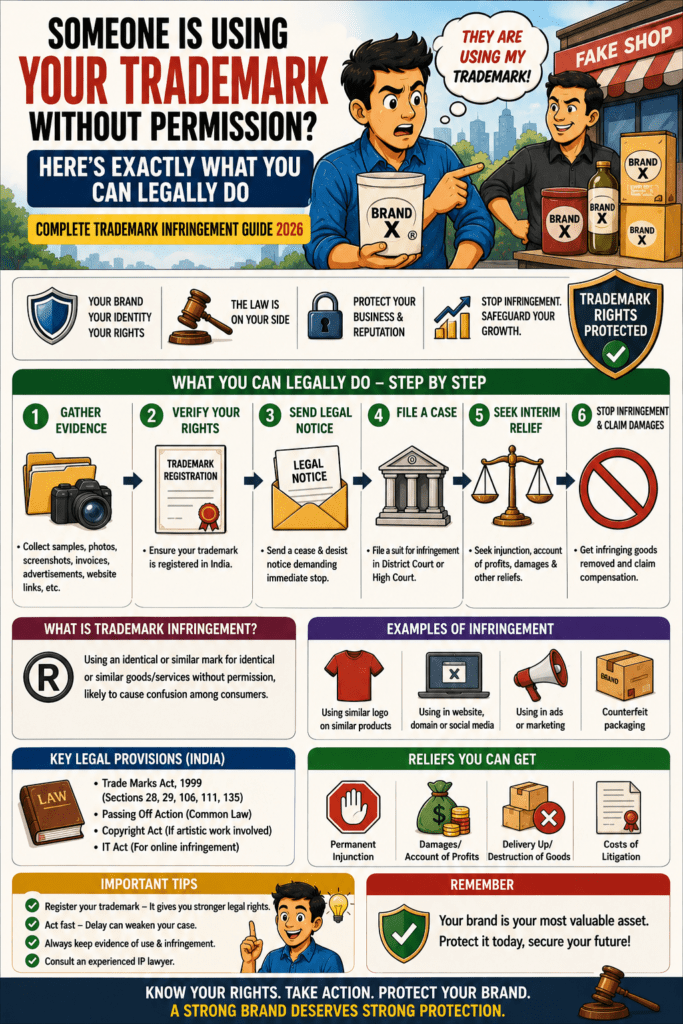
- Introduction
- What Is a Trademark?
- Which Law Governs Trademarks in India?
- What Is Trademark Infringement?
- What Is Passing Off?
- How Do You Know If Someone Is Infringing Your Trademark?
- What Should You Do If Someone Is Using Your Trademark?
- What Remedies Are Available?
- Can You Claim Compensation?
- What If Someone Copies Only My Logo?
- What If Someone Uses My Trademark Online?
- Can I Stop Fake Sellers on Online Marketplaces?
- Jurisprudence Behind Trademark Protection
- Landmark Principles Followed by Courts
- Practical Tips
- Myth vs Reality
- Frequently Asked Questions (FAQs)
- Key Takeaways
- Conclusion
Introduction
Imagine spending years building your brand.
Your business grows, customers begin recognising your logo, your brand name becomes valuable, and suddenly you discover that another person is selling products using your trademark.
The copied mark may be:
- almost identical;
- deceptively similar;
- used on similar products;
- used on websites or social media;
- printed on fake packaging;
- displayed in advertisements.
The immediate questions are:
- Can I stop them?
- Can I claim compensation?
- Can I file a criminal case?
- Will a legal notice be enough?
- What if my trademark is not registered?
The good news is that Indian law provides strong protection to trademark owners.
This guide explains everything you need to know about trademark infringement in simple language.
What Is a Trademark?
A trademark is a sign that identifies the source of goods or services.
It helps customers distinguish one business from another.
A trademark may include:
- a brand name;
- logo;
- word mark;
- device mark;
- slogan;
- label;
- symbol;
- packaging;
- shape of goods;
- colour combination (in appropriate cases).
A trademark is one of the most valuable assets of a business.
Which Law Governs Trademarks in India?
Trademark protection in India is governed primarily by the Trade Marks Act, 1999 and the Trade Marks Rules, 2017.
These laws provide:
- registration of trademarks;
- protection against infringement;
- remedies for passing off;
- civil remedies;
- criminal offences;
- border enforcement in appropriate cases.
What Is Trademark Infringement?
Trademark infringement occurs when a person uses a registered trademark, or a mark that is identical or deceptively similar, without the permission of the registered proprietor in a manner prohibited by the Trade Marks Act, 1999.
The objective of the law is to prevent consumer confusion and protect the goodwill of the trademark owner.
The statutory provisions dealing with infringement are primarily contained in Sections 28 and 29 of the Trade Marks Act, 1999.
What Is Passing Off?
Many people believe that only registered trademarks receive legal protection.
That is incorrect.
Even if a trademark is not registered, the owner may still have a remedy through the common law action of passing off, provided the business has acquired goodwill and the defendant’s conduct is likely to mislead consumers.
Passing off protects business reputation from unfair commercial practices.
How Do You Know If Someone Is Infringing Your Trademark?
Some common examples include:
- using the same brand name;
- using a deceptively similar logo;
- copying packaging or trade dress;
- selling counterfeit products;
- using your mark on websites or online marketplaces;
- using your trademark in advertisements to mislead customers;
- adopting a confusingly similar business name.
The central question is whether the use is likely to cause confusion or deception among consumers.
What Should You Do If Someone Is Using Your Trademark?
Step 1: Collect Evidence
Before taking legal action, preserve evidence such as:
- photographs of products;
- invoices;
- advertisements;
- website screenshots;
- social media posts;
- product packaging;
- online listings;
- customer complaints.
Strong evidence often determines the success of a case.
Step 2: Verify Your Trademark Registration
Check whether:
- your trademark is registered;
- the registration is valid;
- the relevant class of goods or services is covered.
Even if the mark is unregistered, legal remedies may still be available through passing off.
Step 3: Send a Cease-and-Desist (Legal) Notice
In many cases, the first legal step is to issue a detailed legal notice demanding that the infringer:
- stop using the trademark;
- remove infringing products and advertisements;
- destroy counterfeit material;
- account for profits where appropriate;
- compensate for losses, if claimed.
Many disputes are resolved at this stage without litigation.
Step 4: File a Civil Suit
If the infringement continues, the trademark owner may institute a civil suit before the competent court seeking relief such as:
- permanent injunction;
- temporary injunction;
- damages;
- rendition of accounts (account of profits, where applicable);
- delivery up and destruction of infringing goods.
Courts may also grant urgent interim protection to prevent further misuse while the case is pending.
Step 5: Consider Criminal Action
The Trade Marks Act also contains criminal provisions relating to certain acts involving falsification, false application of trademarks, and dealing in infringing goods.
Depending on the facts, criminal proceedings may also be initiated in accordance with law.
What Remedies Are Available?
The law provides several remedies, including:
Injunction
A court may restrain the infringer from continuing the unlawful use of the trademark.
Damages
The trademark owner may claim monetary compensation for the loss suffered.
Account of Profits
Instead of damages, the owner may seek an account of the profits earned by the infringer, where legally appropriate.
Delivery Up and Destruction
The court may direct surrender or destruction of counterfeit labels, packaging, and infringing goods.
Criminal Proceedings
Serious cases involving counterfeit goods or dishonest use may also attract criminal consequences under the Trade Marks Act.
Can You Claim Compensation?
Yes.
Where infringement has caused financial loss, harm to goodwill, or diversion of customers, the trademark owner may seek damages in a civil suit.
The amount depends on:
- nature of infringement;
- duration of misuse;
- reputation of the mark;
- profits earned by the infringer;
- actual loss suffered.
What If Someone Copies Only My Logo?
A logo can itself be a trademark.
If a copied logo is identical or deceptively similar and is likely to create confusion, legal action may be available.
What If Someone Uses My Trademark Online?
Trademark infringement can occur on:
- websites;
- online marketplaces;
- e-commerce platforms;
- social media;
- advertisements;
- domain names (in appropriate cases).
The digital nature of the infringement does not reduce your legal protection.
Can I Stop Fake Sellers on Online Marketplaces?
Yes.
Many online marketplaces have mechanisms for reporting intellectual property violations.
In addition, civil remedies before courts remain available where appropriate.
Jurisprudence Behind Trademark Protection
Trademark law serves several important purposes.
1. Protecting Consumers
Consumers should be able to identify the genuine source of goods and services without being misled.
2. Protecting Business Goodwill
A trademark represents years of investment, reputation, and customer trust.
The law protects that goodwill from unfair exploitation.
3. Encouraging Fair Competition
Businesses should compete through innovation and quality—not by copying another person’s reputation.
4. Preventing Consumer Confusion
The core objective of trademark law is to avoid deception in the marketplace.
Landmark Principles Followed by Courts
Indian courts generally examine factors such as:
- similarity of the marks;
- similarity of goods or services;
- likelihood of consumer confusion;
- overall impression of the competing marks;
- reputation and distinctiveness of the earlier mark;
- intention of the alleged infringer, where relevant.
The test is not whether the marks are identical in every detail, but whether an ordinary consumer is likely to be confused.
Practical Tips
✅ Register your trademark as early as possible.
✅ Monitor online marketplaces regularly.
✅ Preserve evidence of infringement.
✅ Maintain records of trademark use.
✅ Send a legal notice promptly.
✅ Consult an intellectual property lawyer before initiating litigation.
❌ Do not ignore small infringements—they may grow into larger disputes.
❌ Do not delay legal action unnecessarily.
❌ Do not assume that changing one letter always avoids infringement.
Myth vs Reality
| Myth | Reality |
|---|---|
| Only famous brands can sue for trademark infringement. | False. Any registered trademark owner may enforce their rights. |
| Changing one letter makes the trademark legal. | Incorrect. Courts examine overall similarity and the likelihood of consumer confusion. |
| An unregistered trademark has no protection. | Wrong. Passing off may protect an unregistered mark that has acquired goodwill. |
| Online copying is not trademark infringement. | False. Trademark law applies to online use as well. |
| Trademark registration lasts forever. | Incorrect. Registration must be renewed in accordance with the law. |
Frequently Asked Questions (FAQs)
Can I sue someone for using my registered trademark?
Yes. A registered proprietor may file an infringement action under the Trade Marks Act, 1999.
What if my trademark is not registered?
You may still have a remedy through an action for passing off if you can establish goodwill, misrepresentation, and damage.
Can I claim compensation?
Yes. Civil courts may award damages or other monetary relief where justified.
Can trademark infringement lead to criminal action?
Yes. Certain acts relating to falsification and dishonest use of trademarks are punishable under the Trade Marks Act.
Can I stop someone from using my trademark on social media?
Yes. Depending on the facts, you may seek removal of infringing content and pursue appropriate legal remedies.
Key Takeaways
- Trademark infringement involves unauthorized use of a registered trademark in violation of the Trade Marks Act.
- Sections 28 and 29 of the Trade Marks Act, 1999 confer and protect the rights of registered proprietors.
- Even unregistered trademarks may receive protection through the law of passing off.
- Civil remedies include injunctions, damages, account of profits, and destruction of infringing goods.
- Serious cases may also attract criminal liability.
- Early legal action and strong evidence significantly improve the chances of protecting your brand.
Conclusion
Your trademark is more than just a name or logo—it represents your reputation, customer trust, and the goodwill you have built over time. When someone uses your trademark without permission, it can mislead customers, damage your business, and dilute the value of your brand.
Indian trademark law provides robust civil and criminal remedies to protect brand owners. The key is to act promptly: gather evidence, assess your legal position, issue an appropriate legal notice, and, where necessary, approach the competent court to prevent further misuse.
Your brand is one of your most valuable business assets. Protecting it today is often far less expensive than rebuilding it after infringement tomorrow.