
- Introduction
- What Is Defamation?
- What Does the Law Say?
- What Amounts to Defamation?
- Can Defamation Happen in Private?
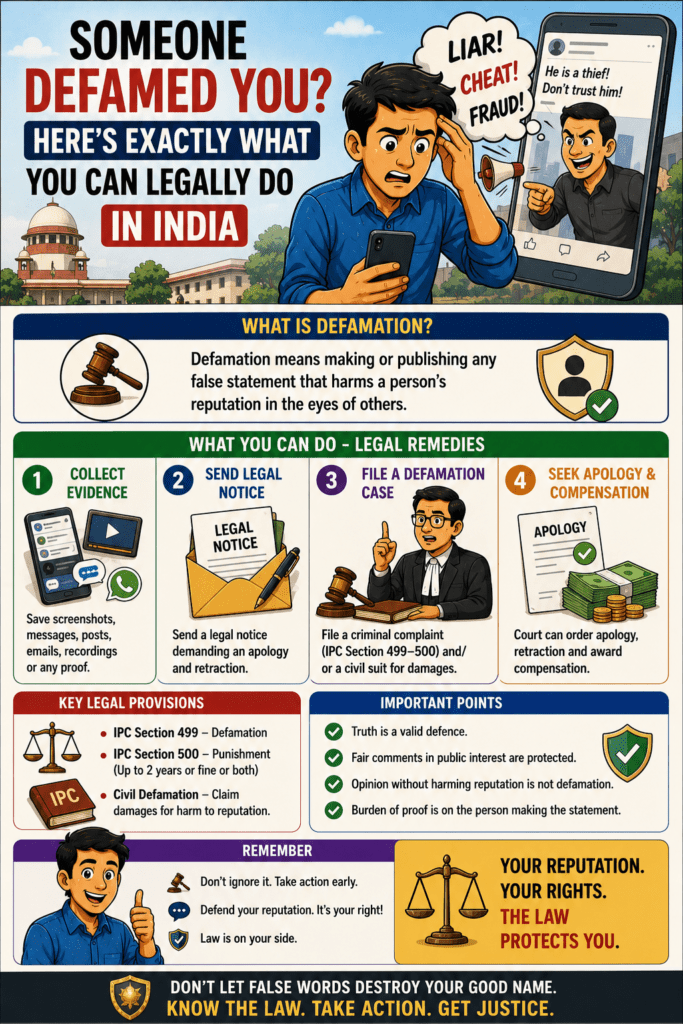
- What Should You Do If Someone Defames You?
- Can You Get Compensation for Defamation?
- Can Defamation Occur at the Workplace?
- Can Social Media Posts Be Defamatory?
- What If Someone Files a False Complaint Against You?
- What Are the Defences to Defamation?
- Jurisprudence Behind Defamation Law
- Practical Tips
- Myth vs Reality
- Frequently Asked Questions (FAQs)
- Key Takeaways
- Conclusion
Introduction
Imagine waking up to discover that someone has spread false rumours about you.
Perhaps a colleague tells your office that you committed fraud.
A neighbour accuses you of theft in front of others.
A relative circulates false allegations in a family WhatsApp group.
A business competitor posts fake reviews online.
Or someone uploads a video on social media making false accusations that damage your reputation.
Your first reaction may be anger, embarrassment, or helplessness.
But the law recognizes that your reputation is a valuable legal right. It is closely connected with your dignity and personal liberty.
If someone intentionally harms your reputation by making false and defamatory statements, the law provides both civil and criminal remedies, depending on the facts of the case.
This guide explains everything you need to know about defamation in India.
What Is Defamation?
In simple words, defamation means making or publishing a false statement about another person that harms that person’s reputation in the eyes of others.
The injury is not merely emotional. A defamatory statement can damage:
- personal reputation;
- professional standing;
- employment;
- business goodwill;
- social relationships;
- public image.
The law protects individuals against such unlawful attacks on their reputation.
What Does the Law Say?
Criminal defamation is recognised under the Bharatiya Nyaya Sanhita, 2023 (BNS).
- Section 356 BNS defines the offence of defamation.
- Section 357 BNS prescribes the punishment.
Apart from criminal law, a person whose reputation has been harmed may also pursue a civil action for damages and injunction under the law of torts.
Thus, the same defamatory act may give rise to both criminal and civil consequences.
What Amounts to Defamation?
Every unpleasant statement is not defamation.
Generally, the following elements are important:
- a statement is made or published;
- it refers to an identifiable person;
- it is communicated to someone other than that person;
- it lowers the person’s reputation in the estimation of others;
- it is not protected by any legal defence.
Each case depends on its own facts.
Can Defamation Happen in Private?
Yes.
Many people wrongly believe that defamation occurs only in newspapers or on television.
Defamation may arise through:
- speeches;
- office meetings;
- WhatsApp groups;
- emails;
- social media posts;
- YouTube videos;
- Facebook posts;
- Instagram reels;
- X (formerly Twitter) posts;
- review platforms;
- letters;
- public notices;
- complaints made without lawful basis;
- conversations in the presence of others.
If a false statement is communicated to another person and damages reputation, legal consequences may arise.
What Should You Do If Someone Defames You?
Step 1: Preserve the Evidence
Collect everything relevant, including:
- screenshots;
- audio recordings (where lawfully available);
- videos;
- emails;
- WhatsApp chats;
- social media posts;
- photographs;
- newspaper publications;
- names of witnesses.
Evidence is often the foundation of a successful case.
Step 2: Avoid Retaliation
Do not respond with abusive messages or defamatory allegations of your own.
An emotional reaction may weaken your legal position.
Step 3: Send a Legal Notice
In many cases, a legal notice may be issued demanding:
- withdrawal of the defamatory statement;
- public apology;
- deletion of online content;
- cessation of further publication;
- compensation where appropriate.
Although not mandatory in every case, a legal notice can often resolve disputes without litigation.
Step 4: Consider Criminal Proceedings
If the facts disclose the offence of criminal defamation under the BNS, the aggrieved person may initiate proceedings before the competent court in accordance with law.
The court will examine whether the ingredients of the offence are made out.
Step 5: Consider Civil Remedies
A civil court may grant relief such as:
- damages (monetary compensation);
- permanent injunctions;
- temporary injunctions;
- restraint against further publication;
- other appropriate relief depending on the facts.
Civil remedies focus on protecting reputation and compensating the victim.
Can You Get Compensation for Defamation?
Yes.
If your reputation has suffered measurable harm, you may seek compensation through a civil suit.
The amount depends on factors such as:
- seriousness of the allegation;
- extent of publication;
- financial loss;
- impact on career or business;
- mental distress;
- surrounding circumstances.
There is no fixed amount prescribed by law.
Can Defamation Occur at the Workplace?
Yes.
Examples include:
- false complaints made maliciously;
- circulating false rumours;
- fake allegations affecting promotions;
- false accusations of misconduct;
- defamatory emails sent to colleagues;
- knowingly false reports intended to damage reputation.
However, genuine complaints made in good faith through proper channels may enjoy legal protection depending on the circumstances.
Can Social Media Posts Be Defamatory?
Absolutely.
Publishing false allegations on platforms such as:
- WhatsApp;
- Facebook;
- Instagram;
- X;
- LinkedIn;
- YouTube;
- Telegram;
may expose the publisher to legal consequences if the essential ingredients of defamation are established.
Deleting the post later does not automatically erase liability.
What If Someone Files a False Complaint Against You?
A false complaint does not automatically amount to defamation.
The legal consequences depend on:
- the nature of the complaint;
- the intention behind it;
- whether it was made in good faith;
- whether it was knowingly false;
- whether it was communicated beyond lawful authorities.
Each case requires careful legal analysis.
What Are the Defences to Defamation?
The law recognises several defences, including in appropriate cases:
- truth, where permitted by law;
- statements made in good faith in circumstances recognised by law;
- fair comment on matters of public interest;
- privileged communications;
- other statutory exceptions.
Therefore, every false statement is not automatically punishable, and every critical statement is not defamatory.
Jurisprudence Behind Defamation Law
Defamation law seeks to balance two equally important values.
1. Right to Reputation
The Supreme Court has recognised that a person’s reputation forms an important facet of dignity and personal liberty protected by the Constitution.
2. Freedom of Speech
Citizens have the right to express opinions, criticise, and comment on matters of public concern.
However, freedom of speech does not include an unrestricted licence to make false statements that unlawfully damage another person’s reputation.
3. Balance Between Rights
The law attempts to strike a balance between:
- protecting free expression; and
- safeguarding individual reputation.
This balance lies at the heart of defamation jurisprudence.
Practical Tips
✅ Preserve all evidence immediately.
✅ Take screenshots before content is deleted.
✅ Identify witnesses.
✅ Consult a lawyer promptly.
✅ Consider both civil and criminal remedies.
✅ Avoid emotional responses on social media.
❌ Do not threaten violence.
❌ Do not publish counter-defamatory content.
❌ Do not destroy relevant evidence.
Myth vs Reality
| Myth | Reality |
|---|---|
| Only newspapers can commit defamation. | False. Defamation can occur through social media, emails, WhatsApp, speeches, meetings, and other forms of communication. |
| Every insult amounts to defamation. | Incorrect. Mere abuse or rude language does not always satisfy the legal ingredients of defamation. |
| If I delete the post later, I cannot be sued. | Wrong. Deletion may reduce further harm, but it does not automatically extinguish legal liability. |
| Only famous people can file defamation cases. | False. Every individual has a legally protected reputation. |
| Truth is always enough to defeat a defamation claim. | Not always. The availability of legal defences depends on the statutory framework and the facts of each case. Courts examine the circumstances carefully. |
Frequently Asked Questions (FAQs)
Can I file a criminal case for defamation?
Yes. If the statutory ingredients are satisfied, criminal proceedings may be initiated before the competent court under the BNS.
Can I claim money for damage to my reputation?
Yes. A civil suit for damages and other appropriate relief may be filed.
Can WhatsApp messages amount to defamation?
Yes. If a defamatory statement is communicated to others through WhatsApp or similar platforms, legal consequences may arise depending on the facts.
Is workplace gossip always defamation?
No. Casual gossip is not automatically actionable. The statement must satisfy the legal requirements of defamation.
Can I seek removal of defamatory online content?
Yes. Depending on the circumstances, appropriate legal proceedings may seek removal of content and restraint against further publication.
Key Takeaways
- Reputation is a valuable legal right protected by law.
- Criminal defamation is recognised under Sections 356 and 357 of the BNS.
- Civil remedies include damages and injunctions.
- Defamation can occur offline or online.
- Preserve evidence before taking legal action.
- Every criticism is not defamation, and every false statement does not automatically result in liability—the facts and legal defences matter.
Conclusion
In today’s digital world, a false allegation can spread across workplaces, neighbourhoods, and social media within minutes, causing lasting damage to a person’s reputation, career, and mental well-being. Indian law recognises the importance of protecting an individual’s good name while also preserving the constitutional right to free speech.
If you believe you have been defamed, act calmly and strategically. Preserve evidence, avoid retaliation, seek legal advice, and consider the appropriate civil or criminal remedy based on the facts. A timely legal response is often more effective than an emotional one.
Your reputation is one of your most valuable assets. The law provides remedies to protect it—but the strength of your case depends on evidence, prompt action, and choosing the correct legal strategy.