
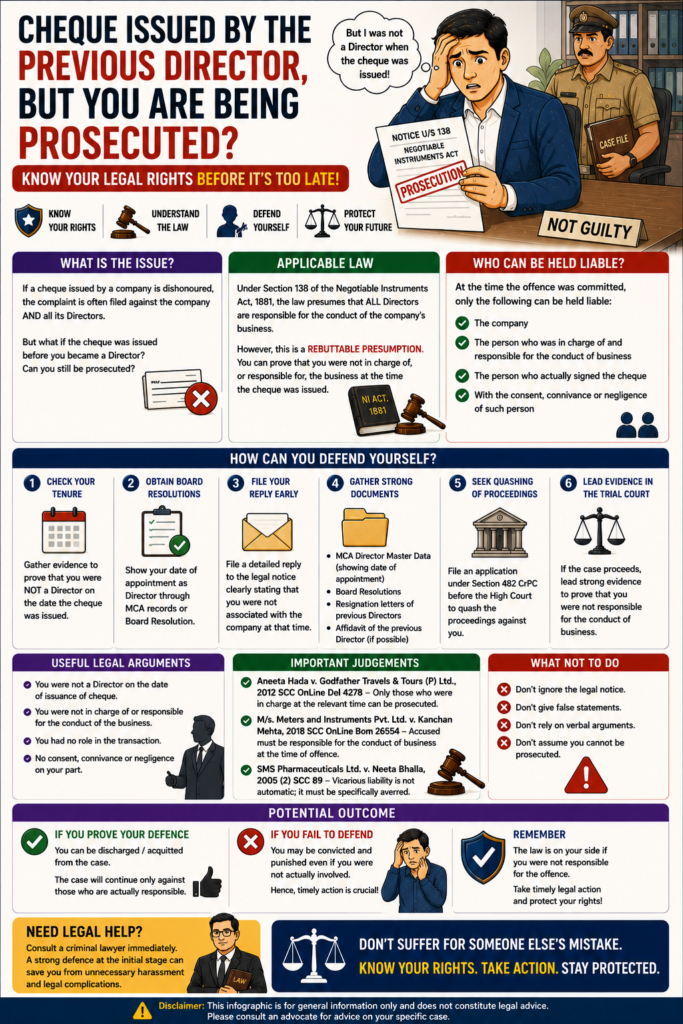
Introduction
Imagine this.
You joined a company as a director.
A few months later, you receive a court summons in a cheque bounce case.
After reading the complaint, you discover that:
- the cheque was issued before you became a director; or
- the cheque was signed by the previous director; or
- the transaction took place before you joined the company.
Your first reaction is obvious:
“How can I be prosecuted for someone else’s cheque?”
The answer is simple.
Indian law does not make every director automatically liable for every cheque issued by a company.
The law carefully defines who can be prosecuted and under what circumstances.
This guide explains your rights, the legal position, important Supreme Court principles, and the remedies available if you have been wrongly arrayed as an accused.
Can Every Director Be Prosecuted?
No.
This is one of the biggest misconceptions in cheque bounce litigation.
Merely being a director does not automatically make a person criminally liable.
The complainant must satisfy the legal requirements laid down under the Negotiable Instruments Act, 1881.
Which Law Governs Director Liability?
Director liability in cheque bounce cases is mainly governed by:
- Section 138 of the Negotiable Instruments Act, 1881 (dishonour of cheque);
- Section 141 of the Negotiable Instruments Act, 1881 (offences by companies).
Section 141 creates a limited form of vicarious criminal liability, meaning that liability may extend beyond the company itself only in circumstances specifically provided by the statute.
Who Can Be Prosecuted?
Depending on the facts, prosecution may lie against:
- the company;
- the signatory of the cheque;
- the Managing Director or Joint Managing Director (subject to the legal principles laid down by courts);
- directors or officers who were in charge of and responsible for the conduct of the company’s business at the relevant time, provided the statutory requirements are met.
Whether a particular director is liable depends on the pleadings and evidence.
When Is a Director Generally Not Liable?
A director may have a strong defence where:
- he or she became a director after the cheque was issued;
- he or she resigned before the relevant events;
- he or she had no role in the conduct of the company’s business at the relevant time;
- he or she did not participate in the transaction;
- the complaint contains only vague allegations without the necessary statutory averments.
Each case depends on its own facts.
What If the Cheque Was Issued Before I Joined the Company?
This is one of the strongest factual circumstances that may support your defence.
If:
- the transaction occurred before your appointment;
- the cheque was issued before you became a director; or
- the offence was complete before your appointment,
you should immediately collect documentary proof of the date of your appointment and obtain legal advice.
The court will examine the specific facts and the allegations in the complaint.
Does Signing the Cheque Matter?
Yes.
The signatory of the cheque may incur liability based on the statutory framework.
However, directors who did not sign the cheque are not automatically liable merely because they are directors.
The complainant must establish liability in accordance with Section 141 of the Negotiable Instruments Act.
What Should You Do If You Receive Summons?
Step 1: Read the Complaint Carefully
Examine:
- the date of the transaction;
- the cheque date;
- the dishonour memo;
- the legal notice;
- the allegations against you.
Many complaints simply array every director without explaining each person’s role.
Step 2: Verify Your Appointment Date
Collect:
- MCA records;
- DIR forms;
- Board resolutions;
- appointment letter;
- resignation documents (if applicable).
These records may become important evidence.
Step 3: Preserve Company Records
Obtain copies of:
- board minutes;
- authorised signatory documents;
- bank mandate;
- correspondence;
- statutory filings.
Step 4: Consult a Lawyer Immediately
Early legal advice may help you determine the appropriate remedy, including raising objections before the trial court or approaching the High Court where legally justified.
Can the Complaint Be Quashed?
In appropriate cases, the High Court may exercise its inherent jurisdiction to quash criminal proceedings where the complaint fails to disclose the essential legal requirements against a particular director or where continuation of the proceedings would amount to an abuse of the process of law.
Quashing is an extraordinary remedy and depends on the facts of each case.
What Must the Complaint Contain?
The complaint should contain the necessary allegations required under Section 141.
A mere statement that a person is a director is generally not sufficient by itself.
The complaint should disclose how and in what manner the accused was responsible for the conduct of the company’s business at the relevant time, unless liability follows by virtue of the person’s position as recognised in law.
Important Supreme Court Principles
The Supreme Court has repeatedly clarified that:
- criminal liability of directors is statutory;
- every director cannot automatically be prosecuted;
- designation alone is insufficient;
- specific pleadings are important;
- liability depends upon the role of the accused at the relevant time.
These principles are now well settled in cheque bounce jurisprudence.
Can I Prove I Was Not Responsible?
Yes.
Depending on the facts, you may rely upon:
- MCA records;
- resignation filings;
- appointment records;
- board resolutions;
- bank mandate;
- internal company documents;
- other admissible evidence.
The court will consider the evidence in accordance with law.
What If I Was a Nominee or Independent Director?
Independent or nominee directors are not automatically liable.
Their liability depends upon the statutory provisions, the allegations in the complaint, and the facts demonstrating their role in the conduct of the company’s business.
Jurisprudence Behind Director Liability
The law balances commercial accountability with fairness.
1. Companies Act Through Human Agency
A company acts through individuals.
The law therefore identifies who was actually responsible for the relevant conduct.
2. Criminal Liability Should Not Be Automatic
Criminal prosecution should not be based merely on a person’s designation.
The statute requires satisfaction of specific legal conditions.
3. Protection of Honest Directors
Persons who had no role in the transaction should not ordinarily be prosecuted merely because they held the office of director.
4. Accountability of Responsible Officers
Those actually responsible for the company’s affairs cannot avoid liability merely by acting through the corporate structure.
Practical Tips
✅ Obtain your MCA appointment and resignation records.
✅ Preserve all board resolutions and company documents.
✅ Compare the cheque date with your appointment date.
✅ Read the complaint carefully.
✅ Seek legal advice immediately after receiving summons.
❌ Do not ignore court summons.
❌ Do not assume every director is legally liable.
❌ Do not destroy company records.
Myth vs Reality
| Myth | Reality |
|---|---|
| Every director is automatically liable for a bounced company cheque. | False. Liability depends on Sections 138 and 141 of the Negotiable Instruments Act and the specific facts. |
| If I joined the company later, I must still face conviction. | Incorrect. The timing of your appointment and your role are highly relevant to determining liability. |
| Only the company can be prosecuted. | False. Responsible officers may also be prosecuted where the statutory requirements are satisfied. |
| Being named in the complaint means I am guilty. | Wrong. Criminal liability is determined by the court after considering the law and the evidence. |
| The High Court can never quash a cheque bounce complaint. | Incorrect. In appropriate cases, quashing may be granted where legal grounds exist. |
Frequently Asked Questions (FAQs)
Can I be prosecuted if I never signed the cheque?
Possibly, but only if the statutory requirements under Section 141 are satisfied. Non-signatories are not automatically liable.
What if I joined the company after the cheque was issued?
That fact may be an important defence. The court will examine the timing of your appointment and the allegations in the complaint.
Can the High Court quash the complaint?
Yes, in appropriate cases where the legal requirements for quashing are met.
Is every Managing Director automatically liable?
The legal position differs depending on the office held and the facts. Courts have recognised that certain office bearers may attract liability because of their position, while other directors require specific averments under Section 141.
Can I rely on MCA records?
Yes. Official company records may be important evidence regarding appointment, resignation, and the relevant period of responsibility.
Key Takeaways
- Merely being a director does not automatically create criminal liability in a cheque bounce case.
- Liability is governed by Sections 138 and 141 of the Negotiable Instruments Act.
- The timing of your appointment, your role in the company, and the allegations in the complaint are critical.
- Preserve documentary evidence such as MCA filings and board resolutions.
- If you have been wrongly implicated, appropriate legal remedies—including seeking quashing in suitable cases—may be available.
Conclusion
Cheque bounce litigation involving companies often results in multiple directors being named as accused. However, Indian law does not permit indiscriminate prosecution of every person who has held the title of director. Criminal liability under the Negotiable Instruments Act is carefully structured and depends on statutory requirements, the individual’s role, and the facts existing at the relevant time.
If you have been prosecuted for a cheque issued by a previous director or for a transaction that occurred before you assumed office, do not assume that liability automatically follows. Gather the relevant company records, understand the allegations, and seek timely legal advice to protect your rights.
In cheque bounce cases, the question is not simply “Who is the director?” but “Who was legally responsible for the company’s business when the offence was allegedly committed?”