
- Introduction
- Can a Cheque Bounce Matter Be Settled Without Going to Court?
- Why Do Most People Prefer Settlement?
- Is Settlement Recognised Under Law?
- The Best Time to Settle a Cheque Bounce Matter
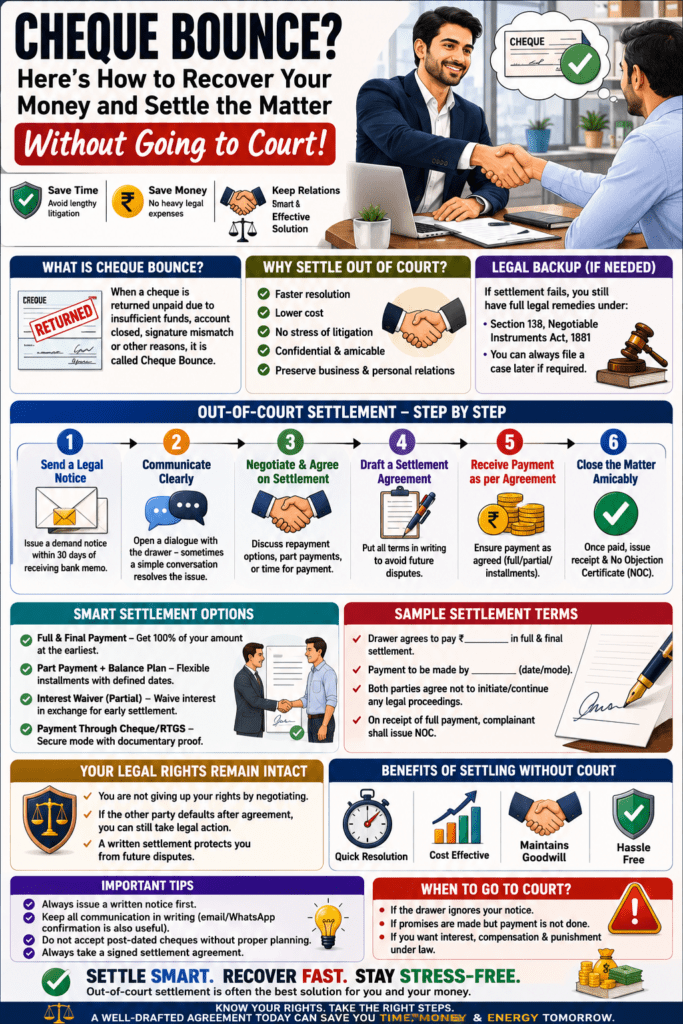
- How to Settle a Cheque Bounce Matter Legally
- Step 3: Execute a Written Settlement Agreement
- Step 4: Use Secure Payment Methods
- Should You Still Send a Legal Notice?
- What If the Person Breaks the Settlement?
- Can Mediation Help?
- What Are the Legal Consequences If Settlement Fails?
- Jurisprudence Behind Settlement of Cheque Bounce Cases
- Advantages of Settlement
- Practical Tips
- Myth vs Reality
- Frequently Asked Questions (FAQs)
- Key Takeaways
- Conclusion
Introduction
Your cheque has bounced.
The bank has returned it unpaid.
The person who issued the cheque owes you money.
Now you are wondering:
- Should I immediately file a court case?
- Can I recover my money without litigation?
- Is settlement legally valid?
- Can a cheque bounce case be resolved through negotiation?
- What happens if the other party agrees to pay?
The good news is that most cheque bounce disputes are settled without a full trial.
In fact, the law itself encourages settlement because the primary objective of a cheque bounce case is usually to ensure payment rather than prolonged litigation.
This article explains how a cheque bounce matter can be settled legally and safely without spending years in court.
Can a Cheque Bounce Matter Be Settled Without Going to Court?
Absolutely Yes.
A cheque bounce dispute is one of the most commonly settled legal disputes in India.
Many matters are resolved:
- before filing a legal notice;
- after receiving the legal notice;
- before filing the complaint;
- during mediation;
- during court proceedings;
- even after conviction, subject to applicable law and court orders.
The law recognises settlement and compromise in cheque bounce cases.
Why Do Most People Prefer Settlement?
Because litigation can involve:
- time;
- legal expenses;
- repeated court appearances;
- business disruption;
- uncertainty of outcome.
Settlement often provides a quicker and more practical solution.
Is Settlement Recognised Under Law?
Yes.
Cheque bounce offences under the Negotiable Instruments Act, 1881 are generally recognised as compoundable offences.
This means that the parties can settle the dispute and resolve the matter in accordance with law.
The legal system encourages genuine settlements where parties voluntarily resolve their disputes.
The Best Time to Settle a Cheque Bounce Matter
Stage 1: Before Sending Legal Notice
This is often the fastest and least expensive stage.
Sometimes the drawer may immediately make payment after learning that the cheque has bounced.
If payment is made promptly and completely, further legal action may become unnecessary.
Stage 2: After Receiving Legal Notice
This is the most common settlement stage.
Once a legal notice is received, many people realise the seriousness of the consequences and become willing to negotiate.
A properly drafted legal notice often leads to successful settlement discussions.
Stage 3: Before Filing a Court Case
Even after issuance of the statutory notice, parties may settle before any complaint is filed.
This saves considerable time and expense.
Stage 4: During Court Proceedings
Settlement remains possible even after a complaint under Section 138 of the Negotiable Instruments Act has been filed.
Courts frequently encourage amicable resolution where appropriate.
How to Settle a Cheque Bounce Matter Legally
Step 1: Verify the Exact Liability
Before entering into negotiations:
- verify the principal amount;
- calculate agreed interest, if applicable;
- determine any settlement amount;
- record all calculations clearly.
Both parties should understand the exact amount being settled.
Step 2: Negotiate Payment Terms
Possible settlement structures include:
Lump Sum Settlement
The entire amount is paid at once.
This is usually the safest option for the creditor.
Installment Settlement
The debtor pays in agreed installments.
The settlement should clearly mention:
- installment dates;
- payment method;
- consequences of default.
Part Payment Settlement
The parties may mutually agree to settle for a reduced amount.
Such arrangements should always be documented in writing.
Step 3: Execute a Written Settlement Agreement
Never rely solely on oral promises.
A proper settlement agreement should mention:
- names of parties;
- cheque details;
- outstanding amount;
- settlement amount;
- payment schedule;
- default clause;
- acknowledgment of liability;
- mode of payment.
A written agreement reduces future disputes.
Step 4: Use Secure Payment Methods
Whenever possible, prefer:
- bank transfer;
- RTGS;
- NEFT;
- demand draft;
- account payee cheque.
Maintain proper proof of payment.
Should You Still Send a Legal Notice?
Usually Yes.
Even if settlement discussions are ongoing, it is often advisable to remain conscious of the statutory timelines prescribed under the Negotiable Instruments Act.
Missing limitation periods may affect legal remedies.
The correct approach depends on the facts of the case and legal advice should be obtained.
What If the Person Breaks the Settlement?
This is a common problem.
A debtor may:
- sign a settlement agreement;
- pay one or two installments;
- stop making payments thereafter.
This is why a properly drafted settlement agreement is extremely important.
Depending on the facts, the original legal remedies and additional contractual remedies may remain available.
Can Mediation Help?
Yes.
Mediation has become one of the most effective methods for resolving cheque bounce disputes.
Advantages include:
- confidentiality;
- speed;
- lower cost;
- flexible solutions;
- preservation of business relationships.
Many commercial disputes are successfully resolved through mediation.
What Are the Legal Consequences If Settlement Fails?
If settlement discussions fail, the creditor may still pursue remedies available under law, including:
- proceedings under Section 138 of the Negotiable Instruments Act;
- civil recovery proceedings;
- other remedies available on the facts.
Settlement negotiations generally do not take away existing legal rights unless specifically agreed otherwise.
Jurisprudence Behind Settlement of Cheque Bounce Cases
The law encourages settlement because the primary concern is often recovery of money.
1. Commercial Certainty
Business transactions function more effectively when disputes are resolved efficiently.
2. Reduction of Litigation
Settlement reduces unnecessary burden on courts.
3. Faster Compensation
The creditor often receives money much faster through settlement than through prolonged litigation.
4. Preservation of Relationships
Settlement allows parties to continue business and personal relationships where appropriate.
Advantages of Settlement
For the Creditor
✅ Faster recovery
✅ Reduced legal expenses
✅ Lower litigation risk
✅ Better cash flow
For the Debtor
✅ Avoid prolonged litigation
✅ Reduced legal costs
✅ Flexible payment terms
✅ Opportunity to resolve the dispute amicably
Practical Tips
✅ Always document the settlement in writing.
✅ Preserve bank records and payment receipts.
✅ Verify every payment received.
✅ Include a default clause.
✅ Obtain legal assistance while drafting the settlement.
❌ Do not rely on verbal assurances.
❌ Do not return original documents without proper settlement.
❌ Do not ignore statutory limitation periods.
Myth vs Reality
| Myth | Reality |
|---|---|
| A cheque bounce case must always go to court. | False. Many disputes are settled without a full trial. |
| Settlement becomes impossible after a legal notice. | Incorrect. Settlement can occur at various stages of the dispute. |
| Verbal settlement is sufficient. | False. Written documentation is strongly advisable. |
| Mediation has no legal value. | Incorrect. Mediated settlements can have significant legal consequences depending on the circumstances. |
| Once a case is filed, compromise is impossible. | Wrong. Settlement remains possible even after institution of proceedings, subject to law. |
Frequently Asked Questions (FAQs)
Can I settle a cheque bounce matter before filing a case?
Yes. Many disputes are successfully resolved before any complaint is filed.
Is a written settlement necessary?
While parties may negotiate informally, a written settlement agreement provides clarity and protection.
Can settlement happen after the complaint is filed?
Yes. Settlement may take place at different stages of the proceedings.
Can I accept installments?
Yes, if both parties agree. The terms should be carefully documented.
Is mediation available in cheque bounce matters?
Yes. Mediation is frequently used to resolve such disputes.
Key Takeaways
- Most cheque bounce disputes can be resolved without a full court trial.
- Settlement is legally recognised and encouraged.
- A written settlement agreement is essential.
- Mediation can be an effective and economical solution.
- Parties should remain mindful of limitation periods under the Negotiable Instruments Act.
- Proper documentation protects both sides and reduces future disputes.
Conclusion
A bounced cheque does not always have to result in years of litigation. In many cases, the fastest and most practical solution is a carefully negotiated settlement that protects the interests of both parties. The law recognises and encourages genuine compromises because they promote commercial certainty, reduce litigation, and facilitate quicker recovery of money.
However, settlement should never be based solely on trust or verbal assurances. Every settlement must be documented properly, payments should be traceable, and statutory timelines should not be ignored.
The smartest cheque bounce strategy is often not winning a case after several years—it is recovering your money quickly, legally, and securely through a well-structured settlement.