
- Introduction
- What Is Probate?
- Which Law Governs Probate?
- Why Is Probate Necessary?
- Is Probate Mandatory in Every Case?
- What Is the Purpose of Probate?
- Who Can Apply for Probate?
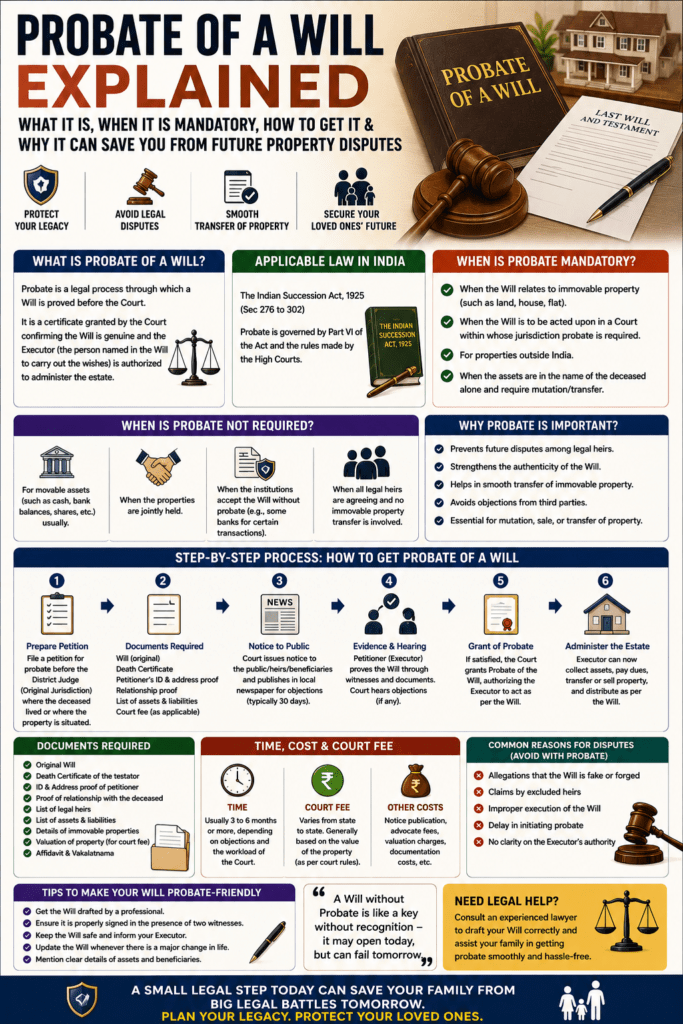
- What Is the Probate Procedure?
- Can Someone Challenge a Probate Petition?
- What If There Is No Executor?
- Probate vs Succession Certificate
- Probate vs Letters of Administration
- Can a Registered Will Still Require Probate?
- Does Probate Make the Will Impossible to Challenge?
- Jurisprudence Behind Probate
- Practical Tips
- Myth vs Reality
- Frequently Asked Questions (FAQs)
- Key Takeaways
- Conclusion
Introduction
A parent spends a lifetime building a house.
A business owner creates valuable assets.
An elderly couple prepares a Will so that there is no dispute after their lifetime.
But after the person’s death, family members begin asking questions:
- Is this Will genuine?
- Who owns the property now?
- Can the property be transferred without probate?
- Is a registered Will enough?
- Can someone challenge the Will?
This is where probate becomes important.
Many people believe that merely having a Will automatically transfers ownership of the property. That is not always true.
In certain situations, the law requires the Will to be proved before a competent court through a probate proceeding.
This guide explains everything you need to know about probate of a Will in India.
What Is Probate?
Probate is a certificate granted by a competent court declaring that the Will has been proved in accordance with law and authorising the executor named in the Will to administer the estate of the deceased.
In simple words,
Probate is the court’s formal recognition that the Will has been duly proved and may be acted upon.
Which Law Governs Probate?
Probate is primarily governed by the Indian Succession Act, 1925, including:
- Section 2 – Definitions;
- Sections 222 to 227 – Grant and effect of probate;
- Sections 276 onwards – Petition and procedure;
- Sections 57 and 213 – Situations where probate becomes legally significant, particularly in relation to certain classes of Wills.
Civil procedure and local High Court rules may also apply.
Why Is Probate Necessary?
Probate serves several important purposes.
It:
- establishes the authenticity of the Will through a judicial process;
- authorises the executor to administer the estate;
- reduces disputes regarding the Will;
- assists in transfer and mutation of property where required;
- provides confidence to banks, authorities, and purchasers dealing with the estate.
Is Probate Mandatory in Every Case?
No.
This is one of the biggest misconceptions.
Probate is not compulsory for every Will in India.
Whether probate is mandatory depends on:
- the religion of the deceased;
- the nature and location of the property;
- the provisions of the Indian Succession Act applicable to the case.
For example, in certain cases involving Wills made by Hindus, Buddhists, Sikhs, or Jains relating to properties situated in areas where the relevant provisions of the Indian Succession Act apply (historically including the ordinary original civil jurisdiction of the High Courts at Mumbai, Chennai and Kolkata, subject to the Act and judicial interpretation), probate assumes particular significance.
Because the legal position depends on the facts, professional legal advice is advisable before proceeding.
What Is the Purpose of Probate?
Probate provides judicial certainty.
Instead of relying solely on the document itself, the court examines whether:
- the Will was executed in accordance with law;
- the testator had the necessary testamentary capacity;
- the execution was voluntary;
- the statutory requirements have been satisfied.
Who Can Apply for Probate?
Generally, the executor named in the Will applies for probate.
If no executor has been appointed, or if the executor cannot act, the appropriate remedy may instead be Letters of Administration under the Indian Succession Act, depending on the facts.
What Is the Probate Procedure?
Step 1: File a Probate Petition
A petition is presented before the competent court having jurisdiction.
The petition generally contains:
- particulars of the deceased;
- date of death;
- details of legal heirs;
- details of the Will;
- description of the estate;
- particulars of the executor.
Step 2: Submit the Required Documents
Common documents include:
- original Will;
- death certificate;
- identity documents;
- property details;
- valuation documents (where required);
- list of legal heirs;
- executor’s details.
Additional documents may be required depending on the case.
Step 3: Issue of Notices
The court generally issues notices to interested persons and may direct publication where required by law or court practice.
This gives persons having an interest an opportunity to raise objections.
Step 4: Evidence Before the Court
The court examines the evidence.
Where necessary, attesting witnesses and other witnesses may be examined to prove the Will in accordance with the Indian Succession Act and the Indian Evidence Act.
Step 5: Grant of Probate
If the court is satisfied that the Will has been duly proved, probate is granted.
The executor may thereafter administer the estate in accordance with the Will and the law.
Can Someone Challenge a Probate Petition?
Yes.
Common grounds include allegations that:
- the Will is forged;
- the testator lacked testamentary capacity;
- the Will was obtained by fraud, coercion, or undue influence;
- statutory formalities were not complied with;
- a later valid Will exists.
The court decides such objections on the basis of evidence.
What If There Is No Executor?
Where there is no executor, or the executor cannot or will not act, the court may, in appropriate cases, grant Letters of Administration to an eligible person instead of probate.
Probate vs Succession Certificate
These two are often confused.
| Probate | Succession Certificate |
|---|---|
| Relates to a Will | Usually relates to certain debts and securities where applicable |
| Confirms the Will through a judicial process | Facilitates collection of specified debts and securities |
| Executor generally applies | Legal heir or eligible applicant generally applies |
| Governed by the Indian Succession Act | Also governed by the Indian Succession Act, but serves a different purpose |
They are not interchangeable.
Probate vs Letters of Administration
| Probate | Letters of Administration |
| Executor is named in the Will | No executor is available or capable of acting |
| Court confirms the executor’s authority | Court appoints an administrator to administer the estate |
| Based on the Will | May also arise in situations involving a Will without an acting executor |
Can a Registered Will Still Require Probate?
Yes.
Registration of a Will and probate are different concepts.
Registration may support the authenticity of the document, but it does not automatically eliminate the need for probate where the law requires it.
Does Probate Make the Will Impossible to Challenge?
No.
A probate proceeding itself provides the forum in which objections can be raised.
Even after probate, legal issues may arise in limited circumstances recognised by law.
Jurisprudence Behind Probate
The law of probate is founded on important legal principles.
1. Respecting the Wishes of the Deceased
The law seeks to ensure that the genuine intentions of the testator are honoured.
2. Preventing Fraud
Probate provides judicial scrutiny before valuable property changes hands.
3. Protecting Legal Heirs
Interested persons receive an opportunity to contest a doubtful Will.
4. Ensuring Certainty in Property Transactions
Banks, revenue authorities, purchasers, and other institutions often rely upon probate where applicable because it provides legal certainty.
Practical Tips
✅ Keep the original Will safely.
✅ Ensure the Will is properly executed and attested.
✅ Preserve medical records where relevant to testamentary capacity.
✅ Maintain complete property records.
✅ Seek legal advice if disputes are anticipated.
❌ Do not assume every registered Will automatically avoids probate.
❌ Do not conceal the existence of legal heirs.
❌ Do not alter or tamper with the original Will.
Myth vs Reality
| Myth | Reality |
| Every Will requires probate. | False. Probate is not mandatory in every case; it depends on the applicable law and facts. |
| A registered Will never needs probate. | Incorrect. Registration and probate serve different legal purposes. |
| Probate transfers ownership by itself. | False. Probate confirms the Will and authorises administration of the estate; succession to property is governed by the Will and applicable law. |
| Anyone can apply for probate. | Incorrect. Probate is generally sought by the executor named in the Will. |
| Probate ends every possible dispute forever. | Not always. Legal challenges may arise in circumstances recognised by law. |
Frequently Asked Questions (FAQs)
Is probate compulsory in India?
Not in every case. Whether probate is mandatory depends on the Indian Succession Act, the religion of the deceased, and the nature and location of the property.
Who files a probate petition?
Generally, the executor named in the Will.
Is probate necessary for a registered Will?
It may be, depending on the applicable legal provisions and the facts.
Can legal heirs object?
Yes. Interested persons may file objections on legally recognised grounds.
What if there is no executor?
In appropriate cases, an eligible person may seek Letters of Administration instead of probate.
Key Takeaways
- Probate is the court’s formal recognition that a Will has been duly proved.
- It is governed primarily by the Indian Succession Act, 1925.
- Probate is not mandatory in every case.
- Whether probate is required depends on the applicable provisions of law and the facts.
- Registration of a Will does not automatically remove the need for probate where it is legally required.
- Probate proceedings help prevent fraud, protect beneficiaries, and provide certainty in administration of estates.
Conclusion
A Will reflects the final wishes of a person, but in certain situations, those wishes must be judicially established before they can be effectively acted upon. Probate serves as that legal assurance by confirming the authenticity of the Will and empowering the executor to administer the estate.
However, one of the most common misunderstandings is that every Will requires probate. That is not the law in India. The requirement depends on the provisions of the Indian Succession Act, 1925, the religion of the testator, and the nature and location of the property.
If you are dealing with a Will after the death of a loved one, it is important to determine at the outset whether probate is legally required. Taking the correct legal route can avoid unnecessary delays, protect the estate, and significantly reduce the chances of future litigation.