
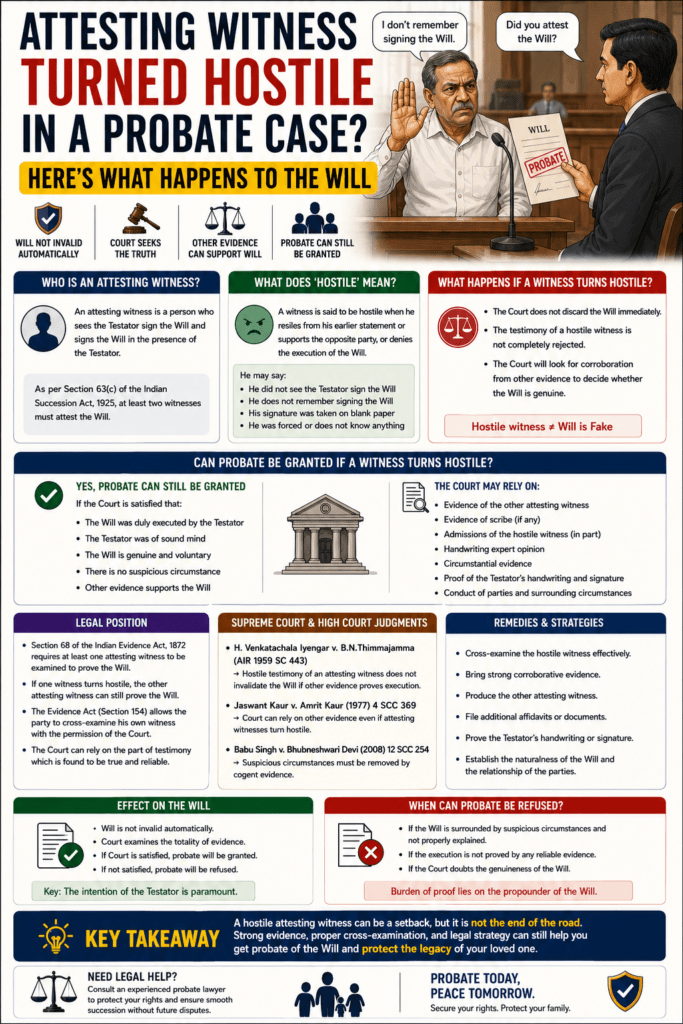
- Introduction
- Who Is an Attesting Witness?
- Why Is an Attesting Witness Important?
- Does the Will Automatically Become Invalid If a Witness Turns Hostile?
- What Does "Hostile Witness" Mean?
- Can the Court Rely on the Testimony of a Hostile Witness?
- How Can a Will Still Be Proved?
- What Happens If Both Attesting Witnesses Fail to Support the Will?
- Can the Witness Be Cross-Examined?
- What If the Witness Says, "I Don't Remember"?
- Can Registration of the Will Help?
- Jurisprudence Behind This Rule
- Practical Tips
- Myth vs Reality
- Frequently Asked Questions (FAQs)
- Key Takeaways
- Landmark Supreme Court Principles
- Conclusion
Introduction
A father executes a Will.
Two witnesses sign it.
Years later, after his death, the executor files a probate petition.
Everything appears straightforward—until one of the attesting witnesses enters the witness box and says:
“I never saw the deceased sign the Will.”
Or,
“I don’t remember signing this document.”
Or even,
“This is not my signature.”
Many people immediately think:
“The Will is finished.”
Not necessarily.
The law does not say that a probate petition automatically fails merely because an attesting witness turns hostile.
Instead, the court examines the entire evidence, the surrounding circumstances, and the statutory requirements before deciding whether the Will has been duly proved.
Who Is an Attesting Witness?
An attesting witness is a person who signs the Will for the purpose of witnessing its execution by the testator.
Under Section 63 of the Indian Succession Act, 1925, an unprivileged Will must ordinarily be attested by at least two witnesses.
Attestation is an important safeguard against fraud and fabrication.
Why Is an Attesting Witness Important?
The witness helps the court determine:
- whether the testator signed or acknowledged the Will;
- whether the execution was voluntary;
- whether the statutory formalities were followed;
- whether the testator appeared to understand the document.
Their testimony is therefore often central to probate proceedings.
Does the Will Automatically Become Invalid If a Witness Turns Hostile?
No.
This is the biggest misconception.
A hostile witness does not automatically invalidate the Will.
The court must examine:
- the testimony as a whole;
- the evidence of any other attesting witness;
- documentary evidence;
- surrounding circumstances;
- admissions, if any;
- other legally admissible evidence.
Each case is decided on its own facts.
What Does “Hostile Witness” Mean?
A hostile witness is generally one who departs from or contradicts an earlier version, resiles from expected testimony, or otherwise does not support the case of the party who called the witness.
Merely declaring a witness hostile does not mean that every part of the witness’s testimony must be discarded.
Can the Court Rely on the Testimony of a Hostile Witness?
Yes.
This is a settled principle of evidence law.
The court may accept those portions of a hostile witness’s testimony that it finds credible and reliable, while rejecting the rest.
The evidence is assessed in the context of the entire record.
How Can a Will Still Be Proved?
Depending on the facts, the court may consider:
1. Testimony of the Other Attesting Witness
If another attesting witness is available and satisfactorily proves the execution of the Will in accordance with law, that evidence may be sufficient.
2. Documentary Evidence
The court may consider:
- the original Will;
- signatures;
- contemporaneous records;
- medical documents, where relevant;
- correspondence;
- registration records, if the Will is registered;
- other admissible evidence.
3. Surrounding Circumstances
The court evaluates whether:
- the Will appears natural;
- the beneficiaries make sense in the factual context;
- there are suspicious circumstances;
- those suspicious circumstances have been satisfactorily explained.
4. Other Permissible Modes of Proof
Where the law permits, and depending on the availability of witnesses and the facts, other legally recognised methods of proving execution may become relevant.
What Happens If Both Attesting Witnesses Fail to Support the Will?
This does not automatically mean that the probate petition will fail.
The court will examine whether the Will can still be proved in accordance with the applicable provisions of the Indian Succession Act and the law of evidence, depending upon the facts and availability of admissible evidence.
The legal outcome depends on the evidence led in each case.
Can the Witness Be Cross-Examined?
Yes.
If an attesting witness gives adverse testimony, the party calling that witness may seek permission of the court to cross-examine the witness in accordance with the applicable law of evidence.
This enables the court to assess the credibility and reliability of the testimony.
What If the Witness Says, “I Don’t Remember”?
This is common, particularly where the Will was executed many years earlier.
A lack of memory does not necessarily amount to proof that the Will was not executed.
The court considers the witness’s evidence together with the other evidence on record.
Can Registration of the Will Help?
Registration does not dispense with the legal requirement of proving a Will where proof is required.
However, registration may be a relevant circumstance supporting the genuineness of the document, though it is not conclusive.
Jurisprudence Behind This Rule
The law seeks to strike a balance between preventing fraud and ensuring that genuine Wills are not defeated merely because of unreliable or forgetful witnesses.
1. Protecting Genuine Testamentary Intent
A valid Will should not ordinarily fail solely because a witness later changes his or her version.
2. Preventing Fabrication
The requirement of attestation and proof helps protect against forged or fabricated Wills.
3. Judicial Evaluation of the Entire Record
Probate courts assess the evidence as a whole rather than deciding cases on isolated statements.
4. Fairness to All Parties
Both the propounder of the Will and the objectors receive an opportunity to present evidence and challenge the evidence of the other side.
Practical Tips
✅ Preserve the original Will carefully.
✅ Ensure that attesting witnesses are chosen thoughtfully at the time of execution.
✅ Keep contact details of the witnesses, where possible.
✅ Maintain medical records if testamentary capacity may later become an issue.
✅ Preserve any contemporaneous documents relating to execution.
❌ Do not assume that a hostile witness automatically destroys the case.
❌ Do not conceal relevant evidence.
❌ Do not rely solely on assumptions about the legal effect of hostile testimony.
Myth vs Reality
| Myth | Reality |
|---|---|
| If an attesting witness turns hostile, the Will automatically becomes invalid. | False. The court considers the entire body of evidence before deciding whether the Will has been duly proved. |
| A hostile witness’s testimony is completely ignored. | Incorrect. The court may rely upon the credible portions of the testimony. |
| Registration alone proves a Will. | False. Registration may support genuineness but does not automatically prove due execution where proof is legally required. |
| If one witness denies execution, probate must fail. | Wrong. Other admissible evidence and the testimony of another attesting witness may still establish the Will. |
| Every inconsistency means the Will is forged. | Incorrect. The court evaluates whether the inconsistencies are material and whether the Will has been proved according to law. |
Frequently Asked Questions (FAQs)
Can probate be granted if one attesting witness turns hostile?
Yes. A hostile witness does not automatically defeat the probate petition. The court examines all the evidence.
Can the court rely on part of a hostile witness’s testimony?
Yes. The court may accept the reliable portion and reject the unreliable portion.
Is the testimony of the second attesting witness important?
Yes. Where available, the evidence of another attesting witness may play a significant role in proving the Will.
Does registration remove the need to prove the Will?
No. Registration and proof of execution are distinct legal concepts.
Can the witness be cross-examined after turning hostile?
Yes, subject to the applicable law of evidence and the permission of the court where required.
Key Takeaways
- An attesting witness turning hostile does not automatically invalidate the Will.
- Probate courts assess the entire body of evidence rather than a single statement.
- The testimony of a hostile witness is not automatically discarded; the court may rely on the credible parts.
- Depending on the facts, the Will may still be proved through another attesting witness or other legally admissible evidence.
- The burden remains on the propounder of the Will to establish due execution in accordance with the Indian Succession Act, 1925 and the applicable law of evidence.
Landmark Supreme Court Principles
Indian courts have consistently held that probate proceedings focus on whether the Will has been duly executed and proved. Some of the leading decisions include:
- H. Venkatachala Iyengar v. B.N. Thimmajamma (1959) – The Supreme Court explained the burden of proving a Will and the approach to suspicious circumstances.
- Jaswant Kaur v. Amrit Kaur (1977) – The Court held that where suspicious circumstances exist, the propounder must satisfactorily explain them before probate can be granted.
- Bharpur Singh v. Shamsher Singh (2009) – The Court reiterated that the propounder must establish due execution and dispel legitimate suspicions; registration alone does not prove a Will.
These judgments make it clear that probate cases are decided on the cumulative effect of all admissible evidence—not merely on whether one witness supports or opposes the Will.
Conclusion
One of the most common fears in probate litigation is that the entire case will collapse if an attesting witness changes his version. Fortunately, that is not the legal position in India. Probate courts are required to look beyond isolated statements and examine the complete factual and legal picture.
A hostile witness may create difficulties, but it does not automatically destroy the Will. The court will assess the credibility of the witness, the testimony of any other attesting witness, documentary evidence, surrounding circumstances, and all other admissible material before deciding whether the Will has been duly proved.
The strength of a probate case lies not in the testimony of a single witness alone, but in the overall quality, consistency, and reliability of the evidence placed before the court.