
- Introduction
- What Is an Order of Conviction?
- What Is an Order of Sentence?
- In Simple Words
- Can There Be Conviction Without Immediate Sentencing?
- Why Does the Court Hear the Accused Before Sentencing?
- Relevant BNSS Provisions
- Why Is This Difference So Important?
- Can You Appeal Against a Conviction?
- Can You Challenge Only the Sentence?
- Can the Sentence Be Suspended?
- Can the Conviction Also Be Suspended?
- Jurisprudence Behind Conviction and Sentence
- Myth vs Reality
- Frequently Asked Questions
- Practical Example
- Key Takeaways
- Conclusion
Introduction
Many people think that once a judge says,
“The accused is convicted,”
the person is immediately sent to prison.
That is not always correct.
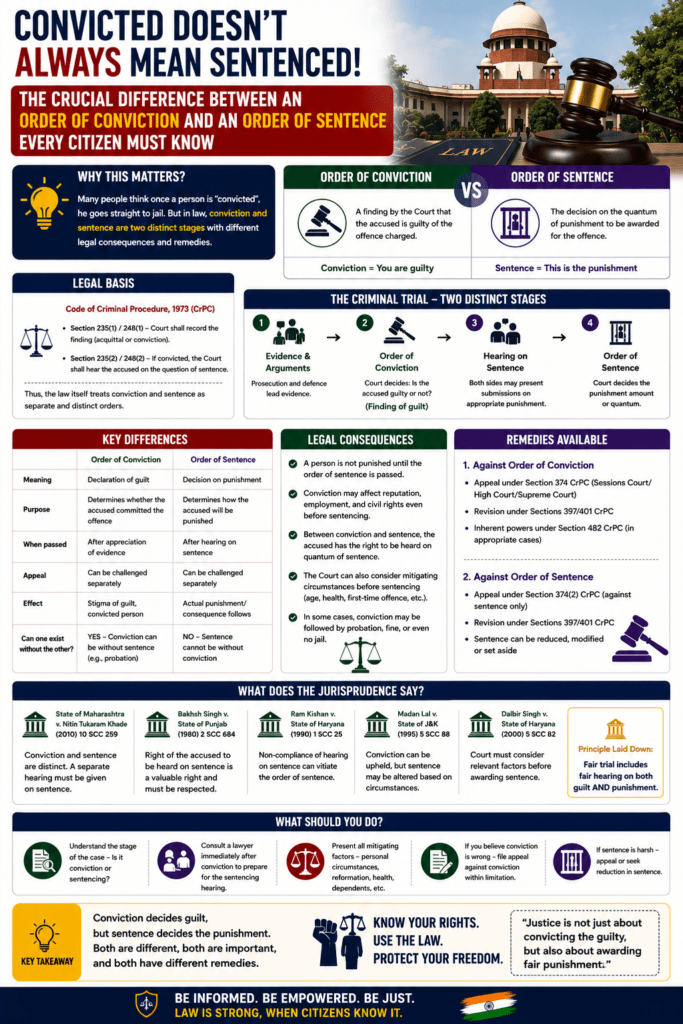
One of the most misunderstood concepts in criminal law is the difference between an Order of Conviction and an Order of Sentence.
Although these two orders are closely connected, they are legally distinct and serve different purposes.
Understanding this distinction is important because it affects:
- your right to appeal,
- your right to seek bail,
- suspension of sentence,
- suspension of conviction,
- and even your employment, elections, and professional career.
This article explains the complete legal position under the Bharatiya Nagarik Suraksha Sanhita, 2023 (BNSS) in simple language.
What Is an Order of Conviction?
An Order of Conviction is the court’s finding that the accused is guilty of committing the offence charged against him or her.
Simply put,
Conviction answers only one question:
“Did the accused commit the offence?”
If the court answers Yes, it records a conviction.
At this stage, the court has determined the guilt of the accused.
What Is an Order of Sentence?
Once the accused has been convicted, the court must decide:
“What punishment should be imposed?”
That punishment is called the sentence.
The order determining the punishment is known as the Order of Sentence.
The sentence may include:
- imprisonment,
- fine,
- compensation,
- probation (where permissible),
- community-based consequences (where provided by law), or
- any other punishment authorised by the relevant statute.
In Simple Words
Think of a criminal case like a two-step process.
Step 1
The court decides:
Is the accused guilty?
This is the Order of Conviction.
Step 2
The court decides:
What punishment should be given?
This is the Order of Sentence.
These are two separate judicial determinations, even though they are often delivered together.
Can There Be Conviction Without Immediate Sentencing?
Yes.
In many criminal cases, after recording the conviction, the court hears the accused specifically on the question of punishment before passing the sentence.
This is recognised in criminal jurisprudence because the punishment should be tailored to the facts of the case and the circumstances of the offender.
Why Does the Court Hear the Accused Before Sentencing?
The law recognises that punishment should not be mechanical.
Before deciding the sentence, the court may consider:
- age of the accused;
- previous criminal record;
- family circumstances;
- possibility of reform;
- gravity of the offence;
- mitigating circumstances;
- aggravating circumstances;
- conduct during trial;
- impact on the victim.
This is often referred to as the hearing on sentence.
Relevant BNSS Provisions
Under the Bharatiya Nagarik Suraksha Sanhita, 2023, after finding an accused guilty, the court proceeds to hear the accused on the question of sentence before imposing punishment, except where the law provides otherwise.
The BNSS continues the long-established principle that conviction and sentencing are conceptually distinct stages of a criminal trial, even if reflected in the same judgment.
Why Is This Difference So Important?
Because different legal consequences flow from each order.
Consequences of Conviction
A conviction may lead to:
- criminal record;
- disqualification from certain public offices;
- consequences under service rules;
- impact on professional licences;
- electoral disqualifications where applicable;
- reputational consequences.
These consequences arise because the court has declared the accused guilty.
Consequences of Sentence
The sentence determines:
- the period of imprisonment;
- amount of fine;
- compensation payable;
- probation;
- commencement of punishment;
- execution of imprisonment.
Without a sentence, the punishment itself is not determined.
Can You Appeal Against a Conviction?
Yes.
A convicted person generally has a statutory right of appeal, subject to the provisions governing the particular case.
The appellate court may:
- set aside the conviction;
- modify the conviction;
- acquit the accused;
- order a retrial; or
- uphold the conviction.
Can You Challenge Only the Sentence?
Yes.
Sometimes an accused accepts the finding of guilt but argues that the punishment is excessively harsh.
In such cases, the appeal may focus primarily on:
- reduction of imprisonment;
- reduction of fine;
- grant of probation;
- modification of punishment.
Thus, both the conviction and the sentence may be independently examined by the appellate court, depending on the grounds raised.
Can the Sentence Be Suspended?
Yes.
One of the most important remedies after conviction is an application seeking suspension of sentence pending appeal.
If granted,
- the sentence remains in abeyance during the pendency of the appeal, and
- the appellant may be released on bail, subject to the court’s order.
This does not automatically erase the conviction.
Can the Conviction Also Be Suspended?
Yes, but only in exceptional circumstances.
The power to suspend a conviction is exercised sparingly because a conviction carries serious legal consequences beyond imprisonment.
Courts generally require special reasons before suspending a conviction.
Jurisprudence Behind Conviction and Sentence
Indian criminal law follows a balanced approach.
The philosophy is simple.
First Principle
No person should be punished unless guilt is proved beyond reasonable doubt.
That is why the court first records a conviction.
Second Principle
Even after guilt is established, punishment should be fair, proportionate, and individualised.
That is why sentencing is treated as a distinct judicial exercise.
Myth vs Reality
| Myth | Reality |
|---|---|
| Conviction and sentence are the same thing. | False. Conviction determines guilt; sentence determines punishment. |
| Once convicted, a person is immediately sent to prison in every case. | Incorrect. The court must determine the appropriate sentence, and legal remedies may be available thereafter. |
| An appeal can challenge only the conviction. | False. The sentence may also be challenged independently on appropriate grounds. |
| Suspension of sentence means the conviction disappears. | Wrong. Suspension of sentence does not automatically suspend or erase the conviction. |
| Every convicted person must necessarily undergo imprisonment. | Incorrect. Depending on the law and facts, the court may impose other legally permissible forms of punishment or grant probation where applicable. |
Frequently Asked Questions
Does conviction automatically mean imprisonment?
Not always. The punishment depends on the sentence imposed by the court and the applicable law.
Can the court hear arguments after convicting the accused?
Yes. Courts commonly hear the accused on the question of sentence before deciding the appropriate punishment.
Can I get bail after conviction?
Yes. In appropriate cases, the appellate court may suspend the sentence and grant bail pending appeal, subject to the governing legal provisions.
Can conviction itself be stayed?
Yes, but only in exceptional circumstances where the court is satisfied that such relief is necessary.
Can the appellate court reduce the punishment?
Yes. An appellate court may modify the sentence if it finds the punishment excessive or otherwise inappropriate in law.
Practical Example
Suppose A is prosecuted for causing grievous hurt.
After the trial:
- The court concludes that A committed the offence.
- This is the Order of Conviction.
The court then hears A regarding age, family responsibilities, lack of previous criminal record, and other mitigating circumstances.
Thereafter, the court imposes:
- two years’ imprisonment and a fine.
- This is the Order of Sentence.
If A files an appeal, the appellate court may:
- overturn the conviction;
- uphold the conviction but reduce the sentence;
- suspend the sentence during the appeal; or
- in exceptional cases, suspend the conviction itself.
Key Takeaways
- Conviction determines whether the accused is guilty.
- Sentence determines the punishment after guilt has been established.
- These are distinct stages of a criminal case, even if pronounced together.
- The accused is ordinarily entitled to be heard on the question of sentence.
- Appeals may challenge the conviction, the sentence, or both.
- Suspension of sentence and suspension of conviction are different legal remedies with different consequences.
Conclusion
The distinction between an Order of Conviction and an Order of Sentence is far more than a technicality—it lies at the heart of a fair criminal justice system. A conviction answers the question of guilt, while a sentence answers the equally important question of what punishment, if any, is just and proportionate.
Recognising this distinction ensures that criminal proceedings remain consistent with the principles of fairness, due process, and proportionality. It also enables an accused person to effectively exercise statutory remedies such as appeal, suspension of sentence, or, in exceptional cases, suspension of conviction.
Understanding these concepts is essential not only for lawyers and litigants but for every citizen seeking to understand how criminal justice actually works.