
Case Title: Archana Avinash Shelke v. State of Maharashtra & Anr.
Case No.: Special Leave Petition (Criminal) No. 2163 of 2025
Date of Judgment: 23 July 2026
Bench: Justice J.B. Pardiwala and Justice K. Vinod Chandran
Can Every Allegation Under the POCSO Act Lead to Trial? Supreme Court Says “No”
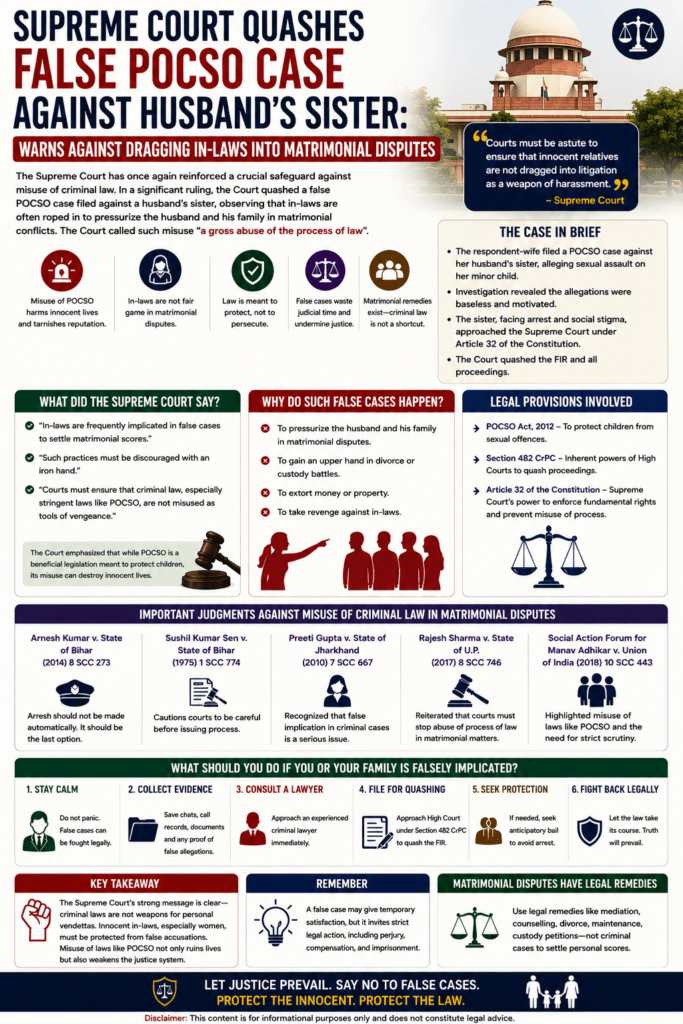
The Supreme Court of India has once again cautioned against the growing misuse of criminal law in family disputes.
In a significant judgment delivered on 23 July 2026, the Court quashed a POCSO case filed against a woman’s former sister-in-law after finding that the allegations appeared to be part of an ongoing matrimonial battle rather than a genuine case of child sexual abuse.
While protecting the sanctity of the Protection of Children from Sexual Offences (POCSO) Act, 2012, the Court also reminded that the law cannot be allowed to become a weapon for settling personal scores.
The judgment is important because it discusses the increasing tendency of dragging relatives into criminal litigation after divorce and the duty of courts to prevent abuse of the legal process.
What is the POCSO Act?
The Protection of Children from Sexual Offences Act, 2012 (POCSO Act) is a special law enacted to protect children below the age of 18 years from sexual abuse, sexual assault, sexual harassment and pornography.
The Act provides:
- child-friendly investigation,
- speedy trial,
- strict punishment for offenders, and
- protection of the identity and dignity of child victims.
Since these offences involve children, courts generally treat allegations under the Act with great seriousness.
However, the Supreme Court has repeatedly clarified that the seriousness of an allegation cannot replace proof or justify malicious prosecution.
What Was the Case About?
The case arose after a husband and wife obtained a divorce by mutual consent.
The couple had twins, who remained in the custody of the father while the mother received visitation rights.
Soon after the divorce, an ugly dispute began between both families.
The father lodged an FIR alleging sexual misconduct by the children’s maternal uncle.
Within just a few hours, the mother filed another FIR making an equally serious allegation that the children’s paternal aunt had sexually assaulted her son.
The accused in this second FIR was the father’s sister (the children’s paternal aunt).
An FIR was registered under:
- Section 354 IPC (Assault or criminal force intending to outrage modesty), and
- Section 8 of the POCSO Act.
The aunt approached the Bombay High Court seeking quashing of the FIR.
What Did the Bombay High Court Do?
Initially, another Division Bench of the Bombay High Court stayed the investigation after observing that the complaint appeared to have no substance.
The High Court also noticed an important fact.
The child’s statement recorded before the Magistrate under Section 164 CrPC did not support the allegations made by his mother.
However, at the final hearing, another Bench refused to quash the FIR.
The High Court observed that since both parties had lodged cross-complaints against each other’s family members, the matter should proceed to trial.
The aunt then approached the Supreme Court.
What Did the Supreme Court Say?
The Supreme Court strongly disagreed with the High Court.
The Bench observed that merely because there are rival complaints between two families does not mean every accused should automatically be forced to undergo a criminal trial.
The Court made a powerful observation:
“It is commonplace, nay customary that in-laws are dragged in to settle scores in cases arising out of marital discord and often children are used to vilify each other.”
The Court further expressed shock at the nature of allegations made by the mother against the child’s paternal aunt.
Why Did the Supreme Court Quash the FIR?
The Court found several circumstances that seriously weakened the prosecution case.
1. No Earlier Complaint Was Ever Made
According to the mother, the alleged sexual abuse had occurred while she was still living in her matrimonial home.
She even claimed to have personally witnessed one such incident.
However, despite making these serious allegations:
- no complaint was ever lodged,
- no police report was filed,
- no allegation was raised during the divorce proceedings.
The FIR surfaced only after the father lodged an FIR against the maternal uncle.
This timing raised serious doubts.
2. Child’s Own Statement Contradicted the FIR
Perhaps the most important factor was the child’s own statement before the Magistrate under Section 164 CrPC.
The Supreme Court noted that the child did not state that any such assault had taken place.
This directly contradicted the allegations contained in the FIR.
3. The FIR Did Not Inspire Confidence
The Court specifically observed that a plain reading of the complaint itself did not inspire confidence.
The allegations appeared to be retaliatory rather than genuine.
4. The High Court Ignored Crucial Material
The Supreme Court criticised the Bombay High Court for not examining:
- the FIR carefully,
- the child’s Section 164 statement, and
- the earlier interim order of another Division Bench which had already found that the allegations lacked substance.
Instead, the High Court mechanically allowed the criminal prosecution to continue merely because rival allegations existed.
Supreme Court’s Strong Message on Misuse of Criminal Law
One of the most significant observations in the judgment is the Court’s recognition of a disturbing trend.
The Bench observed that it has almost become customary to implicate in-laws whenever matrimonial disputes become bitter.
The Court also expressed concern that children are often drawn into such litigation and used as tools against the other parent.
This observation is consistent with several earlier Supreme Court decisions warning against:
- false implication of relatives,
- exaggerated criminal allegations,
- misuse of special laws,
- and criminal litigation motivated by personal vengeance.
Can Courts Quash an FIR Even in Serious Offences?
Yes.
Although offences under the POCSO Act are extremely serious, courts can still quash criminal proceedings if they find that:
- allegations are inherently improbable,
- the complaint is malicious,
- criminal law has been abused,
- or continuation of prosecution would amount to abuse of the process of law.
The Supreme Court reiterated that criminal trials should not become instruments of harassment.
Why Is This Judgment Important?
This judgment is significant because it strikes a careful balance.
On one hand, it protects genuine child victims and reinforces the importance of the POCSO Act.
On the other hand, it makes it equally clear that false allegations cannot be permitted to destroy innocent lives.
The Court recognised that criminal prosecution itself becomes a punishment when innocent persons are forced to undergo years of litigation despite the absence of credible material.
Does This Mean All POCSO Cases Are False?
Absolutely not.
The Supreme Court made no such observation.
The Court only dealt with the peculiar facts of this particular case.
The POCSO Act continues to remain one of India’s strongest child protection laws, and genuine complaints must always be investigated thoroughly and prosecuted rigorously.
However, where courts find that criminal proceedings have been initiated purely as retaliation in family disputes, they possess the power to prevent misuse of the legal process.
Key Takeaways from the Judgment
- The seriousness of a POCSO allegation does not eliminate judicial scrutiny.
- Courts must examine whether the complaint is genuine before allowing prosecution to continue.
- In-laws cannot be forced to face criminal trials merely because they are relatives.
- The child’s own statement carries significant evidentiary value.
- Criminal law cannot be used as a weapon to settle matrimonial disputes.
- The High Court and Supreme Court can quash false criminal proceedings where continuation would amount to abuse of the process of law.
Conclusion
The Supreme Court’s decision in Archana Avinash Shelke v. State of Maharashtra & Anr. (2026) is another reminder that while laws protecting children must be enforced with utmost seriousness, they must never be allowed to become tools for personal revenge.
The judgment reinforces an important constitutional principle—criminal law exists to deliver justice, not to settle family scores. Courts must remain vigilant to ensure that genuine victims receive protection while innocent individuals are not subjected to needless criminal prosecution based on allegations that lack credibility.
For families caught in matrimonial disputes, the ruling sends a clear message: the justice system will protect real victims, but it will not tolerate the misuse of powerful criminal laws to harass relatives or gain leverage in personal conflicts.