
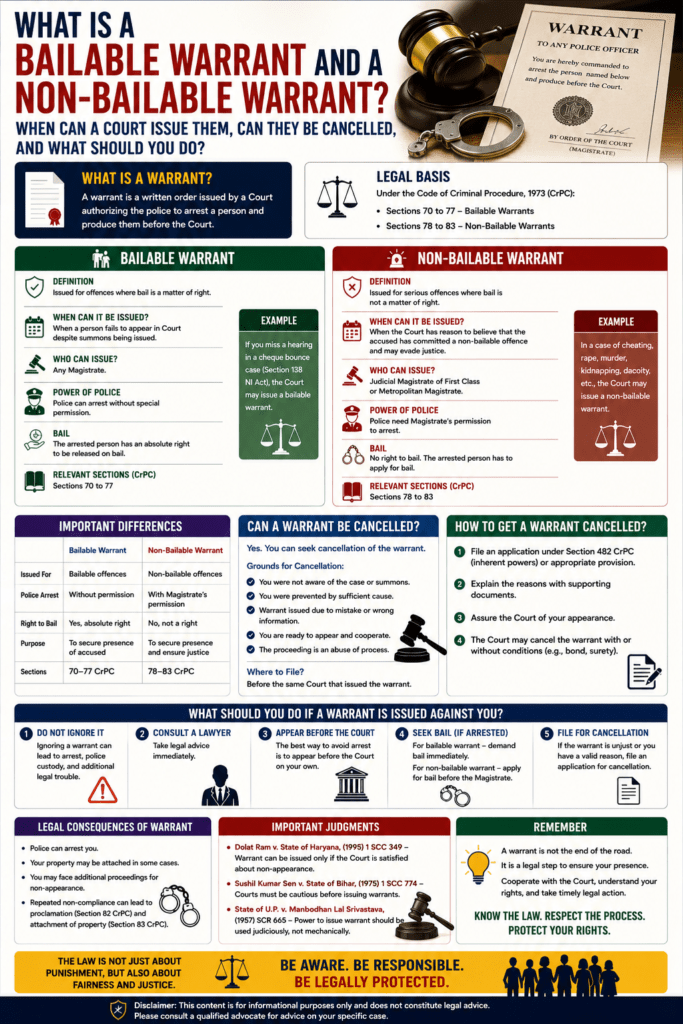
- Introduction
- What Is a Warrant?
- Why Does a Court Issue a Warrant?
- Types of Warrants
- What Is a Bailable Warrant?
- What Is a Non-Bailable Warrant (NBW)?
- When Does a Court Issue a Non-Bailable Warrant?
- Can a Court Issue an NBW at the Very First Hearing?
- Does an NBW Mean I Will Go to Jail?
- Can a Warrant Be Cancelled or Recalled?
- What Should You Do If a Warrant Has Been Issued Against You?
- ✔ Obtain a copy or verify the warrant.
- ✔ Consult a criminal lawyer immediately.
- ✔ Ascertain whether it is a bailable or non-bailable warrant.
- ✔ Appear before the issuing court at the earliest opportunity.
- ✔ File an appropriate application seeking recall or cancellation of the warrant, along with any necessary bail application.
- Legal Consequences of Ignoring a Warrant
- Jurisprudence Behind Warrants
- Landmark Supreme Court Judgments
- Myth vs Reality
- Frequently Asked Questions
- Key Takeaways
- Conclusion
Introduction
Imagine waking up one morning and learning that a court has issued a warrant against you.
The first question most people ask is:
“Will I be arrested immediately?”
The answer depends on what type of warrant has been issued.
Many people believe that every warrant means immediate jail or that a non-bailable warrant (NBW) automatically means bail is impossible. Both assumptions are incorrect.
Indian criminal law recognises different types of warrants, and the consequences of each are very different.
This article explains everything you need to know about bailable warrants and non-bailable warrants, the legal provisions under the Bharatiya Nagarik Suraksha Sanhita, 2023 (BNSS), landmark Supreme Court judgments, your rights, and the remedies available if a warrant has been issued against you.
What Is a Warrant?
A warrant is a written order issued by a competent criminal court directing the police or another authorised officer to arrest a particular person and produce that person before the court.
Unlike a police arrest in some situations, a warrant carries the authority of the court.
The provisions relating to warrants are contained in Chapter VI of the Bharatiya Nagarik Suraksha Sanhita, 2023 (BNSS), broadly covering Sections 72 to 78, which deal with the form, execution, endorsement, and related aspects of warrants.
Why Does a Court Issue a Warrant?
A warrant is generally issued to ensure the presence of an accused before the court.
It is not meant to punish a person.
Courts issue warrants only when they consider them necessary for the proper administration of justice.
Types of Warrants
Broadly, criminal courts issue two kinds of arrest warrants:
1. Bailable Warrant (BW)
2. Non-Bailable Warrant (NBW)
The difference between the two is significant.
What Is a Bailable Warrant?
A bailable warrant is an arrest warrant that allows the arrested person to secure release on bail by complying with the conditions specified in the warrant, such as furnishing the required bond and sureties.
Its primary purpose is to secure the person’s appearance before the court while avoiding unnecessary detention.
Courts generally prefer a bailable warrant where:
- the accused is not likely to abscond;
- there is no serious risk of tampering with evidence;
- the offence or surrounding circumstances do not justify a harsher coercive measure; or
- the person has previously cooperated with the proceedings.
What Is a Non-Bailable Warrant (NBW)?
A non-bailable warrant is a more stringent coercive process.
When a person is arrested under an NBW, there is no automatic right to immediate release merely because the arrest is under that warrant.
The arrested person must ordinarily be produced before the competent court, and release will depend upon the applicable law and the court’s orders.
An NBW does not mean that bail is legally barred forever. It simply means that release is not automatic and requires judicial consideration.
When Does a Court Issue a Non-Bailable Warrant?
Courts generally issue an NBW only where a less restrictive process has failed or would be ineffective.
Examples include situations where:
- summons have been repeatedly ignored;
- a bailable warrant has not secured the person’s appearance;
- the accused is deliberately evading the proceedings;
- there is a genuine apprehension that the accused may abscond;
- there is a real risk of influencing witnesses or destroying evidence; or
- the nature and gravity of the case justify such a measure.
The issuance of an NBW is a judicial decision based on the facts of the case.
Can a Court Issue an NBW at the Very First Hearing?
Yes, but only in appropriate cases.
Ordinarily, courts follow a graduated approach:
Summons → Bailable Warrant → Non-Bailable Warrant
However, where the facts demonstrate an immediate necessity, a court may issue an NBW without first issuing a bailable warrant.
Such power must be exercised cautiously.
Does an NBW Mean I Will Go to Jail?
Not necessarily.
This is one of the biggest misconceptions.
An NBW authorises arrest, but it does not automatically decide the issue of bail.
After arrest, the person may seek appropriate relief before the competent court, depending upon:
- the nature of the offence;
- the applicable statutory provisions;
- the facts of the case; and
- the court’s discretion.
Can a Warrant Be Cancelled or Recalled?
Yes.
If a person voluntarily appears before the issuing court and satisfactorily explains the circumstances, the court may, in an appropriate case, recall or cancel the warrant.
Courts often consider factors such as:
- whether the absence was deliberate;
- whether there was a genuine reason for non-appearance;
- past conduct of the accused; and
- whether continued coercive process is still necessary.
What Should You Do If a Warrant Has Been Issued Against You?
Do not panic or ignore it.
A prudent course generally includes:
✔ Obtain a copy or verify the warrant.
✔ Consult a criminal lawyer immediately.
✔ Ascertain whether it is a bailable or non-bailable warrant.
✔ Appear before the issuing court at the earliest opportunity.
✔ File an appropriate application seeking recall or cancellation of the warrant, along with any necessary bail application.
Ignoring a warrant often makes the situation more difficult.
Legal Consequences of Ignoring a Warrant
Failure to comply with a court-issued warrant may result in:
- arrest by the executing agency;
- further coercive measures;
- adverse orders regarding bail;
- delay in disposal of the case; and
- unnecessary complications in the proceedings.
Prompt compliance generally works in the person’s favour.
Jurisprudence Behind Warrants
The law governing warrants reflects two important constitutional principles.
1. Personal Liberty
Article 21 protects personal liberty.
Arrest should not become the first response where a less restrictive alternative would suffice.
2. Administration of Justice
At the same time, courts must ensure that accused persons do not frustrate criminal proceedings by repeatedly avoiding appearance.
The warrant mechanism balances these competing concerns.
Landmark Supreme Court Judgments
Inder Mohan Goswami v. State of Uttaranchal (2007) 12 SCC 1
This is one of the leading judgments on the issuance of non-bailable warrants.
The Supreme Court held that:
- an NBW should not be issued routinely;
- courts must exercise great caution before curtailing personal liberty;
- coercive measures should ordinarily be proportionate to the circumstances; and
- where possible, less restrictive methods should be adopted before issuing an NBW.
The judgment emphasises that the issuance of an NBW is a serious step and should not become a matter of routine.
State through CBI v. Dawood Ibrahim Kaskar (2000) 10 SCC 438
The Supreme Court discussed the purpose of warrants and coercive processes in ensuring the presence of accused persons before the court while preserving the fairness of criminal proceedings.
Myth vs Reality
| Myth | Reality |
|---|---|
| Every warrant means immediate jail. | False. The consequences depend on the nature of the warrant and the applicable legal process. |
| A non-bailable warrant means bail can never be granted. | Incorrect. An NBW does not permanently bar bail; it only means release is not automatic. |
| Courts always issue an NBW first. | False. Courts ordinarily prefer less restrictive measures such as summons and, where appropriate, bailable warrants before issuing an NBW. |
| Ignoring a warrant will make it disappear. | Wrong. Ignoring a warrant usually leads to more serious legal consequences. |
| A warrant can never be recalled. | Incorrect. Courts may recall or cancel a warrant in appropriate cases if sufficient grounds are shown. |
Frequently Asked Questions
Can the police arrest me immediately on the basis of a non-bailable warrant?
Yes. An NBW authorises the police to arrest you and produce you before the court.
Can I get bail after being arrested under an NBW?
Yes, subject to the applicable law and the discretion of the competent court.
Can the issuing court cancel the warrant?
Yes. In appropriate cases, the issuing court may recall or cancel the warrant upon being satisfied with the explanation offered.
Should I ignore a warrant if I believe it was wrongly issued?
No. The correct course is to approach the court through lawful remedies. Ignoring the warrant may aggravate the situation.
Key Takeaways
- A bailable warrant allows release on fulfilment of the conditions specified in the warrant.
- A non-bailable warrant authorises arrest but does not automatically deny the possibility of bail.
- Courts generally adopt a graduated approach before issuing an NBW, though exceptions exist where circumstances warrant immediate coercive action.
- Warrants exist to secure attendance before the court, not to punish.
- If a warrant has been issued, timely legal action is almost always preferable to avoidance.
Conclusion
A warrant is one of the most important coercive tools available to a criminal court, but it is also one of the most carefully regulated. The distinction between a bailable warrant and a non-bailable warrant is not merely technical—it directly affects a person’s liberty and the manner in which the criminal process unfolds.
The Supreme Court has consistently reminded courts that personal liberty is a constitutional value and that non-bailable warrants should not be issued mechanically. At the same time, individuals must respect the authority of the court and respond promptly to its processes.
Understanding your rights, acting without delay, and seeking appropriate legal advice can often prevent a manageable situation from becoming a far more serious legal problem.