Disclaimer!

This Website is owned and operated by Law Offices of Zuber Ali and is made available strictly for educational, informational, and public legal awareness purposes. All content published on this Website, including but not limited to blog posts, case summaries, full texts or excerpts of judgments, legal articles, explanations, commentaries, and any other material, is provided solely to promote general understanding of legal principles and developments in Indian law among the public.
The information and materials available on this Website do not constitute legal advice, professional opinion, or any form of legal services. Nothing contained on this Website is intended to create, nor should it be construed as creating, any attorney-client relationship, lawyer-client relationship, or any other professional relationship between the user and the owner/operator of this Website or any person associated with it. Users are strongly advised not to rely upon or act on the basis of any content available on this Website without seeking specific advice from a qualified and competent legal professional who is duly enrolled and authorized to practice law.
We make reasonable efforts to ensure that the information on this Website is accurate and up-to-date at the time of publication. However, We do not provide any warranty, express or implied, as to the completeness, accuracy, reliability, suitability, or timeliness of the content. Laws, rules, regulations, and judicial pronouncements are dynamic and subject to amendments, clarifications, interpretations, and reversals. Accordingly, We shall not be responsible or liable for any errors, omissions, inaccuracies, or for any consequences arising from the use of, or reliance upon, any information provided on this Website.
To the maximum extent permitted under applicable Indian law, including but not limited to the Information Technology Act, 2000 and other relevant statutes, We expressly disclaim all liability for any direct, indirect, incidental, consequential, special, punitive, or exemplary damages arising out of or in any way connected with the access to, use of, or inability to use this Website or any content therein. This includes, without limitation, any loss, damage, injury, or harm, whether financial, legal, or otherwise, suffered by any user or third party due to decisions or actions taken based on the material available on this Website.
This Website may occasionally contain links to external websites, government portals, databases, or third-party resources. We do not endorse, control, monitor, or assume any responsibility for the accuracy, privacy practices, or content of such external sources. Any access to or use of such third-party resources is entirely at the user’s own risk.
By accessing, browsing, or using this Website in any manner, you expressly acknowledge that you have read, understood, and voluntarily agreed to this Disclaimer. You further agree that your use of this Website is at your sole risk and that you will not hold Us liable for any issues arising from such use. If you do not agree with any part of this Disclaimer, you must immediately cease accessing or using this Website.

Judgement List

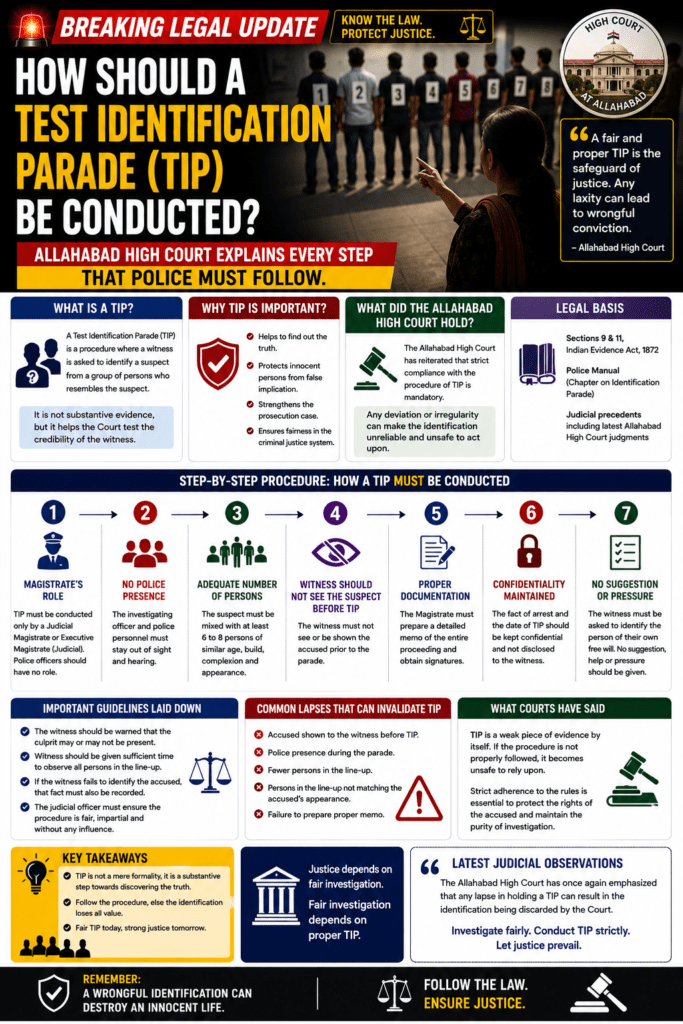
How Should a Test Identification Parade (TIP) Be Conducted? Allahabad High Court Explains Every Step That Police Must Follow

Case Details Case Title: Kanhai & Others v. State of Uttar Pradesh Court: Allahabad High Court Case No.: Criminal Appeal No. 1470 of 1987 Date Reserved: 06 July 2026 Date Delivered: 29 July 2026 Neutral Citation: Not Assigned Coram: Hon’ble Justice Santosh Rai Background of the Case The prosecution alleged that on 21 February 1985, […]
How Should a Test Identification Parade (TIP) Be Conducted? Allahabad High Court Explains Every Step That Police Must Follow Read More »

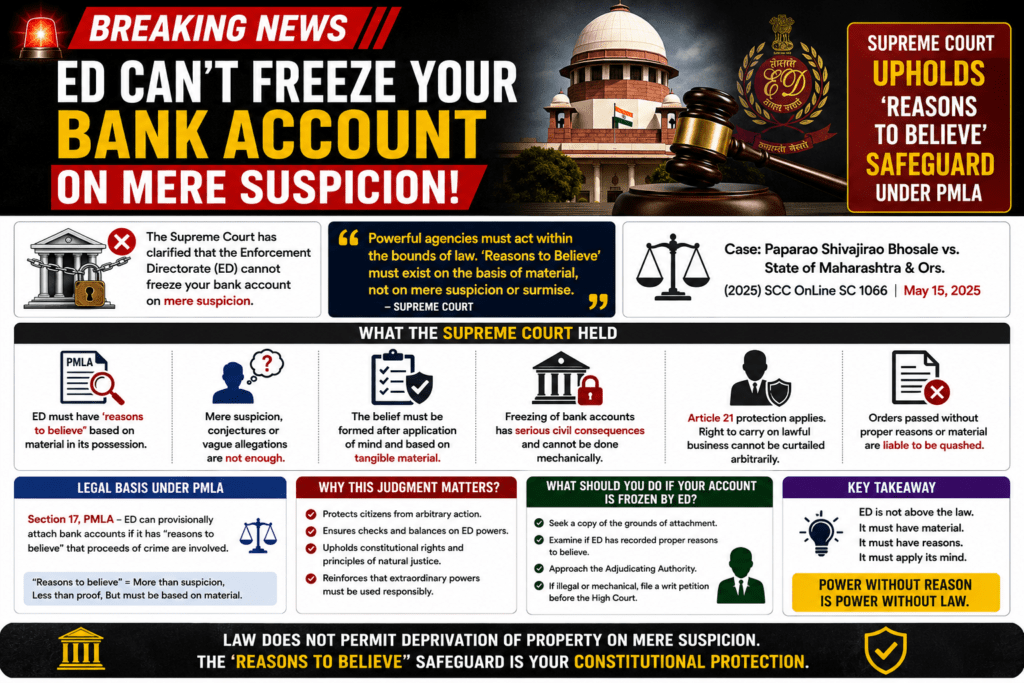
ED Can’t Freeze Your Bank Account on Mere Suspicion: Supreme Court Upholds ‘Reasons to Believe’ Safeguard Under PMLA

Case Details Case Title: Directorate of Enforcement v. Poonam Malik Case No.: Special Leave Petition (Criminal) Diary No(s). 25221 of 2026 Date of Judgment: 31 July 2026 Coram: Impugned Judgment: Delhi High Court A Major Relief Against Arbitrary ED Action In an important judgment protecting the constitutional rights of citizens, the Supreme Court has affirmed

ED Can’t Freeze Your Bank Account on Mere Suspicion: Supreme Court Upholds ‘Reasons to Believe’ Safeguard Under PMLA Read More »

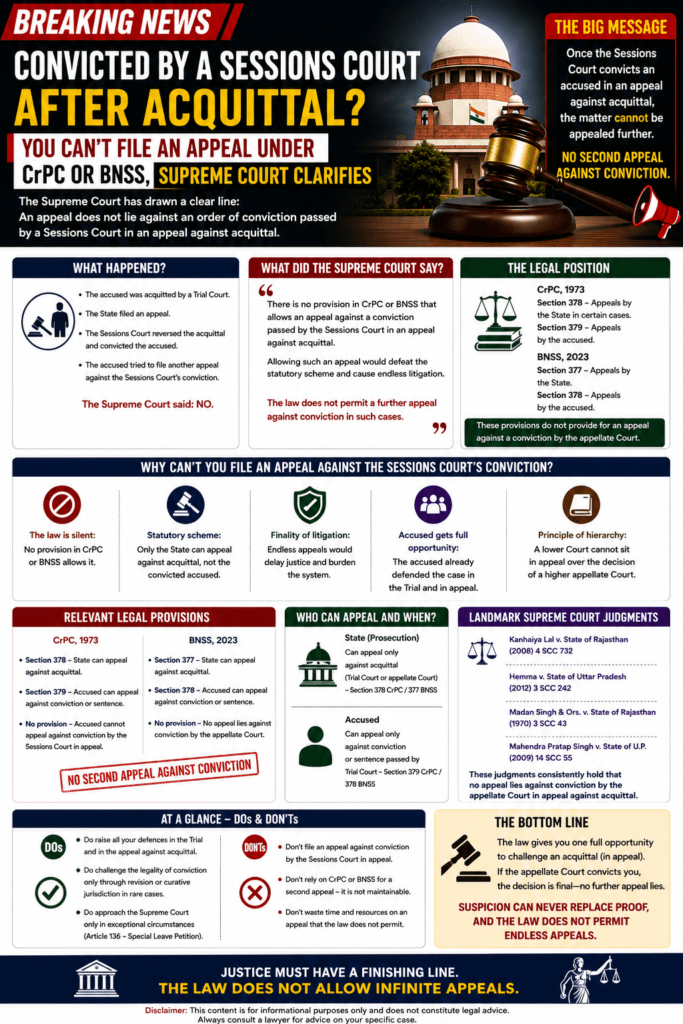
Convicted by a Sessions Court After Acquittal? You Can’t File an Appeal Under CrPC or BNSS, Supreme Court Clarifies

The Supreme Court settles an important procedural question: When a Sessions Court reverses an acquittal and convicts an accused in appeal, the remedy is Revision—not another Appeal. Case Details Case Title: Vishnu Kumar Gupta v. State of Madhya Pradesh & Another Case No.: Special Leave Petition (Criminal) No. 13891 of 2025 Citation: 2026 INSC (Citation

Convicted by a Sessions Court After Acquittal? You Can’t File an Appeal Under CrPC or BNSS, Supreme Court Clarifies Read More »

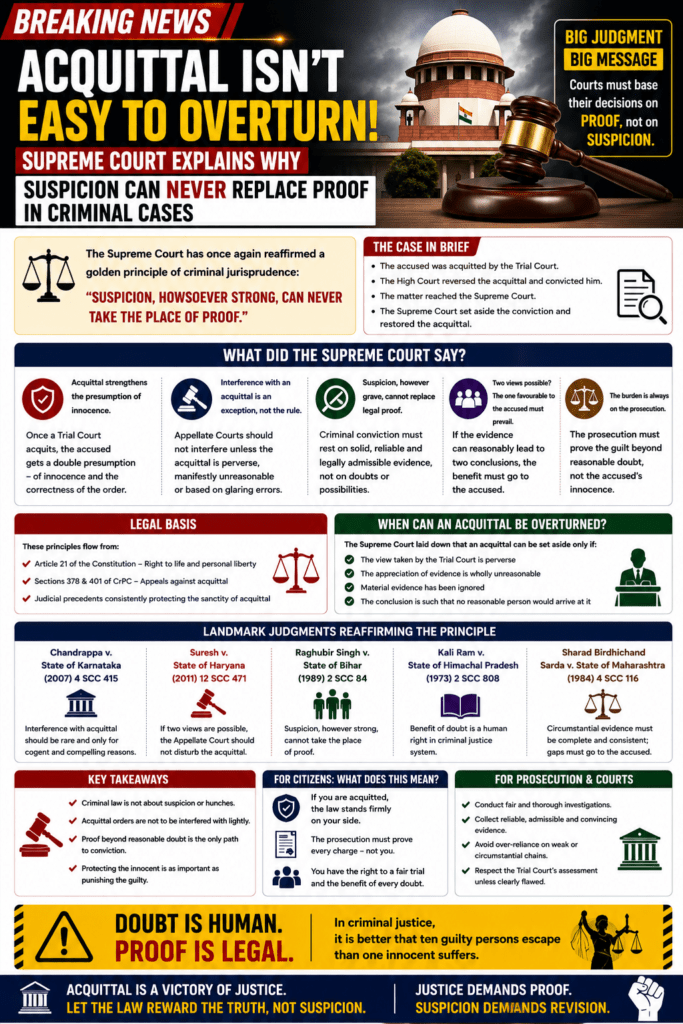
Acquittal Isn’t Easy to Overturn! Supreme Court Explains Why Suspicion Can Never Replace Proof in Criminal Cases

Case Title: Khalil Pasha & Ors. v. Abdul Rasheed & Anr. Neutral Citation: 2026 INSC 754 Case No.: Criminal Appeal arising out of Special Leave Petition (Criminal) No. 1115 of 2023 Date of Judgment: 28 July 2026 Bench: Justice J.B. Pardiwala and Justice K. Vinod Chandran Can Someone Be Convicted Simply Because the Crime Looks

Acquittal Isn’t Easy to Overturn! Supreme Court Explains Why Suspicion Can Never Replace Proof in Criminal Cases Read More »

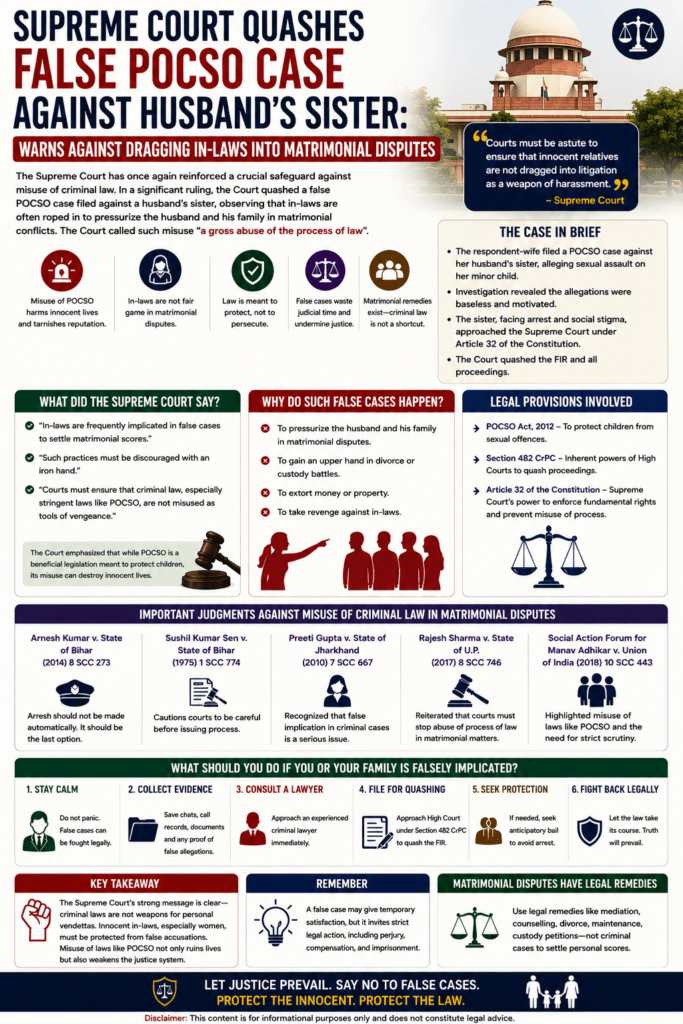
Supreme Court Quashes False POCSO Case Against Husband’s Sister: Warns Against Dragging In-Laws into Matrimonial Disputes

Case Title: Archana Avinash Shelke v. State of Maharashtra & Anr. Case No.: Special Leave Petition (Criminal) No. 2163 of 2025 Date of Judgment: 23 July 2026 Bench: Justice J.B. Pardiwala and Justice K. Vinod Chandran Can Every Allegation Under the POCSO Act Lead to Trial? Supreme Court Says “No” The Supreme Court of India

Supreme Court Quashes False POCSO Case Against Husband’s Sister: Warns Against Dragging In-Laws into Matrimonial Disputes Read More »

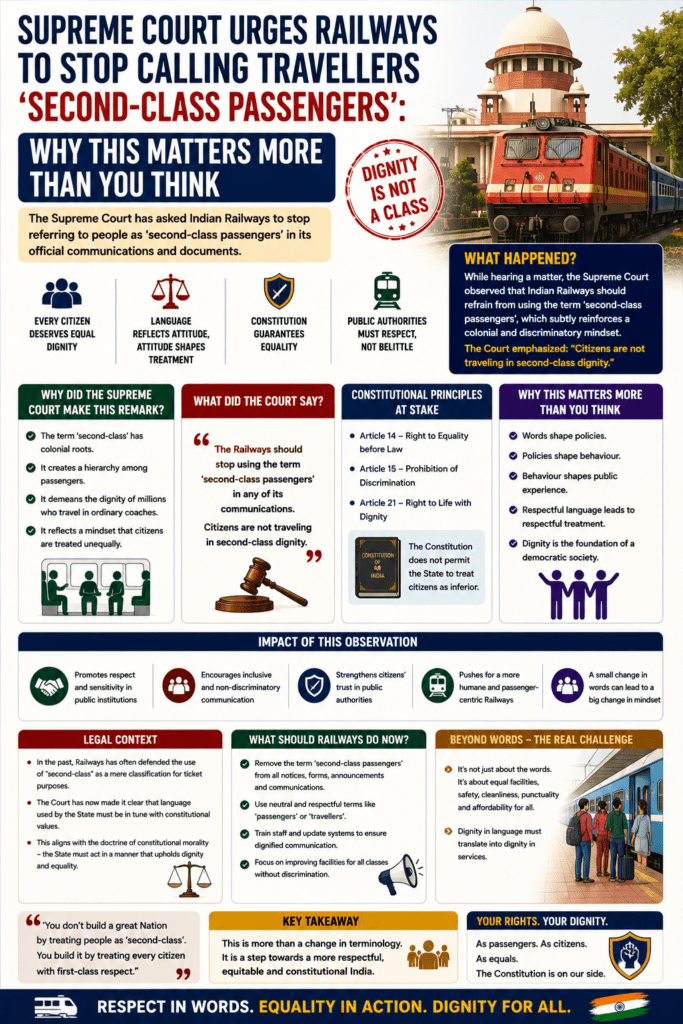
Supreme Court Urges Railways to Stop Calling Travellers ‘Second-Class Passengers’: Why This Matters More Than You Think

Case Details Case Title: Lata v. Union of India & AnotherCase No.: Civil Appeal No. ____ of 2026 (Arising out of SLP (Civil) No. 30726 of 2025)Date of Judgment: 17 July 2026Coram: Hon’ble Mr. Justice Sanjay KarolCitation: Yet to be officially reported Introduction Have you ever booked a train ticket and noticed that your ticket

Supreme Court Urges Railways to Stop Calling Travellers ‘Second-Class Passengers’: Why This Matters More Than You Think Read More »

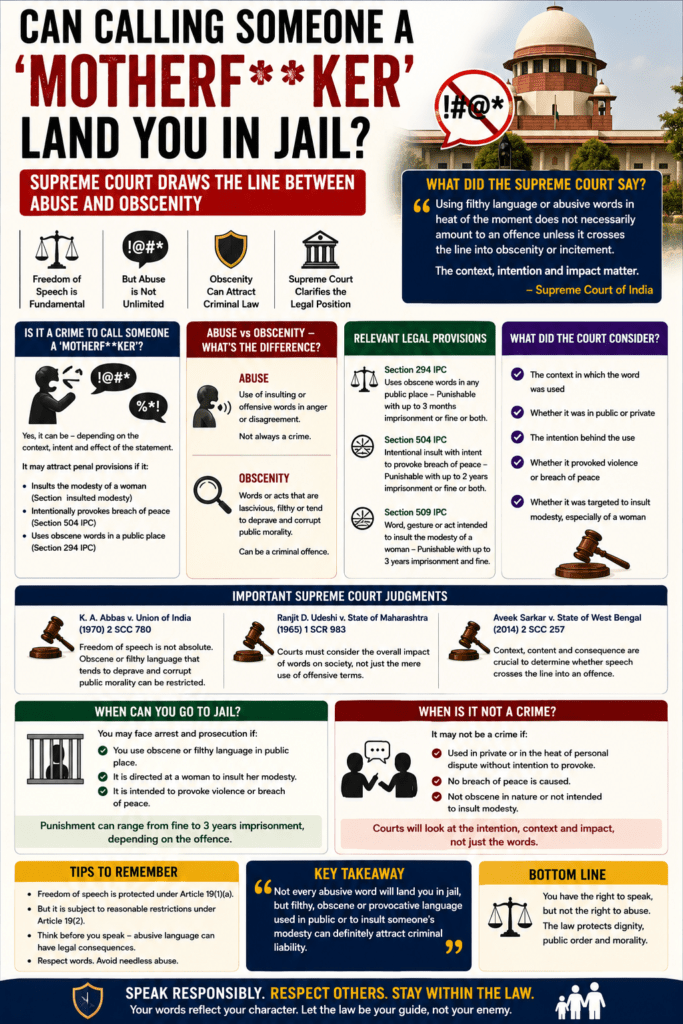
Can Calling Someone a ‘Motherf****ker’ Land You in Jail? Supreme Court Draws the Line Between Abuse and Obscenity

Case Details Case Title: Mani @ Subramaniyam v. State Rep. by the Deputy Superintendent of PoliceCourt: Supreme Court of IndiaCase No.: Criminal Appeal No. 3241 of 2026 (Arising out of SLP (Crl.) No. 4516 of 2025)Date of Judgment: 17 July 2026Coram: Justice Sanjay Karol and Justice Vipul M. PancholiNeutral Citation: 2026 INSC 719Relevant Provisions: Sections

Can Calling Someone a ‘Motherf****ker’ Land You in Jail? Supreme Court Draws the Line Between Abuse and Obscenity Read More »

Can a Medical Negligence Case Continue After the Doctor Dies? Supreme Court Gives an Important Ruling

Case Title: Kumud Lall vs Suresh Chandra Roy (Dead) Through LRs and Others ‘The Supreme Court clarifies whether legal heirs of a deceased doctor can be made liable in medical negligence cases under the Consumer Protection Act.‘ Medical negligence cases are often filed years after treatment. During this time, it is possible that the doctor

Can a Medical Negligence Case Continue After the Doctor Dies? Supreme Court Gives an Important Ruling Read More »

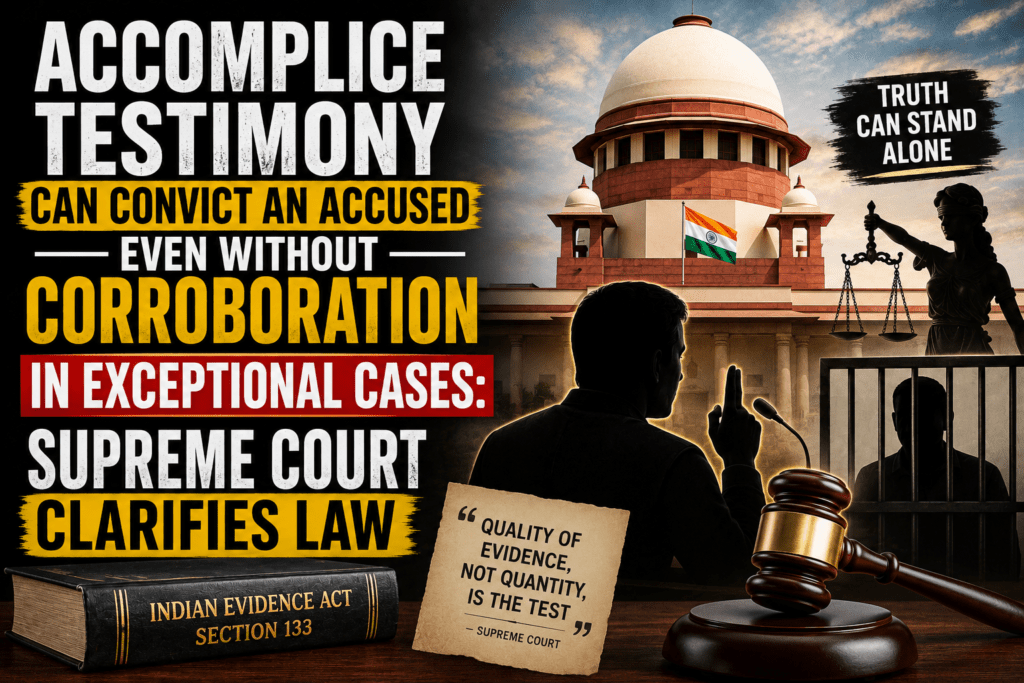
Accomplice Testimony Can Convict an Accused Even Without Corroboration in Exceptional Cases: Supreme Court Clarifies Law

The Supreme Court has delivered an important judgment clarifying the evidentiary value of an accomplice’s testimony in criminal trials. The Court held that although courts generally seek corroboration of an approver’s statement, there is no absolute rule of law requiring independent corroboration in every case. If the testimony of the approver is found to be

Accomplice Testimony Can Convict an Accused Even Without Corroboration in Exceptional Cases: Supreme Court Clarifies Law Read More »