
Case Details
Case Title: Lata v. Union of India & Another
Case No.: Civil Appeal No. ____ of 2026 (Arising out of SLP (Civil) No. 30726 of 2025)
Date of Judgment: 17 July 2026
Coram: Hon’ble Mr. Justice Sanjay Karol
Citation: Yet to be officially reported
Introduction
Have you ever booked a train ticket and noticed that your ticket says “Second Class”?
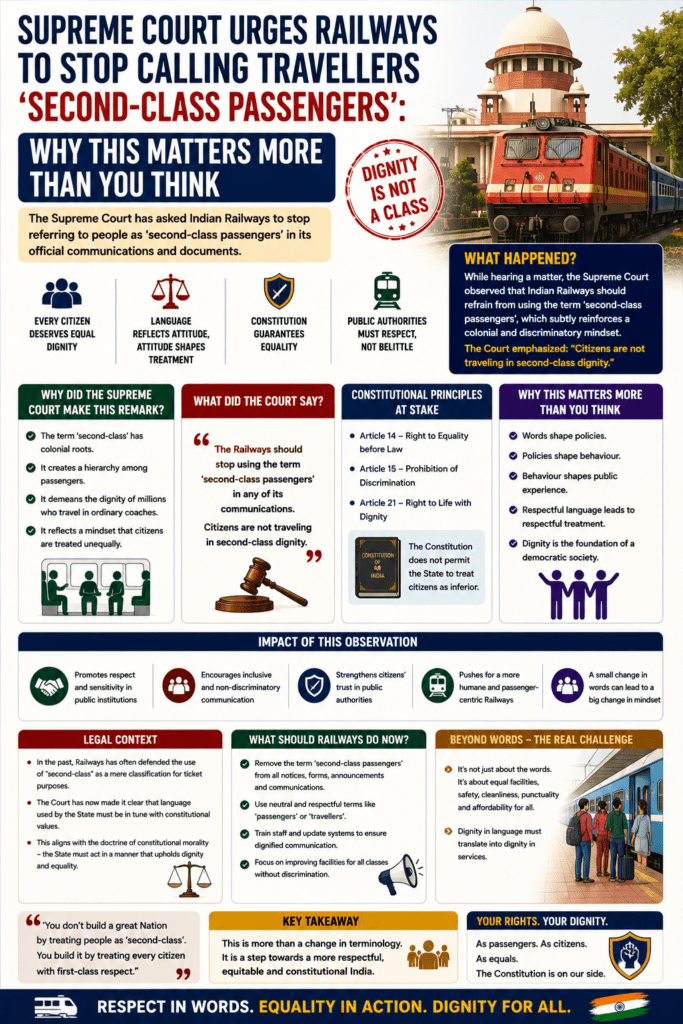
For decades, Indian Railways has used the expression “Second Class Passenger” for ordinary travel coaches. Most people never questioned it. But now, the Supreme Court of India has.
In a remarkable judgment, the Supreme Court has observed that the expression “Second Class” carries an unnecessary social stigma and creates an impression that some passengers are somehow “second-grade” citizens.
The Court has now requested the Railway Ministry to reconsider this terminology and adopt language that reflects equality, dignity and constitutional values.
This may look like a small issue at first glance, but the judgment raises a much bigger question:
Can the language used by the Government itself affect the dignity of citizens?
The Supreme Court believes it can.
What Was the Case About?
The case arose from a railway dispute, but while deciding the matter, Justice Sanjay Karol noticed something interesting.
Indian Railways still describes one of its most commonly used travel categories as “Second Class.”
The Court questioned whether such terminology is still appropriate in a modern constitutional democracy where every citizen enjoys equal status before the law.
Although railway coaches are classified based on facilities and fare, the Court observed that describing passengers themselves as “second-class passengers” sends an undesirable message.
Why Did the Supreme Court Object?
The Court explained that words are not merely labels.
Language shapes how society thinks.
When the State repeatedly refers to millions of passengers as travelling in “Second Class”, it unintentionally creates an impression that these passengers occupy an inferior social position.
According to the Court, public institutions should avoid language that appears to divide citizens into higher and lower categories.
The Constitution Recognises Equality, Not Social Hierarchy
One of the strongest foundations of the judgment is the Indian Constitution itself.
Article 14
Every person is equal before law.
The Constitution does not recognise first-class citizens or second-class citizens.
Article 21
Every individual has the right to live with dignity.
Human dignity is not limited to protection against physical harm. It also includes respect in the way the State treats its citizens.
The Court indicated that official terminology should reflect these constitutional values.
But Isn’t “Second Class” Just a Railway Category?
Many people may wonder:
“It’s only a ticket category. Why make an issue out of it?”
The Supreme Court acknowledged that coach classification itself is perfectly valid.
Different fares and facilities naturally require different categories.
However, the Court distinguished between:
- classification of coaches; and
- labelling people.
Passengers are purchasing different travel facilities—not different levels of human worth.
The Court suggested that railway terminology should describe the coach or service, not create labels that appear to classify the people travelling in them.
A Small Change With Big Symbolic Value
This judgment reflects a larger constitutional philosophy.
Throughout the years, courts and governments have gradually replaced many outdated expressions.
Examples include replacing words considered discriminatory, insensitive or inconsistent with constitutional morality.
The Supreme Court believes that government language should evolve with society.
Changing the terminology from “Second Class” to something more neutral would cost almost nothing, yet would reinforce the message that every traveller deserves equal respect.
Did the Supreme Court Issue a Binding Direction?
No.
The Court did not order Indian Railways to immediately change the terminology.
Instead, Justice Sanjay Karol requested the Railway Ministry to examine the issue and consider replacing the expression with more dignified and appropriate terminology.
The final decision now rests with the Railway Administration.
Why This Judgment Is Important
Although the case appears to concern railway terminology, it actually highlights a much deeper legal principle.
The judgment reminds public authorities that:
- Government language should reflect constitutional values.
- Citizens should not be unnecessarily labelled in ways that diminish dignity.
- Equality is not merely a legal concept—it should also be reflected in public administration.
- Even seemingly ordinary administrative expressions deserve periodic review.
The decision demonstrates how constitutional values can influence everyday governance.
What Could Replace “Second Class”?
The Court did not suggest any specific alternative.
However, if the Railways decides to make changes, it may adopt more neutral expressions such as:
- Ordinary Class
- Standard Class
- General Coach
- Economy Class
- Non-AC Standard Coach
Such terminology focuses on the type of travel, rather than appearing to describe the passenger.
What Does This Mean for Passengers?
For passengers, nothing changes immediately.
Train fares, reservations, coach categories and ticket booking remain exactly the same.
The judgment only encourages the Railways to reconsider the terminology used in official records and tickets.
Legal Significance of the Judgment
Although the observation may appear symbolic, it carries significant constitutional value.
The Supreme Court has reaffirmed that:
- dignity is central to the Constitution;
- language used by public authorities matters;
- equality should be reflected not only in laws but also in government communication; and
- even routine administrative terminology should be consistent with constitutional ideals.
The judgment is another reminder that constitutional values are meant to guide every aspect of governance—even the words printed on a railway ticket.
Conclusion
The Supreme Court’s observations in Lata v. Union of India & Another (2026) go beyond railway terminology. They reinforce a simple but powerful constitutional message:
No Indian citizen should ever feel that the State considers them “second-class.”
Whether the Railways ultimately changes the terminology remains to be seen. But the judgment has already started an important conversation about dignity, equality and the power of language in public administration.
Sometimes, changing a single word can reflect a much larger commitment to respecting every citizen equally.
Key Takeaway
The Supreme Court has urged Indian Railways to reconsider the expression “Second Class Passenger,” observing that official language should reflect the constitutional values of equality and dignity. While the Court has not issued a mandatory direction, it has encouraged the Railways to adopt more respectful terminology that avoids implying any hierarchy among citizens.