
- Introduction
- What Happened?
- Does the Police Have Power to Shift Someone to a Hospital?
- Does an Adult Have the Right to Refuse Medical Treatment?
- What If the Police Were Acting Under a High Court Order?
- Can the Police Use Force?
- What If Someone Is Kept in Hospital Against His Wishes?
- What Legal Remedies Are Available?
- Jurisprudence Behind the Law
- Myth vs Reality
- Frequently Asked Questions
- Landmark Judicial Principles
- Key Takeaways
- Conclusion
Introduction
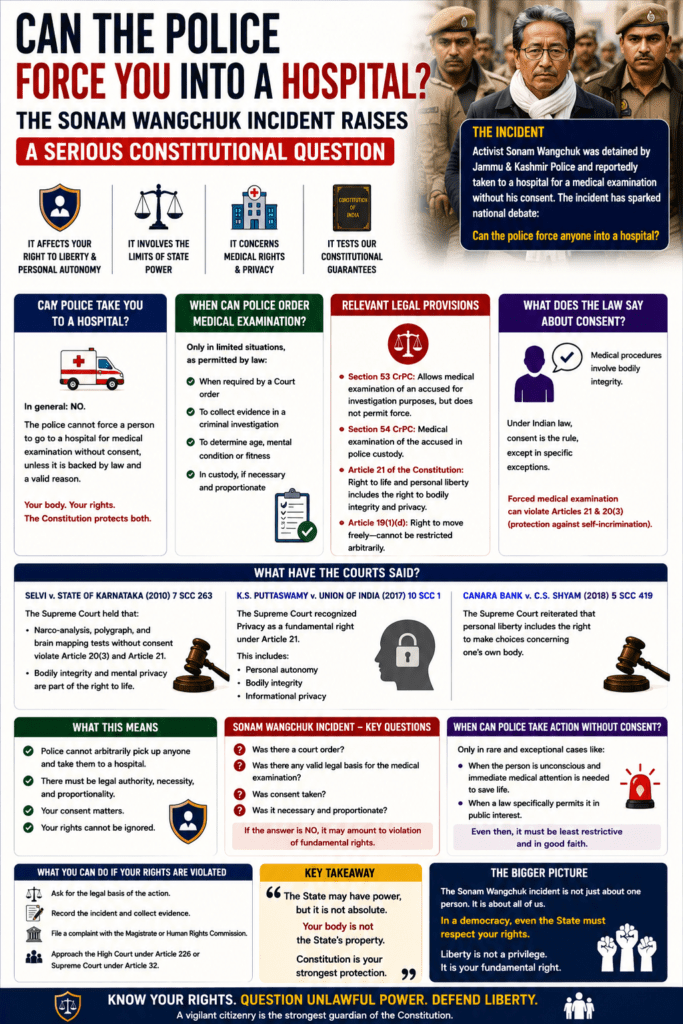
The recent incident involving Sonam Wangchuk, who was shifted by the Delhi Police from his hunger strike to Safdarjung Hospital, has sparked a nationwide legal debate.
Many people are asking:
- Can the police force someone into a hospital?
- Does a hunger strike automatically give the police power to intervene?
- Can an adult refuse medical treatment?
- What remedies are available if the police exceed their powers?
These are not merely political questions—they are constitutional questions involving personal liberty, bodily autonomy, medical consent, police powers, and judicial oversight.
What Happened?
According to Delhi Police, Sonam Wangchuk was shifted to Safdarjung Hospital because:
- his health had significantly deteriorated;
- medical experts advised immediate treatment; and
- the action was taken in compliance with directions recorded by the Delhi High Court.
However, Wangchuk’s legal team has questioned the legality of the action, the circumstances of his continued stay in hospital, and has sought judicial intervention.
Because legal proceedings are continuing, the legality of every aspect of the police action has not been finally determined by a court.
Does the Police Have Power to Shift Someone to a Hospital?
The answer is: Sometimes—but not always.
Indian law does not give the police an unrestricted power to take a conscious adult to a hospital against his wishes.
Such action must be supported by law and justified by necessity.
Possible legal bases may include:
- protection of life;
- medical emergency;
- compliance with a judicial order;
- statutory powers under applicable laws.
Every case depends on its own facts.
Does an Adult Have the Right to Refuse Medical Treatment?
Generally, yes.
The Supreme Court has recognised that personal liberty under Article 21 includes bodily autonomy and the right to make decisions concerning one’s own body, subject to lawful restrictions.
However, where the State demonstrates compelling legal grounds—such as an imminent threat to life combined with lawful authority—the position becomes more complex.
There is no universal rule that every refusal of treatment must always be honoured regardless of circumstances.
What If the Police Were Acting Under a High Court Order?
If the police were genuinely implementing judicial directions and acting on expert medical advice, the legality of their conduct will largely depend upon:
- the exact wording of the court’s order;
- whether the order authorised the action taken;
- the medical opinion relied upon;
- whether only reasonable force was used;
- whether the person was treated with dignity;
- whether the action continued only for as long as legally necessary.
A court order does not automatically authorise every method of implementation.
Can the Police Use Force?
Only such force as is lawfully authorised, necessary, and proportionate.
Indian constitutional law requires that State action affecting liberty be:
- lawful;
- reasonable;
- non-arbitrary;
- proportionate.
Excessive force can be challenged even where the underlying objective was lawful.
What If Someone Is Kept in Hospital Against His Wishes?
If a conscious adult alleges that he is being kept in a hospital without lawful authority, the legality of that continued restraint may be examined by the courts.
The key question is:
Is there lawful authority to continue restricting that person’s liberty?
If the answer is no, constitutional remedies may become available.
What Legal Remedies Are Available?
If a person believes that the police acted illegally or beyond their authority, the following remedies may be available depending on the facts:
1. Writ Petition under Article 226
The High Court can examine:
- legality of police action;
- violation of Article 21;
- arbitrary exercise of power;
- continued detention;
- unlawful restrictions.
2. Habeas Corpus
If a person is unlawfully deprived of liberty, a petition for Habeas Corpus may be maintainable before the High Court or Supreme Court.
3. Article 32 Before the Supreme Court
Where a fundamental right has been violated, the Supreme Court may be approached directly in appropriate cases.
4. Compensation
If the court finds that a person’s constitutional rights have been violated through unlawful detention or arbitrary State action, it may award public law compensation in an appropriate case.
5. Human Rights Remedies
A complaint may also be made before the National Human Rights Commission (NHRC) or the relevant State Human Rights Commission where the facts disclose a violation of human rights.
6. Departmental Action
Police officials who act outside the law may face disciplinary proceedings, depending on the facts.
Jurisprudence Behind the Law
The issue involves several constitutional principles.
Article 21 – Right to Life and Personal Liberty
Article 21 protects not only life but also:
- dignity;
- bodily integrity;
- autonomy;
- freedom from arbitrary State action.
Doctrine of Proportionality
Even where the State pursues a legitimate objective, the measures adopted must be proportionate and no more restrictive than necessary.
Rule of Law
Every action of the police must have legal authority.
The State cannot curtail personal liberty merely because it believes it is acting in a person’s best interests.
Myth vs Reality
| Myth | Reality |
|---|---|
| Police can take anyone to a hospital whenever they want. | False. Police powers must have legal authority and must satisfy constitutional standards. |
| A hunger striker can never be shifted to a hospital. | Incorrect. Depending on the medical condition, judicial directions, and applicable law, intervention may be legally justified. |
| A High Court order gives unlimited powers to the police. | False. Police must act within the scope of the order and the Constitution. |
| Every forced hospitalisation is illegal. | Incorrect. It depends on the facts, medical necessity, statutory authority, and judicial scrutiny. |
| If the police exceed their powers, there is no remedy. | False. Constitutional, civil, human rights, and departmental remedies may all be available. |
Frequently Asked Questions
Can police force me into a hospital?
Only where authorised by law and justified by the facts.
Can I refuse treatment?
A competent adult generally has autonomy over medical decisions, but exceptional situations may involve competing legal considerations.
Can I challenge police action?
Yes. If you believe your liberty has been unlawfully restricted, you may approach the High Court or the Supreme Court, depending on the circumstances.
Can I receive compensation?
If a court finds that your constitutional rights were violated, compensation may be awarded in an appropriate case.
Landmark Judicial Principles
Indian constitutional jurisprudence has consistently recognised:
- Personal liberty is the rule; deprivation of liberty is the exception.
- Every restriction on liberty must have authority of law.
- State action must be fair, just, reasonable, and proportionate.
- Courts remain the ultimate guardians of fundamental rights.
These principles emerge from landmark decisions such as Maneka Gandhi v. Union of India, D.K. Basu v. State of West Bengal, Nilabati Behera v. State of Orissa, and Justice K.S. Puttaswamy v. Union of India, all of which reinforce that governmental action affecting liberty must comply with constitutional safeguards.
Key Takeaways
- Police do not possess an unlimited power to compel hospitalisation.
- Whether the Sonam Wangchuk action was legally justified depends on the exact court directions, the medical evidence, and whether the police acted proportionately.
- Even where the objective is protection of life, constitutional safeguards continue to apply.
- If State authorities exceed their lawful powers, remedies include writ petitions, habeas corpus, compensation, and human rights proceedings.
Conclusion
The Sonam Wangchuk episode highlights one of the most delicate questions in constitutional law: Where should the law draw the line between protecting a person’s life and respecting that person’s liberty?
Indian law does not provide a simple yes-or-no answer. It requires a careful balance between the State’s duty to protect life and the individual’s right to autonomy and personal liberty. Ultimately, whether a police action is lawful depends not on its stated purpose alone, but on whether it is backed by law, supported by genuine medical necessity, proportionate, and consistent with constitutional guarantees.
In a constitutional democracy, the police are not the final judges of personal liberty—the courts are.